This Week in Neurosurgery — Oct 7, 2026
Generated Oct 8, 2026 · 11:17
The week's practice-changing Neurosurgery research, summarized for clinicians.
If the audio fails to play, refresh the page to renew the link.
Get next week’s Neurosurgery briefing — free.
In your podcast app, or readable in your inbox with the audio one tap away.
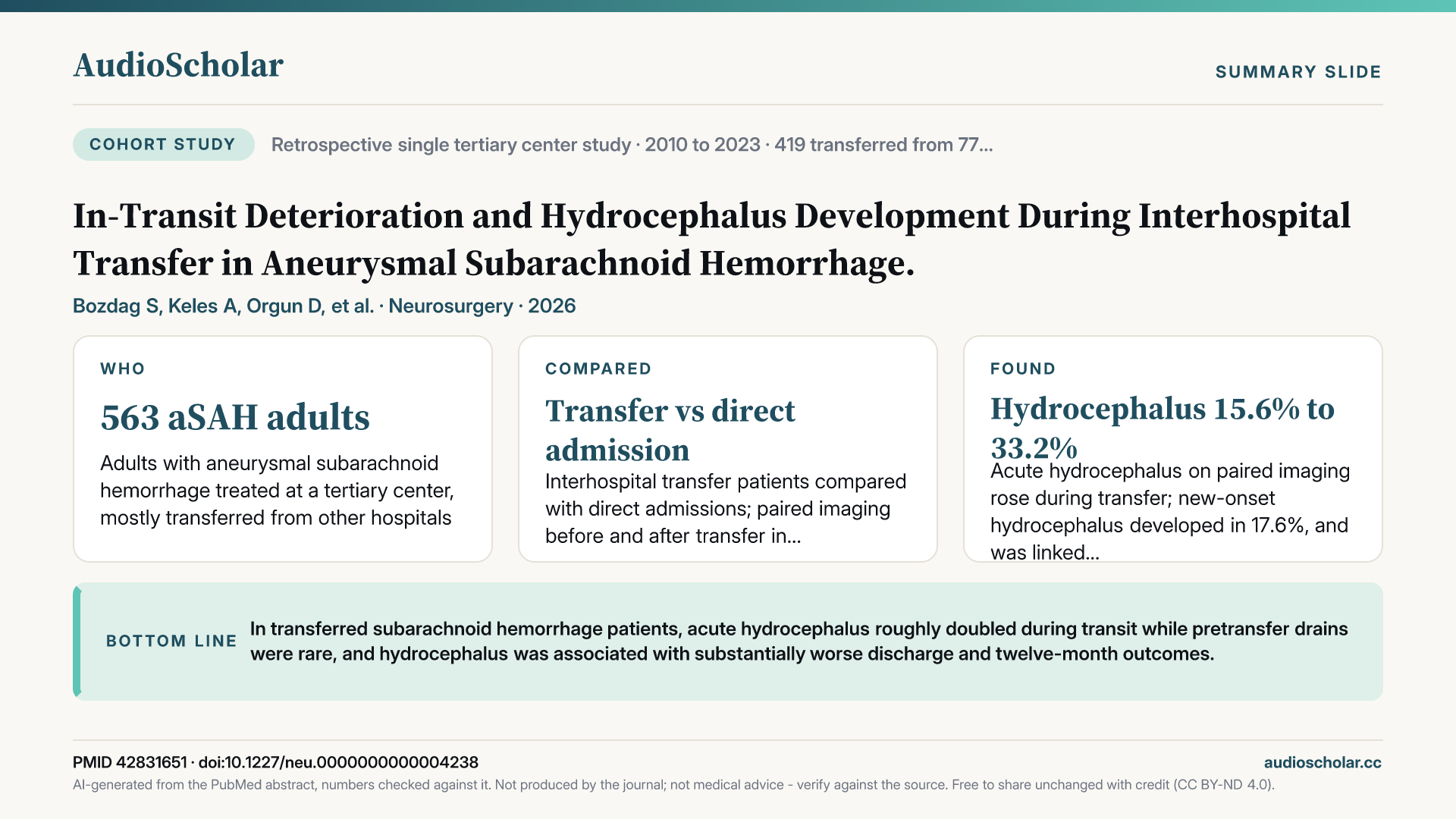
In-Transit Deterioration and Hydrocephalus Development During Interhospital Transfer in Aneurysmal Subarachnoid Hemorrhage.
In transferred subarachnoid hemorrhage patients, acute hydrocephalus roughly doubled during transit while pretransfer drains were rare, and hydrocephalus was associated with substantially worse discharge and twelve-month outcomes.
Neurosurgery · 2026 · PubMed

This week’s papers
- 01
In-Transit Deterioration and Hydrocephalus Development During Interhospital Transfer in Aneurysmal Subarachnoid Hemorrhage.
In transferred subarachnoid hemorrhage patients, acute hydrocephalus roughly doubled during transit while pretransfer drains were rare, and hydrocephalus was associated with substantially worse discharge and twelve-month outcomes.
Bozdag S et al. · Neurosurgery · 2026
- 02
Tiny (≤3 mm) Unruptured Intracranial Aneurysms: A 13-Year Contemporary Insight on Treatment Safety From a Multicenter Registry.
Treating unruptured aneurysms of three millimeters or less carried complication rates similar to small aneurysms, with communicating artery locations and stent-assisted coiling linked to higher intraoperative risk.
El-Hajj VG et al. · Neurosurgery · 2026
- 03
Development of a prediction model for aneurysmal events to guide imaging surveillance in autosomal dominant polycystic kidney disease.
A four-point score using multiple aneurysms, hypertension and family history stratified five-year aneurysm event risk from zero to nearly half in polycystic kidney disease, pending external validation.
Miyamoto S et al. · Journal of Neurosurgery · 2026
- 04
Angiographic classification of nonacute carotid artery occlusion to predict the feasibility and clinical outcomes of endovascular recanalization.
A new angiographic classification of nonacute carotid occlusion predicted recanalization success, about 81 percent for types A and B versus 12 percent for type D, and lower long-term ischemic risk.
Hou C et al. · Journal of Neurosurgery · 2026
- 05
Intrawound antibiotic use and postoperative surgical site infection in instrumented spine surgery: a statewide registry analysis of 24,015 patients from the Spine Care Outcomes Assessment Program.
Among more than 24,000 instrumented spine surgeries, intrawound antibiotics were not associated with lower infection risk, whereas open approach, lumbar level and low albumin were the strongest predictors.
Laynes R et al. · Journal of Neurosurgery: Spine · 2026
- 06
Wound dehiscence following biportal endoscopic versus microscopic spine surgery for single-level lumbar decompression: a post hoc analysis of two randomized controlled trials.
Pooled trial data showed wound dehiscence occurred only after microscopic lumbar decompression, about nine percent, and never after biportal endoscopy, though the analysis is post hoc and hypothesis-generating.
Park SM et al. · Neurosurgical Focus · 2026
- 07
Endoscopic repair of spontaneous ventral spinal cerebrospinal fluid leaks after failed open intradural surgery, and vice versa.
In ten patients with persistent ventral thoracic CSF leaks, switching to the alternative surgical corridor resolved leaks in eight without complications, and all patients ended with no or mild disability.
Schievink WI et al. · Journal of Neurosurgery: Spine · 2026
- 08
Surgical characteristics and postoperative outcomes in a retrospective cohort study of patients with molecularly defined oligodendroglioma.
In molecularly defined oligodendroglioma, gross total resection but not subtotal resection independently predicted longer progression-free survival versus biopsy, with benefit seen in grade 2 but not grade 3 tumors.
Kalluri AL et al. · Journal of Neuro-Oncology · 2026
- 09
Long-Term Outcomes of Endoscopic Endonasal Resection for Tuberculum Sella Meningiomas.
Endoscopic endonasal resection of tuberculum sellae meningiomas achieved Simpson grade 1 removal in 78 percent, frequent visual improvement and under eight percent recurrence, with CSF leak in 13 percent.
Tang A et al. · Neurosurgery · 2026
- 10
The Kuopio Idiopathic Normal Pressure Hydrocephalus Protocol Revisited: The Predictive Value of Cerebrospinal Fluid Tap Test.
The CSF tap test showed near-chance accuracy for predicting shunt response in normal pressure hydrocephalus, with negative predictive value of 45 percent, suggesting strict thresholds may exclude potential responders.
Luikku AJ et al. · Neurosurgery · 2026
The full briefing
This AudioScholar briefing is generated by artificial intelligence for healthcare professionals and trainees. It is not medical advice.
Welcome to This Week in Neurosurgery. This week we're covering 10 notable papers spanning cerebrovascular care from transfer to surveillance, complications and salvage strategies in spine surgery, and the evidence behind surgical decisions in tumors and hydrocephalus. Let's dive in.
We start with cerebrovascular work, where several papers ask what happens to patients during the gaps in our systems of care. In Neurosurgery, Bozdag and colleagues examined 563 patients with aneurysmal subarachnoid hemorrhage at a tertiary center over thirteen years, and roughly three quarters of these patients arrived by interhospital transfer from 77 referring facilities, mostly because the referring hospital had no neurosurgical coverage [1]. Transferred patients waited about four times longer for aneurysm confirmation, and ultra-early treatment within three hours was rare among them. The striking finding came from paired scans taken before and after transfer: acute hydrocephalus roughly doubled during the journey, to about a third of patients, and new-onset hydrocephalus appeared in close to one in five patients. Yet an external ventricular drain was placed before transfer in only about one in twenty patients overall. Patients who developed hydrocephalus had markedly worse outcomes, with favorable discharge falling from about sixty percent to well under a third. The authors are careful to frame these as associations from a retrospective single-center cohort, not proven intervention targets, but they argue the transfer interval is a vulnerable phase rather than a passive delay, and that regional transfer pathways deserve prospective study.
Also in Neurosurgery, El-Hajj and colleagues used the multicenter Stroke Thrombectomy and Aneurysm Registry to look at tiny unruptured aneurysms, three millimeters or smaller, which made up about fifteen percent of more than five thousand treated aneurysms [2]. Complication rates, mortality, and long-term outcomes were essentially the same as for aneurysms between three and five millimeters, with intraoperative complications around five percent in both groups. Anterior and posterior communicating artery locations each roughly quadrupled to quintupled the odds of an intraoperative complication, as did stent-assisted coiling relative to clipping, while good baseline function was protective. The authors conclude that procedural risk in tiny aneurysms is low, but given their very low rupture risk, this registry reframes the question as a balance rather than settling whether these lesions should be treated at all. A complementary question about whom to watch came from Miyamoto and colleagues in the Journal of Neurosurgery, who built a four-point risk score for aneurysm growth, morphological change, new aneurysm formation, or rupture in patients with autosomal dominant polycystic kidney disease [3]. Multiple aneurysms carried the strongest signal, about a fivefold increase in odds, with hypertension and family history adding to the score. In the validation cohort, five-year event rates climbed from zero in the low-risk group to nearly half in the high-risk group. This comes from two Japanese referral centers with only internal validation, and the authors themselves flag selection bias, so it is a promising framework for tailoring surveillance intervals rather than a ready tool.
Rounding out this theme, Hou and colleagues, also in the Journal of Neurosurgery, proposed an angiographic classification for nonacute symptomatic carotid occlusion based on distal reconstitution level and stump morphology, drawn from a nationwide prospective registry of 425 patients [4]. Overall recanalization succeeded in just over half of patients, but the classification separated them sharply: about four in five type A and B occlusions were opened, compared with about one in nine type D occlusions. Complications and thirty-day strokes did not differ across types, and over roughly three years, patients with type A or B occlusions had about a quarter of the risk of later ischemic events. This supports using angiographic morphology to identify candidates for recanalization, though it is observational and outcomes were not compared against medical therapy alone.
Our second theme turns to spine surgery, where three papers address wound complications and revision strategy. In the Journal of Neurosurgery: Spine, Laynes and colleagues analyzed more than 24,000 instrumented cervical and lumbar procedures from Washington State's Spine Care Outcomes Assessment Program [5]. About one percent of patients developed a surgical site infection, and intrawound antibiotics showed no association with infection risk, either crude or adjusted. Instead, an open approach was associated with roughly five times the risk, lumbar surgery with a bit more than double, and higher serum albumin with about a two-thirds reduction. As a registry analysis it cannot exclude confounding by which surgeons chose to use local antibiotics, but it adds real-world weight to the view that intrawound antibiotics are not a reliable safeguard on their own, and it points toward nutrition and approach as more consequential factors.
The minimally invasive theme continues in Neurosurgical Focus, where Park and colleagues pooled two randomized trials comparing biportal endoscopic and microscopic single-level lumbar decompression [6]. Of 211 patients, nine developed wound dehiscence requiring resuturing, and every one of those patients was in the microscopic group, about nine percent of that arm. Incisions of 35 millimeters or longer and drain output of 100 milliliters or more were the strongest risk markers. This is a post hoc secondary analysis with few events, and the authors explicitly call it hypothesis-generating, but read alongside the registry data it reinforces a consistent association between less tissue disruption and fewer wound problems.
Also in the Journal of Neurosurgery: Spine, Schievink and Walker described ten patients with spontaneous intracranial hypotension from thoracic ventral cerebrospinal fluid leaks that persisted after a failed repair [7]. Six patients underwent endoscopic extradural salvage after failed open intradural surgery, and four underwent the reverse. There were no operative complications, a persistent ventral dural defect was found in every case, and the extradural collection resolved in eight of ten patients, including all four open salvage cases. Every patient ended with no or mild disability. It is a small series from a highly specialized center, but it suggests switching corridors to avoid scar tissue is a feasible revision strategy.
Our final theme concerns tumor and hydrocephalus surgery, where the papers test how firmly our standard decision tools hold up. In the Journal of Neuro-Oncology, Kalluri and colleagues reviewed 277 adults with molecularly defined, IDH-mutant, 1p/19q co-deleted oligodendroglioma [8]. Resection was associated with longer progression-free survival than biopsy, about 76 versus 44 months, but on adjusted analysis only gross total resection, not subtotal resection, independently predicted benefit. That advantage held for grade 2 tumors but not grade 3, and new permanent deficits occurred in under one in ten patients. As a retrospective cohort it cannot fully separate tumor biology from surgical selection, but it adds support for maximal safe resection in this molecularly defined group.
In Neurosurgery, Tang and colleagues reported 92 tuberculum sellae meningiomas resected through an endoscopic endonasal approach over sixteen years [9]. Simpson grade 1 resection was achieved in just under four in five patients, and about seven in ten patients with preoperative visual dysfunction reported improvement, with decline in only two patients. Complications occurred in about a fifth of patients, mostly cerebrospinal fluid leak in about one in eight. Recurrence was under eight percent over a median of about four years, and incomplete resection was the only factor tied to recurrence, with a very large increase in risk. Without a transcranial comparison group, this supports the approach as safe and effective in experienced hands rather than establishing superiority.
Finally, also in Neurosurgery, Luikku and colleagues revisited the Kuopio protocol for idiopathic normal pressure hydrocephalus, following 181 shunted patients with the multidomain Gothenburg scale [10]. Overall, patients improved substantially at three and twelve months. Patients without tap test improvement did not show a statistically significant response as a group, yet the tap test's classification accuracy was barely better than chance, and its negative predictive value was under fifty percent. In other words, a negative tap test missed a large share of patients who went on to benefit. This prospective population-based cohort, from a single region, supports the authors' conclusion that strict reliance on tap test thresholds may exclude patients who could gain from shunting.
If you only have time for one paper this week, make it the transfer study by Bozdag and colleagues in Neurosurgery [1]. It reframes the interhospital transfer for subarachnoid hemorrhage as an active period of deterioration, with hydrocephalus roughly doubling in transit, and opens the question of how regional systems prepare these patients before they move.
Here is what this week's evidence adds up to in Neurosurgery. First, retrospective but paired imaging data suggest that patients with subarachnoid hemorrhage can deteriorate and develop hydrocephalus during transfer, and whether earlier drainage changes outcomes remains untested. Second, procedural risk for tiny unruptured aneurysms appears similar to slightly larger ones, with location and stent-assisted coiling marking higher risk, while the case for treating them at all is still unsettled; risk scores for surveillance, as in polycystic kidney disease, await external validation. Third, a large registry found no association between intrawound antibiotics and spinal infection, and pooled trial data link endoscopic decompression with fewer wound dehiscences, both observational or post hoc. Fourth, gross total resection was associated with longer progression-free survival in grade 2 oligodendroglioma, from a single retrospective cohort. And fifth, a prospective cohort shows the tap test has weak predictive accuracy for shunt response in normal pressure hydrocephalus, so a negative test is far from definitive, though selection protocols have not yet been revised on this basis.
That's your roundup for This Week in Neurosurgery. The full transcript and references are available on the episode page. This is an AI-curated summary — for clinical decisions, always consult primary sources and current guidelines. See you next week.
If this weekly briefing is useful, follow the show in your podcast app so new episodes arrive automatically. And if you have a paper you have been meaning to read, upload the PDF, or paste any link, at audioscholar dot C C. We will turn it into audio like this one, in any of thirty-one languages.
This is an automated summary generated by artificial intelligence, which can make mistakes. Always review the original source materials.
Spot something worth flagging?
Get this every week in your podcast app — free.
New neurosurgery episodes land in your feed automatically — listen on your commute.