This Week in Pulmonary — Oct 13, 2026
Generated Oct 13, 2026 · 11:18
The week's practice-changing Pulmonary research, summarized for clinicians.
If the audio fails to play, refresh the page to renew the link.
Get next week’s Pulmonary briefing — free.
In your podcast app, or readable in your inbox with the audio one tap away.
2026 Global Initiative for Asthma (GINA) Strategy Report: Executive Summary and Key Changes.
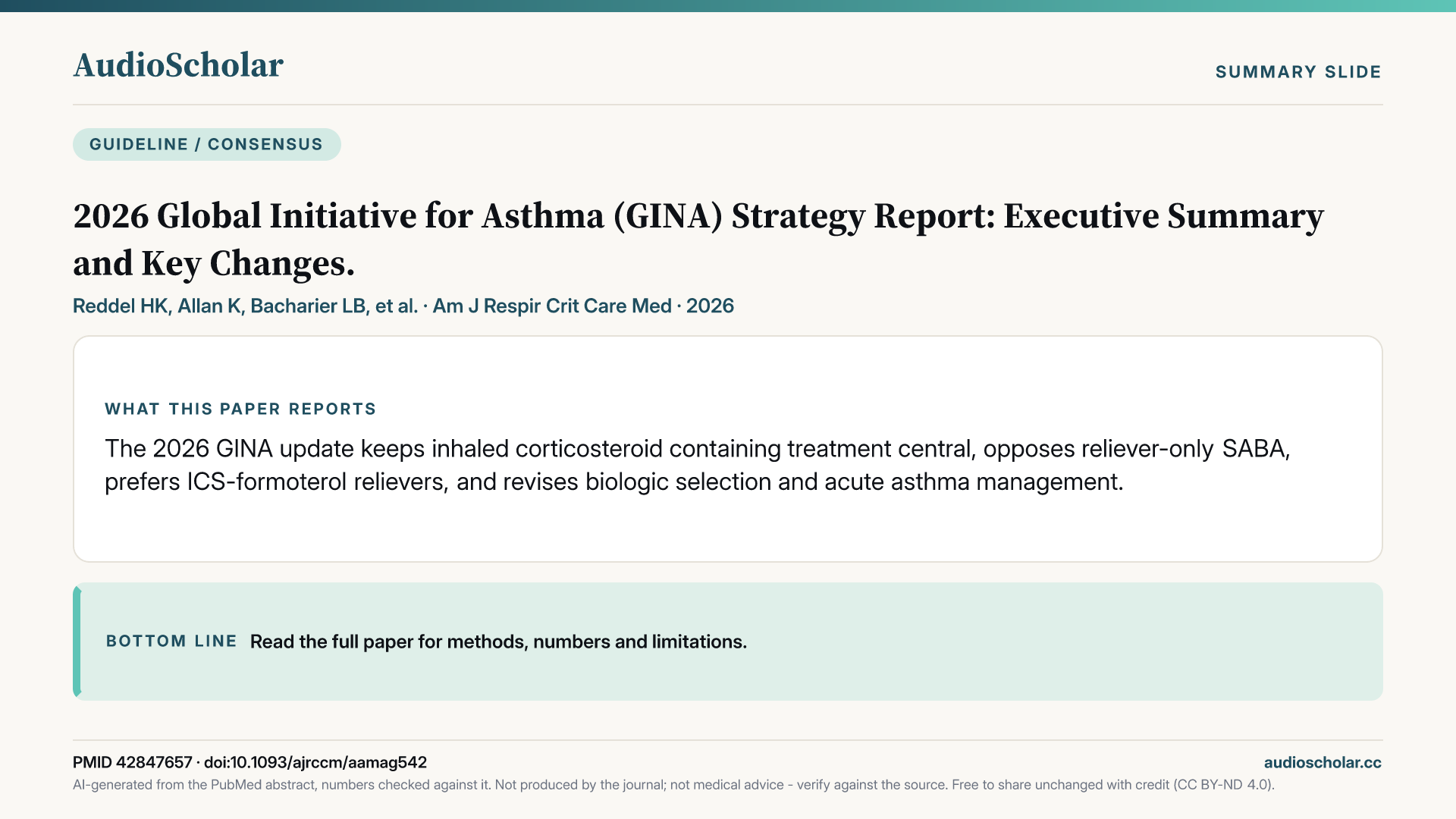
The 2026 GINA update keeps inhaled corticosteroid containing treatment central, opposes reliever-only SABA, prefers ICS-formoterol relievers, and revises biologic selection and acute asthma management.
American Journal of Respiratory and Critical Care Medicine · 2026 · PubMed

This week’s papers
- 01
2026 Global Initiative for Asthma (GINA) Strategy Report: Executive Summary and Key Changes.
The 2026 GINA update keeps inhaled corticosteroid containing treatment central, opposes reliever-only SABA, prefers ICS-formoterol relievers, and revises biologic selection and acute asthma management.
Reddel HK et al. · American Journal of Respiratory and Critical Care Medicine · 2026
- 02
Scottish Airways Research Network (SARN) Delphi Consensus on pre-biologic assessment, clinical remission and post-remission management in severe asthma.
Scottish severe asthma specialists agreed remission should be judged after at least 12 months without maintenance oral steroids or exacerbations, and biologic de-escalation should not be routine.
Jabbal S et al. · Respiratory Medicine · 2026
- 03
Real-World Effectiveness of Dupilumab in Patients with Severe Asthma in Europe: Findings from the EU-ADVANTAGE Study.
In 1,281 European patients with severe asthma, starting dupilumab was associated with halved exacerbations and about two thirds fewer oral corticosteroid prescriptions over the following year.
Bourdin A et al. · Respiratory Medicine · 2026
- 04
Real-world effectiveness of dupilumab in COPD: a German multicenter analysis.
Among 99 German patients with type 2 COPD, dupilumab was associated with about 70 percent fewer exacerbations, though FEV1 gains were not significant and the design was uncontrolled.
Abdo M et al. · Respiratory Research · 2026
- 05
Switching from mepolizumab to benralizumab in eosinophilic granulomatosis with polyangiitis (EGPA).
After mepolizumab failure in EGPA, benralizumab achieved complete response in about a third of 68 patients, with lower response after primary failure and few sustained remissions.
Cottu A et al. · Chest · 2026
- 06
ERS/ESRS clinical practice guideline for continuous positive airway pressure for the treatment of adult obstructive sleep apnoea.
European guidance strongly recommends CPAP for sleep apnoea with daytime sleepiness, conditionally for hypertension and older adults, and leaves it optional for atrial fibrillation or glycaemic goals.
Testelmans D et al. · European Respiratory Journal · 2026
- 07
GLP-1-based therapies in lung diseases.
GLP-1 receptor agonists show mechanistic and observational promise in asthma, COPD, pulmonary hypertension and interstitial lung disease, but randomised trials in lung populations remain scarce.
O'Callaghan M et al. · European Respiratory Journal · 2026
- 08
Short and Long-Term Outcomes of Intermediate-High Risk Pulmonary Embolism Treated with Catheter-Directed Reperfusion Therapy Versus Anticoagulation.
In over 50,000 patients with intermediate-high risk pulmonary embolism, catheter-directed therapy was associated with about 30 percent lower mortality, though observational confounding means randomised trials are needed.
Brasher W et al. · Respiratory Medicine · 2026
- 09
Effectiveness of Continuous Automatic Endotracheal Cuff Pressure Monitoring in Preventing Ventilator-Associated Pneumonia in the Pediatric Intensive Care Unit: A Randomized Controlled Trial.
In 241 ventilated children, continuous automatic cuff pressure monitoring lowered ventilator-associated pneumonia from about 24 to 13 percent, although several secondary analyses were not significant.
Aşık A et al. · Chest · 2026
- 10
Individualized Treatment Effects of Cefepime vs Piperacillin-Tazobactam in Adults Hospitalized with Acute Infection.
A secondary ACORN analysis found patient characteristics modified the kidney effects of cefepime versus piperacillin-tazobactam, but not delirium effects, offering hypothesis-generating support for individualised antibiotic choice.
Qian ET et al. · American Journal of Respiratory and Critical Care Medicine · 2026
The full briefing
This AudioScholar briefing is generated by artificial intelligence for healthcare professionals and trainees. It is not medical advice.
Welcome to This Week in Pulmonary. This week we're covering 10 notable papers spanning asthma strategy and biologic therapy across airway disease, new evidence frameworks for sleep apnoea and metabolic therapies, and acute and critical care questions from pulmonary embolism to the ventilated child. Let's dive in.
We start with airway disease, where a major strategy update and several real-world biologic studies landed together. In the American Journal of Respiratory and Critical Care Medicine, Reddel and colleagues present the executive summary of the 2026 Global Initiative for Asthma report [1]. The core architecture is familiar: an assess, adjust, review cycle aimed at both symptom control and future risk, with objective confirmation of diagnosis wherever possible. GINA continues to strongly recommend inhaled corticosteroid containing treatment for all adults, adolescents, children and most preschoolers with asthma, and continues to recommend against short-acting beta agonist only treatment. For adults and adolescents, low-dose budesonide-style ICS-formoterol as an anti-inflammatory reliever, either as needed alone or as maintenance and reliever therapy, remains the preferred track because of its substantial reduction in severe exacerbations compared with reliever regimens built on short-acting beta agonists. The 2026 changes centre on expanded anti-inflammatory reliever options for adults and children, revised guidance on severe asthma and biologic selection, and substantial updates to acute asthma care, including post-discharge reassessment. Alongside that global document, a Scottish Delphi consensus led by Jabbal, in Respiratory Medicine, tackles what happens around biologics [2]. Thirty specialists from 15 centres reached agreement that pre-biologic assessment should include treatment optimisation, phenotyping, type 2 biomarkers and comorbidities, and that clinical remission should generally be judged after at least 12 months, defined by no maintenance oral steroids, minimal symptoms, no severe exacerbations, stable lung function and normalised quality of life. The panel could not agree on a specific Asthma Control Questionnaire threshold for remission, or on restricting biologics for smokers not engaged in cessation, and it judged that dose-interval extension or discontinuation should not be routine but may suit selected patients in sustained remission under close specialist supervision. This is expert opinion, useful as a framework for consistency rather than as outcome evidence.
Two real-world dupilumab studies then extend the trial data. In Respiratory Medicine, the EU-ADVANTAGE chart review by Bourdin and colleagues pulled records of 1,281 patients with severe asthma across five European countries [3]. Comparing the year before and after starting dupilumab, severe exacerbations were roughly halved and oral corticosteroid prescriptions fell by about two thirds, while the share of patients with at least one hospitalisation dropped from about nine percent to about three percent. In Respiratory Research, Abdo and colleagues report a German multicentre cohort of 99 patients with COPD and type 2 inflammation, a very sick group with an average FEV1 of 37 percent predicted [4]. Moderate-to-severe exacerbations fell by about 70 percent over a median of 11 months, with similar effects regardless of comorbid asthma, chronic bronchitis or emphysema severity, and the CAT score improved by about four and a half points. The FEV1 gain of about 50 millilitres was not statistically significant, and eight patients had no reduction in exacerbations. Both studies are uncontrolled before-and-after designs, so regression to the mean is a real concern, and the COPD authors acknowledge that the high baseline exacerbation burden may partly explain the dramatic response. Still, they align with the randomised trials rather than contradicting them. Finally in this theme, Chest publishes a retrospective European study led by Cottu on switching from mepolizumab to benralizumab in eosinophilic granulomatosis with polyangiitis [5]. Among 68 patients followed for a median of just over two years, about a third of patients achieved complete response at some point, though only about a fifth of patients maintained it at last follow-up. Lung function improved modestly and nearly four in ten patients came off glucocorticoids entirely. Patients whose mepolizumab failure was primary, rather than a later loss of response, had markedly lower odds of complete response, and almost a fifth of patients stopped benralizumab for persistent respiratory symptoms. The signal supports benralizumab as an option after mepolizumab failure, but it is retrospective and the authors call for prospective sequencing studies.
Our second theme is how we frame benefit in sleep and metabolic lung disease. In the European Respiratory Journal, Testelmans and colleagues present the joint European Respiratory Society and European Sleep Research Society guideline on CPAP for adult obstructive sleep apnoea [6]. Using GRADE methodology, the task force makes a strong recommendation for CPAP only in patients with excessive daytime sleepiness. For moderate-to-severe disease, older adults, and patients with hypertension or treatment-resistant hypertension, recommendations are conditional, grounded in benefits on sleepiness, patient-reported outcomes and blood pressure. Notably, for patients without daytime sleepiness, for reducing atrial fibrillation recurrence, and for improving glycaemic control, the panel suggests either CPAP or no treatment, which is an explicit acknowledgement that the evidence does not clearly favour CPAP for those cardiometabolic goals. Also in the European Respiratory Journal, a narrative review by O'Callaghan and colleagues surveys GLP-1 receptor agonists in lung disease [7]. Preclinical work shows effects on airway inflammation, endothelial function and fibroblast activation, and observational data hint at better asthma control, fewer COPD exacerbations and lower mortality in interstitial lung disease. But the authors are clear that high-quality randomised trials in pulmonary populations remain limited, and that separating weight-loss effects from direct lung effects is unresolved. Read together, these two papers sit at an interesting junction: the obesity and metabolic dimension of lung and sleep disease is drawing attention, yet the guideline shows how often promising cardiometabolic signals have not held up as firm outcome benefits.
Our third theme covers acute and critical care. In Respiratory Medicine, Brasher and colleagues used a multi-institutional electronic health record database from the United States to compare catheter-directed intervention with anticoagulation alone in just over 50,000 patients with intermediate-high risk pulmonary embolism [8]. After overlap weighting, catheter-directed therapy was associated with about a 30 percent lower hazard of death. Among survivors, it was also associated with roughly a fifth fewer heart failure readmissions, fewer respiratory failure readmissions, and about 30 percent less chronic oxygen use, though there was no significant difference in chronic thromboembolic pulmonary hypertension. The scale is impressive, but this is observational data in a field where selection for intervention is heavily confounded, and the authors themselves frame it as support for randomised trials powered for long-term outcomes rather than as settled evidence. In Chest, an open-label randomised trial led by Aşık tested continuous automatic endotracheal cuff pressure monitoring against intermittent manual checks in 241 ventilated children [9]. Ventilator-associated pneumonia occurred in about 13 percent of children with automatic monitoring versus about 24 percent with manual monitoring, an absolute reduction of roughly 11 points, and time spent within the target pressure range was higher with the device. The supporting analyses were weaker: the rate per ventilator-day and the unadjusted time-to-event analysis did not reach significance, and only the adjusted model narrowly did. So the primary result is positive, but fragile, and from a single open-label trial. Finally, back in the American Journal of Respiratory and Critical Care Medicine, Qian and colleagues performed a secondary analysis of the ACORN trial, which had found no average difference between cefepime and piperacillin-tazobactam on kidney injury or death [10]. Using a model to predict individual treatment effects, they found heterogeneity: among 626 patients predicted to benefit from cefepime, survival without acute kidney injury was about 81 percent with cefepime versus about 74 percent with piperacillin-tazobactam. In the smaller group predicted to benefit from piperacillin-tazobactam, the difference was not statistically significant, and effects on delirium or coma were not modified by patient characteristics. This is hypothesis-generating precision medicine, interesting for intensivists, but it needs external validation before bedside use.
If you only have time for one paper this week, make it the 2026 GINA executive summary from Reddel and colleagues [1]. It is the reference document that shapes asthma care for nearly every pulmonologist, and this year's changes to reliever options, biologic selection and acute management reach patients across the entire severity spectrum.
Here is what this week's evidence adds up to in Pulmonary. First, the global asthma strategy continues to anchor care on inhaled corticosteroid containing treatment and against reliever monotherapy with short-acting beta agonists, and the 2026 update broadens anti-inflammatory reliever options, while expert consensus on biologic remission and de-escalation remains opinion rather than trial evidence. Second, real-world data for dupilumab in severe asthma and type 2 COPD echo the randomised trials, with large exacerbation reductions, though uncontrolled designs likely overstate the effect size. Third, the European CPAP guideline reserves its strong recommendation for sleepy patients and leaves CPAP for atrial fibrillation recurrence or glycaemic control as a genuinely open choice. Fourth, catheter-directed therapy for intermediate-high risk pulmonary embolism shows a consistent observational signal for lower mortality and fewer long-term complications, but randomised outcome data are still needed. And fifth, automated cuff pressure control reduced ventilator-associated pneumonia in one paediatric trial with a borderline margin, and individualised antibiotic selection between cefepime and piperacillin-tazobactam remains a research concept for now.
That's your roundup for This Week in Pulmonary. The full transcript and references are available on the episode page. This is an AI-curated summary — for clinical decisions, always consult primary sources and current guidelines. See you next week.
If this weekly briefing is useful, follow the show in your podcast app so new episodes arrive automatically. And a quick rating on Apple Podcasts or Spotify helps other physicians discover the show.
This is an automated summary generated by artificial intelligence, which can make mistakes. Always review the original source materials.
Spot something worth flagging?
Get this every week in your podcast app — free.
New pulmonary episodes land in your feed automatically — listen on your commute.