This Week in Infectious Disease — Oct 16, 2026
Generated Oct 17, 2026 · 10:45
The week's practice-changing Infectious Disease research, summarized for clinicians.
If the audio fails to play, refresh the page to renew the link.
Get next week’s Infectious Disease briefing — free.
In your podcast app, or readable in your inbox with the audio one tap away.
Long-Acting HIV Therapy in African Adults with Adherence Challenges.
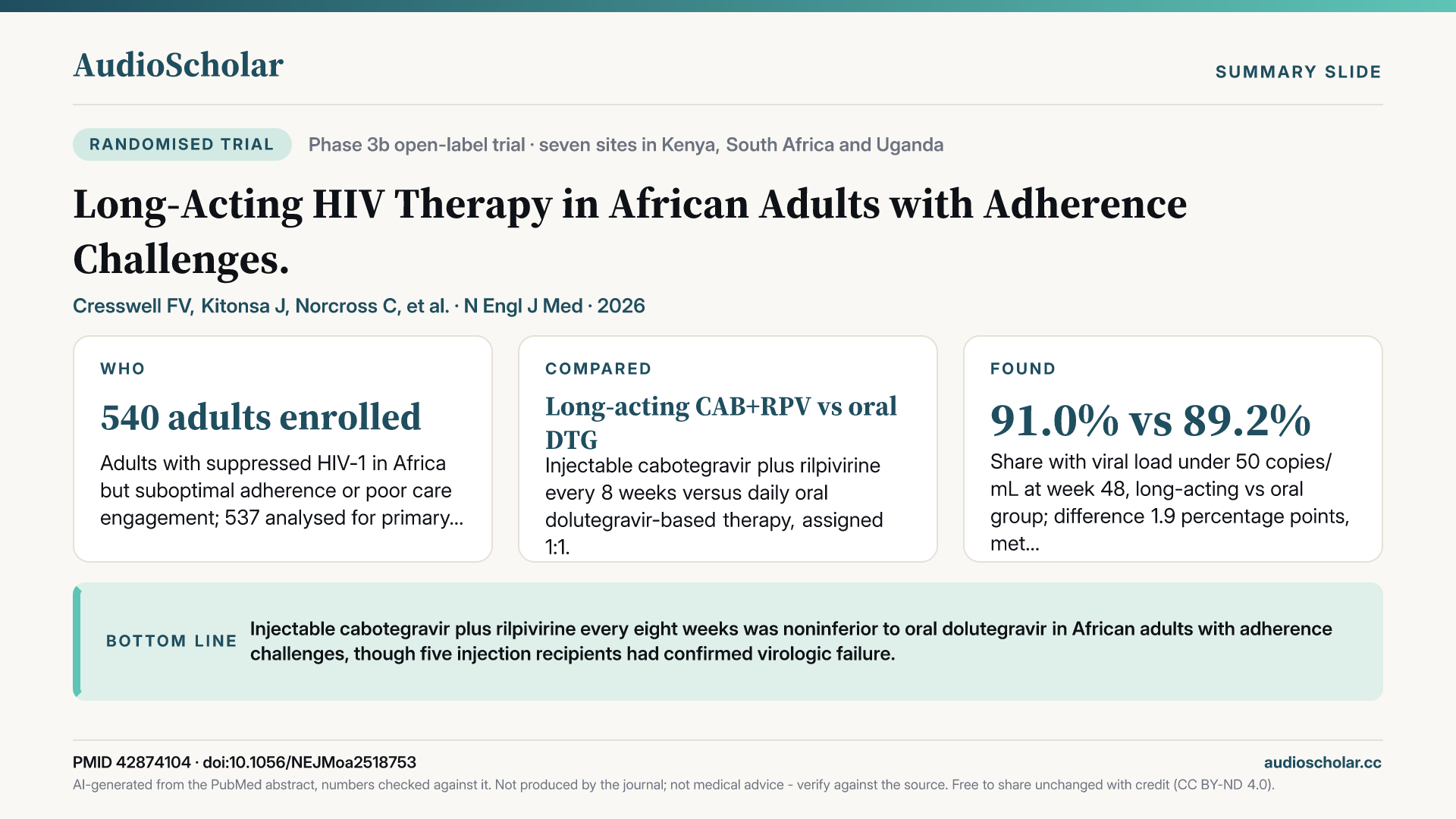
Injectable cabotegravir plus rilpivirine every eight weeks was noninferior to oral dolutegravir in African adults with adherence challenges, though five injection recipients had confirmed virologic failure.
New England Journal of Medicine · 2026 · PubMed

This week’s papers
- 01
Long-Acting HIV Therapy in African Adults with Adherence Challenges.
Injectable cabotegravir plus rilpivirine every eight weeks was noninferior to oral dolutegravir in African adults with adherence challenges, though five injection recipients had confirmed virologic failure.
Cresswell FV, Kitonsa J, Norcross C, et al. · New England Journal of Medicine · 2026
From the briefingIn the New England Journal of Medicine, Cresswell and colleagues report the IMPALA trial, an open-label phase 3b study at seven sites in Kenya, South Africa, and Uganda [1]. It enrolled 540 adults who were virally suppressed but had documented trouble with adherence or care engagement, exactly the people usually excluded from injectable trials, and randomized them to cabotegravir plus rilpivirine injections every eight weeks or continued oral dolutegravir-based therapy. Notably, no baseline resistance testing was done. At 48 weeks, about 91 percent of patients on injections remained suppressed, compared with about 89 percent on oral therapy, meeting the noninferiority bar. The trade-off was confirmed virologic failure in five patients on injections and none on oral therapy, while serious adverse events were similar.
If you only have time for one paper this week, make it the IMPALA trial in the New England Journal of Medicine [1]. It challenges the long-standing assumption that long-acting injectables belong only to patients who already adhere well, while its small failure signal reopens the question of how to select candidates when resistance testing is not available.
Written by AI from the published abstract, for healthcare professionals. Not medical advice; check the paper before acting on it.
- 02
Risk Factors and Therapeutic Consequences of Virologic Failure With Long-Acting Cabotegravir Plus Rilpivirine in the Dat'AIDS Cohort.
In about 2,200 French adults on injectable cabotegravir plus rilpivirine, virologic failure was under two percent, but half of genotyped failures developed resistance, mostly compromising dolutegravir and bictegravir.
Deschanvres C, Hocqueloux L, Cabié A, et al. · Clinical Infectious Diseases · 2026
From the briefingThat failure signal connects directly to a Clinical Infectious Diseases analysis from the French Dat'AIDS cohort led by Deschanvres [2]. Among roughly 2,200 suppressed adults switched to the same injectable regimen, virologic failure occurred in just under two percent, typically within the first few months. Half of the genotyped failures showed new resistance, and that resistance compromised dolutegravir and bictegravir far more often than doravirine. Resistance also emerged during low-level viremia or transient blips that later resolved. Higher body mass index, a nadir CD4 count below 200, suppression for less than a year before switching, and historical resistance mutations each independently raised failure risk. Read together, the two papers suggest injectables can match oral therapy even in people who struggle with daily pills, but failures, though uncommon, can cost integrase inhibitor options. The African trial is a single industry-funded study with 48-week follow-up, and the French data are observational, so the candidate-selection factors are suggestive rather than validated.
Written by AI from the published abstract, for healthcare professionals. Not medical advice; check the paper before acting on it.
- 03
Randomized Trial Comparing Minocycline-EDTA-Ethanol Lock to Standard-of-Care Antibiotic Lock for Management of Central Line-Associated Bloodstream Infection.
A minocycline-EDTA-ethanol lock salvaged more long-term central catheters than standard antibiotic locks in bloodstream infection, retaining 57 versus 38 percent, with similar adverse events and mortality.
Chaftari AM, Rathore V, Hachem R, et al. · Clinical Infectious Diseases · 2026
From the briefingAlso in Clinical Infectious Diseases, Chaftari and colleagues ran a 34-center superiority trial in the United States, Puerto Rico, and India comparing a minocycline, EDTA, and ethanol lock with standard antibiotic lock therapy, each alongside systemic antibiotics, in 241 patients with central line-associated bloodstream infection and a long-term catheter [3]. Catheter retention was 57 percent with the novel lock versus 38 percent with standard locks, and the risk of catheter failure over time was roughly halved. Both clinical and microbiological failures were substantially lower, and adverse events and mortality were similar, with no drug-related serious events. This is one trial, open to replication, but it is randomized and multicenter, which is more than most lock therapy data can claim.
Written by AI from the published abstract, for healthcare professionals. Not medical advice; check the paper before acting on it.
- 04
Recurrent and Relapsing Catheter-Related Bloodstream Infections in Patients Requiring Long-term Vascular Access.
An expert review frames recurrent catheter infections as a team problem, emphasizing lock therapy, shared decision-making, documentation, and deliberate preservation of venous access for future devices.
Mermel LA, Baskin KM, Buetti N, et al. · Clinical Infectious Diseases · 2026
From the briefingThe companion piece, a state-of-the-art review from Mermel and colleagues in the same journal, places such tools in a broader framework for patients with recurrent or relapsing catheter infections [4]. The authors emphasize a team approach, shared decision-making with patients and families, lock therapy, judicious use of antibiotic-impregnated catheters, and deliberate preservation of venous access for future devices. As expert opinion, it frames priorities rather than generating new evidence.
Written by AI from the published abstract, for healthcare professionals. Not medical advice; check the paper before acting on it.
- 05
Antibiotic Stewardship, Resistance, and Mortality in Vancomycin-Resistant Enterococcus: A Quasi-Experimental Study of Linezolid Restrictions.
Linezolid restriction cut use by 27 percent and resistance by 41 percent without raising overall mortality, but mortality rose among patients screening positive for vancomycin-resistant Enterococcus.
Kong EL, Kubiak DW, Shenoy ES, et al. · Clinical Infectious Diseases · 2026
From the briefingKong and colleagues, in Clinical Infectious Diseases, used a difference-in-differences design across more than half a million admissions at two academic centers to evaluate linezolid restriction [5]. Prior authorization and stricter criteria cut linezolid use by about a quarter and linezolid-resistant enterococcal isolates by about two fifths, with no rise in overall mortality. But among patients screening positive for vancomycin-resistant Enterococcus, in-hospital mortality rose by nearly five percentage points, with larger increases in those with bacteremia or sepsis. The design is quasi-experimental at only two hospitals, yet the finding raises the possibility that stewardship gains can be bought with harm in exactly the high-risk subgroup, and the authors suggest screening-informed safeguards.
Written by AI from the published abstract, for healthcare professionals. Not medical advice; check the paper before acting on it.
- 06
Daptomycin for enterococcal bloodstream infections and endocarditis: reconciling clinical evidence, susceptibility testing, and regulatory frameworks.
Reviewers argue misaligned daptomycin breakpoints drive enterococcal underdosing and propose higher MIC-informed doses, beta-lactam combination in endocarditis, and weekly creatine kinase monitoring, pending prospective trials.
Díez-Vidal A, Vizcarra P, Oñoro-López CM, et al. · The Lancet Infectious Diseases · 2026
From the briefingIn The Lancet Infectious Diseases, Díez-Vidal and colleagues tackle the other major option for these infections, daptomycin for enterococcal bacteremia and endocarditis [6]. They argue that the lack of regulatory approval, randomized trials, and harmonized breakpoints, with American standards offering breakpoints and European standards offering none, is itself a source of underdosing. Drawing on observational data linking 10 to 12 milligrams per kilogram daily to lower mortality in vancomycin-resistant faecium, they propose at least 8 milligrams per kilogram for faecium, 10 to 12 in vancomycin-resistant disease, beta-lactam combination in endocarditis, and weekly creatine kinase monitoring. This is a reasoned framework, not trial evidence.
Written by AI from the published abstract, for healthcare professionals. Not medical advice; check the paper before acting on it.
- 07
Outpatient Antibiotic Fills and 30-Day Readmission Following Patient-Directed Discharge in Drug Use-Associated Infective Endocarditis in a National Medicaid Cohort.
Only 17 percent of patients leaving early with drug use-associated endocarditis filled antibiotics within three days, and antibiotic fills were associated with markedly fewer 30-day readmissions in Medicaid data.
Gispen F, Mao J, Karan K, et al. · Clinical Infectious Diseases · 2026
From the briefingFinally, Gispen and colleagues, again in Clinical Infectious Diseases, examined national Medicaid data on nearly 20,000 patients with drug use-associated endocarditis [7]. Just over a quarter of patients left via patient-directed discharge, and only about one in six of those patients filled an antibiotic within three days, compared with over two in five of other patients. Patient-directed discharge roughly doubled the odds of 30-day readmission, while an antibiotic fill was associated with roughly halving it, and the apparent protection was even larger among those who left early. These are observational claims data, so residual confounding is likely, but they support planning for early departure, bedside medication delivery, and oral or long-acting options.
Written by AI from the published abstract, for healthcare professionals. Not medical advice; check the paper before acting on it.
- 08
Efficacy, safety, and immunogenicity of a nine-valent vaccine (ExPEC9V) for the prevention of invasive Escherichia coli disease in older adults: a phase 3, randomised, placebo-controlled trial (E.mbrace).
A nine-valent Escherichia coli conjugate vaccine produced strong antibody responses but did not prevent invasive disease in over 17,000 older adults, leading to futility termination and discontinued development.
Bonten M, Butler CC, Edwards A, et al. · The Lancet Infectious Diseases · 2026
From the briefingIn The Lancet Infectious Diseases, Bonten and colleagues report the E.mbrace trial of a nine-valent Escherichia coli conjugate vaccine in more than 17,000 adults aged 60 and older with recent urinary tract infection [8]. Despite robust and durable antibody responses, the vaccine showed no protection against invasive disease, with 11 cases in the vaccine group and 13 with placebo. The trial stopped for futility and development has been discontinued, a sobering reminder that antibody levels did not translate into clinical protection here.
Written by AI from the published abstract, for healthcare professionals. Not medical advice; check the paper before acting on it.
- 09
Omitting the Eradication Phase of Treatment of Adults with Melioidosis: A Pilot, Single-Center Randomized Controlled Trial.
In a 33-patient melioidosis pilot, omitting oral eradication therapy led to recurrence in 29 percent versus none, yet 81 percent of trimethoprim-sulfamethoxazole recipients had adverse reactions.
Smith S, Stewart J, Binotto E, et al. · Open Forum Infectious Diseases · 2026
From the briefingIn Open Forum Infectious Diseases, Smith and colleagues ran a pilot randomized trial asking whether prolonged intravenous therapy alone could replace the three-month trimethoprim-sulfamethoxazole eradication phase in melioidosis [9]. Among only 33 patients, none in the standard group had culture-confirmed recurrence at two years, versus five of 17 patients given intravenous therapy alone. Yet about four in five patients receiving eradication therapy had an adverse drug reaction, several requiring hospitalization and one intensive care. The pilot is tiny, but the recurrence signal argues against abandoning eradication wholesale, while the toxicity argues for identifying who truly needs it and at what dose.
Written by AI from the published abstract, for healthcare professionals. Not medical advice; check the paper before acting on it.
- 10
Empirical Antifungal Treatment of Critically Ill Patients With Influenza-Associated Acute Respiratory Distress Syndrome: A Bayesian Perspective.
A Bayesian reanalysis of 172 patients with influenza ARDS estimated a 94 percent probability that empirical mold-active antifungals reduce aspergillosis, but found no mortality benefit.
Wilhelmer C, Kriegl L, Krause R, et al. · Clinical Infectious Diseases · 2026
From the briefingLastly, Wilhelmer and colleagues, in Clinical Infectious Diseases, reanalyzed 172 critically ill patients with influenza-associated ARDS in a Bayesian framework [10]. Empirical mold-active antifungal therapy was associated with roughly halving the hazard of influenza-associated aspergillosis, with an estimated 94 percent probability of benefit, though the plausible range still included no effect, and there was no mortality benefit. This is a retrospective reanalysis, hypothesis-generating rather than practice-defining.
Written by AI from the published abstract, for healthcare professionals. Not medical advice; check the paper before acting on it.
The full briefing
This AudioScholar briefing is generated by artificial intelligence for healthcare professionals and trainees. It is not medical advice.
Welcome to This Week in Infectious Disease. This week we're covering 10 notable papers spanning long-acting HIV therapy, the management of catheter and enterococcal bloodstream infections, and several studies that put long-held treatment and prevention assumptions to the test. Let's dive in.
We start with long-acting antiretroviral therapy, where one trial expands the population that might benefit and a large cohort clarifies the price of failure. In the New England Journal of Medicine, Cresswell and colleagues report the IMPALA trial, an open-label phase 3b study at seven sites in Kenya, South Africa, and Uganda [1]. It enrolled 540 adults who were virally suppressed but had documented trouble with adherence or care engagement, exactly the people usually excluded from injectable trials, and randomized them to cabotegravir plus rilpivirine injections every eight weeks or continued oral dolutegravir-based therapy. Notably, no baseline resistance testing was done. At 48 weeks, about 91 percent of patients on injections remained suppressed, compared with about 89 percent on oral therapy, meeting the noninferiority bar. The trade-off was confirmed virologic failure in five patients on injections and none on oral therapy, while serious adverse events were similar. That failure signal connects directly to a Clinical Infectious Diseases analysis from the French Dat'AIDS cohort led by Deschanvres [2]. Among roughly 2,200 suppressed adults switched to the same injectable regimen, virologic failure occurred in just under two percent, typically within the first few months. Half of the genotyped failures showed new resistance, and that resistance compromised dolutegravir and bictegravir far more often than doravirine. Resistance also emerged during low-level viremia or transient blips that later resolved. Higher body mass index, a nadir CD4 count below 200, suppression for less than a year before switching, and historical resistance mutations each independently raised failure risk. Read together, the two papers suggest injectables can match oral therapy even in people who struggle with daily pills, but failures, though uncommon, can cost integrase inhibitor options. The African trial is a single industry-funded study with 48-week follow-up, and the French data are observational, so the candidate-selection factors are suggestive rather than validated.
Our next theme is long-term vascular access, where a randomized trial and a state-of-the-art review both address catheter salvage. Also in Clinical Infectious Diseases, Chaftari and colleagues ran a 34-center superiority trial in the United States, Puerto Rico, and India comparing a minocycline, EDTA, and ethanol lock with standard antibiotic lock therapy, each alongside systemic antibiotics, in 241 patients with central line-associated bloodstream infection and a long-term catheter [3]. Catheter retention was 57 percent with the novel lock versus 38 percent with standard locks, and the risk of catheter failure over time was roughly halved. Both clinical and microbiological failures were substantially lower, and adverse events and mortality were similar, with no drug-related serious events. This is one trial, open to replication, but it is randomized and multicenter, which is more than most lock therapy data can claim. The companion piece, a state-of-the-art review from Mermel and colleagues in the same journal, places such tools in a broader framework for patients with recurrent or relapsing catheter infections [4]. The authors emphasize a team approach, shared decision-making with patients and families, lock therapy, judicious use of antibiotic-impregnated catheters, and deliberate preservation of venous access for future devices. As expert opinion, it frames priorities rather than generating new evidence.
The third theme is antibiotic access, both when we restrict it and when patients leave before we can provide it. Kong and colleagues, in Clinical Infectious Diseases, used a difference-in-differences design across more than half a million admissions at two academic centers to evaluate linezolid restriction [5]. Prior authorization and stricter criteria cut linezolid use by about a quarter and linezolid-resistant enterococcal isolates by about two fifths, with no rise in overall mortality. But among patients screening positive for vancomycin-resistant Enterococcus, in-hospital mortality rose by nearly five percentage points, with larger increases in those with bacteremia or sepsis. The design is quasi-experimental at only two hospitals, yet the finding raises the possibility that stewardship gains can be bought with harm in exactly the high-risk subgroup, and the authors suggest screening-informed safeguards. In The Lancet Infectious Diseases, Díez-Vidal and colleagues tackle the other major option for these infections, daptomycin for enterococcal bacteremia and endocarditis [6]. They argue that the lack of regulatory approval, randomized trials, and harmonized breakpoints, with American standards offering breakpoints and European standards offering none, is itself a source of underdosing. Drawing on observational data linking 10 to 12 milligrams per kilogram daily to lower mortality in vancomycin-resistant faecium, they propose at least 8 milligrams per kilogram for faecium, 10 to 12 in vancomycin-resistant disease, beta-lactam combination in endocarditis, and weekly creatine kinase monitoring. This is a reasoned framework, not trial evidence. Finally, Gispen and colleagues, again in Clinical Infectious Diseases, examined national Medicaid data on nearly 20,000 patients with drug use-associated endocarditis [7]. Just over a quarter of patients left via patient-directed discharge, and only about one in six of those patients filled an antibiotic within three days, compared with over two in five of other patients. Patient-directed discharge roughly doubled the odds of 30-day readmission, while an antibiotic fill was associated with roughly halving it, and the apparent protection was even larger among those who left early. These are observational claims data, so residual confounding is likely, but they support planning for early departure, bedside medication delivery, and oral or long-acting options.
Our final theme gathers studies that tested a reasonable assumption and found the answer more complicated. In The Lancet Infectious Diseases, Bonten and colleagues report the E.mbrace trial of a nine-valent Escherichia coli conjugate vaccine in more than 17,000 adults aged 60 and older with recent urinary tract infection [8]. Despite robust and durable antibody responses, the vaccine showed no protection against invasive disease, with 11 cases in the vaccine group and 13 with placebo. The trial stopped for futility and development has been discontinued, a sobering reminder that antibody levels did not translate into clinical protection here. In Open Forum Infectious Diseases, Smith and colleagues ran a pilot randomized trial asking whether prolonged intravenous therapy alone could replace the three-month trimethoprim-sulfamethoxazole eradication phase in melioidosis [9]. Among only 33 patients, none in the standard group had culture-confirmed recurrence at two years, versus five of 17 patients given intravenous therapy alone. Yet about four in five patients receiving eradication therapy had an adverse drug reaction, several requiring hospitalization and one intensive care. The pilot is tiny, but the recurrence signal argues against abandoning eradication wholesale, while the toxicity argues for identifying who truly needs it and at what dose. Lastly, Wilhelmer and colleagues, in Clinical Infectious Diseases, reanalyzed 172 critically ill patients with influenza-associated ARDS in a Bayesian framework [10]. Empirical mold-active antifungal therapy was associated with roughly halving the hazard of influenza-associated aspergillosis, with an estimated 94 percent probability of benefit, though the plausible range still included no effect, and there was no mortality benefit. This is a retrospective reanalysis, hypothesis-generating rather than practice-defining.
If you only have time for one paper this week, make it the IMPALA trial in the New England Journal of Medicine [1]. It challenges the long-standing assumption that long-acting injectables belong only to patients who already adhere well, while its small failure signal reopens the question of how to select candidates when resistance testing is not available.
Here is what this week's evidence adds up to in Infectious Disease. First, injectable cabotegravir plus rilpivirine held suppression as well as oral dolutegravir in African adults with adherence challenges, but uncommon failures carried resistance that can cost integrase inhibitor options, and the predictors of failure come from observational data. Second, a single randomized trial supports a minocycline, EDTA, and ethanol lock for salvaging long-term catheters, pending replication and wider availability. Third, linezolid restriction lowered use and resistance at the population level but was associated with higher mortality in patients colonized with vancomycin-resistant Enterococcus, a quasi-experimental finding that tempers how restriction policies are designed. Fourth, observational data link early antibiotic access after patient-directed discharge in drug use-associated endocarditis to substantially fewer readmissions. Fifth, an Escherichia coli vaccine failed despite strong immunogenicity, and a small melioidosis pilot suggests eradication therapy still prevents recurrence in some patients, at considerable toxicity cost.
That's your roundup for This Week in Infectious Disease. The full transcript and references are available on the episode page. This is an AI-curated summary — for clinical decisions, always consult primary sources and current guidelines. See you next week.
If this weekly briefing is useful, follow the show in your podcast app so new episodes arrive automatically. And a quick rating on Apple Podcasts or Spotify helps other physicians discover the show.
This is an automated summary generated by artificial intelligence, which can make mistakes. Always review the original source materials.
Spot something worth flagging?
Get this every week in your podcast app — free.
New infectious_disease episodes land in your feed automatically — listen on your commute.