This Week in Rheumatology — Oct 15, 2026
Generated Oct 15, 2026 · 12:18
The week's practice-changing Rheumatology research, summarized for clinicians.
If the audio fails to play, refresh the page to renew the link.
Get next week’s Rheumatology briefing — free.
In your podcast app, or readable in your inbox with the audio one tap away.
The 2026 British Society for Rheumatology guideline for the treatment of polymyalgia rheumatica.
The updated British guideline for polymyalgia rheumatica supports faster glucocorticoid tapering, early methotrexate, interleukin 6 receptor blockade for steroid-dependent disease, and bone protection for all patients.
Rheumatology · 2026 · PubMed

This week’s papers
- 01
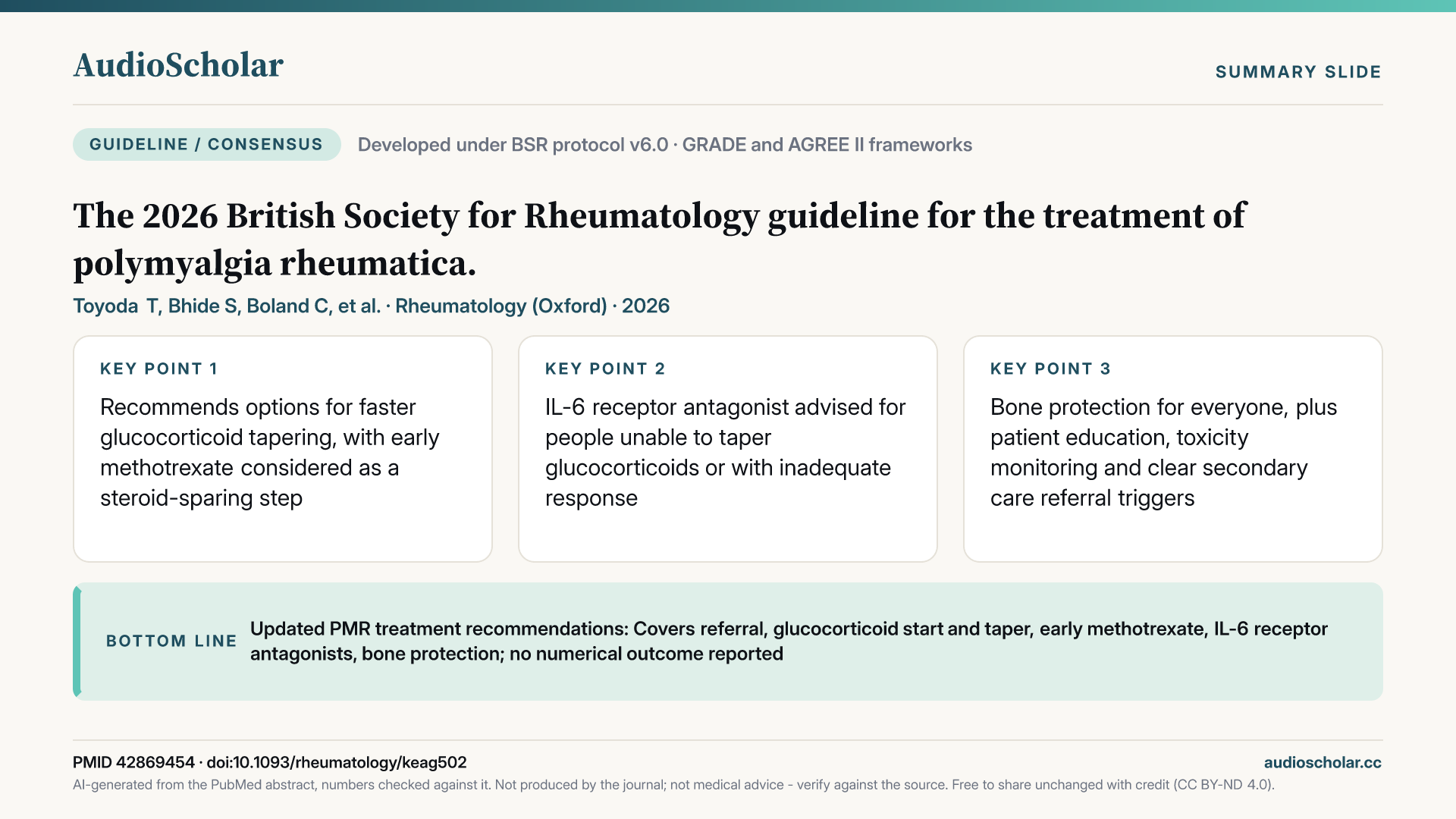
The 2026 British Society for Rheumatology guideline for the treatment of polymyalgia rheumatica.
The updated British guideline for polymyalgia rheumatica supports faster glucocorticoid tapering, early methotrexate, interleukin 6 receptor blockade for steroid-dependent disease, and bone protection for all patients.
Toyoda T et al. · Rheumatology · 2026
From the briefingIn Rheumatology, Toyoda and colleagues present the 2026 British Society for Rheumatology guideline for polymyalgia rheumatica, which supersedes the 2009 guidance and was built using GRADE and AGREE II methods [1]. The starting point is familiar: glucocorticoids remain the cornerstone, but many patients relapse during tapering and accumulate steroid toxicity. The update addresses when patients should be discussed with or referred to rheumatology, offers options for a faster glucocorticoid taper, supports consideration of early methotrexate, and positions interleukin 6 receptor antagonists for patients who cannot taper or respond inadequately. It also recommends bone protection for all people with polymyalgia rheumatica, alongside ongoing education and monitoring for steroid harm. The abstract does not grade each recommendation, so the strength behind individual statements will need to be read in the full document, but the overall direction is clear: steroid sparing earlier and more deliberately.
If you only have time for one paper this week, make it the British Society for Rheumatology polymyalgia rheumatica guideline [1]. It replaces guidance that is nearly two decades old and formally reframes a very common condition around faster tapering, earlier methotrexate and a defined place for interleukin 6 blockade.
Written by AI from the published abstract, for healthcare professionals. Not medical advice; check the paper before acting on it.
- 02
Imaging for diagnosis, monitoring and outcome prediction in polymyalgia rheumatica: a systematic literature review and meta-analysis informing an international task force.
Across 49 studies, bilateral and extracapsular shoulder and hip inflammation supported polymyalgia diagnosis, but evidence quality was limited and glucocorticoids substantially reduced imaging sensitivity across modalities.
Konzett V et al. · RMD Open · 2026
From the briefingComplementing this, Konzett and colleagues in RMD Open report a systematic review and meta-analysis of imaging in polymyalgia rheumatica, commissioned to inform an international task force [2]. Across 49 studies, distinct patterns emerged that support diagnosis, notably extracapsular and bilateral inflammatory changes around the shoulders and hips, but few were validated in independent cohorts, and not a single study was judged at low risk of bias. Two practical signals stand out. Glucocorticoids substantially reduced sensitivity across every imaging modality, and PET scores lost accuracy after treatment and when distinguishing polymyalgia from other inflammatory diseases. Evidence on imaging for monitoring and predicting outcome was sparse. Taken together, the two papers suggest that imaging, where it is used, is most informative before steroids start, while the treatment guideline pushes toward earlier steroid-sparing therapy, though the imaging evidence base remains of limited quality and awaits formal recommendations.
Written by AI from the published abstract, for healthcare professionals. Not medical advice; check the paper before acting on it.
- 03
Long-term comparative outcomes of rituximab and belimumab in lupus patients.
In a single-centre lupus cohort, rituximab and belimumab achieved similar rates of low disease activity, though belimumab showed longer drug survival when used as a second-line biologic.
Sagy I et al. · Rheumatology · 2026
From the briefingIn Rheumatology, Sagy and colleagues used the British biologics registry at a single centre in Cambridge to compare rituximab and belimumab head to head in real-world practice over more than a decade [3]. Among 176 patients contributing 175 rituximab courses and 58 belimumab courses, the two drugs did not differ in achieving low disease activity, defined as a SLEDAI score of 4 or less on no more than 5 milligrams of prednisolone, and this held in both standard and propensity-weighted analyses. Belimumab users actually started with higher disease activity. Drug survival was similar when either agent was the first biologic, but in second-line use belimumab stayed on board longer, with about a third lower rate of discontinuation-type events by the authors' estimate. This is observational, single-centre work with unequal follow-up, so it reassures rather than settles; the drug survival difference is flagged by the authors as needing further study.
Written by AI from the published abstract, for healthcare professionals. Not medical advice; check the paper before acting on it.
- 04
B-cell landscape remodelling following dual BAFF/APRIL inhibition with telitacicept in lupus nephritis: extrafollicular axis clearance and its association with clinical response.
In a small lupus nephritis cohort, telitacicept depleted plasmablasts and plasma cells that belimumab spared, and early depletion of these cells tracked with sustained renal response.
Yi W et al. · Lupus Science & Medicine · 2026
From the briefingA smaller and more mechanistic study in Lupus Science and Medicine, led by Yi, looked at telitacicept, which blocks both BAFF and APRIL, in active lupus nephritis [4]. Sixteen telitacicept-treated patients were compared with just five belimumab-treated patients over 24 weeks. Just under two thirds of the telitacicept patients reached a primary efficacy renal response by week 24, and reductions in proteinuria and anti-double-stranded DNA were numerically greater than with belimumab. The striking finding was immunological: telitacicept essentially eradicated plasmablasts and mature plasma cells, an extrafollicular compartment that remained largely untouched by belimumab, and early falls in these cells tracked closely with sustained renal response. With a reference group of five, these comparisons are hypothesis-generating, but they offer a plausible mechanistic rationale for dual blockade and candidate early biomarkers.
Written by AI from the published abstract, for healthcare professionals. Not medical advice; check the paper before acting on it.
- 05
Antimalarial exposure and renal histopathologic findings in lupus nephritis.
Among 165 patients with biopsy-proven lupus nephritis, prior antimalarial exposure was not associated with differences in proliferative class, activity, chronicity, or tubulointerstitial damage on kidney biopsy.
Kharouf F et al. · Rheumatology · 2026
From the briefingRounding out the theme, Kharouf and colleagues, also in Rheumatology, examined whether antimalarial exposure before kidney biopsy was linked to milder histology in 165 patients from the Toronto Lupus Clinic [5]. About half of patients were on an antimalarial, and after adjustment exposure showed no detectable association with proliferative class, NIH activity or chronicity indices, or interstitial fibrosis and tubular atrophy, even with a year or more of continuous use. The authors are careful to frame this within the limits of sample size and design; it does not speak to the broader benefits of hydroxychloroquine in lupus, but it tempers any assumption that antimalarials visibly soften renal pathology.
Written by AI from the published abstract, for healthcare professionals. Not medical advice; check the paper before acting on it.
- 06
Bimekizumab efficacy across GRAPPA domains to 3 years in patients with psoriatic arthritis: a post hoc analysis of two phase 3 studies.
Pooled phase 3 and extension data in 1,112 psoriatic arthritis patients showed bimekizumab responses sustained to three years across joints, entheses, skin and nails, with rare IBD or uveitis.
Deodhar A et al. · Rheumatology · 2026
From the briefingStaying with biologics but turning to psoriatic arthritis, Deodhar and colleagues in Rheumatology report a pooled post hoc analysis of the bimekizumab phase 3 programme, covering both biologic-naive and TNF-inhibitor-experienced patients, extended to three years in the open-label phase [6]. Among 1,112 treated patients, improvements were sustained across the GRAPPA domains: just over half of patients maintained an ACR50 response, well over half achieved resolution of enthesitis, about two thirds achieved complete skin clearance, and a similar proportion achieved nail clearance. Inflammatory bowel disease and uveitis events were rare, and inflammatory markers of cardiovascular risk stayed improved. As an industry-supported, open-label extension with imputation for missing data, this supports durability rather than comparative superiority, but it adds reassurance about the breadth of response across psoriatic disease manifestations.
Written by AI from the published abstract, for healthcare professionals. Not medical advice; check the paper before acting on it.
- 07
Higher risk of Long COVID among patients with autoimmune rheumatic diseases and immunomodulatory therapy: a retrospective cohort analysis of national US data.
In a large national United States cohort, autoimmune rheumatic disease carried about a 56 percent higher Long COVID risk, with rituximab, glucocorticoids and Sjögren's disease linked to greater risk.
Singh N et al. · Arthritis & Rheumatology · 2026
From the briefingIn Arthritis and Rheumatology, Singh and colleagues used the National Clinical Cohort Collaborative, a national United States data resource, to examine Long COVID in nearly 190,000 matched patients [7]. Long COVID was recorded in about 3 percent of patients with autoimmune rheumatic disease versus about 1.5 percent of controls, and after adjustment the autoimmune group carried roughly a 56 percent higher risk. Within that group, more severe acute COVID, lung disease, obesity, and prior exposure to rituximab or glucocorticoids were associated with higher risk, and Sjögren's disease stood out. Because Long COVID was identified through a diagnostic code or clinic visit, true rates are likely undercounted, but the relative signal is consistent with what many clinicians have suspected.
Written by AI from the published abstract, for healthcare professionals. Not medical advice; check the paper before acting on it.
- 08
Cardiovascular risk stratification using chest CT in idiopathic inflammatory myopathies.
Incidental coronary calcification on routine chest CT was present in 43 percent of myositis patients and predicted stepwise worse cardiovascular death-free survival, with high disease activity linked to calcification.
Kastrati K et al. · Rheumatology · 2026
From the briefingCardiovascular risk is the focus of a single-centre study in Rheumatology from Kastrati and colleagues, who asked whether coronary calcium seen incidentally on routine high-resolution chest CT can stratify risk in idiopathic inflammatory myopathies [8]. Among 234 patients, coronary calcification was present in just over four in ten, and greater calcium burden was associated with stepwise worse cardiovascular death-free survival, a finding replicated in a matched systemic sclerosis cohort. High disease activity roughly quadrupled the odds of moderate calcification, linking inflammation with vascular burden. Since many myositis patients already undergo chest CT for interstitial lung disease screening, this points to a low-cost source of risk information, though prospective validation is still needed.
Written by AI from the published abstract, for healthcare professionals. Not medical advice; check the paper before acting on it.
- 09
IgG4-related disease is not associated with an increased incidence of malignancy in a large, single-centre cohort.
Over a median eight years, patients with IgG4-related disease showed no excess cancer incidence versus the general population, though smoking and older age at onset increased malignancy risk.
Michelson DA et al. · Annals of the Rheumatic Diseases · 2026
From the briefingReassurance comes from the Annals of the Rheumatic Diseases, where Michelson and colleagues followed 348 patients with IgG4-related disease for a median of about eight years [9]. Roughly one in ten patients developed a malignancy, but the overall incidence was no higher than expected in the general population. Within the cohort, smoking more than doubled cancer risk and older age at onset added risk, while female sex and submandibular gland involvement were associated with lower risk. This single-centre study argues against routine intensified cancer screening based on the diagnosis alone, while highlighting conventional risk factors.
Written by AI from the published abstract, for healthcare professionals. Not medical advice; check the paper before acting on it.
- 10
Genomic ascertainment of systemic autoinflammatory diseases: a retrospective cohort study in two population-based biobanks.
Pathogenic autoinflammatory gene variants occurred in about one in 4,000 biobank participants, roughly half showed inflammatory features, yet almost none carried a documented autoinflammatory diagnosis.
Ercelen D et al. · Lancet Rheumatology · 2026
From the briefingFinally, in the Lancet Rheumatology, Ercelen and colleagues took a genome-first approach across two large biobanks, Geisinger and the UK Biobank, totalling about 640,000 participants [10]. Pathogenic variants in 17 autoinflammatory disease genes were found in about one in 4,000 people, and roughly half of these carriers showed inflammatory features, particularly pulmonary and cutaneous disease, vasculitis and rheumatic autoimmune diagnoses, with more immunosuppressant use. Yet only one carrier had a documented autoinflammatory diagnosis. Penetrance differed markedly between the two cohorts, and code-based phenotyping is imprecise, but the message is that monogenic autoinflammatory disease is likely under-recognised among patients already in rheumatology clinics.
Written by AI from the published abstract, for healthcare professionals. Not medical advice; check the paper before acting on it.
The full briefing
This AudioScholar briefing is generated by artificial intelligence for healthcare professionals and trainees. It is not medical advice.
Welcome to This Week in Rheumatology. This week we're covering 10 notable papers spanning a refreshed approach to polymyalgia rheumatica, the evolving biologic toolkit in lupus and psoriatic arthritis, and the hidden risks that travel with rheumatic disease, from Long COVID to coronary calcium to undiagnosed genetic inflammation. Let's dive in.
Polymyalgia rheumatica gets two substantial papers this week, both aimed at moving a common condition beyond the old habit of long, slow steroid courses. In Rheumatology, Toyoda and colleagues present the 2026 British Society for Rheumatology guideline for polymyalgia rheumatica, which supersedes the 2009 guidance and was built using GRADE and AGREE II methods [1]. The starting point is familiar: glucocorticoids remain the cornerstone, but many patients relapse during tapering and accumulate steroid toxicity. The update addresses when patients should be discussed with or referred to rheumatology, offers options for a faster glucocorticoid taper, supports consideration of early methotrexate, and positions interleukin 6 receptor antagonists for patients who cannot taper or respond inadequately. It also recommends bone protection for all people with polymyalgia rheumatica, alongside ongoing education and monitoring for steroid harm. The abstract does not grade each recommendation, so the strength behind individual statements will need to be read in the full document, but the overall direction is clear: steroid sparing earlier and more deliberately. Complementing this, Konzett and colleagues in RMD Open report a systematic review and meta-analysis of imaging in polymyalgia rheumatica, commissioned to inform an international task force [2]. Across 49 studies, distinct patterns emerged that support diagnosis, notably extracapsular and bilateral inflammatory changes around the shoulders and hips, but few were validated in independent cohorts, and not a single study was judged at low risk of bias. Two practical signals stand out. Glucocorticoids substantially reduced sensitivity across every imaging modality, and PET scores lost accuracy after treatment and when distinguishing polymyalgia from other inflammatory diseases. Evidence on imaging for monitoring and predicting outcome was sparse. Taken together, the two papers suggest that imaging, where it is used, is most informative before steroids start, while the treatment guideline pushes toward earlier steroid-sparing therapy, though the imaging evidence base remains of limited quality and awaits formal recommendations.
Lupus therapeutics form our second theme, with three papers probing how B-cell targeted drugs compare and what older agents do or do not achieve. In Rheumatology, Sagy and colleagues used the British biologics registry at a single centre in Cambridge to compare rituximab and belimumab head to head in real-world practice over more than a decade [3]. Among 176 patients contributing 175 rituximab courses and 58 belimumab courses, the two drugs did not differ in achieving low disease activity, defined as a SLEDAI score of 4 or less on no more than 5 milligrams of prednisolone, and this held in both standard and propensity-weighted analyses. Belimumab users actually started with higher disease activity. Drug survival was similar when either agent was the first biologic, but in second-line use belimumab stayed on board longer, with about a third lower rate of discontinuation-type events by the authors' estimate. This is observational, single-centre work with unequal follow-up, so it reassures rather than settles; the drug survival difference is flagged by the authors as needing further study. A smaller and more mechanistic study in Lupus Science and Medicine, led by Yi, looked at telitacicept, which blocks both BAFF and APRIL, in active lupus nephritis [4]. Sixteen telitacicept-treated patients were compared with just five belimumab-treated patients over 24 weeks. Just under two thirds of the telitacicept patients reached a primary efficacy renal response by week 24, and reductions in proteinuria and anti-double-stranded DNA were numerically greater than with belimumab. The striking finding was immunological: telitacicept essentially eradicated plasmablasts and mature plasma cells, an extrafollicular compartment that remained largely untouched by belimumab, and early falls in these cells tracked closely with sustained renal response. With a reference group of five, these comparisons are hypothesis-generating, but they offer a plausible mechanistic rationale for dual blockade and candidate early biomarkers. Rounding out the theme, Kharouf and colleagues, also in Rheumatology, examined whether antimalarial exposure before kidney biopsy was linked to milder histology in 165 patients from the Toronto Lupus Clinic [5]. About half of patients were on an antimalarial, and after adjustment exposure showed no detectable association with proliferative class, NIH activity or chronicity indices, or interstitial fibrosis and tubular atrophy, even with a year or more of continuous use. The authors are careful to frame this within the limits of sample size and design; it does not speak to the broader benefits of hydroxychloroquine in lupus, but it tempers any assumption that antimalarials visibly soften renal pathology.
Staying with biologics but turning to psoriatic arthritis, Deodhar and colleagues in Rheumatology report a pooled post hoc analysis of the bimekizumab phase 3 programme, covering both biologic-naive and TNF-inhibitor-experienced patients, extended to three years in the open-label phase [6]. Among 1,112 treated patients, improvements were sustained across the GRAPPA domains: just over half of patients maintained an ACR50 response, well over half achieved resolution of enthesitis, about two thirds achieved complete skin clearance, and a similar proportion achieved nail clearance. Inflammatory bowel disease and uveitis events were rare, and inflammatory markers of cardiovascular risk stayed improved. As an industry-supported, open-label extension with imputation for missing data, this supports durability rather than comparative superiority, but it adds reassurance about the breadth of response across psoriatic disease manifestations.
Our final theme concerns the risks and diagnoses that sit just outside the routine rheumatology visit. In Arthritis and Rheumatology, Singh and colleagues used the National Clinical Cohort Collaborative, a national United States data resource, to examine Long COVID in nearly 190,000 matched patients [7]. Long COVID was recorded in about 3 percent of patients with autoimmune rheumatic disease versus about 1.5 percent of controls, and after adjustment the autoimmune group carried roughly a 56 percent higher risk. Within that group, more severe acute COVID, lung disease, obesity, and prior exposure to rituximab or glucocorticoids were associated with higher risk, and Sjögren's disease stood out. Because Long COVID was identified through a diagnostic code or clinic visit, true rates are likely undercounted, but the relative signal is consistent with what many clinicians have suspected. Cardiovascular risk is the focus of a single-centre study in Rheumatology from Kastrati and colleagues, who asked whether coronary calcium seen incidentally on routine high-resolution chest CT can stratify risk in idiopathic inflammatory myopathies [8]. Among 234 patients, coronary calcification was present in just over four in ten, and greater calcium burden was associated with stepwise worse cardiovascular death-free survival, a finding replicated in a matched systemic sclerosis cohort. High disease activity roughly quadrupled the odds of moderate calcification, linking inflammation with vascular burden. Since many myositis patients already undergo chest CT for interstitial lung disease screening, this points to a low-cost source of risk information, though prospective validation is still needed. Reassurance comes from the Annals of the Rheumatic Diseases, where Michelson and colleagues followed 348 patients with IgG4-related disease for a median of about eight years [9]. Roughly one in ten patients developed a malignancy, but the overall incidence was no higher than expected in the general population. Within the cohort, smoking more than doubled cancer risk and older age at onset added risk, while female sex and submandibular gland involvement were associated with lower risk. This single-centre study argues against routine intensified cancer screening based on the diagnosis alone, while highlighting conventional risk factors. Finally, in the Lancet Rheumatology, Ercelen and colleagues took a genome-first approach across two large biobanks, Geisinger and the UK Biobank, totalling about 640,000 participants [10]. Pathogenic variants in 17 autoinflammatory disease genes were found in about one in 4,000 people, and roughly half of these carriers showed inflammatory features, particularly pulmonary and cutaneous disease, vasculitis and rheumatic autoimmune diagnoses, with more immunosuppressant use. Yet only one carrier had a documented autoinflammatory diagnosis. Penetrance differed markedly between the two cohorts, and code-based phenotyping is imprecise, but the message is that monogenic autoinflammatory disease is likely under-recognised among patients already in rheumatology clinics.
If you only have time for one paper this week, make it the British Society for Rheumatology polymyalgia rheumatica guideline [1]. It replaces guidance that is nearly two decades old and formally reframes a very common condition around faster tapering, earlier methotrexate and a defined place for interleukin 6 blockade.
Here is what this week's evidence adds up to in Rheumatology. First, polymyalgia rheumatica care is shifting toward earlier steroid sparing and universal bone protection, backed by a GRADE-based national guideline, while the imaging evidence that might refine diagnosis is promising but low in quality and blunted once steroids begin. Second, in lupus, rituximab and belimumab look broadly comparable for reaching low disease activity in one observational cohort, dual BAFF and APRIL blockade shows intriguing but very preliminary plasma cell effects in nephritis, and antimalarial exposure was not linked to milder kidney histology. Third, bimekizumab's response in psoriatic arthritis appears durable to three years across domains, based on open-label extension data. Fourth, patients with autoimmune rheumatic disease, especially those on rituximab or glucocorticoids, appear to carry a higher risk of Long COVID, and incidental coronary calcium on chest CT carries prognostic weight in myositis, both from observational data. And finally, IgG4-related disease does not appear to raise overall cancer risk, whereas monogenic autoinflammatory disease may be considerably more common and less often diagnosed than assumed, a gap that genetic evaluation could help close once phenotyping is better defined.
That's your roundup for This Week in Rheumatology. The full transcript and references are available on the episode page. This is an AI-curated summary — for clinical decisions, always consult primary sources and current guidelines. See you next week.
If this weekly briefing is useful, follow the show in your podcast app so new episodes arrive automatically. And a quick rating on Apple Podcasts or Spotify helps other physicians discover the show.
This is an automated summary generated by artificial intelligence, which can make mistakes. Always review the original source materials.
Spot something worth flagging?
Get this every week in your podcast app — free.
New rheumatology episodes land in your feed automatically — listen on your commute.