Peritoneal Dialysis Update — Aug 20, 2026
Generated Oct 8, 2026 · 11:29
The latest research on this topic, summarized for clinicians.
If the audio fails to play, refresh the page to renew the link.
Get this every week in your podcast app — free.
New research episodes land in your feed automatically — listen on your commute.
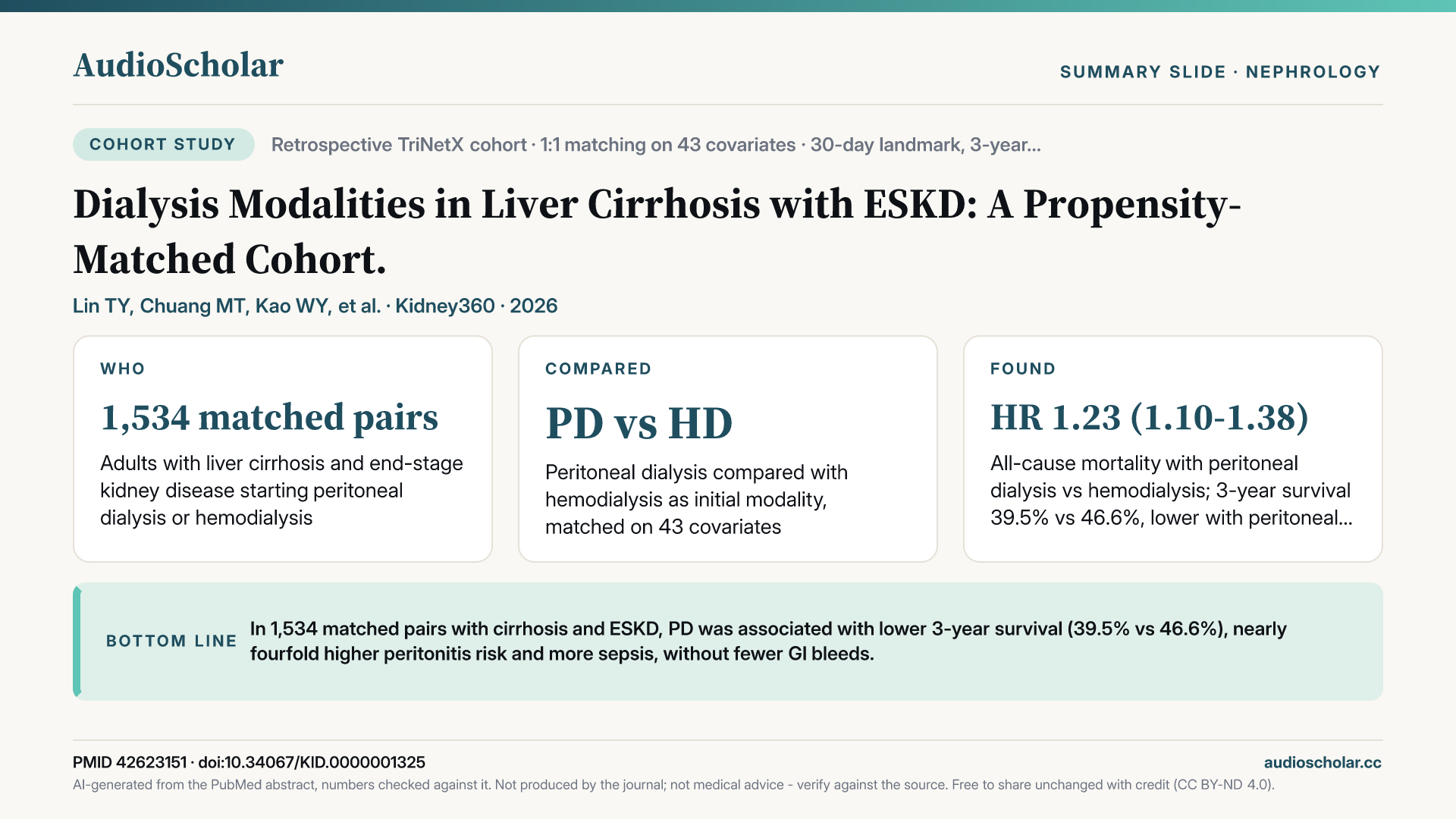
Dialysis Modalities in Liver Cirrhosis with ESKD: A Propensity-Matched Cohort.
In 1,534 matched pairs with cirrhosis and ESKD, PD was associated with lower 3-year survival (39.5% vs 46.6%), nearly fourfold higher peritonitis risk and more sepsis, without fewer GI bleeds.
Kidney360 · 2026 · PubMed

Papers in this briefing
- 01
Dialysis modality and survival in octogenarians: real-world population-based cohort study.
Among 4205 octogenarians, initial PD versus HD showed no adjusted five-year survival difference, but switching from PD to HD carried higher mortality (HR 1.46), supporting close monitoring of PD patients.
Clinical kidney journal · 2026
- 02
Dialysis Modalities in Liver Cirrhosis with ESKD: A Propensity-Matched Cohort.
In 1,534 matched pairs with cirrhosis and ESKD, PD was associated with lower 3-year survival (39.5% vs 46.6%), nearly fourfold higher peritonitis risk and more sepsis, without fewer GI bleeds.
Kidney360 · 2026
- 03
Incidence of peritoneal dialysis transfer to hemodialysis after the free-choice dialysis policy in Thailand; A tertiary center experience.
PD-to-HD transfer incidence rose from 4.31 to 10.89 per 100 person-years after the free-choice policy (IRR 2.52); peritonitis, not patient preference, was the leading cause.
Peritoneal Dialysis International · 2026
- 04
Roxadustat and incidence of peritoneal dialysis-associated peritonitis: a propensity score-matched cohort study.
Among 136 matched PD patients, roxadustat was associated with fewer peritonitis episodes than erythropoietin (0.131 vs 0.212 per patient-year; adjusted IRR 0.494), though prospective validation is needed.
Clinical and experimental nephrology · 2026
- 05
Clinical characteristics and influencing factors of roxadustat-induced central hypothyroidism in patients receiving peritoneal dialysis.
Central hypothyroidism developed in 15.8% of 76 PD patients on roxadustat, resolved after withdrawal, and was more likely with lower baseline albumin, supporting routine thyroid monitoring.
Peritoneal Dialysis International · 2026
- 06
One-Year Nutritional and Metabolic Changes in Patients on Incremental Peritoneal Dialysis Under Different Protein Diets: A Multicenter Pragmatic Cohort Study.
In 205 incremental PD patients, a protein diet of 0.6 g/kg/day or less gave similar albumin and BMI trajectories to higher protein, with lower urea, phosphate and potassium.
Nutrients · 2026
- 07
Peritoneal Dialysis in the Transplant Pathway: From Waitlist to Graft Failure.
PD offers continuous clearance, residual function preservation and lower cardiovascular impact as a bridge to transplant, but evidence is fragmented and perioperative catheter management lacks shared frameworks.
Kidney360 · 2026
- 08
Clinical association between fibroblast growth factor 23 (FGF23) levels and the severity of vascular calcification and cardiovascular event risk in peritoneal dialysis patients.
In 150 PD patients, higher FGF23 correlated with greater vascular calcification and independently predicted cardiovascular events (HR 1.74 per log unit), modestly improving risk discrimination.
Clinical nephrology · 2026
- 09
Association of Malnutrition, Inflammation, and Residual Kidney Clearance in Peritoneal Dialysis: A Cross-Sectional Analysis.
In 47 PD patients, higher residual kidney clearance was associated with lower malnutrition-inflammation scores and higher albumin, and IL-6 tracked with malnutrition, while erythropoietin resistance was unrelated.
International journal of nephrology · 2026
- 10
Regional Collaboration with Home Care Physicians is Associated with a Lower Proportion of In-hospital Deaths in Peritoneal Dialysis patients: A Single-center Retrospective Observational Study.
In-hospital deaths among PD patients fell from 73% to 46% after strengthening home-care physician collaboration, which was independently associated with out-of-hospital death (adjusted OR 24.5).
Internal medicine · 2026
The full briefing
This AudioScholar briefing is generated by artificial intelligence for healthcare professionals and trainees. It is not medical advice.
Welcome to your bi-weekly update in Peritoneal Dialysis. This period's papers ask who actually does well on peritoneal dialysis and what happens when the technique fails. A large cohort in cirrhosis challenges a long-held comfort with peritoneal dialysis in that group. Roxadustat turns up as both a possible peritonitis shield and a cause of central hypothyroidism. A cluster of studies ties nutrition, residual kidney function and phosphate biology to outcomes. And two papers follow the modality to its edges, toward transplantation and toward death at home.
The modality decision for high-risk patients is where this period's evidence pulls hardest in opposite directions, and three studies frame it.
Writing in the Clinical Kidney Journal, Toapanta and colleagues used the Catalan Renal Registry to ask whether initial modality matters for survival in patients over eighty [1]. They identified more than four thousand octogenarians who started dialysis over two decades, then propensity-matched about two hundred peritoneal dialysis starters to roughly three times as many haemodialysis controls. Five-year survival did not differ by starting modality. The striking signal came from switching. Patients who moved from peritoneal dialysis to haemodialysis carried close to a fifty percent higher risk of death, while patients who stayed on peritoneal dialysis did not differ from haemodialysis patients. The authors modelled switching as a time-varying exposure to avoid immortal-time bias, which is careful work. Still, this is observational, the peritoneal dialysis group was small and selected, and switching is almost certainly a marker of deterioration rather than a cause of it. The finding supports peritoneal dialysis as a reasonable option for selected very elderly patients. It also suggests that transfer to haemodialysis identifies a patient whose trajectory has changed.
Kidney360 published a much less reassuring picture in a narrower population. Lin and colleagues drew on the TriNetX electronic record network to compare peritoneal dialysis and haemodialysis in patients with cirrhosis and end-stage kidney disease [2]. They matched about fifteen hundred pairs on more than forty covariates and started follow-up at a thirty-day landmark. Peritoneal dialysis was associated with worse three-year survival, about forty percent against forty-seven percent. Peritonitis risk was nearly four times higher, sepsis was more common, hospital admissions were more frequent, and there was no offsetting reduction in serious gastrointestinal bleeding. Exploratory cardiovascular outcomes also leaned against peritoneal dialysis. The matching is extensive, but electronic record networks miss what drives modality choice in cirrhosis, such as ascites burden, liver disease severity scores and transplant candidacy. That residual confounding could easily favour haemodialysis.
So these two cohorts pull apart. One finds peritoneal dialysis survival-neutral in a frail population, and the other finds it harmful in a population often thought to suit it well. They are not strictly contradictory, because the populations differ, but they cannot both reflect a general truth about peritoneal dialysis in high-risk patients. What would settle it is a cirrhosis cohort with liver severity scores and ascites data. Ideally it would also use the same time-varying switching approach the Catalan group applied, which neither the cirrhosis study nor most prior work has done.
The Thai experience adds the system-level view. In Peritoneal Dialysis International, Sorajj and colleagues reviewed a single tertiary centre before and after Thailand moved from a peritoneal-dialysis-first policy to free choice of modality [3]. Transfers to haemodialysis roughly two-and-a-half-fold increased immediately after the change. The leading cause was peritonitis, and patient preference accounted for only about one in eight transfers. The before-and-after design cannot separate the policy from secular trends, the pandemic period, or shifts in staffing and case mix. Even so, the finding argues that technique survival depends on programme structure and infection control as much as on patient choice. Read alongside the Catalan data, a jump in transfers may carry mortality consequences.
Roxadustat has become a common anaemia agent in peritoneal dialysis units across Asia, and this period brings one signal of benefit and one of harm.
In Clinical and Experimental Nephrology, Yang, Zhao and Tang compared peritonitis rates in patients on roxadustat versus recombinant erythropoietin [4]. After matching, the study included sixty-eight patients per group followed for about two hundred and twenty-five patient-years. The roxadustat group had roughly half the adjusted rate of peritonitis. The authors propose that stabilising hypoxia-inducible factor modulates peritoneal immunity. With only forty-one episodes in total, matching on a handful of variables, and a decade-long enrolment window spanning changes in practice, this is hypothesis-generating. The authors themselves call for prospective validation.
Also in Peritoneal Dialysis International, Yang and colleagues at Peking University International Hospital examined seventy-six roxadustat-treated patients for central hypothyroidism [5]. They found it in about one in six patients, with low thyroid hormones and suppressed thyroid-stimulating hormone. Over half of the affected patients had mild symptoms, and thyroid function returned to baseline in every affected patient after the drug was stopped. Lower baseline albumin predicted the problem, with each gram per litre of albumin lowering the risk by roughly a sixth. The study is small and retrospective, from one centre. It nonetheless matches a known class effect and strengthens the case the authors make for thyroid monitoring before and during therapy.
Together, the two studies show that roxadustat's effects reach well beyond haemoglobin, in both directions. The safety signal is the firmer of the two, and the hypoalbuminaemic patients most prone to central hypothyroidism are often the same inflamed patients in whom peritonitis is a concern.
That link to albumin runs straight into the nutrition and residual function work.
In Nutrients, Borrelli and colleagues reported a one-year interim analysis of the multicentre Italian I-COPE cohort of incremental peritoneal dialysis [6]. They compared two hundred and five patients prescribed protein at or below 0.6 grams per kilogram per day against those prescribed more. Albumin followed the same course in both groups, an early dip and then a plateau. Body mass index and persistence on incremental therapy did not differ either. The lower-protein group had lower urea, phosphate and potassium. Diet was assigned by local protocol rather than randomised, adherence was prescribed rather than measured, and the follow-up is short. Within those limits, the study suggests a lower-protein diet in incremental peritoneal dialysis need not cost nutritional status.
A small cross-sectional study in the International Journal of Nephrology, from Jeerangsapasuk and colleagues, looked at forty-seven stable patients [7] [9]. Higher residual kidney clearance went with better malnutrition-inflammation scores and higher albumin. Interleukin-6 tracked with malnutrition, while erythropoietin resistance showed no relationship to any of these markers. With that sample size and design, causation runs in either direction. Still, the study reinforces residual function as part of the nutritional picture. That is precisely what incremental prescribing aims to preserve.
The phosphate thread continues in Clinical Nephrology, where Meiyang and colleagues followed one hundred and fifty patients at a single centre for a median of three years [8]. Higher circulating FGF23 was associated with more calcification across radiographic, coronary and aortic measures, and with more cardiovascular events. Each step up in log-transformed FGF23 carried about three quarters more hazard, and adding the marker modestly improved risk discrimination. The testing was clinician-initiated, so selection bias is a real concern despite the authors' attempts to address it. The link appears partly to run through calcification. The marker is promising for risk stratification, but prospective validation is still needed.
Finally, two papers place peritoneal dialysis within the longer arc of a patient's life.
In Kidney360, Alfieri and colleagues reviewed peritoneal dialysis as a bridge to transplantation [7]. They covered its theoretical advantages for residual function and cardiovascular stability, perioperative management, the unsettled question of when to remove the catheter after transplant, and return to peritoneal dialysis after graft failure. They are candid that the evidence is fragmented and that shared frameworks are lacking, so their suggestions rest on clinical experience.
In Internal Medicine, Oka and colleagues described a single Japanese centre that strengthened its collaboration with home care physicians [10]. In-hospital deaths among patients on peritoneal dialysis fell from nearly three quarters to under half. Collaboration was strongly associated with dying outside hospital, though the enormous effect estimate reflects only twenty-six deaths in the later period. A historical comparison cannot exclude other changes over time, but the study offers a concrete model for aligning place of death with patient preference.
If you read only one paper from this period, make it the Kidney360 cirrhosis cohort from Lin and colleagues. It directly reopens the assumption that peritoneal dialysis is a natural fit for patients with liver disease and ascites. The study is large enough that the question now demands better-designed answers.
Here is what this period adds up to. First, starting modality alone appears to matter less for survival in selected very elderly patients than what happens afterwards, and transfer to haemodialysis may be a meaningful warning sign, though that evidence is observational. Second, the case for peritoneal dialysis in cirrhosis is now genuinely contested, and only cohorts with liver severity data can resolve it. Third, roxadustat carries a reasonably consistent thyroid safety signal in peritoneal dialysis, while its apparent protection against peritonitis rests on one small study. Fourth, residual function, protein intake and phosphate biology are converging as linked levers in incremental care, with mostly early, non-randomised evidence. And watch the edges of the pathway, where catheter management after transplant and home-based end-of-life care remain largely guided by experience rather than trials.
That's your Peritoneal Dialysis update for this period. Until next time.
This is an automated summary generated by artificial intelligence, which can make mistakes. Always review the original source materials.
Spot something worth flagging?
Get this every week in your podcast app — free.
New research episodes land in your feed automatically — listen on your commute.