This Week in Neurosurgery — Oct 14, 2026
Generated Oct 15, 2026 · 10:51
The week's practice-changing Neurosurgery research, summarized for clinicians.
If the audio fails to play, refresh the page to renew the link.
Get next week’s Neurosurgery briefing — free.
In your podcast app, or readable in your inbox with the audio one tap away.
Ventriculolumbar Irrigation Effects on Delayed Cerebral Infarction and Outcome After Aneurysmal Subarachnoid Hemorrhage: A Prospective Registry Study.
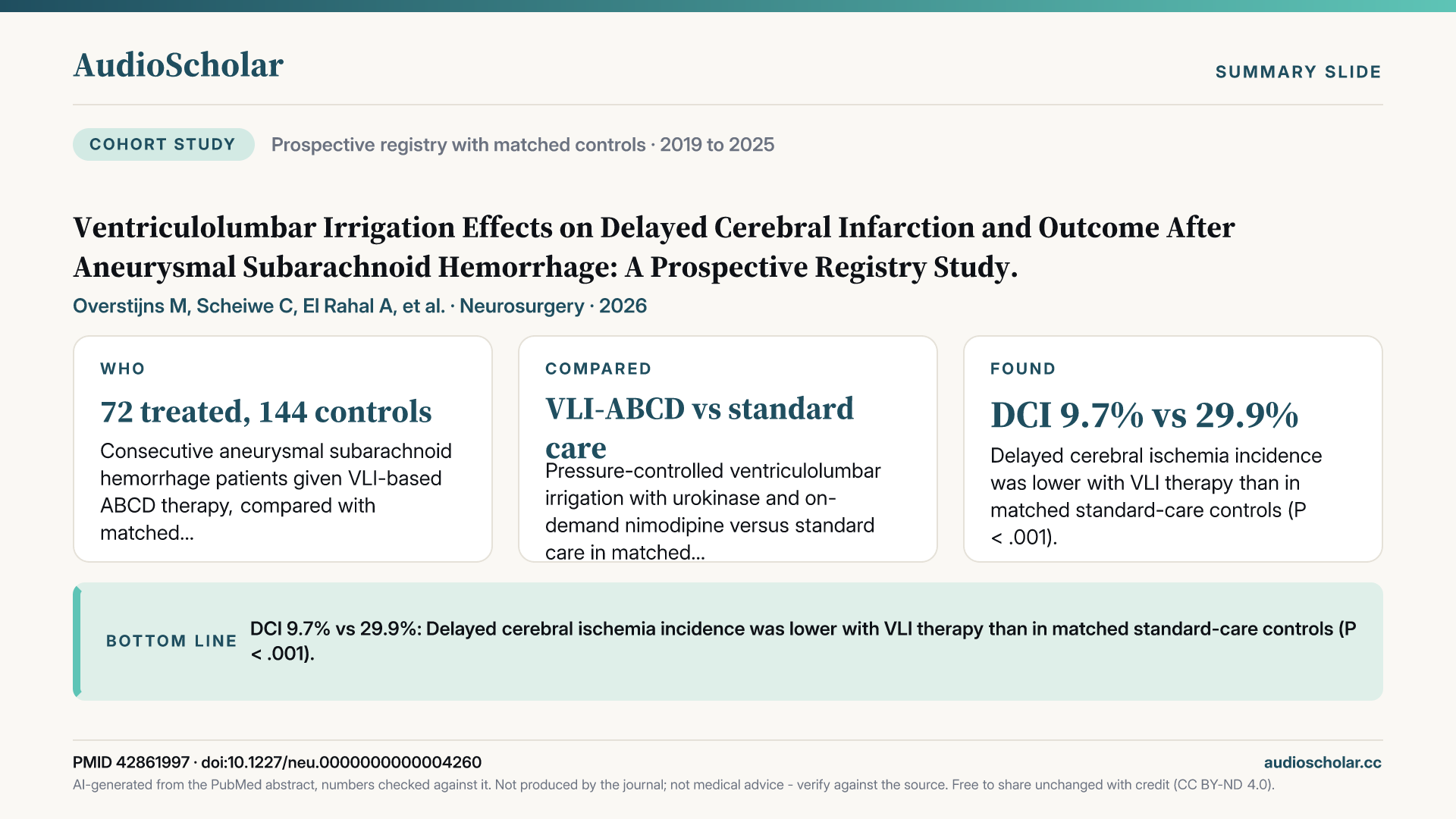
Bedside ventriculolumbar irrigation with urokinase and nimodipine was associated with delayed cerebral ischemia falling from about 30 to 10 percent after aneurysmal subarachnoid hemorrhage, pending randomized confirmation.
Neurosurgery · 2026 · PubMed

This week’s papers
- 01
Ventriculolumbar Irrigation Effects on Delayed Cerebral Infarction and Outcome After Aneurysmal Subarachnoid Hemorrhage: A Prospective Registry Study.
Bedside ventriculolumbar irrigation with urokinase and nimodipine was associated with delayed cerebral ischemia falling from about 30 to 10 percent after aneurysmal subarachnoid hemorrhage, pending randomized confirmation.
Overstijns M et al. · Neurosurgery · 2026
From the briefingWe start with two papers that ask whether actively treating blood in and around the brain changes outcomes. In Neurosurgery, Overstijns and colleagues report a prospective registry of ventriculolumbar irrigation after aneurysmal subarachnoid hemorrhage [1]. The technique is a simplified, bedside version of active blood clearance and vasodilation therapy: pressure-controlled irrigation from the ventricle to the lumbar space with urokinase, plus nimodipine delivered intrathecally on demand. Seventy-two treated patients were compared with 144 matched controls receiving standard care. Delayed cerebral ischemia occurred in about one in ten treated patients versus about three in ten controls, roughly a two-thirds reduction. Shunt-dependent hydrocephalus fell by a similar margin, and average modified Rankin scores at 180 days were about one point better. The advantage held when the comparison group was restricted to patients with passive drainage alone. These are large differences, but they come from a non-randomized registry with matched rather than randomized controls, so selection and era effects cannot be excluded, and the authors themselves say randomized trials are needed before this changes standard care.
If you only have time for one paper this week, make it the ventriculolumbar irrigation registry in Neurosurgery [1]. It reopens the question of whether actively clearing subarachnoid blood can prevent delayed cerebral ischemia, with a bedside technique simple enough that a randomized trial now looks both feasible and overdue.
Written by AI from the published abstract, for healthcare professionals. Not medical advice; check the paper before acting on it.
- 02
Charge Comparison of Standalone Middle Meningeal Artery Embolization to Non-surgical Medical Management for Chronic Subdural Hematoma - A Propensity Score Matched Analysis.
In 46 matched chronic subdural hematoma patients, standalone middle meningeal artery embolization raised six-month hospital charges but shortened stays and avoided rescue drainage, which five medically managed patients needed.
Shah ST et al. · World Neurosurgery · 2026
From the briefingTurning to chronic subdural hematoma, Shah and colleagues in World Neurosurgery examined the economics of standalone middle meningeal artery embolization against non-surgical medical management [2]. After propensity matching, 23 patients in each arm were compared. Embolization carried higher six-month hospital charges, about 24 thousand dollars more on average, driven mainly by the procedure itself. Yet embolized patients spent fewer days in hospital, three versus eight, and none needed rescue drainage, compared with five medically managed patients. The sample is small, some baseline imbalance persisted after matching, and charges are not true costs, so this is an early signal about value rather than a settled cost analysis.
Written by AI from the published abstract, for healthcare professionals. Not medical advice; check the paper before acting on it.
- 03
Safety and Efficacy of Repeat Surgery for Recurrent Craniopharyngiomas: A RAPID Consortium Collaboration.
Across 16 United States centers, repeat surgery for recurrent craniopharyngioma achieved resection, complication and endocrine outcomes comparable to primary surgery, though follow-up averaged only about 1.6 years.
Shih RM et al. · Neurosurgery · 2026
From the briefingIn Neurosurgery, Shih and colleagues used the RAPID consortium registry from 16 academic skull base centers in the United States to compare 483 operations, 123 of them for recurrent disease [3]. Despite prior treatment, and prior radiation in a third of the recurrent cases, repeat surgery achieved a similar split of gross and subtotal resection, similarly low complication and reoperation rates, and comparable long-term endocrine function. New vasopressin deficiency was actually more common after primary surgery. The caveat is follow-up averaging only about a year and a half, which is short for a tumor known to recur late.
Written by AI from the published abstract, for healthcare professionals. Not medical advice; check the paper before acting on it.
- 04
Neoadjuvant Treatment of BRAFV600E Papillary Craniopharyngiomas: A Case Series.
In five patients with BRAF V600E papillary craniopharyngioma, transventricular biopsy followed by BRAF/MEK inhibition shrank tumors by about 98 percent over roughly five years without new vasopressin deficiency.
Wang AJ et al. · Operative Neurosurgery · 2026
From the briefingSet against that, a small series in Operative Neurosurgery from Wang and colleagues describes a very different pathway for the papillary subtype carrying the BRAF V600E mutation [4]. Five patients with third ventricular tumors underwent endoscopic transventricular biopsy and then BRAF and MEK inhibition. Over about five years of follow-up, tumors shrank by roughly 98 percent on average, no patient developed vasopressin deficiency or endocrine decline, and two patients with baseline visual deficits improved; two patients also chose radiation after five cycles. Five patients cannot establish a standard, but the two papers together frame a live question: the registry supports repeat resection as safe, while the case series suggests that, for mutation-positive papillary tumors, biopsy and targeted therapy may avoid the open operation altogether.
Written by AI from the published abstract, for healthcare professionals. Not medical advice; check the paper before acting on it.
- 05
Comparative Outcomes of Stereotactic Radiosurgery and Surgical Resection for Radiation-Induced Meningiomas.
In a single-institution retrospective series, radiation-induced meningiomas had worse local control after surgery than sporadic meningiomas, and primary radiosurgery achieved better local control than resection.
Bales TR et al. · Neurosurgery · 2026
From the briefingRadiation-induced meningiomas were the focus of Bales and colleagues, also in Neurosurgery [5]. In a single-institution series of 47 patients with 73 tumors, compared against sporadic meningiomas, close to half of the radiation-induced patients had multiple tumors versus about one in six with sporadic disease. Surgically treated radiation-induced tumors had worse local control than surgically treated sporadic ones, and within the radiation-induced group, primary radiosurgery was associated with better local control than resection, an advantage that persisted at five and seven years even when the analysis was limited to gross totally resected tumors. This is retrospective and selection for radiosurgery likely favored smaller lesions despite size adjustment, but it supports the authors' view that these are biologically distinct tumors and strengthens the case for radiosurgery as a primary option.
Written by AI from the published abstract, for healthcare professionals. Not medical advice; check the paper before acting on it.
- 06
The Contemporary Association of Hospital volume with Outcomes of Surgery for Vestibular Schwannoma in the United States.
National data on nearly 20,000 vestibular schwannoma resections link hospitals performing at least ten cases yearly with lower odds of major adverse events, facial weakness and non-home discharge.
Ali K et al. · World Neurosurgery · 2026
From the briefingWhere tumor surgery is done also matters, according to Ali and colleagues in World Neurosurgery, who analyzed nearly 20,000 vestibular schwannoma resections in the Nationwide Readmissions Database [6]. Spline modeling put the high-volume threshold at ten cases a year, and about two thirds of patients were treated at such hospitals. After adjustment, high-volume care was associated with about a third lower odds of major adverse events, roughly 40 percent lower odds of facial droop and dysphagia, more than halved odds of non-home discharge, and stays about a day shorter. Administrative coding cannot capture tumor size or facial nerve grading, and patients at high-volume centers were younger and wealthier, so residual confounding is plausible, but the findings add to the argument for centralization.
Written by AI from the published abstract, for healthcare professionals. Not medical advice; check the paper before acting on it.
- 07
Risk stratification for unfavorable outcome after resection of selected brain metastases in patients with multiple brain metastases.
Among 132 patients with multiple brain metastases undergoing resection of selected lesions, 28 percent died within 90 days, with older age, frailty and lower Karnofsky score predicting worse outcomes.
Eibl T et al. · Journal of Neuro-Oncology · 2026
From the briefingFinally in oncology, Eibl and colleagues in the Journal of Neuro-Oncology looked at 132 patients with multiple brain metastases who underwent resection of selected lesions for symptoms or diagnosis [7]. Just over a quarter of patients died within 90 days. Older age, greater frailty on the five-item modified frailty index, lower Karnofsky score, and not receiving adjuvant treatment were associated with early death, while tumor volume and lesion number did not track with length of stay. The adjuvant finding likely partly reflects patients too unwell to continue treatment, but the frailty and performance data give a concrete framework for counseling in this group.
Written by AI from the published abstract, for healthcare professionals. Not medical advice; check the paper before acting on it.
- 08
Morphological subtypes of Chiari malformation type I and clinical outcomes after posterior fossa decompression.
Shape analysis of 186 adult Chiari I MRIs identified three cerebellar subtypes, and a midline compression subtype showed earlier and more frequent headache recurrence after posterior fossa decompression.
Nanda P et al. · Journal of Neurosurgery · 2026
From the briefingOur last theme covers structural disease and complications in spine and hindbrain surgery. In the Journal of Neurosurgery, Nanda and colleagues applied automated shape analysis to MRI scans from 186 adults with Chiari malformation type one [8]. Clustering identified three subtypes: one with posteroinferior cerebellar fullness and platybasia, one with midline front-to-back compression, and one defined mainly by tonsillar descent. Patients with the midline compression pattern had headaches return sooner and more often after posterior fossa decompression, with roughly a sixfold higher hazard, although that estimate is imprecise. The clusters were reproducible across random splits of the data, but external validation is still required before morphology could guide surgical selection.
Written by AI from the published abstract, for healthcare professionals. Not medical advice; check the paper before acting on it.
- 09
Long-term dysphagia after multilevel anterior decompressive surgery for cervical myelopathy: findings from the phase III CSM-Protect trial.
After multilevel anterior cervical surgery for myelopathy, dysphagia affected about two thirds of patients at five weeks and over a third at one year, predicted by C5 involvement and baseline symptoms.
Bak AB et al. · Journal of Neurosurgery: Spine · 2026
From the briefingIn the Journal of Neurosurgery: Spine, Bak and colleagues revisited the phase three CSM-Protect trial to describe dysphagia after mostly multilevel anterior surgery for degenerative cervical myelopathy [9]. Among 132 eligible patients, dysphagia peaked at five weeks, affecting about two thirds of patients, and still affected over a third of patients at one year, with about one in seven having moderate or severe symptoms. Surgery involving C5 and pre-existing dysphagia each raised the odds of persistent dysphagia roughly four- to fivefold, and a shorter duration of myelopathic symptoms was also a risk factor. This is a secondary analysis of a trial not designed for this question, but it offers realistic numbers for consent discussions.
Written by AI from the published abstract, for healthcare professionals. Not medical advice; check the paper before acting on it.
- 10
Durotomy Incidence in Degenerative Lumbar Spine Surgeries: A Systematic Review and Comparative Meta-Analysis of Proportions.
A meta-analysis of 39 studies and over 280,000 patients puts incidental durotomy in degenerative lumbar surgery near 5 percent, higher in revisions, with no meaningful open versus minimally invasive difference.
Gebeyehu TF et al. · Neurosurgery · 2026
From the briefingRounding out the spine papers, Gebeyehu and colleagues in Neurosurgery pooled 39 studies with over 280,000 patients undergoing degenerative lumbar surgery [10]. Incidental durotomy occurred in about 5 percent of cases, rising to roughly 9 percent in revisions, while open and minimally invasive or endoscopic approaches were essentially the same at around 6 to 7 percent. About one in ten durotomies led to a persistent cerebrospinal fluid leak. Heterogeneity across studies was extreme, so the pooled figure is a broad benchmark rather than a precise rate, but it challenges the assumption that minimally invasive techniques meaningfully lower durotomy risk.
Written by AI from the published abstract, for healthcare professionals. Not medical advice; check the paper before acting on it.
The full briefing
This AudioScholar briefing is generated by artificial intelligence for healthcare professionals and trainees. It is not medical advice.
Welcome to This Week in Neurosurgery. This week we're covering 10 notable papers spanning cerebrospinal fluid and hemorrhage management, the evolving balance between surgery, radiosurgery and targeted therapy for skull base and intracranial tumors, and the complications and phenotypes that shape spine and hindbrain surgery. Let's dive in.
We start with two papers that ask whether actively treating blood in and around the brain changes outcomes. In Neurosurgery, Overstijns and colleagues report a prospective registry of ventriculolumbar irrigation after aneurysmal subarachnoid hemorrhage [1]. The technique is a simplified, bedside version of active blood clearance and vasodilation therapy: pressure-controlled irrigation from the ventricle to the lumbar space with urokinase, plus nimodipine delivered intrathecally on demand. Seventy-two treated patients were compared with 144 matched controls receiving standard care. Delayed cerebral ischemia occurred in about one in ten treated patients versus about three in ten controls, roughly a two-thirds reduction. Shunt-dependent hydrocephalus fell by a similar margin, and average modified Rankin scores at 180 days were about one point better. The advantage held when the comparison group was restricted to patients with passive drainage alone. These are large differences, but they come from a non-randomized registry with matched rather than randomized controls, so selection and era effects cannot be excluded, and the authors themselves say randomized trials are needed before this changes standard care. Turning to chronic subdural hematoma, Shah and colleagues in World Neurosurgery examined the economics of standalone middle meningeal artery embolization against non-surgical medical management [2]. After propensity matching, 23 patients in each arm were compared. Embolization carried higher six-month hospital charges, about 24 thousand dollars more on average, driven mainly by the procedure itself. Yet embolized patients spent fewer days in hospital, three versus eight, and none needed rescue drainage, compared with five medically managed patients. The sample is small, some baseline imbalance persisted after matching, and charges are not true costs, so this is an early signal about value rather than a settled cost analysis.
Our largest theme this week is how surgery fits alongside other options for intracranial and skull base tumors, and craniopharyngioma offers a striking pair of papers. In Neurosurgery, Shih and colleagues used the RAPID consortium registry from 16 academic skull base centers in the United States to compare 483 operations, 123 of them for recurrent disease [3]. Despite prior treatment, and prior radiation in a third of the recurrent cases, repeat surgery achieved a similar split of gross and subtotal resection, similarly low complication and reoperation rates, and comparable long-term endocrine function. New vasopressin deficiency was actually more common after primary surgery. The caveat is follow-up averaging only about a year and a half, which is short for a tumor known to recur late. Set against that, a small series in Operative Neurosurgery from Wang and colleagues describes a very different pathway for the papillary subtype carrying the BRAF V600E mutation [4]. Five patients with third ventricular tumors underwent endoscopic transventricular biopsy and then BRAF and MEK inhibition. Over about five years of follow-up, tumors shrank by roughly 98 percent on average, no patient developed vasopressin deficiency or endocrine decline, and two patients with baseline visual deficits improved; two patients also chose radiation after five cycles. Five patients cannot establish a standard, but the two papers together frame a live question: the registry supports repeat resection as safe, while the case series suggests that, for mutation-positive papillary tumors, biopsy and targeted therapy may avoid the open operation altogether. Radiation-induced meningiomas were the focus of Bales and colleagues, also in Neurosurgery [5]. In a single-institution series of 47 patients with 73 tumors, compared against sporadic meningiomas, close to half of the radiation-induced patients had multiple tumors versus about one in six with sporadic disease. Surgically treated radiation-induced tumors had worse local control than surgically treated sporadic ones, and within the radiation-induced group, primary radiosurgery was associated with better local control than resection, an advantage that persisted at five and seven years even when the analysis was limited to gross totally resected tumors. This is retrospective and selection for radiosurgery likely favored smaller lesions despite size adjustment, but it supports the authors' view that these are biologically distinct tumors and strengthens the case for radiosurgery as a primary option. Where tumor surgery is done also matters, according to Ali and colleagues in World Neurosurgery, who analyzed nearly 20,000 vestibular schwannoma resections in the Nationwide Readmissions Database [6]. Spline modeling put the high-volume threshold at ten cases a year, and about two thirds of patients were treated at such hospitals. After adjustment, high-volume care was associated with about a third lower odds of major adverse events, roughly 40 percent lower odds of facial droop and dysphagia, more than halved odds of non-home discharge, and stays about a day shorter. Administrative coding cannot capture tumor size or facial nerve grading, and patients at high-volume centers were younger and wealthier, so residual confounding is plausible, but the findings add to the argument for centralization. Finally in oncology, Eibl and colleagues in the Journal of Neuro-Oncology looked at 132 patients with multiple brain metastases who underwent resection of selected lesions for symptoms or diagnosis [7]. Just over a quarter of patients died within 90 days. Older age, greater frailty on the five-item modified frailty index, lower Karnofsky score, and not receiving adjuvant treatment were associated with early death, while tumor volume and lesion number did not track with length of stay. The adjuvant finding likely partly reflects patients too unwell to continue treatment, but the frailty and performance data give a concrete framework for counseling in this group.
Our last theme covers structural disease and complications in spine and hindbrain surgery. In the Journal of Neurosurgery, Nanda and colleagues applied automated shape analysis to MRI scans from 186 adults with Chiari malformation type one [8]. Clustering identified three subtypes: one with posteroinferior cerebellar fullness and platybasia, one with midline front-to-back compression, and one defined mainly by tonsillar descent. Patients with the midline compression pattern had headaches return sooner and more often after posterior fossa decompression, with roughly a sixfold higher hazard, although that estimate is imprecise. The clusters were reproducible across random splits of the data, but external validation is still required before morphology could guide surgical selection. In the Journal of Neurosurgery: Spine, Bak and colleagues revisited the phase three CSM-Protect trial to describe dysphagia after mostly multilevel anterior surgery for degenerative cervical myelopathy [9]. Among 132 eligible patients, dysphagia peaked at five weeks, affecting about two thirds of patients, and still affected over a third of patients at one year, with about one in seven having moderate or severe symptoms. Surgery involving C5 and pre-existing dysphagia each raised the odds of persistent dysphagia roughly four- to fivefold, and a shorter duration of myelopathic symptoms was also a risk factor. This is a secondary analysis of a trial not designed for this question, but it offers realistic numbers for consent discussions. Rounding out the spine papers, Gebeyehu and colleagues in Neurosurgery pooled 39 studies with over 280,000 patients undergoing degenerative lumbar surgery [10]. Incidental durotomy occurred in about 5 percent of cases, rising to roughly 9 percent in revisions, while open and minimally invasive or endoscopic approaches were essentially the same at around 6 to 7 percent. About one in ten durotomies led to a persistent cerebrospinal fluid leak. Heterogeneity across studies was extreme, so the pooled figure is a broad benchmark rather than a precise rate, but it challenges the assumption that minimally invasive techniques meaningfully lower durotomy risk.
If you only have time for one paper this week, make it the ventriculolumbar irrigation registry in Neurosurgery [1]. It reopens the question of whether actively clearing subarachnoid blood can prevent delayed cerebral ischemia, with a bedside technique simple enough that a randomized trial now looks both feasible and overdue.
Here is what this week's evidence adds up to in Neurosurgery. First, active intrathecal blood clearance after aneurysmal subarachnoid hemorrhage was associated with substantially less delayed ischemia and shunt dependence, but the evidence is registry-level and awaits randomized confirmation. Second, craniopharyngioma management is diversifying: multicenter data support the safety of repeat resection, while a five-patient series suggests targeted therapy can durably control BRAF-mutant papillary tumors, and how these pathways compare head to head is unsettled. Third, radiation-induced meningiomas appear biologically more aggressive, and single-center data favor radiosurgery for local control. Fourth, outcome data keep pointing toward volume and patient fitness, from vestibular schwannoma centers to frailty in multiple brain metastases, though both studies are observational. Fifth, complication benchmarks were updated: dysphagia persists in over a third of patients a year after multilevel anterior cervical surgery, and lumbar durotomy runs near 5 percent regardless of open or minimally invasive approach.
That's your roundup for This Week in Neurosurgery. The full transcript and references are available on the episode page. This is an AI-curated summary — for clinical decisions, always consult primary sources and current guidelines. See you next week.
If this weekly briefing is useful, follow the show in your podcast app so new episodes arrive automatically. And a quick rating on Apple Podcasts or Spotify helps other physicians discover the show.
This is an automated summary generated by artificial intelligence, which can make mistakes. Always review the original source materials.
Spot something worth flagging?
Get this every week in your podcast app — free.
New neurosurgery episodes land in your feed automatically — listen on your commute.