This Week in Nephrology — Jul 15, 2026
Generated Jul 15, 2026 · 14:41
The week's practice-changing Nephrology research, summarized for clinicians.
If the audio fails to play, refresh the page to renew the link.
Get next week’s Nephrology briefing — free.
In your podcast app, or readable in your inbox with the audio one tap away.
Remote Patient Monitoring Automated Peritoneal Dialysis and Clinical Outcomes: A Nationwide Real-World Cohort Study from Taiwan
Clinical Journal of the American Society of Nephrology · 2026 · PubMed

This week’s papers
- 01
Remote Patient Monitoring Automated Peritoneal Dialysis and Clinical Outcomes: A Nationwide Real-World Cohort Study from Taiwan
Chung MC et al. · Clinical Journal of the American Society of Nephrology · 2026
- 02
PREDICT Tool for Pregnancy-Associated CKD Progression
Ralston E et al. · Kidney International Reports · 2026
- 03
Anti-CD20 Therapies and Antinephrin Autoantibodies in IgA Nephropathy With Minimal Change Disease
Liang Y et al. · Kidney International Reports · 2026
- 04
Kidney Survival in Children With Steroid-Resistant Nephrotic Syndrome Treated by Rituximab
Chan EY et al. · Kidney International Reports · 2026
- 05
An Interactive Virtual Nephrologist to Engage Patients With Advanced CKD About Transplantation
Reese PP et al. · American Journal of Kidney Diseases · 2026
- 06
Characterization of Patient-Reported Loin Pain in IgAN
Newman KL et al. · Kidney International Reports · 2026
- 07
Viewpoint on donor-derived cell-free DNA: context of use and clinical utility are key
Budde K et al. · American Journal of Transplantation · 2026
- 08
The kidney distal tubule potassium switch, modern diet and hypertension
Welling PA et al. · Nature Reviews Nephrology · 2026
The full briefing
Welcome to This Week in Nephrology. This week we are covering eight notable papers spanning three broad themes: advancements in glomerular disease management and symptom characterization, digital health innovations that reshape home dialysis and transplant education, and clinical tools for risk prediction in pregnancy and hypertension. Let us dive in.
We begin with glomerular diseases, where a pair of new studies in Kidney International Reports sheds light on patient-reported symptoms and targeted therapies. First, we look at a symptom that is frequently reported by patients but often overlooked by clinicians: loin pain in IgA nephropathy. Researchers in the United Kingdom conducted a mixed-methods study in collaboration with the National Registry of Rare Kidney Diseases, surveying three hundred and fifty-eight patients with biopsy-proven IgA nephropathy and interviewing twenty-one of them [6]. They found that loin pain is highly prevalent, affecting nearly seventy-one percent of those surveyed. The pain was predominantly described as an intermittent aching sensation that remained consistent in character but distinct from other types of pain. Crucially, the presence of loin pain was independent of the patient's chronic kidney disease stage, meaning that even patients with early-stage disease and preserved kidney function suffered significantly. This pain was also associated with broader systemic symptoms, poorer self-reported mental health, and lower self-efficacy. Many patients expressed frustration, noting that healthcare professionals provided very little support or guidance to manage this debilitating symptom. This study highlights a critical need for clinicians to actively inquire about loin pain and develop targeted supportive care strategies rather than dismissing it as clinically insignificant.
For patients who present with an overlap of IgA nephropathy and minimal change disease, therapeutic strategies have remained poorly defined. A retrospective study also published in Kidney International Reports evaluated forty-five adult patients with this specific overlap syndrome, comparing the efficacy of anti-CD20 monoclonal antibodies, such as rituximab, against standard full-dose prolonged steroids [3]. The researchers found that while total remission rates of nephrotic syndrome were comparable between the two groups, the anti-CD20 group achieved a significantly longer recurrence-free period. The median relapse-free interval was extended from seventeen point one months in the steroid group to thirty point four months in the anti-CD20 group. Furthermore, patients receiving B-cell depleting therapy experienced significantly fewer total adverse events and lower rates of rehospitalization. The study also evaluated the prevalence of circulating antinephrin autoantibodies, detecting them in thirty-one percent of patients with minimal change disease-IgA nephropathy, which is comparable to the rate seen in classic minimal change disease. Patients with high antinephrin antibody levels, defined as greater than one hundred and fifty nanograms per milliliter, had an almost four-fold increased risk of recurrence and a significantly shorter relapse-free interval of fourteen months compared to over forty-eight months in those with lower levels. Because antibody levels closely tracked disease activity, sequential testing of antinephrin antibodies could serve as a valuable biomarker to guide treatment decisions and monitor for impending relapses.
The clinical utility of B-cell depletion is further explored in pediatric populations. An international retrospective cohort study published in Kidney International Reports evaluated long-term kidney survival in one hundred and fifty-one children with steroid-resistant nephrotic syndrome who had failed calcineurin inhibitors and subsequently received rituximab [4]. The cohort had a median age of six point eight years, and sixty-two percent had focal segmental glomerulosclerosis on biopsy. Over a follow-up period of three to seven years, the overall kidney survival rates were eighty-three percent at three years, seventy-six percent at five years, and seventy-two percent at seven years post-rituximab. However, the patient's baseline kidney function prior to receiving rituximab was a powerful predictor of long-term survival. For children with stage one chronic kidney disease, the five-year kidney survival rate was nearly ninety-two percent, but this dropped to seventy percent for those with stage two disease, and to just thirty-six percent for those with stage three disease. Other key predictors of inferior kidney survival included lower baseline serum albumin, a biopsy showing focal segmental glomerulosclerosis, and a lack of remission at six months. In fact, children who did not achieve complete or partial remission by six months had a fourteen-fold increased risk of progression, whereas those who did achieve remission had a one hundred percent kidney survival rate at five years. These findings strongly suggest that rituximab should not be reserved as a late rescue therapy; rather, it should be initiated early in the disease course before irreversible chronic kidney damage occurs.
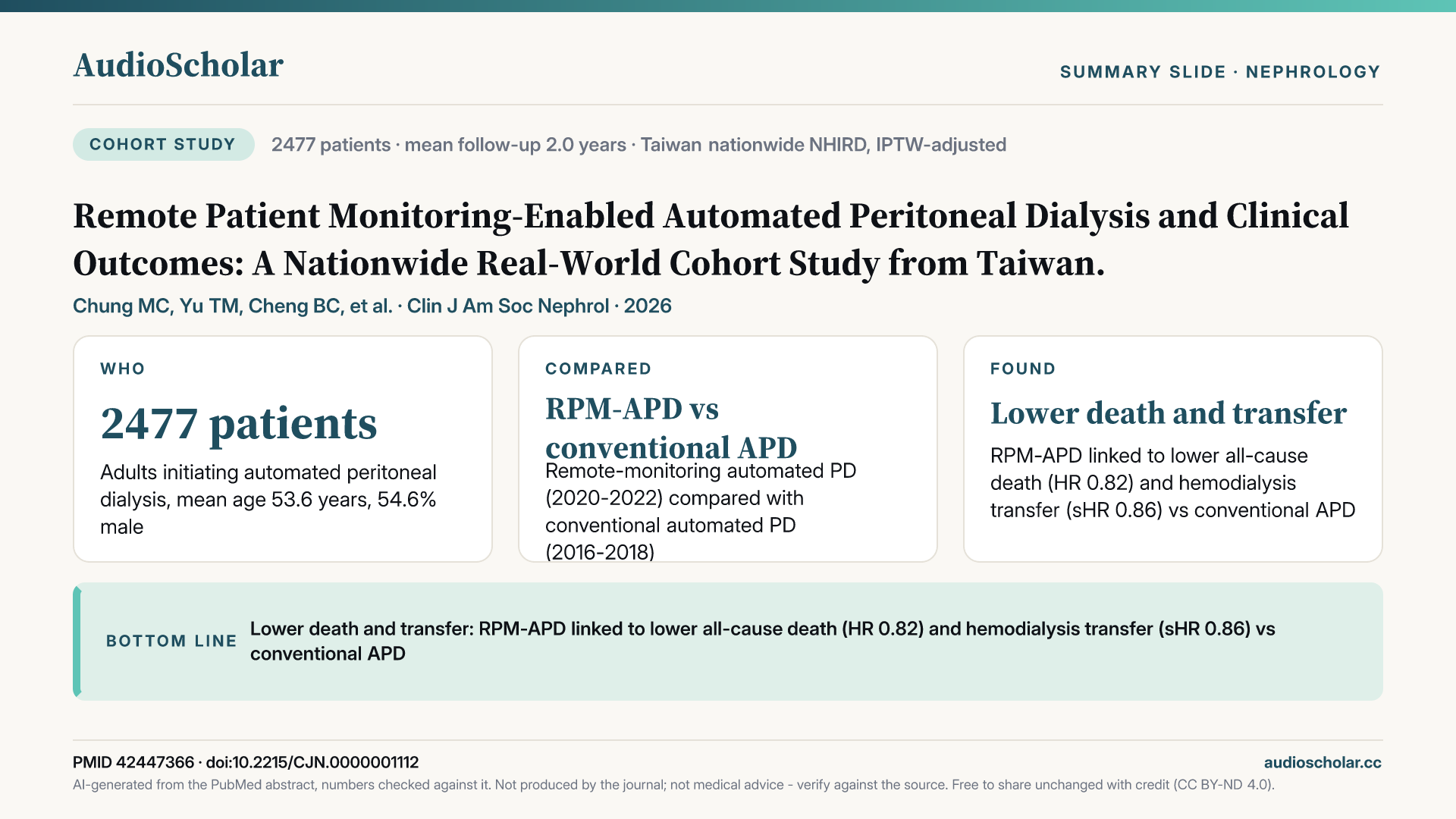
We transition now to digital health and care delivery, starting with home-based dialysis. In the Clinical Journal of the American Society of Nephrology, researchers published a nationwide, real-world cohort study from Taiwan evaluating the impact of remote patient monitoring in automated peritoneal dialysis [1]. Using the National Health Insurance Research Database, they compared over twelve hundred patients initiating remote monitoring-enabled automated peritoneal dialysis between 2020 and 2022 against a balanced cohort of twelve hundred patients who initiated conventional automated peritoneal dialysis between 2016 and 2018. After balancing baseline covariates using inverse probability of treatment weighting, the remote patient monitoring group demonstrated an eighteen percent lower risk of all-cause mortality and a fourteen percent lower risk of transferring to permanent hemodialysis. While the risks of peritonitis and major adverse cardiac events were similar between the two groups, patients using remote monitoring experienced significantly fewer annual hospitalizations, averaging one point six hospitalizations per year compared to over two hospitalizations per year in the conventional group. These findings suggest that real-time access to automated peritoneal dialysis treatment data allows clinical teams to identify and address issues early, keeping home dialysis patients safer, preventing technique failure, and reducing the burden on inpatient healthcare resources.
Innovative digital tools are also showing promise in patient education and engagement. A single-arm, open-label trial published in the American Journal of Kidney Diseases evaluated an interactive, video-based virtual transplant nephrologist designed to educate patients with advanced chronic kidney disease about kidney transplantation [5]. Many patients with advanced disease do not receive sufficient information or harbor unaddressed concerns about transplantation, which can limit their access to this life-saving therapy. The study enrolled adults with an estimated glomerular filtration rate of less than twenty-five milliliters per minute. Participants accessed the platform via a smartphone, first selecting the demographic profile of their virtual clinician. Interestingly, female and Black participants demonstrated strong preferences to select a gender- or race-concordant virtual nephrologist. Patients spent a median of twelve point six minutes reviewing personalized educational topics. The primary outcome, which was the participant's intention to speak with their human doctor about kidney transplantation, increased significantly after the virtual encounter. While the long-term clinical impact of this increased intention remains to be validated in randomized controlled trials, this highly customizable digital tool represents a scalable and culturally sensitive approach to overcoming educational barriers and promoting equitable access to transplantation.
As digital tools change how we engage patients, advanced biomarkers are changing how we monitor transplant recipients, though their implementation requires careful clinical reasoning. In a viewpoint article published in the American Journal of Transplantation, authors discuss the ongoing debate surrounding donor-derived cell-free DNA in kidney transplantation [7]. They argue that the transplant community needs to shift its focus from basic diagnostic metrics, such as sensitivity and specificity, toward clinical utility within well-defined contexts of use. Given that published data shows a moderate specificity of approximately eighty percent for donor-derived cell-free DNA, the authors emphasize that predictive values and likelihood ratios are far more conclusive measures for clinical medicine because they incorporate disease prevalence and sensitivity. To guide clinicians effectively, the authors call for rigorous cost-benefit assessments across different prevalence scenarios and graft pathologies. They advocate for future interventional studies with clear clinical outcome endpoints to clarify the true potential of this biomarker within routine clinical decision-making frameworks.
Next, we explore risk prediction in pregnancy. Prepregnancy counseling is highly recommended for women with chronic kidney disease, but until now, clinicians have lacked validated tools to estimate individualized risk. A study in Kidney International Reports details the development and external validation of the PREDICT tool, designed to estimate postpartum kidney progression and neonatal outcomes [2]. The development cohort included seven hundred and forty-six women with a prepregnancy estimated glomerular filtration rate of less than ninety milliliters per minute, and the models were validated in two large external cohorts totaling over seven thousand patients. The primary outcome was a twenty-five percent or greater reduction in estimated glomerular filtration rate or the initiation of kidney replacement therapy within twelve months postpartum. The secondary outcome was a composite of a small-for-gestational-age infant or preterm delivery before thirty-four weeks. The PREDICT model demonstrated high sensitivity and negative predictive value. For example, using a risk cut-point of fifteen percent for the primary kidney outcome yielded a ninety percent sensitivity and an eighty-five percent negative predictive value. Notably, the model's one-year risk predictions were significantly higher and more reflective of clinical reality than those generated by the standard two-year Kidney Failure Risk Equation. This tool provides a reliable, individualized risk assessment that can help patients and clinicians make highly informed, personalized decisions.
Finally, we review the physiological underpinnings of hypertension. A comprehensive review published in Nature Reviews Nephrology discusses the potassium switch signaling mechanism in the kidney's distal convoluted tubule and its role in modern salt-sensitive hypertension [8]. The potassium switch comprises a Kir4.1 and Kir5.1 potassium-sensing channel, a WNK kinase-induced phosphorylation cascade, and the thiazide-diuretic-targeted sodium chloride co-transporter. This physiological system is evolutionary optimized for the low-salt, high-potassium hunter-gatherer diet. However, the modern diet is high in sodium and low in potassium. When dietary potassium consumption is low, the potassium switch is activated to conserve potassium. Unfortunately, this potassium conservation comes at the expense of increasing sodium reabsorption in the distal nephron, which directly drives and exacerbates salt-sensitive hypertension and its associated cardiovascular complications. This review underscores that low dietary potassium consumption plays an equally important role in hypertension as high dietary sodium, highlighting the vital clinical importance of dietary potassium interventions in managing hypertensive patients.
If you only have time for one paper this week, make it the nationwide cohort study on remote patient monitoring for automated peritoneal dialysis from the Clinical Journal of the American Society of Nephrology [1]. This study provides robust, real-world evidence that remote monitoring is associated with a lower risk of death, fewer hospitalizations, and reduced transfers to hemodialysis. For practicing nephrologists, this is a highly practice-changing publication that supports the routine integration of remote monitoring technology to improve the safety and technique survival of home peritoneal dialysis.
Here are the key takeaways from this week in Nephrology. First, remote patient monitoring in automated peritoneal dialysis is associated with improved patient survival, fewer annual hospitalizations, and a lower risk of transfer to hemodialysis, supporting its adoption in contemporary home dialysis care [1]. Second, in children with steroid-resistant nephrotic syndrome, rituximab is associated with a seventy to eighty percent kidney survival rate over three to seven years, but its efficacy is highly dependent on early initiation before the development of advanced chronic kidney disease or focal segmental glomerulosclerosis [4]. Third, the newly validated PREDICT tool offers highly sensitive, individualized risk assessment for pregnant women with chronic kidney disease, providing a valuable resource for prepregnancy counseling and postpartum monitoring [2]. Fourth, loin pain is highly prevalent in patients with IgA nephropathy, occurring independently of chronic kidney disease stage, and requires active clinical recognition and supportive management to address its negative psychosocial impact [6]. Finally, the distal tubule potassium switch explains how low dietary potassium drives sodium retention, emphasizing that addressing low potassium intake is just as critical as restricting sodium in patients with salt-sensitive hypertension [8].
That's your roundup for This Week in Nephrology. The full transcript and references are available on the episode page in your AudioScholar library. This is an AI-curated summary — for clinical decisions, always consult primary sources and current guidelines. See you next week.
If this weekly briefing is useful, follow the show in your podcast app so new episodes arrive automatically. And for audio briefings on your own clinical questions and papers, visit audioscholar dot C C.
This is an automated summary generated by artificial intelligence, which can make mistakes. Always review the original source materials.
Spot something worth flagging?
Get this every week in your podcast app — free.
New nephrology episodes land in your feed automatically — listen on your commute.