This Week in Family Medicine — Oct 11, 2026
Generated Oct 12, 2026 · 11:21
The week's practice-changing Family Medicine research, summarized for clinicians.
If the audio fails to play, refresh the page to renew the link.
Get next week’s Family Medicine briefing — free.
In your podcast app, or readable in your inbox with the audio one tap away.
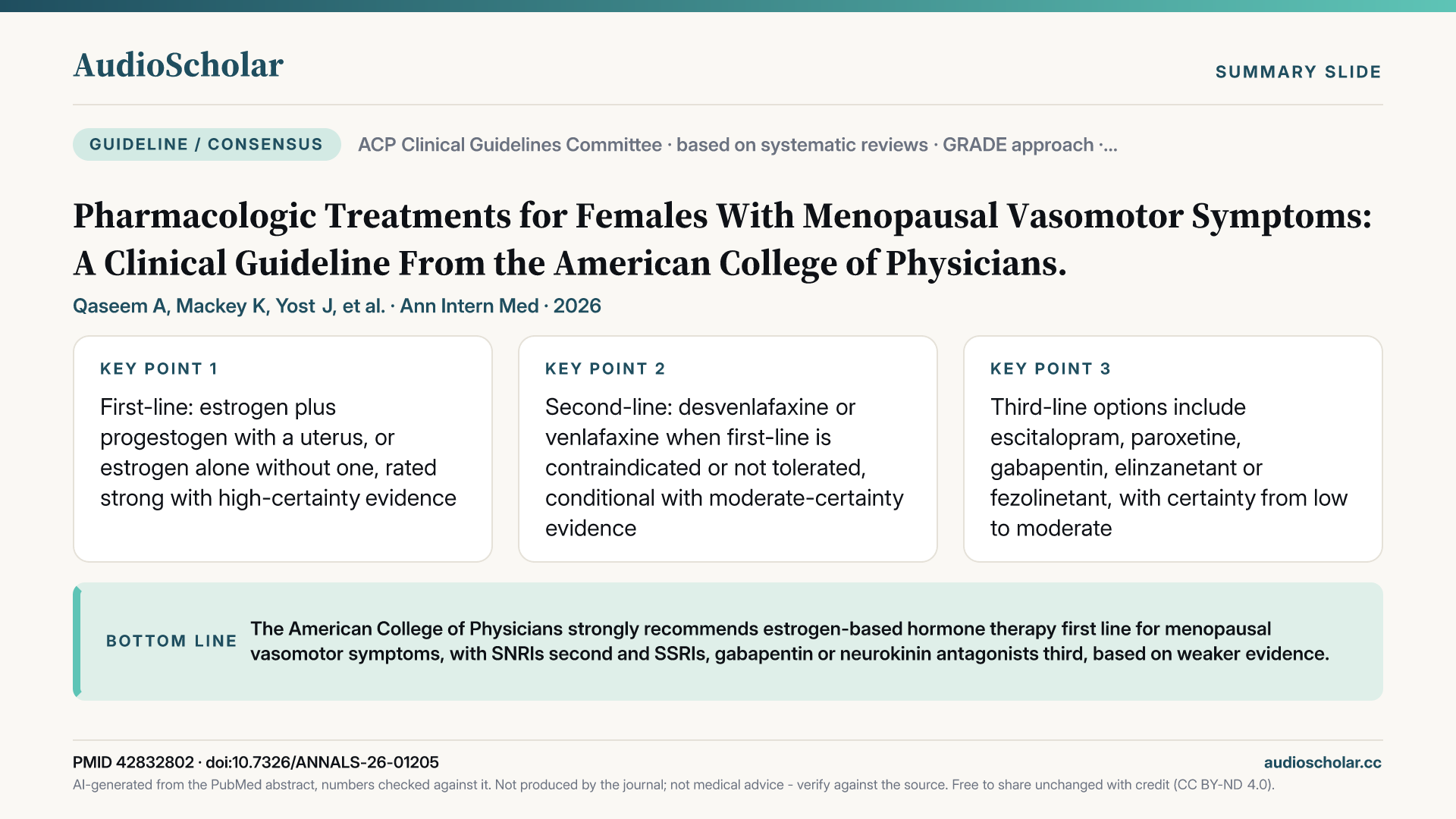
Pharmacologic Treatments for Females With Menopausal Vasomotor Symptoms: A Clinical Guideline From the American College of Physicians.
The American College of Physicians strongly recommends estrogen-based hormone therapy first line for menopausal vasomotor symptoms, with SNRIs second and SSRIs, gabapentin or neurokinin antagonists third, based on weaker evidence.
Annals of Internal Medicine · 2026 · PubMed

This week’s papers
- 01
Smoking Cessation Among Underserved Patients Referred for Lung Cancer Screening: A Randomized Clinical Trial.
Among underserved smokers referred for lung cancer screening, contingent financial incentives roughly doubled six-month confirmed abstinence, while adding free cessation pharmacotherapy alone was not superior to ask-advise-refer.
Hart JL et al. · JAMA · 2026
- 02
Evaluation of Intervention Strategies to Improve Follow-Up Colonoscopy After Abnormal FIT/FOBT Result: A Systematic Review and Meta-Analysis.
Patient navigation, patient reminders and clinician reminders were associated with higher colonoscopy completion after abnormal stool tests, rising from about 48 to 69 percent, while automated referral evidence was inconsistent.
Chua WY et al. · JAMA Internal Medicine · 2026
- 03
Reclassification of office blood pressure categories according to the 2024 European Society of Cardiology guidelines and its implications for clinical practice in primary care: a cross-sectional study.
Applying 2024 European cardiology blood pressure categories in a Turkish primary care population labelled over half as elevated and cut treated patients at target from about 54 to 31 percent.
Çifçi İ, Koç EM · BMC Primary Care · 2026
- 04
Advance Care Planning for Black and White Older Adults With Serious Illness: The EQUAL ACP Randomized Trial.
Facilitated and self-guided advance care planning produced no significant difference in one-year completion within Black or White seriously ill older adults, though facilitation appeared relatively more effective for Black participants.
Johnson KS et al. · JAMA · 2026
- 05
Pharmacologic Treatments for Females With Menopausal Vasomotor Symptoms: A Clinical Guideline From the American College of Physicians.
The American College of Physicians strongly recommends estrogen-based hormone therapy first line for menopausal vasomotor symptoms, with SNRIs second and SSRIs, gabapentin or neurokinin antagonists third, based on weaker evidence.
Qaseem A et al. · Annals of Internal Medicine · 2026
- 06
Oral small-molecule GLP-1RA safiglipron versus dapagliflozin in type 2 diabetes: a randomized, double-blind, active-comparator-controlled phase 3 trial.
Oral safiglipron was non-inferior to dapagliflozin for HbA1c lowering in metformin-treated type 2 diabetes, with the 90 mg dose superior, but caused more gastrointestinal adverse events.
Guo L et al. · Nature Medicine · 2026
- 07
Temporary Cessation of DMARD Therapy and COVID-19 Supplemental Dose Vaccine Immunogenicity in Patients With Inflammatory Arthritis: The COVER Randomized Clinical Trial.
Holding biologic or JAK inhibitor therapy for two weeks after a COVID-19 booster did not improve antibody response in inflammatory arthritis but roughly doubled the odds of transient disease flare.
Curtis JR et al. · JAMA Internal Medicine · 2026
- 08
Effect of Fluvoxamine and Metformin for Fatigue in Patients With Long COVID : An Adaptive Randomized Trial.
Fluvoxamine modestly improved long COVID fatigue and quality of life versus placebo over 90 days with fewer adverse events, while metformin results were inconclusive after dose reduction and futility stopping.
Reis G et al. · Annals of Internal Medicine · 2026
- 09
Strengthening health systems to prioritise, provide care, and prevent osteoarthritis: a roadmap for global health policy.
A global policy roadmap argues osteoarthritis, expected to affect nearly a billion people by 2050, needs surveillance, integration into primary and chronic care, and prevention targeting weight and joint injury.
Briggs AM et al. · The Lancet · 2026
- 10
Migraine.
A seminar describes migraine as a chronic neurovascular disorder whose genetic and network-level mechanisms have driven mechanism-based therapies that are substantially improving patient outcomes and clinical practice.
Tassorelli C et al. · The Lancet · 2026
The full briefing
This AudioScholar briefing is generated by artificial intelligence for healthcare professionals and trainees. It is not medical advice.
Welcome to This Week in Family Medicine. This week we're covering 10 notable papers spanning the gap between screening and follow-through, the evidence behind common prescribing decisions, and big-picture frameworks for chronic conditions we manage every day. Let's dive in.
Our first theme is what happens after we identify a risk, because several papers this week ask whether patients actually get from a positive screen or a conversation to a completed action. In JAMA, Hart and colleagues randomized more than three thousand currently smoking adults referred for lung cancer screening at health systems in the United States, all of them Black, Hispanic, rural, or of low socioeconomic status [1]. Usual care was the familiar ask, advise, and refer approach. Adding free nicotine replacement and reimbursement for varenicline or bupropion did not improve biochemically confirmed six month abstinence over usual care alone. What did move the needle was adding financial incentives of up to six hundred dollars contingent on confirmed quitting, which roughly doubled sustained abstinence, from about four percent to just under nine percent. A mobile health tool layered on top did not add further benefit. The absolute numbers are sobering, with fewer than one in ten patients quitting even in the best arm, but the trial is large, rigorous, and directly relevant to the cessation services Medicare already requires alongside screening. The finding that free medication alone did not help in this population is worth sitting with, though the trial cannot say whether better uptake of that medication would have changed things.
A related problem appears in JAMA Internal Medicine, where Chua and colleagues pooled 21 studies of nearly twenty thousand patients to examine interventions that improve colonoscopy completion after an abnormal fecal immunochemical or occult blood test [2]. Patient navigation, patient reminders, and clinician reminders were each associated with higher completion, with relative gains in the range of a quarter to a third. Across studies, completion rose from just under half of patients in control groups to roughly seven in ten with interventions. Automated referral to gastroenterology showed the largest effect but also the most inconsistency between studies, and the authors say more work is needed there and on which components of multicomponent programs actually drive the benefit. Taken together with the cessation trial, the message is that the screening test is only the start of the pathway, and the follow-through step is where structured system support appears to matter.
On the blood pressure front, a cross-sectional study in BMC Primary Care by Çifçi and Koç applied the 2024 European Society of Cardiology categories to 882 adults at a single family health center in Izmir [3]. The hypertension threshold of 140 over 90 is unchanged, but the new elevated blood pressure category swept in about three quarters of patients previously considered below the threshold, so that more than half of all participants were now labelled elevated. Among treated patients, the proportion at target fell from just over half to under a third under the newer targets. This is a single-center retrospective snapshot, so it describes the scale of reclassification rather than any outcome, but it gives a sense of the extra assessment and follow-up workload the new framework could imply for primary care.
Advance care planning rounds out this theme. In JAMA, the EQUAL trial led by Johnson randomized ten primary care and geriatrics clinics in the southern United States to a facilitated or a self-guided approach, both delivered by lay facilitators, for Black and White adults aged 65 and older with serious illness [4]. Within each racial group, completion within a year did not differ significantly between approaches, so the primary result is negative. Roughly seven in ten participants overall completed some form of planning, though most of that was informal family discussion rather than formal documentation. A significant interaction suggested the facilitated approach worked relatively better for Black participants than for White participants, and racial concordance between participant and facilitator made no difference. That interaction is hypothesis generating rather than settled.
Our second theme is prescribing, with a major guideline and three trials touching everyday medication decisions. In the Annals of Internal Medicine, Qaseem and colleagues present the American College of Physicians guideline on pharmacologic treatment of menopausal vasomotor symptoms [5]. It gives a strong recommendation, based on high certainty evidence, for estrogen as first-line therapy, combined with a progestogen in women with a uterus and as monotherapy in women without one. For women who cannot take or do not tolerate hormones, it conditionally suggests desvenlafaxine or venlafaxine second, then escitalopram, paroxetine, gabapentin, or the neurokinin receptor antagonists elinzanetant or fezolinetant third, with certainty ranging from moderate to low. The guideline frames every choice within shared decision making that weighs harms, comorbidities, preferences, cost, and access. For a field that spent years hesitant about hormone therapy, a strong first-line endorsement from an internal medicine body is a clear signal.
On diabetes, Nature Medicine published OUTSTAND-2, a phase 3 trial by Guo and colleagues comparing safiglipron, an oral small-molecule GLP-1 receptor agonist taken without fasting restrictions, against dapagliflozin in 810 adults in China inadequately controlled on metformin [6]. All three safiglipron doses were non-inferior for HbA1c lowering at 32 weeks, and the 90 milligram dose met the criterion for superiority, with a modest edge of about a quarter of a percentage point. Considerably more patients reached an HbA1c below seven percent on safiglipron. Weight loss was similar between the higher doses and dapagliflozin, gastrointestinal side effects were more common, and discontinuations for adverse events ran around four percent versus under two. This is one trial in one population, without cardiovascular or kidney outcomes, so its place relative to established agents remains open.
Two trials address immune-related questions. In JAMA Internal Medicine, the COVER trial by Curtis and colleagues randomized 840 patients with rheumatoid arthritis, psoriatic arthritis, or axial spondyloarthritis on biologics or JAK inhibitors to hold or continue therapy for two weeks after a COVID-19 booster [7]. Holding therapy produced no meaningful improvement in antibody response, yet roughly doubled the odds of a disease flare, most notably with JAK inhibitors, although flares resolved by six weeks. The authors conclude routine interruption is likely not warranted, and this is the kind of pragmatic trial that answers a common counseling question directly. And in the Annals of Internal Medicine, Reis and colleagues ran an adaptive placebo-controlled trial in 399 Brazilian adults with long COVID fatigue [8]. Fluvoxamine at 100 milligrams twice daily for 60 days produced a modest improvement on the fatigue severity scale, with a high probability of superiority over placebo, plus better quality of life and fewer adverse events than placebo. Metformin results were inconclusive after a dose reduction for side effects and early stopping for futility. The fluvoxamine effect is small, durability beyond 90 days is unknown, and other long COVID symptoms were not studied, so this is promising early evidence rather than a settled treatment.
Our final theme is the big picture, with two Lancet pieces on conditions that fill primary care schedules. Briggs and colleagues set out a global policy roadmap for osteoarthritis, projected to affect almost a billion people by 2050 [9]. They argue the condition suffers an identity problem, seen as inevitable with ageing, and call for national surveillance, integrating osteoarthritis into primary and chronic disease care, scaling up person-centred care, and prevention targeting excess body weight and joint injury. It is a policy document rather than new data, but it squarely places primary care at the center of the response. Alongside it, Tassorelli and colleagues offer a Lancet seminar on migraine, describing it as a chronic neurovascular disorder whose genetic and network-level mechanisms have driven mechanism-based therapies that the authors say are transforming care [10].
If you only have time for one paper this week, make it the American College of Physicians guideline on menopausal vasomotor symptoms [5]. It settles, with a strong recommendation and high certainty evidence, the long-running question of where hormone therapy sits, and lays out a clear sequence for the many women who cannot use it.
Here is what this week's evidence adds up to in Family Medicine. First, a large trial in underserved adults shows contingent financial incentives roughly doubled smoking cessation around lung screening while free medication alone did not, though absolute quit rates stayed low. Second, pooled evidence supports navigation and reminders for improving colonoscopy follow-up after an abnormal stool test, with automated referral still uncertain. Third, a strong guideline now supports estrogen-based therapy as first line for vasomotor symptoms, with lower certainty evidence behind the non-hormonal alternatives. Fourth, a pragmatic randomized trial indicates that pausing biologics or JAK inhibitors around COVID boosters brings flares without better antibody responses. And finally, facilitated and self-guided advance care planning performed similarly overall, with a possible but unconfirmed advantage of facilitation for Black patients.
That's your roundup for This Week in Family Medicine. The full transcript and references are available on the episode page. This is an AI-curated summary — for clinical decisions, always consult primary sources and current guidelines. See you next week.
If this weekly briefing is useful, follow the show in your podcast app so new episodes arrive automatically. And a quick rating on Apple Podcasts or Spotify helps other physicians discover the show.
This is an automated summary generated by artificial intelligence, which can make mistakes. Always review the original source materials.
Spot something worth flagging?
Get this every week in your podcast app — free.
New family_medicine episodes land in your feed automatically — listen on your commute.