This Week in Nephrology — Jul 8, 2026
Generated Jul 8, 2026 · 16:52
The week's practice-changing Nephrology research, summarized for clinicians.
If the audio fails to play, refresh the page to renew the link.
Get next week’s Nephrology briefing — free.
In your podcast app, or readable in your inbox with the audio one tap away.
Circulating Antinephrin Antibodies in Adult Chinese Patients With IgAN and Nephrotic-Range Proteinuria.
Kidney international reports · 2026 · PubMed

This week’s papers
- 01
Pivotal Clinical Trials in C3 Glomerulopathy: answers and remaining uncertainties.
Caravaca-Fontan F, Bruchfeld A, Moran SM, et al. · Nephrology, dialysis, transplantation · 2026
- 02
Randomized Crossover Trial of Low Sodium Dialysate on Tissue Sodium Accumulation in Hemodialysis.
Ertuglu LA, Dilaver RG, Gamboa J, et al. · Kidney international reports · 2026
- 03
Effect of Semaglutide on Measured vs Estimated Glomerular Filtration Rate.
Yahya R, Iversen E, Sivalingam S, et al. · Nephrology, dialysis, transplantation · 2026
- 04
Circulating Antinephrin Antibodies in Adult Chinese Patients With IgAN and Nephrotic-Range Proteinuria.
Si F, Shu Y, Tang C, et al. · Kidney international reports · 2026
- 05
Ultrasensitive Immunoassay Using a Novel Galactose-Deficient IgA1 Antibody and Its Clinical Application in the Diagnosis of IgAN.
Kao S, Zhang Y, Dang S, et al. · Kidney international reports · 2026
- 06
Severe Pregnancy-Associated Acute Kidney Injury and Maternal Vulnerability.
Liao HW, Luyckx V, Ostermann M, et al. · Nephrology, dialysis, transplantation · 2026
- 07
Approach to Hyperkalemia: The Role of Diet and Pharmacological Therapies.
Biruete A, Fried LF · American journal of kidney diseases · 2026
- 08
High Protein Diets: What to Tell Our Patients.
Garibotto G, Verzola D, Picciotto D, et al. · American journal of kidney diseases · 2026
- 09
Impact of immunosuppressive therapy on renal and patient survival in rapidly progressive secondary IgA nephropathy.
Shabaka A, Sevillano AM, Vian J, et al. · Nephrology, dialysis, transplantation · 2026
- 10
Evidence-Based Medicine versus Personalized Medicine when attempting to block complement in IgA nephropathy.
Castellano G, Stravalaci M, Podesta MA, et al. · Nephrology, dialysis, transplantation · 2026
The full briefing
Welcome to This Week in Nephrology. This week we are covering ten notable papers spanning advancements in glomerular disease biomarkers and therapies, practical dietary and metabolic management in chronic kidney disease, and critical clinical updates in acute kidney injury and diabetic nephrology. Let us dive in.
We begin with a major focus on glomerular diseases, where the landscape of both ultra-rare complement-mediated diseases and more common glomerulonephritides is rapidly evolving. In a comprehensive review published in Nephrology Dialysis Transplantation, Caravaca-Fontan and colleagues analyze the pivotal phase three clinical trials evaluating proximal complement inhibitors for complement three glomerulopathy and primary immune complex-mediated membranoproliferative glomerulonephritis [1]. The paper highlights the selective factor B inhibitor iptacopan and the complement three inhibitor pegcetacoplan, both of which demonstrated clinically meaningful reductions in proteinuria and stabilization of kidney function. Despite these clear signs of efficacy, the authors emphasize that major clinical uncertainties persist. Practicing nephrologists still face unresolved questions regarding optimal patient selection, the ideal timing and duration of therapy, treatment sequencing, monitoring strategies, and long-term kidney outcomes. The Caravaca-Fontan paper points out that while the reduction in proteinuria is highly promising, we lack validated biomarkers to guide complement blockade in clinical practice. This leaves clinicians in a difficult position regarding when to discontinue treatment or how to manage special patient populations, such as pregnant women or those with severe renal impairment. This highlights a critical gap between clinical trial efficacy and real-world implementation, where long-term kidney outcomes and equitable treatment access remain major concerns. This clinical uncertainty is echoed by Castellano and colleagues in Nephrology Dialysis Transplantation, who contrast evidence-based medicine with personalized medicine when attempting to block the complement pathway in IgA nephropathy [10]. They discuss the inherent tension between standardized clinical trial data and the need for personalized, patient-specific complement inhibition strategies in a disease as heterogeneous as IgA nephropathy.
This theme of treatment heterogeneity and the limitations of traditional therapies is further illustrated by a retrospective multicenter cohort study published in Nephrology Dialysis Transplantation by Shabaka and colleagues [9]. They investigated the impact of escalating immunosuppressive therapy beyond corticosteroids in ninety-two adult patients with biopsy-proven, rapidly progressive secondary IgA nephropathy. This is a highly vulnerable and complex patient population, with a mean age of sixty-one years, a mean estimated glomerular filtration rate at presentation of only seventeen milliliters per minute, and nearly one-third requiring dialysis. Liver disease was the most frequent underlying condition, present in over half of the cohort. To minimize confounding and immortal time bias, the investigators used inverse probability of treatment weighting and landmark analyses. Over a median follow-up of thirty-six months, more than a third of the patients progressed to kidney failure, and over a third died. Crucially, the study found that escalating treatment beyond corticosteroids was not associated with improved renal survival or reduced all-cause mortality. Instead, the presence of underlying liver disease and the need for dialysis at presentation were independent predictors of kidney failure, with liver disease-associated IgA nephropathy carrying the poorest prognosis. The high mortality rate observed in this cohort—thirty-seven percent over three years—underlines the severe nature of rapidly progressive secondary IgA nephropathy. The fact that treatment escalation, which included aggressive regimens beyond standard corticosteroids, did not yield any survival benefit or reduce the risk of kidney failure suggests that we may be exposing these fragile patients to unnecessary drug toxicities without clear therapeutic gain. This finding is particularly relevant for patients with underlying liver disease, who already face compromised immune systems and metabolic challenges. These findings suggest that aggressive immunosuppression may offer little benefit in secondary IgA nephropathy, highlighting the primary role of supportive care.
To improve our ability to personalize treatment and avoid unnecessary immunosuppression, we need highly sensitive, non-invasive biomarkers. Two recent papers in Kidney International Reports offer promising diagnostic advancements in this area. First, Kao and colleagues developed a high-sensitivity time-resolved fluorescence immunoassay using a novel monoclonal antibody, termed MH33, to detect galactose-deficient IgA1 in patients with IgA nephropathy [5]. Using surface plasmon resonance, the researchers demonstrated that the MH33 antibody recognizes a specific glycoepitope distinct from the traditional KM55 antibody. When evaluated clinically, this novel assay achieved an area under the curve of 0.90 for distinguishing IgA nephropathy from healthy and non-IgA renal disease controls, which significantly outperformed the KM55-based assay's area under the curve of 0.78. At its optimal cutoff value, the MH33 assay demonstrated a specificity of over ninety-three percent and a sensitivity of over sixty-four percent, representing a major step toward a reliable, non-invasive diagnostic biomarker. The moderate correlation between the novel MH33 antibody and the established KM55 antibody suggests that they target distinct glycoepitopes on the galactose-deficient IgA1 molecule. This represents a major technological advancement, as the MH33-based assay could provide a more comprehensive assessment of pathogenic IgA1 glycoforms, potentially improving our ability to monitor disease activity and response to therapy over time without requiring serial kidney biopsies.
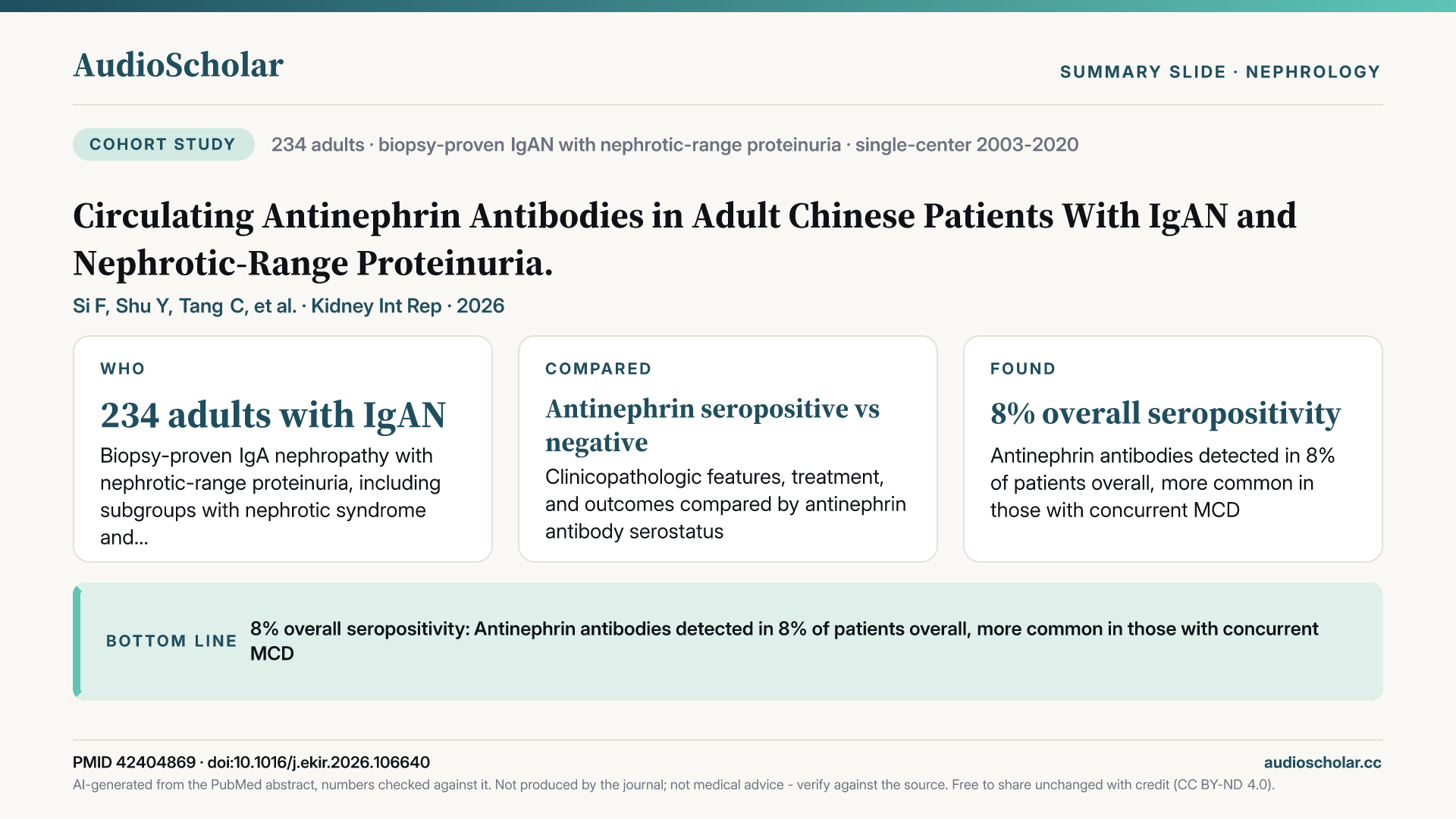
In another study published in Kidney International Reports, Si and colleagues evaluated the prevalence and clinical relevance of circulating antinephrin antibodies in two hundred and thirty-four adult Chinese patients with biopsy-proven IgA nephropathy and nephrotic-range proteinuria [4]. They found an overall antinephrin seropositivity rate of eight percent. However, this rate rose to thirty-five percent in patients who had concurrent minimal change disease. Patients who were antinephrin seropositive presented with heavier proteinuria and lower serum albumin, but their kidney biopsies revealed milder chronic lesions. Most importantly, seropositive patients were more likely to receive glucocorticoids and achieved significantly higher complete remission rates, with sixty-seven percent achieving complete remission compared to thirty percent of seronegative patients. None of the seropositive patients reached the composite renal endpoint, compared to twenty-eight percent of the seronegative group. These results suggest that circulating antinephrin antibodies mark a distinct, highly steroid-responsive podocytopathy-like phenotype within the IgA nephropathy spectrum, which could help clinicians identify patients who will benefit most from targeted glucocorticoid therapy.
Our second theme focuses on practical dietary and metabolic management in patients with kidney disease, specifically addressing sodium, potassium, and protein regulation. In Kidney International Reports, Ertuglu and colleagues conducted a randomized crossover trial evaluating the safety and efficacy of low-sodium dialysate on tissue sodium accumulation in twenty-eight patients on maintenance hemodialysis [2]. Patients completed four weeks of low-sodium dialysate at 132 milliequivalents per liter and four weeks of high-sodium dialysate at 138 milliequivalents per liter, with tissue sodium measured via sodium magnetic resonance imaging. While the low-sodium dialysate was associated with a decrease in skin sodium in adjusted models, the overall differences in muscle and skin sodium between the two treatments did not reach statistical significance. Interestingly, the study revealed that a higher ultrafiltration rate was significantly associated with a decrease in both skin and muscle sodium. There were no significant changes in inflammatory markers or prealbumin, and no serious study-related adverse events occurred. This suggests that both dialysate sodium concentration and ultrafiltration rates can modify tissue sodium, though larger trials are needed to confirm these effects.
When managing chronic hyperkalemia, clinicians have traditionally relied on strict dietary potassium restrictions. However, a review by Biruete and Fried in the American Journal of Kidney Diseases challenges this conventional paradigm [7]. The authors point out that the association between dietary potassium intake and serum potassium levels is weak, as it fails to account for complex internal and external physiological balance factors. Furthermore, traditional dietary restrictions lead to highly restrictive diets that limit nutrient-dense foods like fruits, vegetables, whole grains, and plant-based proteins. This can inadvertently worsen nutritional status and overall cardiovascular health. The authors advocate for a comprehensive, individualized management strategy that moves away from blanket dietary restrictions, instead combining modern pharmacological potassium binders with more liberalized, high-quality diets to preserve patient nutrition and quality of life.
The debate over dietary recommendations is also active regarding protein intake. In another review in the American Journal of Kidney Diseases, Garibotto and colleagues examine the growing trend of high-protein diets [8]. While conditions like aging and dialysis-treated chronic kidney disease are characterized by anabolic resistance, meaning patients require higher protein intake to stimulate muscle protein synthesis, excessive protein ingestion also leads to increased uremic toxins and ureagenesis. The authors emphasize that in the absence of resistance training, protein supplementation has only marginal effects on muscle strength and physical performance. For inactive or sedentary patients, muscle mass and function are much more effectively maintained through physical exercise rather than high-protein diets, which may carry unnecessary metabolic and renal risks.
Our final theme covers critical clinical updates in acute kidney injury and diabetes therapeutics. In Nephrology Dialysis Transplantation, Liao and colleagues examined electronic health care records from over four million pregnancies in the United States to analyze trends in severe pregnancy-associated acute kidney injury between 2012 and 2022 [6]. The investigators defined severe acute kidney injury stringently as either the initiation of dialysis or a first recorded estimated glomerular filtration rate of less than fifteen milliliters per minute. Alarmingly, the incidence of severe pregnancy-associated acute kidney injury increased nearly three-fold, rising from 9.0 per 10,000 pregnancies in 2012 to 2013, to 27.6 per 10,000 pregnancies during the COVID-19 era of 2020 to 2022. This rise was independently associated with older maternal age and underlying chronic cardiometabolic conditions, including chronic hypertension, obesity, diabetes, hyperlipidemia, and pre-existing chronic kidney disease, as well as active COVID-19 infection. The authors noted that the rising trend in severe pregnancy-associated acute kidney injury was already evident prior to 2020, but was significantly accelerated during the pandemic. The independent association with chronic conditions like hypertension and diabetes suggests that our obstetric and nephrology clinics must work more closely together to identify high-risk patients early in pregnancy. Managing these metabolic risk factors aggressively before and during pregnancy could be key to reversing this worrying trend. Crucially, while maternal mortality among these patients increased during the pandemic, the proportion requiring dialysis remained stable. This dissociation underscores the urgent need for earlier risk stratification and multidisciplinary care to prevent mortality in these vulnerable patients.
Finally, we look at the renal monitoring of patients receiving glucagon-like peptide-1 receptor agonists. Yahya and colleagues published a post-hoc analysis of a randomized, double-blind, placebo-controlled trial in Nephrology Dialysis Transplantation, evaluating the effect of semaglutide on measured versus estimated glomerular filtration rate in forty-eight patients with type two diabetes and albuminuria [3]. Over twenty-six weeks of treatment on top of empagliflozin, semaglutide was associated with a small but significant increase in plasma creatinine and beta-trace protein compared to placebo, while there was no significant change in cystatin C, beta-two microglobulin, or measured GFR. This study is particularly valuable because it addresses a common clinical dilemma: how to interpret a rising creatinine level shortly after initiating a glucagon-like peptide-1 receptor agonist. Since the measured GFR remained stable, the small increase in plasma creatinine and beta-trace protein likely reflects benign hemodynamic or metabolic changes rather than actual tissue damage. Using the combined equation helps prevent premature discontinuation of a highly beneficial cardiovascular and renal therapy. Because of these marker-specific changes, estimated GFR equations based on creatinine or cystatin C alone were consistently outperformed by combined equations. The authors concluded that the combined creatinine-cystatin C estimated GFR equation provided the most reliable estimates of measured GFR in patients receiving semaglutide. This is an important clinical consideration for nephrologists to avoid misinterpreting minor, non-pathological rises in creatinine as a true decline in kidney function.
If you only have time for one paper this week, make it the study by Si and colleagues on antinephrin antibodies in IgA nephropathy [4]. This study identifies a clinically distinct, highly steroid-responsive podocytopathy-like phenotype in IgA nephropathy patients with nephrotic-range proteinuria, offering a practical serological marker to guide treatment decisions and avoid unnecessary broad immunosuppression.
Here are the key takeaways from this week in Nephrology. First, circulating antinephrin antibodies identify a specific, highly steroid-responsive podocytopathy-like phenotype in patients with IgA nephropathy and nephrotic-range proteinuria, which could significantly help target glucocorticoid therapy. Second, when monitoring kidney function in patients taking semaglutide, clinicians should use the combined creatinine-cystatin C estimated GFR equation to obtain the most reliable results, as the drug can cause minor, non-pathological increases in plasma creatinine. Third, in patients with rapidly progressive secondary IgA nephropathy, particularly those with underlying liver disease, escalating immunosuppressive therapy beyond corticosteroids does not improve renal or patient survival, reinforcing the primary role of supportive care. Fourth, the management of chronic hyperkalemia should shift away from blanket dietary potassium restrictions toward an individualized approach that combines modern pharmacological binders with nutrient-rich, plant-based diets to preserve patient nutritional status. Finally, the incidence of severe pregnancy-associated acute kidney injury in the United States has increased nearly three-fold over the past decade, driven by rising maternal age and chronic cardiometabolic risk factors, emphasizing the need for early multidisciplinary intervention.
That's your roundup for This Week in Nephrology. The full transcript and references are available on the episode page in your AudioScholar library. This is an AI-curated summary — for clinical decisions, always consult primary sources and current guidelines. See you next week.
If this weekly briefing is useful, follow the show in your podcast app so new episodes arrive automatically. And for audio briefings on your own clinical questions and papers, visit audioscholar dot C C.
This is an automated summary generated by artificial intelligence, which can make mistakes. Always review the original source materials.
Spot something worth flagging?
Get this every week in your podcast app — free.
New nephrology episodes land in your feed automatically — listen on your commute.