This Week in Allergy & Immunology — Oct 18, 2026
Generated Oct 19, 2026 · 11:30
The week's practice-changing Allergy & Immunology research, summarized for clinicians.
If the audio fails to play, refresh the page to renew the link.
Get next week’s Allergy & Immunology briefing — free.
In your podcast app, or readable in your inbox with the audio one tap away.
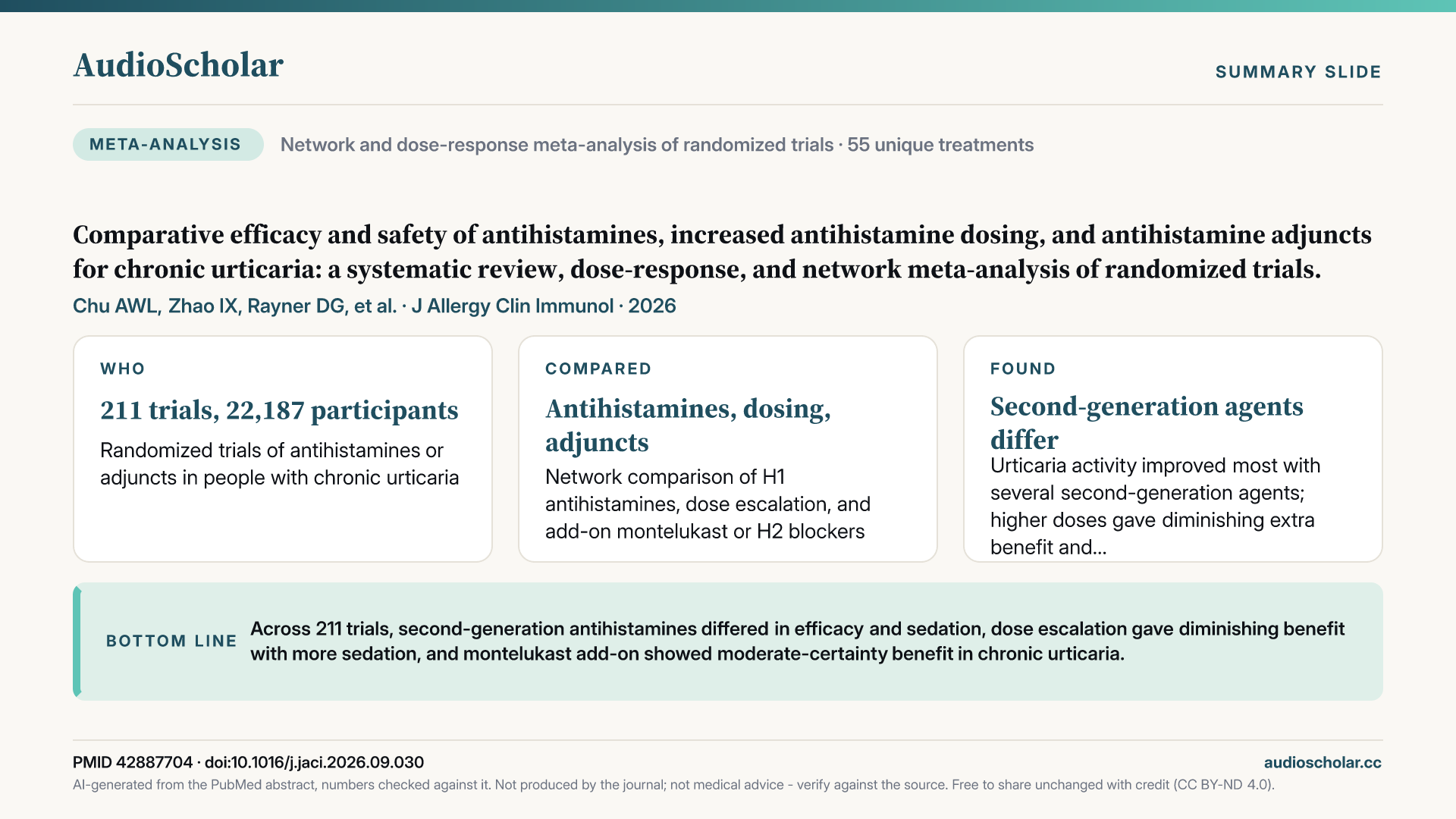
Comparative efficacy and safety of antihistamines, increased antihistamine dosing, and antihistamine adjuncts for chronic urticaria: a systematic review, dose-response, and network meta-analysis of randomized trials.
Across 211 trials, second-generation antihistamines differed in efficacy and sedation, dose escalation gave diminishing benefit with more sedation, and montelukast add-on showed moderate-certainty benefit in chronic urticaria.
Journal of Allergy and Clinical Immunology · 2026 · PubMed

This week’s papers
- 01
Comparative efficacy and safety of antihistamines, increased antihistamine dosing, and antihistamine adjuncts for chronic urticaria: a systematic review, dose-response, and network meta-analysis of randomized trials.
Across 211 trials, second-generation antihistamines differed in efficacy and sedation, dose escalation gave diminishing benefit with more sedation, and montelukast add-on showed moderate-certainty benefit in chronic urticaria.
Chu AWL et al. · Journal of Allergy and Clinical Immunology · 2026
From the briefingIn the Journal of Allergy and Clinical Immunology, Chu and colleagues report a large systematic review, dose-response, and network meta-analysis of 211 randomized trials and over 22,000 participants, conducted to inform the updated Joint Task Force on Practice Parameters chronic urticaria guideline [1]. The headline is that second-generation antihistamines are not interchangeable. Bilastine, desloratadine, fexofenadine, and levocetirizine ranked among the most effective for overall urticaria activity, quality of life, and sleep, while cetirizine and loratadine performed well on activity scores. First-generation agents were both less beneficial and more harmful as a class. Escalating from a single to a quadruple daily dose appeared to bring diminishing additional benefit while likely increasing sedation, and the sedation ranking is clinically useful: diphenhydramine, hydroxyzine, and doxepin were the most sedating, cetirizine and levocetirizine intermediate, and bilastine, desloratadine, fexofenadine, and loratadine the least. Adding montelukast to a second-generation agent may further reduce activity with moderate certainty, whereas the evidence for adding an H2 blocker was very low certainty.
If you only have time for one paper this week, make it the antihistamine network meta-analysis by Chu and colleagues in the Journal of Allergy and Clinical Immunology [1]. It brings guideline-grade evidence to the most common treatment decision in urticaria, reopening the long-held assumptions that second-generation antihistamines are interchangeable and that quadrupling the dose is a cost-free step.
Written by AI from the published abstract, for healthcare professionals. Not medical advice; check the paper before acting on it.
- 02
Relapse Rates, Time-to-Flare, and Biomarker Predictors Following Omalizumab Gradual De-escalation versus Abrupt Discontinuation in Controlled Chronic Spontaneous Urticaria: A Systematic Review and Meta-Analysis of Randomized Controlled Trials and Observational Cohorts.
Gradual omalizumab de-escalation in controlled chronic spontaneous urticaria was associated with about 31 percent relapse versus 49 percent after abrupt stopping, with high IgE and eosinophils predicting relapse.
Dogan MS et al. · International Archives of Allergy and Immunology · 2026
From the briefingAt the other end of the treatment pathway, Dogan and colleagues, in the International Archives of Allergy and Immunology, pooled trials and observational cohorts on discontinuing omalizumab in well-controlled chronic spontaneous urticaria [2]. Overall, roughly four in ten patients relapsed after stopping. Gradual de-escalation was associated with a relapse rate of about 31 percent versus about 49 percent with abrupt discontinuation, and reducing the dose to 150 milligrams every four weeks had the lowest relapse rate, around a quarter of patients. High total IgE, raised blood eosinophils, concomitant angioedema, and longer disease duration predicted relapse. The authors acknowledge that small-study effects could not be excluded and much of the data are observational, so this supports tapering as a reasonable approach rather than settling it.
Written by AI from the published abstract, for healthcare professionals. Not medical advice; check the paper before acting on it.
- 03
Second-line dupilumab after anti-IL5/Rα failure: remission rates and clinical outcomes in severe asthma.
Among 173 Danish severe asthma patients switching to dupilumab after anti-IL-5 failure, 17 percent reached full remission, with nasal polyps and atopic dermatitis favoring and COPD opposing remission.
Hansen S et al. · The Journal of Allergy and Clinical Immunology: In Practice · 2026
From the briefingHansen and colleagues, in The Journal of Allergy and Clinical Immunology: In Practice, followed 173 Danish adults who switched to dupilumab after failing to reach remission on anti-IL-5 or anti-IL-5 receptor therapy [3]. At twelve months, about two thirds of patients were exacerbation-free and three quarters were off maintenance oral steroids, but only 17 percent met all four remission domains, with impaired lung function the most persistent barrier. Baseline biomarkers did not predict remission, whereas comorbid atopic dermatitis and nasal polyps were associated with remission and coexisting COPD with non-remission. This is uncontrolled registry data, but it suggests that interclass switching yields full remission in nearly one in five patients and that broad type 2 comorbidity may matter more than eosinophil counts.
Written by AI from the published abstract, for healthcare professionals. Not medical advice; check the paper before acting on it.
- 04
Hereditary α-tryptasemia is associated with response to omalizumab in severe allergic asthma.
Hereditary alpha-tryptasemia was independently associated with roughly four-and-a-half-fold higher odds of poor omalizumab response in severe allergic asthma, and some carriers had normal basal tryptase.
Rijavec M et al. · Annals of Allergy, Asthma & Immunology · 2026
From the briefingMeanwhile, in the Annals of Allergy, Asthma and Immunology, Rijavec and colleagues genotyped 181 patients on omalizumab across Slovenian and British centers [4]. Hereditary alpha-tryptasemia was present in about one in twelve patients overall, but it was found in a fifth of poor responders compared with one in twenty good responders, and it remained independently associated with poor response, with roughly four and a half times the odds. Notably, four of the fifteen carriers had basal tryptase below 8 nanograms per milliliter, so tryptase levels alone would have missed them. The cohort is small and replication is needed before genotyping informs biologic selection.
Written by AI from the published abstract, for healthcare professionals. Not medical advice; check the paper before acting on it.
- 05
Efficacy and Safety of Sublingual versus Subcutaneous Immunotherapy for Patients with Allergic Rhinitis with Asthma: A Systematic Review and Meta-analysis.
In allergic rhinitis with asthma, sublingual immunotherapy had fewer asthma-worsening events and subcutaneous greater visual analog improvement, with no differences in symptoms, medication use, or most safety outcomes.
Jiang Q et al. · International Archives of Allergy and Immunology · 2026
From the briefingTurning to allergen immunotherapy, Jiang and colleagues, also in the International Archives of Allergy and Immunology, meta-analyzed nine head-to-head studies of sublingual versus subcutaneous immunotherapy in allergic rhinitis with asthma [5]. Sublingual therapy was associated with substantially fewer asthma-worsening events, with moderate certainty, while subcutaneous therapy produced greater improvement in visual analog scores. There were no significant differences in rhinitis symptoms, medication use, asthma symptom scores, systemic reactions, or withdrawals. The authors stress the studies were few, heterogeneous, and used nonstandardized outcomes, so neither route can be called superior on this evidence.
Written by AI from the published abstract, for healthcare professionals. Not medical advice; check the paper before acting on it.
- 06
A Systematic Review and Meta-Analysis of Temporal Trends in United States' Pediatric Food Allergy.
Self-reported pediatric food allergy in the United States rose from 5.6 to 6.6 percent between 2012 and 2018, mainly in adolescents, with no convincing decline after early allergen introduction.
Caid K, Keet C · Annals of Allergy, Asthma & Immunology · 2026
From the briefingCaid and Keet, in the Annals of Allergy, Asthma and Immunology, examined national survey data on self-reported pediatric food allergy in the United States [6]. Prevalence rose from about 5.6 percent in 2012 to 6.6 percent in 2018, and exploratory later data suggest a plateau around seven to eight percent. The increase was concentrated in adolescents, with little change in younger children, and trends did not differ by race or ethnicity. The authors conclude there is no convincing population-level decline yet following early allergen introduction, though self-report and a 2019 survey redesign limit interpretation, and the flat trend in young children leaves room for a delayed effect.
Written by AI from the published abstract, for healthcare professionals. Not medical advice; check the paper before acting on it.
- 07
International survey of parental and patient perspectives on emerging adrenaline devices for community-based management of anaphylaxis: An EAACI task force report.
Caregivers and adults with food allergy found adrenaline nasal spray appealing and easier to use, yet many worried about effectiveness and few wanted it prescribed without an autoinjector.
Gonzalez-Matamala MF et al. · Pediatric Allergy and Immunology · 2026
From the briefingOn treatment, Gonzalez-Matamala and colleagues report an EAACI task force survey in Pediatric Allergy and Immunology of over 500 caregivers and over 200 adults with food allergy [7]. Most respondents expected to feel more comfortable using adrenaline nasal spray than an autoinjector, and over half anticipated using it earlier during a reaction. Yet close to half of caregivers were extremely worried the spray might not work as well, and only about one in six caregivers wanted to be prescribed the nasal spray alone. Non-injectable adrenaline is attractive, but patients want efficacy data beyond pharmacokinetic bridging.
Written by AI from the published abstract, for healthcare professionals. Not medical advice; check the paper before acting on it.
- 08
Pediatric Alpha-Gal Syndrome: From Missed Diagnosis to the Burden of Avoidance.
Pediatric alpha-gal syndrome is often diagnosed late due to delayed and gastrointestinal presentations; the review favors least-restrictive avoidance, noting no pediatric data on nutrition, growth, or remission exist.
Miliordos K, Triga M · Annals of Allergy, Asthma & Immunology · 2026
From the briefingRounding out this theme, Miliordos and Triga, also in the Annals, review pediatric alpha-gal syndrome [8]. Pediatric cohorts show prolonged diagnostic delay and frequent gastrointestinal-only presentations, and a missing tick bite history does not exclude the diagnosis, while sensitization without a compatible delayed phenotype does not establish it. The authors favor least-restrictive avoidance, preserving tolerated dairy, and product-specific rather than blanket medication assessment. In mostly adult data, the large majority of patients improved but fewer than half fully resolved, and no prospective pediatric study has measured nutrition, growth, or quality of life.
Written by AI from the published abstract, for healthcare professionals. Not medical advice; check the paper before acting on it.
- 09
Systemic Allergic Reactions to mRNA COVID-19 Vaccines: A Randomized Placebo-controlled Trial.
In an underenrolled placebo-controlled trial, systemic reactions to mRNA COVID-19 vaccines in people with severe allergy history were uncommon, not significantly increased, and occurred at placebo-like rates.
Wheatley LM et al. · Journal of Allergy and Clinical Immunology · 2026
From the briefingWheatley and colleagues, in the Journal of Allergy and Clinical Immunology, report a randomized, placebo-controlled trial of mRNA COVID-19 vaccination in people with prior severe allergic reactions or mast cell disorders [9]. Enrollment fell far short, with 723 of a planned 3,400 participants. Systemic allergic reactions within 90 minutes occurred in about three percent of high-risk participants after the Pfizer vaccine and one percent after Moderna, versus none in the comparison group, but these differences were not statistically significant. Crucially, among high-risk participants, reaction rates after vaccine were similar to placebo, and extensive laboratory work found no plausible immunologic mechanism, pointing toward non-allergic causes. The trial was underpowered, but it adds weight to the view that allergic history alone does not signal true vaccine allergy.
Written by AI from the published abstract, for healthcare professionals. Not medical advice; check the paper before acting on it.
- 10
Delayed Drug Hypersensitivity: Mechanistic Advances and Emerging Therapies.
Delayed drug hypersensitivity phenotypes appear driven by shared effector pathways rather than culprit drugs, supporting targeted TNF, IL-36, IL-5, and JAK inhibition, though validated biomarkers and trials are lacking.
Siddiqui A et al. · Current Allergy and Asthma Reports · 2026
From the briefingFinally, Siddiqui and colleagues, in Current Allergy and Asthma Reports, review delayed drug hypersensitivity [10]. They argue that HLA risk alleles are necessary but not sufficient, with susceptibility shaped by pre-existing, often virus-primed T cells, and that the dominant effector pathway determines phenotype more than the culprit drug: cytotoxic resident memory CD8 cells with interferon and JAK-STAT signaling in Stevens-Johnson syndrome and toxic epidermal necrolysis, IL-36 in acute generalized exanthematous pustulosis, and the IL-5 axis and herpesvirus reactivation in DRESS. This underpins interest in targeted TNF, IL-36, IL-5, and JAK inhibition, though no biomarker yet identifies the dominant mechanism and randomized evidence is lacking.
Written by AI from the published abstract, for healthcare professionals. Not medical advice; check the paper before acting on it.
The full briefing
This AudioScholar briefing is generated by artificial intelligence for healthcare professionals and trainees. It is not medical advice.
Welcome to This Week in Allergy & Immunology. This week we're covering 10 notable papers spanning chronic urticaria management, biologic and immunotherapy choices in allergic airway disease, and the shifting landscape of food allergy, anaphylaxis, and drug hypersensitivity. Let's dive in.
Chronic urticaria gets two complementary analyses this week, one on how to start treatment and one on how to stop it. In the Journal of Allergy and Clinical Immunology, Chu and colleagues report a large systematic review, dose-response, and network meta-analysis of 211 randomized trials and over 22,000 participants, conducted to inform the updated Joint Task Force on Practice Parameters chronic urticaria guideline [1]. The headline is that second-generation antihistamines are not interchangeable. Bilastine, desloratadine, fexofenadine, and levocetirizine ranked among the most effective for overall urticaria activity, quality of life, and sleep, while cetirizine and loratadine performed well on activity scores. First-generation agents were both less beneficial and more harmful as a class. Escalating from a single to a quadruple daily dose appeared to bring diminishing additional benefit while likely increasing sedation, and the sedation ranking is clinically useful: diphenhydramine, hydroxyzine, and doxepin were the most sedating, cetirizine and levocetirizine intermediate, and bilastine, desloratadine, fexofenadine, and loratadine the least. Adding montelukast to a second-generation agent may further reduce activity with moderate certainty, whereas the evidence for adding an H2 blocker was very low certainty. At the other end of the treatment pathway, Dogan and colleagues, in the International Archives of Allergy and Immunology, pooled trials and observational cohorts on discontinuing omalizumab in well-controlled chronic spontaneous urticaria [2]. Overall, roughly four in ten patients relapsed after stopping. Gradual de-escalation was associated with a relapse rate of about 31 percent versus about 49 percent with abrupt discontinuation, and reducing the dose to 150 milligrams every four weeks had the lowest relapse rate, around a quarter of patients. High total IgE, raised blood eosinophils, concomitant angioedema, and longer disease duration predicted relapse. The authors acknowledge that small-study effects could not be excluded and much of the data are observational, so this supports tapering as a reasonable approach rather than settling it.
In severe asthma, two papers look at who responds to which biologic, and a third asks how to choose between immunotherapy routes. Hansen and colleagues, in The Journal of Allergy and Clinical Immunology: In Practice, followed 173 Danish adults who switched to dupilumab after failing to reach remission on anti-IL-5 or anti-IL-5 receptor therapy [3]. At twelve months, about two thirds of patients were exacerbation-free and three quarters were off maintenance oral steroids, but only 17 percent met all four remission domains, with impaired lung function the most persistent barrier. Baseline biomarkers did not predict remission, whereas comorbid atopic dermatitis and nasal polyps were associated with remission and coexisting COPD with non-remission. This is uncontrolled registry data, but it suggests that interclass switching yields full remission in nearly one in five patients and that broad type 2 comorbidity may matter more than eosinophil counts. Meanwhile, in the Annals of Allergy, Asthma and Immunology, Rijavec and colleagues genotyped 181 patients on omalizumab across Slovenian and British centers [4]. Hereditary alpha-tryptasemia was present in about one in twelve patients overall, but it was found in a fifth of poor responders compared with one in twenty good responders, and it remained independently associated with poor response, with roughly four and a half times the odds. Notably, four of the fifteen carriers had basal tryptase below 8 nanograms per milliliter, so tryptase levels alone would have missed them. The cohort is small and replication is needed before genotyping informs biologic selection. Turning to allergen immunotherapy, Jiang and colleagues, also in the International Archives of Allergy and Immunology, meta-analyzed nine head-to-head studies of sublingual versus subcutaneous immunotherapy in allergic rhinitis with asthma [5]. Sublingual therapy was associated with substantially fewer asthma-worsening events, with moderate certainty, while subcutaneous therapy produced greater improvement in visual analog scores. There were no significant differences in rhinitis symptoms, medication use, asthma symptom scores, systemic reactions, or withdrawals. The authors stress the studies were few, heterogeneous, and used nonstandardized outcomes, so neither route can be called superior on this evidence.
Food allergy and anaphylaxis care form our third theme, with sobering epidemiology and shifting patient expectations. Caid and Keet, in the Annals of Allergy, Asthma and Immunology, examined national survey data on self-reported pediatric food allergy in the United States [6]. Prevalence rose from about 5.6 percent in 2012 to 6.6 percent in 2018, and exploratory later data suggest a plateau around seven to eight percent. The increase was concentrated in adolescents, with little change in younger children, and trends did not differ by race or ethnicity. The authors conclude there is no convincing population-level decline yet following early allergen introduction, though self-report and a 2019 survey redesign limit interpretation, and the flat trend in young children leaves room for a delayed effect. On treatment, Gonzalez-Matamala and colleagues report an EAACI task force survey in Pediatric Allergy and Immunology of over 500 caregivers and over 200 adults with food allergy [7]. Most respondents expected to feel more comfortable using adrenaline nasal spray than an autoinjector, and over half anticipated using it earlier during a reaction. Yet close to half of caregivers were extremely worried the spray might not work as well, and only about one in six caregivers wanted to be prescribed the nasal spray alone. Non-injectable adrenaline is attractive, but patients want efficacy data beyond pharmacokinetic bridging. Rounding out this theme, Miliordos and Triga, also in the Annals, review pediatric alpha-gal syndrome [8]. Pediatric cohorts show prolonged diagnostic delay and frequent gastrointestinal-only presentations, and a missing tick bite history does not exclude the diagnosis, while sensitization without a compatible delayed phenotype does not establish it. The authors favor least-restrictive avoidance, preserving tolerated dairy, and product-specific rather than blanket medication assessment. In mostly adult data, the large majority of patients improved but fewer than half fully resolved, and no prospective pediatric study has measured nutrition, growth, or quality of life.
Our final theme is drug and vaccine hypersensitivity, where mechanism is reshaping how reactions are interpreted. Wheatley and colleagues, in the Journal of Allergy and Clinical Immunology, report a randomized, placebo-controlled trial of mRNA COVID-19 vaccination in people with prior severe allergic reactions or mast cell disorders [9]. Enrollment fell far short, with 723 of a planned 3,400 participants. Systemic allergic reactions within 90 minutes occurred in about three percent of high-risk participants after the Pfizer vaccine and one percent after Moderna, versus none in the comparison group, but these differences were not statistically significant. Crucially, among high-risk participants, reaction rates after vaccine were similar to placebo, and extensive laboratory work found no plausible immunologic mechanism, pointing toward non-allergic causes. The trial was underpowered, but it adds weight to the view that allergic history alone does not signal true vaccine allergy. Finally, Siddiqui and colleagues, in Current Allergy and Asthma Reports, review delayed drug hypersensitivity [10]. They argue that HLA risk alleles are necessary but not sufficient, with susceptibility shaped by pre-existing, often virus-primed T cells, and that the dominant effector pathway determines phenotype more than the culprit drug: cytotoxic resident memory CD8 cells with interferon and JAK-STAT signaling in Stevens-Johnson syndrome and toxic epidermal necrolysis, IL-36 in acute generalized exanthematous pustulosis, and the IL-5 axis and herpesvirus reactivation in DRESS. This underpins interest in targeted TNF, IL-36, IL-5, and JAK inhibition, though no biomarker yet identifies the dominant mechanism and randomized evidence is lacking.
If you only have time for one paper this week, make it the antihistamine network meta-analysis by Chu and colleagues in the Journal of Allergy and Clinical Immunology [1]. It brings guideline-grade evidence to the most common treatment decision in urticaria, reopening the long-held assumptions that second-generation antihistamines are interchangeable and that quadrupling the dose is a cost-free step.
Here is what this week's evidence adds up to in Allergy & Immunology. First, second-generation antihistamines differ meaningfully in efficacy and sedation, dose escalation offers diminishing returns, and montelukast as an add-on now has moderate-certainty support, while H2 blockers remain weakly supported. Second, observational data associate gradual omalizumab tapering in urticaria with fewer relapses than abrupt stopping, though small-study bias remains possible. Third, in severe asthma, full remission after switching biologic classes is achieved by a minority of patients, and both comorbidity profile and tryptase genotype emerge as possible response markers, each awaiting replication. Fourth, self-reported pediatric food allergy in the United States has not yet declined at the population level, and patients welcome needle-free adrenaline but want stronger effectiveness evidence. Fifth, an underpowered but placebo-controlled trial suggests most reactions to mRNA vaccines in allergic individuals are not immunologic, and mechanism-based therapy for severe delayed drug reactions remains promising but unproven.
That's your roundup for This Week in Allergy & Immunology. The full transcript and references are available on the episode page. This is an AI-curated summary — for clinical decisions, always consult primary sources and current guidelines. See you next week.
If this weekly briefing is useful, follow the show in your podcast app so new episodes arrive automatically. And think of one colleague — in any specialty — who never has time to keep up with the literature. Tell them about AudioScholar: a free ten-minute weekly for every specialty, to listen to in any podcast app, or to read at audioscholar dot C C.
This is an automated summary generated by artificial intelligence, which can make mistakes. Always review the original source materials.
Spot something worth flagging?
Get this every week in your podcast app — free.
New allergy_immunology episodes land in your feed automatically — listen on your commute.