This Week in Nephrology — Oct 14, 2026
Generated Oct 14, 2026 · 10:36
The week's practice-changing Nephrology research, summarized for clinicians.
If the audio fails to play, refresh the page to renew the link.
Get next week’s Nephrology briefing — free.
In your podcast app, or readable in your inbox with the audio one tap away.
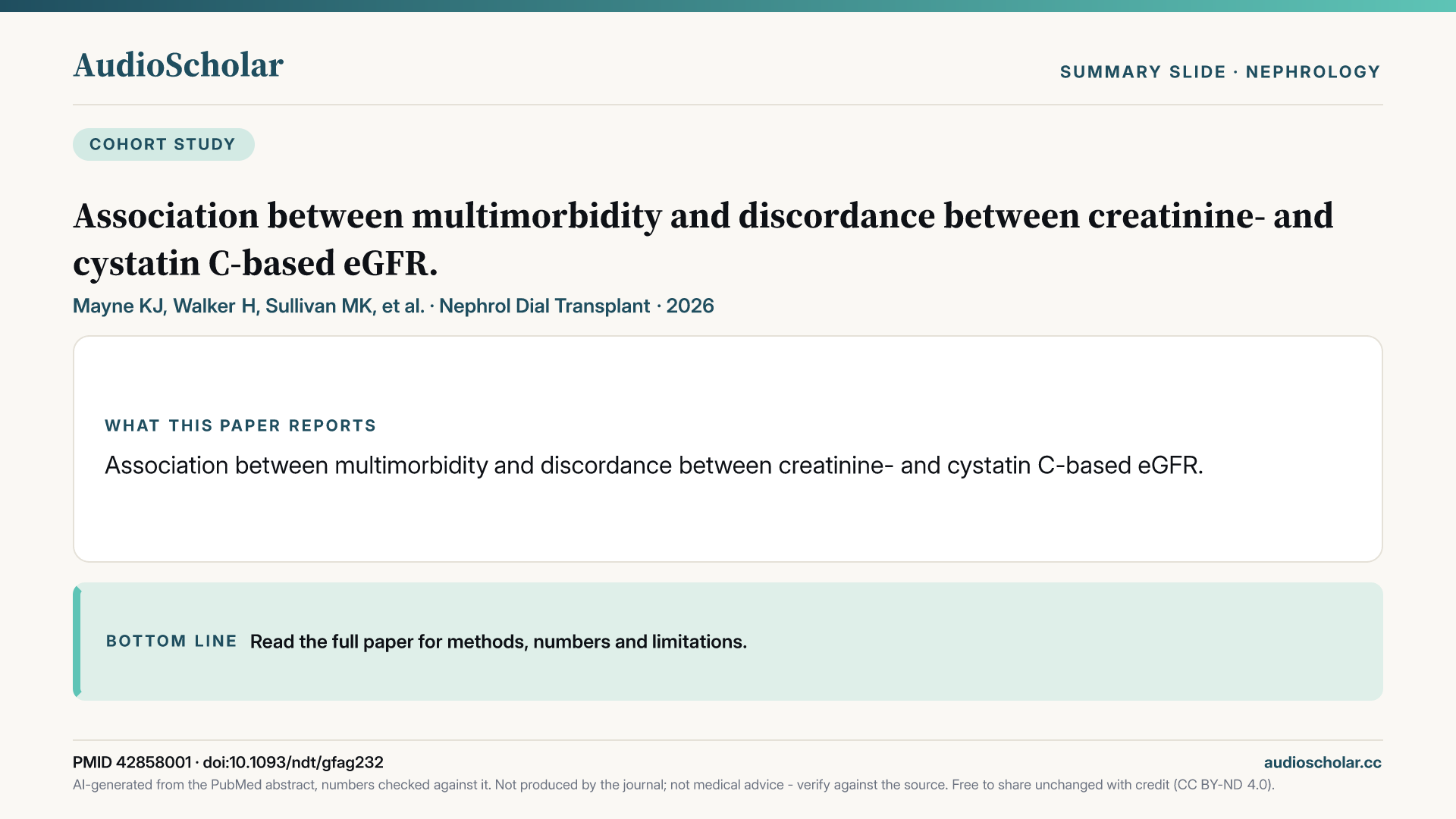
Association between multimorbidity and discordance between creatinine- and cystatin C-based eGFR.
Among over 400,000 UK Biobank participants, four or more chronic conditions raised the odds of cystatin C eGFR falling far below creatinine eGFR more than fourfold, reclassifying many to worse CKD stages.
Nephrology Dialysis Transplantation · 2026 · PubMed

This week’s papers
- 01
A Microsimulation of Eligibility for Cardiorenal Combination Treatment and Potential Deaths Averted.
In a national survey-based microsimulation, most United States adults with diabetes and CKD qualified for combination cardiorenal therapy, yet uptake was minimal, and triple therapy was projected to avert twice the deaths of dual therapy.
Nardone M et al. · Journal of the American Society of Nephrology · 2026
- 02
Validation of the Klinrisk CKD Progression Model in the Dapagliflozin and Prevention of Adverse Outcomes in CKD (DAPA-CKD) Population.
The Klinrisk machine-learning model predicted CKD progression well in DAPA-CKD and beat KDIGO heat-map staging, while dapagliflozin benefited patients across all predicted risk levels, though several inputs were imputed.
Jongs N et al. · Kidney360 · 2026
- 03
Association between multimorbidity and discordance between creatinine- and cystatin C-based eGFR.
Among over 400,000 UK Biobank participants, four or more chronic conditions raised the odds of cystatin C eGFR falling far below creatinine eGFR more than fourfold, reclassifying many to worse CKD stages.
Mayne KJ et al. · Nephrology Dialysis Transplantation · 2026
- 04
Debating targets for systolic blood pressure lowering in CKD.
A structured debate weighs evidence for and against a systolic target below 120 mmHg in CKD, noting KDIGO adopted it while other major guideline bodies have not.
Dounousi E et al. · Nephrology Dialysis Transplantation · 2026
- 05
Contemporary Approaches to Kidney Dysfunction and Diuretic Resistance in Acute Decompensated Heart Failure.
A review argues that creatinine rises during decongestion or therapy initiation in acute heart failure can mislead in isolation, and describes combination diuretic strategies for overcoming diuretic resistance.
Bharati J et al. · Clinical Journal of the American Society of Nephrology · 2026
- 06
Barriers to and Facilitators of the Adoption of Peritoneal Dialysis: A Systematic Review of Qualitative Studies.
A synthesis of thirteen qualitative studies found peritoneal dialysis uptake shaped by multilevel barriers, most consistently poor modality education, fear of infection, and hemodialysis-centric health systems.
Shankar R et al. · American Journal of Kidney Diseases · 2026
- 07
Urgent Start of Peritoneal Dialysis Versus Hemodialysis in Kidney Failure in Severe Metabolic Acidosis: A Prospective Study.
In 68 patients with kidney failure and severe metabolic acidosis, urgent-start peritoneal dialysis corrected pH and bicarbonate similarly to hemodialysis, with comparable in-hospital mortality, in a small non-randomized cohort.
Mendoza-Gaitán E et al. · Kidney360 · 2026
- 08
Targeting the B-Cell Activating Factor and a Proliferation-Inducing Ligand Pathway in IgAN: From Disease Pathogenesis to Clinical Trial Evidence.
A review summarizes how APRIL and dual BAFF-APRIL inhibitors lower galactose-deficient IgA1, hematuria and proteinuria and slow eGFR decline, positioning this pathway as central to IgA nephropathy treatment.
Vasquez-Rios G et al. · Kidney International Reports · 2026
- 09
IgG4-related kidney disease: treatment standard.
An expert treatment standard for IgG4-related kidney disease keeps glucocorticoids as induction cornerstone, highlights rituximab's efficacy for induction and maintenance, and distinguishes management of retroperitoneal fibrosis from parenchymal disease.
Peyronel F et al. · Nephrology Dialysis Transplantation · 2026
- 10
Kidney Transcatheter Arterial Embolization Reduces Kidney Cyst Infection in Patients With ADPKD.
In a retrospective cohort of 416 ADPKD patients, kidney arterial embolization cut cyst infection frequency by roughly two thirds, with larger kidney volume reductions linked to fewer infections.
Yoshimura Y et al. · Kidney International Reports · 2026
The full briefing
This AudioScholar briefing is generated by artificial intelligence for healthcare professionals and trainees. It is not medical advice.
Welcome to This Week in Nephrology. This week we're covering 10 notable papers spanning cardiorenal risk and how we measure and stratify it, the realities of choosing peritoneal dialysis, and evolving treatment of immune-mediated and cystic kidney disease. Let's dive in.
Our first theme is the gap between what cardiorenal guidelines recommend and what is actually delivered, and how we decide who is at highest risk. In the Journal of the American Society of Nephrology, Nardone and colleagues built a microsimulation from national survey data on roughly eight thousand United States adults, applying 73 guideline recommendations and trial inclusion criteria to estimate who would qualify for combinations of renin-angiotensin system inhibitors, SGLT2 inhibitors, GLP-1 receptor agonists and nonsteroidal mineralocorticoid receptor antagonists [1]. Uptake was strikingly low: about one in five adults was on a renin-angiotensin blocker, only about one percent were on an SGLT2 inhibitor or a GLP-1 agonist, and no participants were on a nonsteroidal MRA. Yet eligibility was high. Among people with both diabetes and CKD, more than four in five qualified for the dual combination of a renin-angiotensin blocker plus an SGLT2 inhibitor, and about four in ten qualified for all four drugs. The model projected that triple therapy adding a GLP-1 agonist would avert roughly twice as many deaths as dual therapy, even though fewer people qualified. These are modelled projections built on assumed treatment effects, not observed outcomes, but they frame the size of the implementation gap. Risk stratification is one route to targeting that effort, and in Kidney360, Jongs and colleagues externally validated the Klinrisk machine-learning model in over four thousand DAPA-CKD participants [2]. The model discriminated well, with an area under the curve of about 0.79, and outperformed the KDIGO heat map in patients with and without diabetes and in IgA nephropathy. Notably, dapagliflozin reduced progression across the full spectrum of predicted risk. One important caveat: eight of the twenty-two model inputs were not measured in the trial and were imputed from the development data, so real-world performance still needs confirmation.
Risk prediction is only as good as the kidney function estimate feeding it, and Mayne and colleagues, writing in Nephrology Dialysis Transplantation, tackled that directly in over four hundred thousand UK Biobank participants [3]. They looked at discordance where the cystatin C-based estimate ran more than thirty percent below the creatinine-based one. Multimorbidity was present in about a third of the whole cohort but in close to two thirds of people with this large negative discordance. People with four or more long-term conditions had more than four times the odds of large discordance compared with those with none, and about fifteen percent of the overall cohort moved to a more advanced CKD stage when cystatin C was used, with reclassification climbing as condition counts rose. This is cross-sectional and based on self-reported conditions, but the authors conclude that cystatin C testing alongside creatinine is warranted in multimorbid patients to refine staging. Also in Nephrology Dialysis Transplantation, Dounousi, Georgianos and Agarwal stage a structured debate on systolic targets in CKD [4]. They trace how the SPRINT trial led KDIGO in 2021 to adopt a target below 120, while ESC, ERA, NICE, ACC and AHA have not followed, and they close with a consensus on implementing the intensive target in practice. It is a perspective piece rather than new data, but it captures a genuine and unresolved split between guideline bodies. Rounding out the theme, a Clinical Journal of the American Society of Nephrology review by Bharati and colleagues addresses kidney dysfunction and diuretic resistance in acute decompensated heart failure [5]. Its central message is that early creatinine rises during decongestion or when starting guideline-directed therapy are hard to interpret in isolation and may mislead if used alone, and that sequential nephron blockade with monitored diuretic response is the current backbone for resistant congestion.
Our second theme is peritoneal dialysis, why it remains underused, and whether it can handle the sickest urgent starts. In the American Journal of Kidney Diseases, Shankar and colleagues synthesized thirteen qualitative studies with nearly six hundred patients, caregivers and clinicians across nine countries, against a backdrop of global PD use of only about eleven percent [6]. Mapping barriers across individual, interpersonal, organizational, community and policy levels, the most consistent organizational barrier was the quality of modality education, reported in most included studies, while fear of infection dominated at the individual level and hemodialysis-centric systems appeared at the policy level. Urgent dialysis starts emerged as a barrier too, which makes the next paper relevant. In Kidney360, Mendoza-Gaitán, with Perl among the co-authors, followed 68 dialysis-naive patients with severe metabolic acidosis needing urgent kidney replacement at a single tertiary centre [7]. With modality chosen by clinical judgment and resources, urgent-start PD and hemodialysis produced similar trajectories of pH and bicarbonate recovery after weighting, and in-hospital mortality was similarly high, around four in ten patients in each group. This is a small, non-randomized cohort with baseline imbalances, so it cannot prove equivalence, but it challenges the assumption that hemodialysis is the only safe option for severe acidosis and speaks directly to the urgent-start barrier identified in the qualitative review.
Our final theme covers immune-mediated and cystic disease, where targeted therapies are reshaping management. In Kidney International Reports, Vasquez-Rios and colleagues review the BAFF and APRIL pathway in IgA nephropathy [8]. They summarize how these ligands drive production of galactose-deficient IgA1 and how selective APRIL inhibitors such as sibeprenlimab and zigakibart, and dual inhibitors including atacicept, povetacicept and telitacicept, reduce galactose-deficient IgA1, hematuria and proteinuria and slow eGFR decline. The authors position this axis as a central therapeutic node and argue for biomarker-guided treatment, though long-term hard outcome data are still accruing. Staying with B-cell biology, Peyronel and colleagues present a Nephrology Dialysis Transplantation treatment standard for IgG4-related kidney disease [9]. They emphasize that glucocorticoids remain the induction cornerstone, that rituximab has shown high efficacy for both induction and maintenance, and that retroperitoneal fibrosis with obstruction is managed quite differently from parenchymal disease, often requiring intervention. This is expert guidance rather than trial evidence, reflecting the limited randomized data in this rare disease. Finally, in Kidney International Reports, Yoshimura and colleagues report a retrospective Japanese cohort of 416 patients with polycystic kidney disease who underwent kidney transcatheter arterial embolization [10]. Cyst infection frequency fell by roughly two thirds after the procedure, and in patients with prior infections, hospital days per year fell by about seventy percent. Greater kidney volume reduction tracked with fewer infections, and no infections occurred among patients whose volume fell by more than three quarters. This is a before-and-after design without a control group and from a highly specialized centre, so regression to the mean and selection effects cannot be excluded, but it builds a hypothesis worth testing prospectively.
If you only have time for one paper this week, make it the UK Biobank analysis of creatinine and cystatin C discordance from Mayne and colleagues [3]. It shows, at enormous scale, that the patients nephrologists see most often, those with several chronic conditions, are precisely the ones in whom creatinine alone may misstage kidney function, which reopens the question of when cystatin C should be routine.
Here is what this week's evidence adds up to in Nephrology. First, modelled data suggest most adults with diabetes and CKD in the United States qualify for multiple cardiorenal drugs yet very few receive them, though the projected deaths averted rest on simulation assumptions. Second, kidney function estimation is a weak link in multimorbid patients, with large cross-sectional data supporting paired cystatin C testing, while prospective outcome evidence for that strategy is still needed; better inputs also matter for prediction tools like Klinrisk, which performed well in a trial population but relied partly on imputed variables. Third, urgent-start peritoneal dialysis corrected severe acidosis comparably to hemodialysis in one small observational cohort, and education and system design remain the most consistently reported barriers to PD uptake. Fourth, B-cell targeted therapy is now central in IgA nephropathy and IgG4-related disease, though long-term outcome data for the newer agents are incomplete. And the debate over a systolic target below 120 in CKD remains open, with guideline bodies still divided.
That's your roundup for This Week in Nephrology. The full transcript and references are available on the episode page. This is an AI-curated summary — for clinical decisions, always consult primary sources and current guidelines. See you next week.
If this weekly briefing is useful, follow the show in your podcast app so new episodes arrive automatically. And a quick rating on Apple Podcasts or Spotify helps other physicians discover the show.
This is an automated summary generated by artificial intelligence, which can make mistakes. Always review the original source materials.
Spot something worth flagging?
Get this every week in your podcast app — free.
New nephrology episodes land in your feed automatically — listen on your commute.