This Week in Nephrology — Aug 20, 2026
Generated Aug 20, 2026 · 10:50
The week's practice-changing Nephrology research, summarized for clinicians.
If the audio fails to play, refresh the page to renew the link.
Get next week’s Nephrology briefing — free.
In your podcast app, or readable in your inbox with the audio one tap away.
Trends in mortality in adult first kidney transplant recipients with and without diabetes as cause of kidney failure: an ERA Registry study
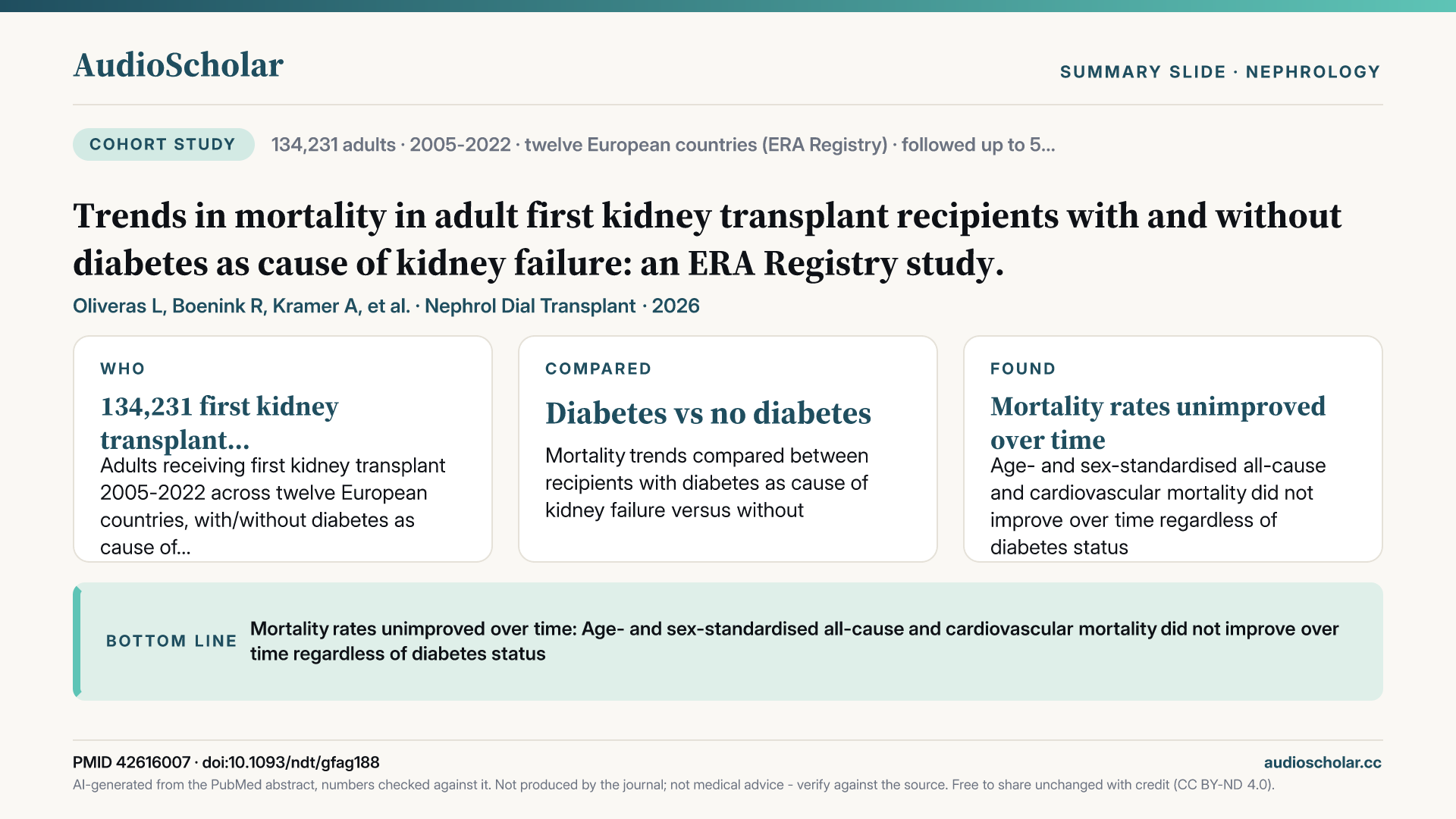
Among 134,000 European kidney transplant recipients, mortality was nearly twice as high when diabetes caused kidney failure, and neither overall nor cardiovascular mortality improved between 2005 and 2022.
Nephrology Dialysis Transplantation · 2026 · PubMed

This week’s papers
- 01
Combination Pharmacotherapy in Type 2 Diabetes and Chronic Kidney Disease: Translating Evidence into Clinical Practice
Recent trial evidence supports simultaneous rather than sequential use of renin-angiotensin blockers, SGLT2 inhibitors, non-steroidal mineralocorticoid receptor antagonists and GLP-1 agonists in diabetic kidney disease.
Lovshin JA · Nephrology Dialysis Transplantation · 2026
- 02
Reframing kidney outcomes in CKD trials: eGFR slopes, competing risks, and pragmatic trial design
Interpreting eGFR slopes, time to kidney failure and competing risks together allows slope differences to be translated into intuitive estimates of dialysis time delayed for patients.
Zoccali C, Levin A · Nephrology Dialysis Transplantation · 2026
- 03
Trends in mortality in adult first kidney transplant recipients with and without diabetes as cause of kidney failure: an ERA Registry study
Among 134,000 European kidney transplant recipients, mortality was nearly twice as high when diabetes caused kidney failure, and neither overall nor cardiovascular mortality improved between 2005 and 2022.
Oliveras L, Boenink R, Kramer A, et al. · Nephrology Dialysis Transplantation · 2026
- 04
Pathogenesis and Translational Perspectives in Myeloma-Associated Nephropathy
Myeloma kidney injury arises from free light chain cast obstruction and proximal tubular toxicity acting alone or together, and is potentially reversible if light chain burden and precipitants are addressed early.
Sanders PW · Journal of the American Society of Nephrology · 2026
- 05
Monoclonal gammopathy in ANCA-associated glomerulonephritis: prevalence, characteristics and outcomes
Monoclonal gammopathy occurred in about 15 percent of patients with ANCA glomerulonephritis but, after adjustment, did not independently predict death, infection, cancer or kidney failure, and none progressed to myeloma.
Desouche A, Garnier AS, Coindre JP, et al. · Nephrology Dialysis Transplantation · 2026
- 06
Scaling up Genomics: A Mainstream Model of Care in Nephrology
A hub-and-spoke training model let general nephrologists order and interpret genomic tests themselves, raising mainstream testing from under a quarter to about three quarters of tests while maintaining a 34 percent diagnostic yield.
Jayasinghe K, Tytherleigh R, Best S, et al. · Clinical Journal of the American Society of Nephrology · 2026
- 07
Peritoneal Dialysis in the Transplant Pathway: From Waitlist to Graft Failure
Peritoneal dialysis offers theoretical advantages as a bridge to transplantation, but evidence remains fragmented and no consensus exists on retaining or removing the peritoneal catheter after transplant.
Alfieri C, Tripodi F, Nardelli L, et al. · Kidney360 · 2026
- 08
Genetic determinants of serum creatinine and cystatin C independent of kidney function generate bias in filtration markers
Dozens of genetic loci influence creatinine and cystatin C without affecting true filtration, producing individual-level bias in estimated GFR of several millilitres per minute that differed by self-reported race.
Titan SM, Rule AD, Olson JE, et al. · Kidney International · 2026
- 09
Donor Kidney Assessment-Functional Metrics and Biomarkers During Ex Situ Machine Perfusion
Machine perfusion offers many candidate functional and biomarker measures of donor kidney quality, but almost none are clinically validated, while roughly 18 percent of donor kidneys are still discarded on subjective grounds.
Bousnina K, Boer K, Porte RJ, et al. · Transplantation · 2026
- 10
A Randomized Controlled Trial Evaluating Digital Health Intervention on Phosphate Control in Patients on Dialysis
A dietary phosphate smartphone app added to standard care did not significantly lower serum phosphate in 190 dialysis patients, with similar reductions of six to seven percent in both groups.
Beer J, Jacques A, Lambert K, et al. · Kidney360 · 2026
The full briefing
Welcome to This Week in Nephrology. This week we're covering ten notable papers spanning how we measure and treat chronic kidney disease, the paraprotein and immune interface with kidney disease, and transplantation and dialysis care delivery. Let's dive in.
We start with how we treat and how we measure progressive kidney disease. In Nephrology Dialysis Transplantation, Lovshin reviews combination pharmacotherapy in type 2 diabetes with chronic kidney disease, a combination that affects something on the order of a third to 40 percent of everyone with type 2 diabetes. The argument is that renin-angiotensin blockade, sodium-glucose cotransporter 2 inhibitors, non-steroidal mineralocorticoid receptor antagonists, and glucagon-like peptide-1 receptor agonists act through distinct pathways, and that recent trial evidence supports using them simultaneously rather than sequentially, with parallel reductions in kidney and cardiovascular risk and less need to start dialysis [1]. The practical message for clinic is to stop treating these agents as a stepwise ladder in which each drug waits for the previous one to fail, and instead to build the regimen in the higher-risk patient with an eye on all four pillars. Alongside that, Zoccali and Levin in the same journal make the case for reframing how we judge those drugs in trials [2]. They argue that estimated glomerular filtration rate slopes, competing-risk methods, and pragmatic registry-based trials need to be read together rather than in isolation, and they offer a translation that is genuinely useful at the bedside — thinking of a slope difference as kidney time, or approximately years of dialysis delayed at a population level. They also reframe competing risk as a clinical problem, not merely a statistical one, which matters in dialysis and advanced chronic kidney disease populations where death competes with the kidney endpoint you are trying to prevent.
Still on measurement, Kidney International published work from Titan and colleagues that should give pause to anyone who treats an estimated filtration rate as a clean number. Using genome-wide data from roughly 470,000 participants in the UK Biobank, they identified 52 loci specific to serum creatinine and 48 specific to cystatin C — variants associated with the biomarker but not with filtration itself [8]. The creatinine-specific loci mapped to energy and muscle metabolism; the cystatin C loci to inflammation, cancer, wound healing, and immune modulation. When they built polygenic scores, individual-level genetic bias in creatinine-based estimated filtration rate averaged just under 4 millilitres per minute and ranged across roughly nine units between the extremes, and this bias differed by self-reported race. Bias in the cystatin C equation was smaller on average but still spanned several units. Crucially, the effect was validated against measured filtration rate in two independent cohorts. The clinical read is that some of the discordance we see between creatinine and cystatin C estimates is heritable and unmeasurable at the bedside, which strengthens the case for measured clearance when a treatment decision — a transplant listing, a chemotherapy dose, a dialysis start — turns on a narrow margin.
Our second theme is the paraprotein and the immune kidney. In the Journal of the American Society of Nephrology, Sanders offers a translational synthesis of myeloma kidney, integrating the two lesions that have often been discussed separately [4]. Monoclonal free light chains precipitate with uromodulin to form obstructing casts in the distal nephron, and they independently activate and injure proximal tubular epithelium; both mechanisms drive tubulointerstitial inflammation and fibrosis, and both can occur alone or synergise. The emphasis on the physicochemical properties and the sheer quantity of light chain as predisposing factors, and on identifiable precipitating factors, reinforces something actionable — that this injury is potentially reversible, and that reducing light chain burden and removing precipitants early is the therapeutic window. Set against that, a multicentre French study in Nephrology Dialysis Transplantation from Desouche and colleagues asks whether an incidental paraprotein changes the trajectory of ANCA-associated glomerulonephritis [5]. Among 332 patients, monoclonal gammopathy was found in about 15 percent, and those patients were older, more often male, more hypertensive, with lower albumin, but with comparable kidney function, ANCA subtype, and histology. On unadjusted analysis the gammopathy roughly doubled mortality and raised infection and cancer risk, but after adjustment none of those associations remained independent, there was no effect on end-stage kidney disease or relapse, and over a median follow-up of nearly five years not a single patient progressed to myeloma or a related malignancy. The message is reassuring — treat the paraprotein in this setting as a marker of age and comorbidity rather than a disease modifier, and avoid letting it derail immunosuppression decisions, while still following it in a standardised way.
Our third theme is transplantation and the delivery of kidney care. The ERA Registry study in Nephrology Dialysis Transplantation from Oliveras and colleagues is a sobering one: across more than 134,000 adults receiving a first kidney transplant in twelve European countries between 2005 and 2022, about 15 percent had diabetes as the cause of kidney failure, and their mortality was nearly twice that of recipients without diabetes — roughly 46 versus 25 deaths per thousand person-years, driven mainly by excess cardiovascular and infection-related death [3]. What stands out is what did not happen. Unlike the general population, age- and sex-standardised all-cause and cardiovascular mortality among transplant recipients did not improve over eighteen years, and the cardiovascular gap between recipients with and without diabetes did not narrow. Both groups saw a rise during the COVID-19 pandemic, driven by infection. That is an implementation indictment as much as a biological one, and it argues for far more aggressive cardiovascular and infection risk management after transplant. Two reviews address the pathway into and out of transplantation. In Transplantation, Bousnina and colleagues survey functional metrics and biomarkers measured during ex situ machine perfusion — renal blood flow, endocrine function, immune mediators, markers of cellular stress and injury, metabolic and imaging-based readouts — noting that roughly 18 percent of donor kidneys are still discarded on largely subjective assessment, and that almost none of these candidate markers are clinically validated for predicting post-transplant outcome [9]. In Kidney360, Alfieri and colleagues review peritoneal dialysis across the transplant pathway, from waitlist bridge to management after graft failure, and are candid that the evidence is limited and fragmented, particularly on whether to retain or remove the peritoneal catheter after transplantation [7]. Both papers are best read as maps of what we still do not know.
Two service-delivery studies round out the week, with opposite verdicts. In the Clinical Journal of the American Society of Nephrology, Jayasinghe and colleagues report a hub-and-spoke mainstreaming model across four tertiary centres, in which nephrologists received training, resources, and case-based discussion so they could order and interpret genomic tests in their own clinics [6]. Across just over a thousand tests, the diagnostic yield was 34 percent and held steady throughout — and importantly, yield was comparable whether testing was ordered by a specialist genomics service or by a local nephrologist. The proportion of testing done in mainstream nephrology settings rose from under a quarter to about three quarters, with more than twice as many unique ordering clinicians, and without cannibalising the multidisciplinary clinics. In contrast, Kidney360 reports a negative trial from Beer and colleagues: 190 dialysis patients across 23 Australian sites randomised to a dietary phosphate app plus standard care or standard care alone [10]. The primary outcome, change in serum phosphate at three months, showed no significant difference between groups — phosphate fell by about six to seven percent in both arms. The intervention arm continued declining to about nine percent at six months, but that too was not statistically significant. Exploratory analyses suggested older women engaged best, but that is hypothesis-generating only. For now, a standalone dietary app should not displace dietitian contact.
If you only have time for one paper this week, make it the ERA Registry mortality analysis [3]. It tells you that for kidney transplant recipients, and especially those who reached kidney failure through diabetes, the survival gains the general population has enjoyed over the past two decades simply have not arrived — and that gap sits squarely in our clinics.
Here are the key takeaways from this week in Nephrology. First, in type 2 diabetes with chronic kidney disease, think in terms of combining agents across mechanisms rather than escalating one at a time. Second, genetic determinants of creatinine and cystatin C that have nothing to do with filtration introduce real, individual-level bias into estimated filtration rate — reach for measured clearance when a decision hinges on the number. Third, an incidental monoclonal gammopathy in ANCA glomerulonephritis is a comorbidity marker, not a disease modifier, and did not predict kidney failure or progression to myeloma. Fourth, post-transplant cardiovascular and infection mortality has not improved in eighteen years of European registry data, and the diabetes gap has not closed. And fifth, mainstreaming genomic testing into general nephrology clinics preserved diagnostic yield while tripling access, whereas a standalone phosphate app did not beat standard care.
That's your roundup for This Week in Nephrology. The full transcript and references are available on the episode page in your AudioScholar library. This is an AI-curated summary — for clinical decisions, always consult primary sources and current guidelines. See you next week.
If this weekly briefing is useful, follow the show in your podcast app so new episodes arrive automatically. And a quick rating on Apple Podcasts or Spotify helps other physicians discover the show.
This is an automated summary generated by artificial intelligence, which can make mistakes. Always review the original source materials.
Spot something worth flagging?
Get this every week in your podcast app — free.
New nephrology episodes land in your feed automatically — listen on your commute.