AI in Medicine Update — Oct 17, 2026
Generated Oct 18, 2026 · 10:08
The latest research on this topic, summarized for clinicians.
If the audio fails to play, refresh the page to renew the link.
Get this every week in your podcast app — free.
New research episodes land in your feed automatically — listen on your commute.
Reporting completeness of clinical trials evaluating large language model interventions in medicine: systematic review.
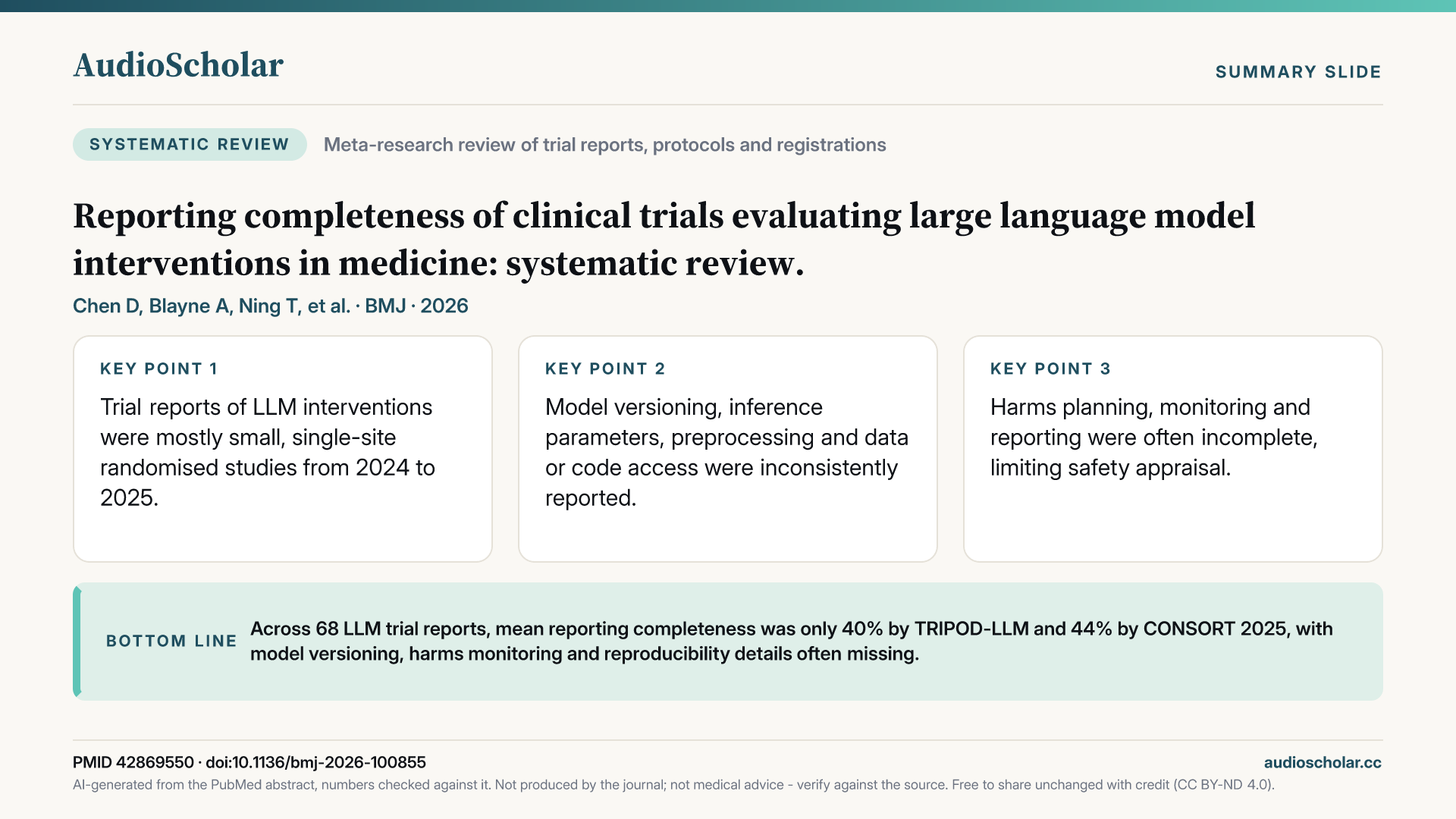
Across 68 LLM trial reports, mean reporting completeness was only 40% by TRIPOD-LLM and 44% by CONSORT 2025, with model versioning, harms monitoring and reproducibility details often missing.
BMJ · 2026 · PubMed

Papers in this briefing
- 01
Clinician Use of an Artificial Intelligence-Enabled Clinical Information Platform.
Over 2.5 years, 952,008 US clinicians submitted 271 million queries to OpenEvidence, mostly for treatment and management (33.1%) rather than diagnosis (13.9%), showing rapid, uneven adoption across specialties and career stages.
JAMA · 2026
From the briefingAI is moving from the background into the clinical conversation itself, and this period offers the first large picture of what that looks like. In JAMA, Patel and colleagues analysed every verified clinician account on OpenEvidence, the AI clinical information platform, over two and a half years [1]. The scale is striking. Close to a million clinicians in the United States submitted about 270 million queries, and monthly active users grew from a few hundred to more than seven hundred thousand. The more useful finding is the pattern of use. The tool is used mainly for treatment and management decisions rather than diagnosis. Nurse practitioners and physician assistants query it more often than physicians do. Early-career physicians and trainees use it heavily, and procedural and imaging specialties barely use it at all. A large share of queries fall outside the clinician's own specialty, rising to nearly nine in ten among emergency physicians. This is a cross-sectional analysis of a single commercial platform. A language model classified the queries, so the purpose categories are themselves AI-generated, and the data say nothing about whether the answers were correct or changed outcomes. What it does establish is that generalists already use AI to make decisions outside their home territory.
Written by AI from the published abstract, for healthcare professionals. Not medical advice; check the paper before acting on it.
- 02
Reporting completeness of clinical trials evaluating large language model interventions in medicine: systematic review.
Across 68 LLM trial reports, mean reporting completeness was only 40% by TRIPOD-LLM and 44% by CONSORT 2025, with model versioning, harms monitoring and reproducibility details often missing.
BMJ · 2026
From the briefingThat leads straight to whether the evidence beneath these tools can bear the weight now being placed on it. In The BMJ, Chen and colleagues systematically reviewed clinical trials of large language model interventions, covering trial reports, protocols and registrations [2]. The trial reports were mostly small, single-site randomised studies. When measured against established standards, including CONSORT-AI and the newer chatbot-specific guidance, reporting was only about half complete on average. The gaps were in exactly the details that matter for language models: which model version was tested, how it was accessed, the settings used and how outputs were processed. Harms planning and reporting were frequently incomplete. A review like this measures reporting, not true quality, and the field is moving fast. Even so, the authors conclude that most published trials could not be replicated or properly appraised for safety.
If you read only one paper from this period, make it the BMJ systematic review from Chen and colleagues [2]. It reopens the question of whether the trial evidence for language-model tools can support the scale of use that the JAMA data describe, and it gives a concrete checklist for judging any new claim.
Written by AI from the published abstract, for healthcare professionals. Not medical advice; check the paper before acting on it.
- 03
Human-artificial intelligence collaboration for comanaging epilepsy in real time.
In 13 inpatients undergoing video-EEG monitoring, an LLM-linked platform improved seizure detector precision from patient feedback alone in pseudoprospective simulation, suggesting adaptive, patient-facing AI devices are feasible.
Nature Medicine · 2026
From the briefingThe epilepsy work in Nature Medicine from Goldblum and colleagues takes the conversation one step further, because here the AI talks directly to patients [3]. Their prototype links scalp or intracranial EEG to a language-model assistant on a smartphone. The assistant tells patients about seizure risk, missed medication and sleep, and it uses their replies to retrain its seizure detector. In a simulation built on recordings from thirteen inpatients undergoing video-EEG monitoring, patient feedback alone made the detector more precise, with fewer false alarms and no expert input. Thirteen patients in a monitored unit is a proof of concept. The approach has not been tested in ambulatory patients or in real time, and it is a long way from an implanted device. Taken together with the scribe viewpoint, though, it raises an open question. Should a feedback loop driven by the patient's own narrative be treated as a source of signal, or as a source of noise?
Written by AI from the published abstract, for healthcare professionals. Not medical advice; check the paper before acting on it.
- 04
An open vision-language model for diverse medical applications.
MedGemma improved out-of-distribution medical image question answering by 2.6-10% and chest X-ray finding classification by 15.5-18.1% over base models, offering an open foundation for medical AI development.
Nature Medicine · 2026
From the briefingOne development points the other way. Also in Nature Medicine, Sellergren and colleagues release MedGemma, a family of open medical vision-language models built on Google's Gemma 3, along with a medically tuned image encoder [4]. On benchmarks, the medical versions clearly beat their base models. The gains were largest in chest X-ray finding classification, at roughly fifteen to eighteen points, and fine-tuning the medical version worked better when training data were scarce. These are benchmark results, not clinical outcomes, and they come from the developers themselves. Still, open weights are precisely the kind of reproducibility artefact the other two reviews found missing. The tension here is worth stating plainly. JAMA shows near-universal adoption for treatment decisions, while The BMJ shows a trial base too thinly reported to judge safety. What would close that gap is adequately sized, pre-registered trials with clinical endpoints, reporting the exact model version.
Written by AI from the published abstract, for healthcare professionals. Not medical advice; check the paper before acting on it.
- 05
AI-assisted scoping review of code sharing in clinical prediction model research.
Of 3,967 articles citing TRIPOD or TRIPOD+AI, only 482 (12.2%) included code-sharing statements, and repositories varied widely in reproducibility features such as documentation and dependency specification.
Nature Medicine · 2026
From the briefingSounack and colleagues reach a parallel conclusion in Nature Medicine, looking at clinical prediction models more broadly [5]. They used a language-model-assisted pipeline to screen nearly four thousand papers that cite the TRIPOD reporting guidelines. Only about one in eight of these papers said the analytical code was shared at all. Even among the repositories that existed, many lacked the documentation, dependency details or structure needed to actually run the code. The screening was partly automated, so some misclassification is likely, and the work is meant to inform a new TRIPOD-Code guideline rather than to grade individual papers.
Written by AI from the published abstract, for healthcare professionals. Not medical advice; check the paper before acting on it.
- 06
Ambient scribes as narrative technologies.
Ambient AI scribes pose underacknowledged risks by superficially interpreting patient narratives, and the authors argue for patient-centred design and five priorities for administrators and clinical leaders rolling them out.
The Lancet · 2026
From the briefingThe Lancet carries a viewpoint from Ostherr and colleagues that looks at ambient scribes, the other tool most clinicians now meet [6]. They argue that scribes are not neutral transcription devices but narrative technologies. In their view, current products flatten the patient's story and drop the social and material context that often carries the clinical meaning. This is an argument from medical humanities scholarship, not data. It nonetheless names a risk that the time-saving studies rarely measure, and it sets out priorities for the managers and clinical leaders who commission these tools.
Written by AI from the published abstract, for healthcare professionals. Not medical advice; check the paper before acting on it.
- 07
Histological aging signatures for monitoring tissue-specific aging and disease.
Deep learning on 25,712 whole-slide images from 40 tissues built tissue clocks that correlated with telomere attrition and comorbidities, and blood-based age-gap prediction identified organ aging across eight diseases.
Nature Medicine · 2026
From the briefingFinally, Abila and colleagues used deep learning on more than twenty-five thousand histology slides from forty tissue types to build tissue clocks [7]. These clocks tracked telomere shortening and comorbidity. Their blood-based proxy then flagged accelerated aging in the relevant organs across eight diseases, including Alzheimer's disease, stroke and Crohn's disease. The source tissue comes from post-mortem donors in the Genotype-Tissue Expression cohort, so the findings are associative, and the clinical role of a blood-derived organ age gap remains undefined.
Written by AI from the published abstract, for healthcare professionals. Not medical advice; check the paper before acting on it.
- 08
Metabolic determinants of cancer immunotherapy outcomes identified by plasma profiling.
A machine-learning model using five metabolites plus clinical variables predicted 12-month progression-free survival on immune-checkpoint inhibitors (AUC 0.88 training, 0.73 validation) and generalized across seven external cohorts.
Nature Medicine · 2026
From the briefingSuissa and colleagues profiled more than four thousand plasma samples from patients receiving checkpoint inhibitors across five tumour types [8]. Five metabolites, combined with age, body mass index and renal function, predicted progression-free survival at one year. Histidine was favourable, while long-chain fatty acids and succinate were unfavourable. In mice, histidine supplementation boosted antitumour immunity, and histidine-rich diets were linked to better outcomes in patients without a particular microbiome signature. Performance fell noticeably from training to a validation cohort of only thirty patients. That drop is exactly the pattern the reproducibility papers warn about, and the dietary finding remains hypothesis-generating rather than trial evidence.
Written by AI from the published abstract, for healthcare professionals. Not medical advice; check the paper before acting on it.
- 09
Blood-based circular RNAs for early diagnosis of Alzheimer's disease.
A 34-circRNA blood model classified biomarker-confirmed Alzheimer's disease better than plasma pTau217 (AUC 0.945 vs 0.877), and combining both reached 0.977, though prospective validation remains needed.
Nature Medicine · 2026
From the briefingTurning to diagnostics, three Nature Medicine biomarker studies show both the promise and the fragility of machine-learning models built on biological data. Phillips and colleagues trained a model on 34 circular RNAs in blood to classify biomarker-confirmed Alzheimer's disease [9]. In their hands, it discriminated better than plasma phospho-tau 217, and the combination of the two performed better still. It stayed specific against Parkinson's disease and frontotemporal dementia, and it replicated in two independent cohorts, including the preclinical A4 cohort. In predicting progression to symptomatic disease, carrying the circular RNA signature roughly tripled the risk, a stronger signal than either phospho-tau 217 or amyloid PET. That progression analysis, however, comes from the discovery cohort, where overfitting is most likely, and the authors themselves call for larger prospective validation. Phospho-tau 217 has a far deeper validation record. A head-to-head prospective comparison in a memory-clinic population would settle which marker is better.
Written by AI from the published abstract, for healthcare professionals. Not medical advice; check the paper before acting on it.
The full briefing
This AudioScholar briefing is generated by artificial intelligence for healthcare professionals and trainees. It is not medical advice.
Welcome to your weekly update in AI in Medicine. Three threads run through this period's papers. First, AI has quietly become part of everyday clinical reasoning, mostly for treatment decisions, and it is now entering the consultation itself. Second, the evidence base behind these tools is thinner and less reproducible than that adoption would suggest. Third, a set of machine-learning biomarker studies make bold claims, in Alzheimer's disease, cancer immunotherapy and organ aging, that still need the kind of validation the methods papers keep asking for. If you use an AI tool at the point of care, or expect to order an AI-derived biomarker, this period is relevant to you.
AI is moving from the background into the clinical conversation itself, and this period offers the first large picture of what that looks like. In JAMA, Patel and colleagues analysed every verified clinician account on OpenEvidence, the AI clinical information platform, over two and a half years [1]. The scale is striking. Close to a million clinicians in the United States submitted about 270 million queries, and monthly active users grew from a few hundred to more than seven hundred thousand. The more useful finding is the pattern of use. The tool is used mainly for treatment and management decisions rather than diagnosis. Nurse practitioners and physician assistants query it more often than physicians do. Early-career physicians and trainees use it heavily, and procedural and imaging specialties barely use it at all. A large share of queries fall outside the clinician's own specialty, rising to nearly nine in ten among emergency physicians. This is a cross-sectional analysis of a single commercial platform. A language model classified the queries, so the purpose categories are themselves AI-generated, and the data say nothing about whether the answers were correct or changed outcomes. What it does establish is that generalists already use AI to make decisions outside their home territory.
The Lancet carries a viewpoint from Ostherr and colleagues that looks at ambient scribes, the other tool most clinicians now meet [6]. They argue that scribes are not neutral transcription devices but narrative technologies. In their view, current products flatten the patient's story and drop the social and material context that often carries the clinical meaning. This is an argument from medical humanities scholarship, not data. It nonetheless names a risk that the time-saving studies rarely measure, and it sets out priorities for the managers and clinical leaders who commission these tools.
The epilepsy work in Nature Medicine from Goldblum and colleagues takes the conversation one step further, because here the AI talks directly to patients [3]. Their prototype links scalp or intracranial EEG to a language-model assistant on a smartphone. The assistant tells patients about seizure risk, missed medication and sleep, and it uses their replies to retrain its seizure detector. In a simulation built on recordings from thirteen inpatients undergoing video-EEG monitoring, patient feedback alone made the detector more precise, with fewer false alarms and no expert input. Thirteen patients in a monitored unit is a proof of concept. The approach has not been tested in ambulatory patients or in real time, and it is a long way from an implanted device. Taken together with the scribe viewpoint, though, it raises an open question. Should a feedback loop driven by the patient's own narrative be treated as a source of signal, or as a source of noise?
That leads straight to whether the evidence beneath these tools can bear the weight now being placed on it. In The BMJ, Chen and colleagues systematically reviewed clinical trials of large language model interventions, covering trial reports, protocols and registrations [2]. The trial reports were mostly small, single-site randomised studies. When measured against established standards, including CONSORT-AI and the newer chatbot-specific guidance, reporting was only about half complete on average. The gaps were in exactly the details that matter for language models: which model version was tested, how it was accessed, the settings used and how outputs were processed. Harms planning and reporting were frequently incomplete. A review like this measures reporting, not true quality, and the field is moving fast. Even so, the authors conclude that most published trials could not be replicated or properly appraised for safety.
Sounack and colleagues reach a parallel conclusion in Nature Medicine, looking at clinical prediction models more broadly [5]. They used a language-model-assisted pipeline to screen nearly four thousand papers that cite the TRIPOD reporting guidelines. Only about one in eight of these papers said the analytical code was shared at all. Even among the repositories that existed, many lacked the documentation, dependency details or structure needed to actually run the code. The screening was partly automated, so some misclassification is likely, and the work is meant to inform a new TRIPOD-Code guideline rather than to grade individual papers.
One development points the other way. Also in Nature Medicine, Sellergren and colleagues release MedGemma, a family of open medical vision-language models built on Google's Gemma 3, along with a medically tuned image encoder [4]. On benchmarks, the medical versions clearly beat their base models. The gains were largest in chest X-ray finding classification, at roughly fifteen to eighteen points, and fine-tuning the medical version worked better when training data were scarce. These are benchmark results, not clinical outcomes, and they come from the developers themselves. Still, open weights are precisely the kind of reproducibility artefact the other two reviews found missing. The tension here is worth stating plainly. JAMA shows near-universal adoption for treatment decisions, while The BMJ shows a trial base too thinly reported to judge safety. What would close that gap is adequately sized, pre-registered trials with clinical endpoints, reporting the exact model version.
Turning to diagnostics, three Nature Medicine biomarker studies show both the promise and the fragility of machine-learning models built on biological data. Phillips and colleagues trained a model on 34 circular RNAs in blood to classify biomarker-confirmed Alzheimer's disease [9]. In their hands, it discriminated better than plasma phospho-tau 217, and the combination of the two performed better still. It stayed specific against Parkinson's disease and frontotemporal dementia, and it replicated in two independent cohorts, including the preclinical A4 cohort. In predicting progression to symptomatic disease, carrying the circular RNA signature roughly tripled the risk, a stronger signal than either phospho-tau 217 or amyloid PET. That progression analysis, however, comes from the discovery cohort, where overfitting is most likely, and the authors themselves call for larger prospective validation. Phospho-tau 217 has a far deeper validation record. A head-to-head prospective comparison in a memory-clinic population would settle which marker is better.
Suissa and colleagues profiled more than four thousand plasma samples from patients receiving checkpoint inhibitors across five tumour types [8]. Five metabolites, combined with age, body mass index and renal function, predicted progression-free survival at one year. Histidine was favourable, while long-chain fatty acids and succinate were unfavourable. In mice, histidine supplementation boosted antitumour immunity, and histidine-rich diets were linked to better outcomes in patients without a particular microbiome signature. Performance fell noticeably from training to a validation cohort of only thirty patients. That drop is exactly the pattern the reproducibility papers warn about, and the dietary finding remains hypothesis-generating rather than trial evidence.
Finally, Abila and colleagues used deep learning on more than twenty-five thousand histology slides from forty tissue types to build tissue clocks [7]. These clocks tracked telomere shortening and comorbidity. Their blood-based proxy then flagged accelerated aging in the relevant organs across eight diseases, including Alzheimer's disease, stroke and Crohn's disease. The source tissue comes from post-mortem donors in the Genotype-Tissue Expression cohort, so the findings are associative, and the clinical role of a blood-derived organ age gap remains undefined.
If you read only one paper from this period, make it the BMJ systematic review from Chen and colleagues [2]. It reopens the question of whether the trial evidence for language-model tools can support the scale of use that the JAMA data describe, and it gives a concrete checklist for judging any new claim.
Here is what this period adds up to. Clinical AI adoption is no longer hypothetical. It is heavy and concentrated among generalists and trainees, and it is used mainly for treatment decisions, although that evidence is descriptive and comes from a single platform. The trial and modelling literature behind these tools is consistently under-reported, especially on model versions and harms, and two independent reviews agree on this. Open models like MedGemma make reproducibility possible but do not guarantee it, and their benefits remain benchmark results. Blood-based AI biomarkers for Alzheimer's disease and immunotherapy response look promising, but they rest on discovery-heavy analyses and small validation sets, and none has entered guidelines. The development to watch is prospective, version-locked validation, both for chat tools and for biomarkers.
That's your AI in Medicine update for this period. Until next time.
This is an automated summary generated by artificial intelligence, which can make mistakes. Always review the original source materials.
Spot something worth flagging?
Get this every week in your podcast app — free.
New research episodes land in your feed automatically — listen on your commute.