This Week in Pediatrics — Oct 19, 2026
Generated Oct 19, 2026 · 11:55
The week's practice-changing Pediatrics research, summarized for clinicians.
If the audio fails to play, refresh the page to renew the link.
Get next week’s Pediatrics briefing — free.
In your podcast app, or readable in your inbox with the audio one tap away.
Optimizing Antibiotic Duration for Pneumonia and Sinusitis in the Pediatric Emergency Department.
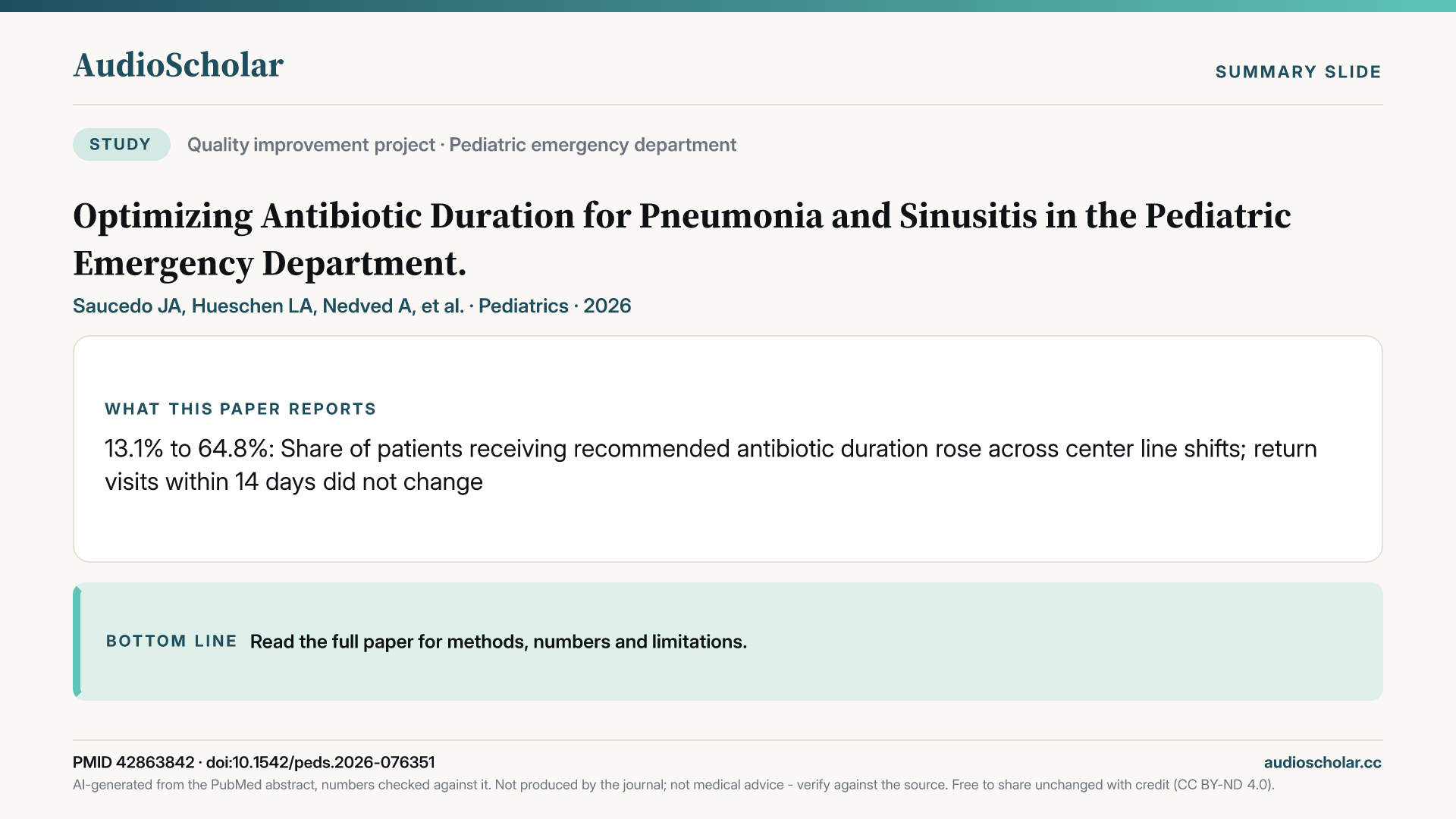
A pediatric emergency department quality improvement program raised guideline-concordant short antibiotic courses for pneumonia and sinusitis from about 13 to 65 percent, without any change in return visits.
Pediatrics · 2026 · PubMed

This week’s papers
- 01
Estimates of Anxiety Symptoms Among US Adolescents.
About one in six adolescents in the United States reported moderate or severe anxiety in 2024, often with depression or suicidal thoughts, yet roughly four in ten with severe symptoms received no treatment.
Bommersbach TJ et al. · JAMA Pediatrics · 2026
From the briefingIn JAMA Pediatrics, Bommersbach and colleagues analysed the 2024 National Survey on Drug Use and Health, covering more than fifteen thousand adolescents aged 12 to 20, using the GAD-7 screener [1]. Roughly one in six adolescents in the United States reported moderate or severe anxiety symptoms, and female adolescents carried a markedly heavier load, with severe symptoms close to three times as common as in males. The comorbidity is striking: among teenagers with severe anxiety, about two thirds of them met criteria for a past-year major depressive episode, and nearly half of them reported suicidal thoughts in the past year. Yet about four in ten adolescents with severe symptoms received no mental health treatment at all, and treatment was less likely for boys, for racial and ethnic minoritized youth, and for the uninsured. This is cross-sectional self-report data, so it describes burden and gaps rather than causes, but the unmet need is hard to dismiss.
Written by AI from the published abstract, for healthcare professionals. Not medical advice; check the paper before acting on it.
- 02
Problematic Social Media Use and Depressive and Anxiety Symptoms in Adolescents.
In over eleven thousand adolescents followed five years, problematic social media use and depressive symptoms predicted each other in certain years, more strongly in girls, with no prospective link to anxiety.
Nagata JM et al. · Pediatrics · 2026
From the briefingAlongside it, in Pediatrics, Nagata and colleagues used five annual waves of the Adolescent Brain Cognitive Development Study, about eleven thousand participants starting around age twelve, to ask whether problematic social media use and mood symptoms drive each other over time [2]. Using within-person models, they found bidirectional links between problematic use and depressive symptoms, but only in certain years of early adolescence, and the links were stronger and more consistent in girls. For anxiety, there were no prospective associations in either direction. So the social media story is narrower than the public debate suggests: it concerns problematic patterns of use rather than screen time, it is tied to depression more than anxiety, and the effect appears time-limited. The authors argue this supports screening that focuses on problematic features of use and attends to developmental timing and sex, though observational cohort data cannot establish that changing use changes mood.
Written by AI from the published abstract, for healthcare professionals. Not medical advice; check the paper before acting on it.
- 03
Prenatal Exposure to Delta 9-Tetrahydrocannabinol and Child Neurodevelopment: A Critical Windows Analysis.
Cannabis exposure detected at delivery was linked to more attention, ADHD, and pervasive developmental problems at age five, suggesting late-gestation exposure carries the strongest neurobehavioral signal in this 460-pair cohort.
Moore BF et al. · Journal of Pediatrics · 2026
From the briefingIn the Journal of Pediatrics, Moore and colleagues followed 460 mother-child pairs in the Healthy Start cohort, measuring delta 9 tetrahydrocannabinol in maternal serum at about 17 and 27 weeks and in cord blood at birth, then assessing behaviour and cognition at age five [3]. Exposure prevalence fell from about 8 percent mid-pregnancy to about 5 percent at delivery, and associations with behaviour were strongest for late-gestation exposure, with exposure detected at delivery linked to higher scores for attention problems, ADHD symptoms, and pervasive developmental problems. The sample is modest and the cord blood subset smaller still, so this is hypothesis-strengthening rather than definitive, but the authors read the timing pattern as evidence that stopping cannabis even late in pregnancy may still matter for the child.
Written by AI from the published abstract, for healthcare professionals. Not medical advice; check the paper before acting on it.
- 04
Benzodiazepine Use Early in Pregnancy and Risk for Congenital Malformations.
Across more than four million insured pregnancies, first-trimester benzodiazepine exposure was not associated with increased major congenital malformations, with no dose-response and only inconsistent signals in coexposure analyses.
Fung K et al. · Annals of Internal Medicine · 2026
From the briefingIn the Annals of Internal Medicine, Fung and colleagues examined first-trimester benzodiazepine fills across more than four million pregnancies in Medicaid and commercial insurance data [4]. The adjusted absolute risk of any major malformation was essentially identical in exposed and unexposed pregnancies, around four to five percent in both groups, and the pooled relative risk sat right at one. There was no dose-response relationship, no consistent organ-specific signal, and similar results across individual benzodiazepines. Coexposure with other psychoactive drugs produced some scattered signals, but no consistent pattern, and the authors flag that for further study. Misclassification and restriction to live births are real limitations, but the scale makes this one of the more reassuring datasets available on the question of structural birth defects. Cannabis looks different.
Written by AI from the published abstract, for healthcare professionals. Not medical advice; check the paper before acting on it.
- 05
Optimizing Antibiotic Duration for Pneumonia and Sinusitis in the Pediatric Emergency Department.
A pediatric emergency department quality improvement program raised guideline-concordant short antibiotic courses for pneumonia and sinusitis from about 13 to 65 percent, without any change in return visits.
Saucedo JA et al. · Pediatrics · 2026
From the briefingIn Pediatrics, Saucedo and colleagues report a quality improvement project in a pediatric emergency department aimed at aligning antibiotic courses with updated guidance, three to five days for uncomplicated community-acquired pneumonia and five to seven days for acute bacterial rhinosinusitis [5]. Through clinical pathways, electronic health record changes, quick-discharge order sets, and prescriber education with feedback, the share of children discharged on an optimal duration climbed from about 13 percent to about 65 percent, just short of their 70 percent goal. Pneumonia drove most of the change, sinusitis improved similarly, and return visits for the same diagnosis within two weeks did not change. As a single-system quality improvement report it cannot prove safety with trial-level rigour, but it shows that shorter-course guidance can be implemented at scale without an apparent rise in bounce-backs.
If you only have time for one paper this week, make it the Saucedo quality improvement study in Pediatrics [5]. Short-course antibiotics for pneumonia and sinusitis are now in guidelines, and this paper addresses the question that remains, whether a busy pediatric emergency department can actually shift prescribing at scale without a signal of harm in return visits.
Written by AI from the published abstract, for healthcare professionals. Not medical advice; check the paper before acting on it.
- 06
Caustic ingestion in children: A prospective analysis of poor outcome key predictors useful for clinical management optimization.
Among 283 children after caustic ingestion, no asymptomatic child had severe mucosal injury, supporting avoidance of endoscopy in asymptomatic older children who can reliably report symptoms.
Gragnaniello P et al. · Journal of Pediatric Gastroenterology and Nutrition · 2026
From the briefingAlso concerned with who needs what, Gragnaniello and colleagues, in the Journal of Pediatric Gastroenterology and Nutrition, prospectively enrolled 283 children admitted after caustic ingestion [6]. No asymptomatic child had a poor outcome, defined as high-grade mucosal injury. Hematemesis, drooling, vomiting, and oropharyngeal or lip lesions all marked higher risk, as did ingestion of caustics decanted into plastic cups or bottles. The authors conclude that endoscopy may be avoidable in truly asymptomatic children, with an important caveat that this does not extend to children under 18 months or those with developmental or neuropsychiatric conditions who cannot reliably report symptoms.
Written by AI from the published abstract, for healthcare professionals. Not medical advice; check the paper before acting on it.
- 07
Association of Early Primary Care Follow-Up With Acute Care Use After ICU Discharge.
In about 180 thousand pediatric ICU stays, primary care follow-up within seven days of discharge was associated with fewer emergency visits and readmissions over the following three months.
Carlton EF et al. · Pediatrics · 2026
From the briefingFinally, Carlton and colleagues, again in Pediatrics, looked at what happens after the intensive care unit [7]. Across roughly 180 thousand pediatric ICU hospitalizations in public and private claims data, about a third of the publicly insured stays were followed by emergency visits or readmission between day 8 and day 90. Children seen in primary care within seven days of discharge had lower acute care use, a modest reduction of a few percent among publicly insured children and roughly a 30 percent reduction among privately insured children, with larger effects in older children and after sepsis, and the association held in more recent data. Matching cannot eliminate the possibility that families who attend early follow-up differ in unmeasured ways, so this supports, but does not prove, the value of early primary care after critical illness.
Written by AI from the published abstract, for healthcare professionals. Not medical advice; check the paper before acting on it.
- 08
Impact on mortality of inhaled nitric oxide in newborns ≤34 weeks with early hypoxemic respiratory failure: systematic review and meta-analysis.
Pooled data from 556 preterm infants showed no significant mortality reduction with inhaled nitric oxide for early hypoxemic respiratory failure, though oxygenation responders by clinical phenotype appeared to fare better.
Alvarado-Socarras JL et al. · Pediatric Research · 2026
From the briefingIn Pediatric Research, Alvarado-Socarras and colleagues pooled studies of inhaled nitric oxide in preterm infants at or below 34 weeks with early hypoxemic respiratory failure [8]. Across six studies and 556 infants in the meta-analysis, there was no statistically significant reduction in mortality, with substantial heterogeneity and generally weak study quality, and treated infants were sicker at baseline. Infants who showed an oxygenation response did better, and that response varied with gestational age, timing of pulmonary hypertension, echocardiographic confirmation, and severity of hypoxemia. The authors argue for a selective, phenotype-driven approach rather than routine use, while acknowledging that only randomized trials can settle the question.
Written by AI from the published abstract, for healthcare professionals. Not medical advice; check the paper before acting on it.
- 09
Aspirin dose and coronary artery lesions in Kawasaki disease: a two-center retrospective comparative effectiveness study.
In 997 Chinese children with Kawasaki disease, aspirin at 30 to under 40 versus 40 to 50 mg/kg/day gave similar coronary lesion rates while roughly halving adverse drug reactions.
Zhao BN et al. · European Journal of Pediatrics · 2026
From the briefingIn the European Journal of Pediatrics, Zhao and colleagues compared aspirin doses within the Chinese guideline range for acute Kawasaki disease across 997 children at two hospitals [9]. Coronary artery lesions at four weeks occurred in about 14 percent of children in both the 30 to under 40 milligram per kilogram per day group and the 40 to 50 milligram group, and IVIG non-response was similar, but adverse drug reactions roughly doubled with the higher dose. Multiple sensitivity analyses agreed, though as the authors note, observational data cannot formally demonstrate equivalence, and the findings come from Chinese children within a specific dose window.
Written by AI from the published abstract, for healthcare professionals. Not medical advice; check the paper before acting on it.
- 10
Clesrovimab in the new era of RSV prevention: one season, one dose, one chance.
Single-dose clesrovimab reduced RSV lower respiratory infection and hospitalization in infants in its pivotal trial, about 51 treated per hospitalization prevented, but head-to-head and post-licensure data remain lacking.
Farhath F et al. · Pediatric Research · 2026
From the briefingAnd in a policy-focused perspective, also in Pediatric Research, Farhath and Kumar review clesrovimab, the single-dose, season-long RSV monoclonal antibody [10]. Drawing on the CLEVER trial, they note it reduced medically attended RSV lower respiratory infection and hospitalization in infants entering their first season, with safety comparable to placebo and roughly 51 infants treated to prevent one hospitalization over five months. They emphasize the gaps: no head-to-head data against nirsevimab, limited post-licensure experience, and open questions on durability and affordability. This is a narrative review rather than new data, and its main contribution is framing RSV prevention as a population strategy rather than a niche intervention for high-risk infants.
Written by AI from the published abstract, for healthcare professionals. Not medical advice; check the paper before acting on it.
The full briefing
This AudioScholar briefing is generated by artificial intelligence for healthcare professionals and trainees. It is not medical advice.
Welcome to This Week in Pediatrics. This week we're covering 10 notable papers spanning adolescent mental health, prenatal medication and substance exposures, and how we treat acutely ill children from the emergency department through the neonatal unit and beyond. Let's dive in.
We start with adolescent mental health, where two large datasets sharpen the picture of anxiety and depression in teenagers. In JAMA Pediatrics, Bommersbach and colleagues analysed the 2024 National Survey on Drug Use and Health, covering more than fifteen thousand adolescents aged 12 to 20, using the GAD-7 screener [1]. Roughly one in six adolescents in the United States reported moderate or severe anxiety symptoms, and female adolescents carried a markedly heavier load, with severe symptoms close to three times as common as in males. The comorbidity is striking: among teenagers with severe anxiety, about two thirds of them met criteria for a past-year major depressive episode, and nearly half of them reported suicidal thoughts in the past year. Yet about four in ten adolescents with severe symptoms received no mental health treatment at all, and treatment was less likely for boys, for racial and ethnic minoritized youth, and for the uninsured. This is cross-sectional self-report data, so it describes burden and gaps rather than causes, but the unmet need is hard to dismiss. Alongside it, in Pediatrics, Nagata and colleagues used five annual waves of the Adolescent Brain Cognitive Development Study, about eleven thousand participants starting around age twelve, to ask whether problematic social media use and mood symptoms drive each other over time [2]. Using within-person models, they found bidirectional links between problematic use and depressive symptoms, but only in certain years of early adolescence, and the links were stronger and more consistent in girls. For anxiety, there were no prospective associations in either direction. So the social media story is narrower than the public debate suggests: it concerns problematic patterns of use rather than screen time, it is tied to depression more than anxiety, and the effect appears time-limited. The authors argue this supports screening that focuses on problematic features of use and attends to developmental timing and sex, though observational cohort data cannot establish that changing use changes mood.
Our second theme is prenatal exposure, and two studies point in somewhat reassuring and somewhat cautionary directions. In the Annals of Internal Medicine, Fung and colleagues examined first-trimester benzodiazepine fills across more than four million pregnancies in Medicaid and commercial insurance data [4]. The adjusted absolute risk of any major malformation was essentially identical in exposed and unexposed pregnancies, around four to five percent in both groups, and the pooled relative risk sat right at one. There was no dose-response relationship, no consistent organ-specific signal, and similar results across individual benzodiazepines. Coexposure with other psychoactive drugs produced some scattered signals, but no consistent pattern, and the authors flag that for further study. Misclassification and restriction to live births are real limitations, but the scale makes this one of the more reassuring datasets available on the question of structural birth defects. Cannabis looks different. In the Journal of Pediatrics, Moore and colleagues followed 460 mother-child pairs in the Healthy Start cohort, measuring delta 9 tetrahydrocannabinol in maternal serum at about 17 and 27 weeks and in cord blood at birth, then assessing behaviour and cognition at age five [3]. Exposure prevalence fell from about 8 percent mid-pregnancy to about 5 percent at delivery, and associations with behaviour were strongest for late-gestation exposure, with exposure detected at delivery linked to higher scores for attention problems, ADHD symptoms, and pervasive developmental problems. The sample is modest and the cord blood subset smaller still, so this is hypothesis-strengthening rather than definitive, but the authors read the timing pattern as evidence that stopping cannabis even late in pregnancy may still matter for the child.
The third theme is acute care, from the emergency department to the transitions after critical illness. In Pediatrics, Saucedo and colleagues report a quality improvement project in a pediatric emergency department aimed at aligning antibiotic courses with updated guidance, three to five days for uncomplicated community-acquired pneumonia and five to seven days for acute bacterial rhinosinusitis [5]. Through clinical pathways, electronic health record changes, quick-discharge order sets, and prescriber education with feedback, the share of children discharged on an optimal duration climbed from about 13 percent to about 65 percent, just short of their 70 percent goal. Pneumonia drove most of the change, sinusitis improved similarly, and return visits for the same diagnosis within two weeks did not change. As a single-system quality improvement report it cannot prove safety with trial-level rigour, but it shows that shorter-course guidance can be implemented at scale without an apparent rise in bounce-backs. Also concerned with who needs what, Gragnaniello and colleagues, in the Journal of Pediatric Gastroenterology and Nutrition, prospectively enrolled 283 children admitted after caustic ingestion [6]. No asymptomatic child had a poor outcome, defined as high-grade mucosal injury. Hematemesis, drooling, vomiting, and oropharyngeal or lip lesions all marked higher risk, as did ingestion of caustics decanted into plastic cups or bottles. The authors conclude that endoscopy may be avoidable in truly asymptomatic children, with an important caveat that this does not extend to children under 18 months or those with developmental or neuropsychiatric conditions who cannot reliably report symptoms. Finally, Carlton and colleagues, again in Pediatrics, looked at what happens after the intensive care unit [7]. Across roughly 180 thousand pediatric ICU hospitalizations in public and private claims data, about a third of the publicly insured stays were followed by emergency visits or readmission between day 8 and day 90. Children seen in primary care within seven days of discharge had lower acute care use, a modest reduction of a few percent among publicly insured children and roughly a 30 percent reduction among privately insured children, with larger effects in older children and after sepsis, and the association held in more recent data. Matching cannot eliminate the possibility that families who attend early follow-up differ in unmeasured ways, so this supports, but does not prove, the value of early primary care after critical illness.
Our last theme puts familiar therapies under the microscope. In Pediatric Research, Alvarado-Socarras and colleagues pooled studies of inhaled nitric oxide in preterm infants at or below 34 weeks with early hypoxemic respiratory failure [8]. Across six studies and 556 infants in the meta-analysis, there was no statistically significant reduction in mortality, with substantial heterogeneity and generally weak study quality, and treated infants were sicker at baseline. Infants who showed an oxygenation response did better, and that response varied with gestational age, timing of pulmonary hypertension, echocardiographic confirmation, and severity of hypoxemia. The authors argue for a selective, phenotype-driven approach rather than routine use, while acknowledging that only randomized trials can settle the question. In the European Journal of Pediatrics, Zhao and colleagues compared aspirin doses within the Chinese guideline range for acute Kawasaki disease across 997 children at two hospitals [9]. Coronary artery lesions at four weeks occurred in about 14 percent of children in both the 30 to under 40 milligram per kilogram per day group and the 40 to 50 milligram group, and IVIG non-response was similar, but adverse drug reactions roughly doubled with the higher dose. Multiple sensitivity analyses agreed, though as the authors note, observational data cannot formally demonstrate equivalence, and the findings come from Chinese children within a specific dose window. And in a policy-focused perspective, also in Pediatric Research, Farhath and Kumar review clesrovimab, the single-dose, season-long RSV monoclonal antibody [10]. Drawing on the CLEVER trial, they note it reduced medically attended RSV lower respiratory infection and hospitalization in infants entering their first season, with safety comparable to placebo and roughly 51 infants treated to prevent one hospitalization over five months. They emphasize the gaps: no head-to-head data against nirsevimab, limited post-licensure experience, and open questions on durability and affordability. This is a narrative review rather than new data, and its main contribution is framing RSV prevention as a population strategy rather than a niche intervention for high-risk infants.
If you only have time for one paper this week, make it the Saucedo quality improvement study in Pediatrics [5]. Short-course antibiotics for pneumonia and sinusitis are now in guidelines, and this paper addresses the question that remains, whether a busy pediatric emergency department can actually shift prescribing at scale without a signal of harm in return visits.
Here is what this week's evidence adds up to in Pediatrics. First, roughly one in six adolescents reports moderate or severe anxiety, often with depression and suicidal thinking, and a large share of them receive no treatment; the social media link appears specific to problematic use and depression, mainly in girls, and remains observational. Second, a very large cohort finds no meaningful increase in major malformations after first-trimester benzodiazepine exposure, while a smaller cohort suggests late-pregnancy cannabis exposure carries the strongest behavioural signal, a finding that needs replication. Third, shorter antibiotic courses for pneumonia and sinusitis can be implemented in an emergency setting without more return visits, and prospective data suggest truly asymptomatic children after caustic ingestion rarely have severe injury, with clear exceptions for the very young and developmentally impaired. Fourth, early primary care follow-up after pediatric intensive care is associated with less acute care use, though causality is not established. Finally, inhaled nitric oxide shows no consistent survival benefit in preterm infants, lower-range aspirin in Kawasaki disease looks as effective with fewer side effects in one observational cohort, and clesrovimab joins the RSV prevention toolkit without yet any head-to-head comparison.
That's your roundup for This Week in Pediatrics. The full transcript and references are available on the episode page. This is an AI-curated summary — for clinical decisions, always consult primary sources and current guidelines. See you next week.
If this weekly briefing is useful, follow the show in your podcast app so new episodes arrive automatically. And think of one colleague — in any specialty — who never has time to keep up with the literature. Tell them about AudioScholar: a free ten-minute weekly for every specialty, to listen to in any podcast app, or to read at audioscholar dot C C.
This is an automated summary generated by artificial intelligence, which can make mistakes. Always review the original source materials.
Spot something worth flagging?
Get this every week in your podcast app — free.
New pediatrics episodes land in your feed automatically — listen on your commute.