This Week in Critical Care — Oct 21, 2026
Generated Oct 21, 2026 · 12:12
The week's practice-changing Critical Care research, summarized for clinicians.
If the audio fails to play, refresh the page to renew the link.
Get next week’s Critical Care briefing — free.
In your podcast app, or readable in your inbox with the audio one tap away.
Intraoperative Dobutamine Plus Norepinephrine to Prevent Postoperative Acute Kidney Injury in Septic Shock: A Randomized Clinical Trial.
Adding intraoperative dobutamine to norepinephrine during surgical source control for septic shock cut new or worsening acute kidney injury from about 35 to 23 percent, with more tachycardia.
JAMA · 2026 · PubMed

This week’s papers
- 01
Effect of Vasopressin Initiation Threshold on Septic Shock Mortality: The VASSPR Cluster Crossover Randomized Strategy Trial.
In nearly four thousand septic shock patients, starting vasopressin at a lower norepinephrine-equivalent threshold did not reduce 28-day mortality or kidney replacement needs compared with a higher threshold.
Peltan ID et al. · JAMA · 2026
- 02
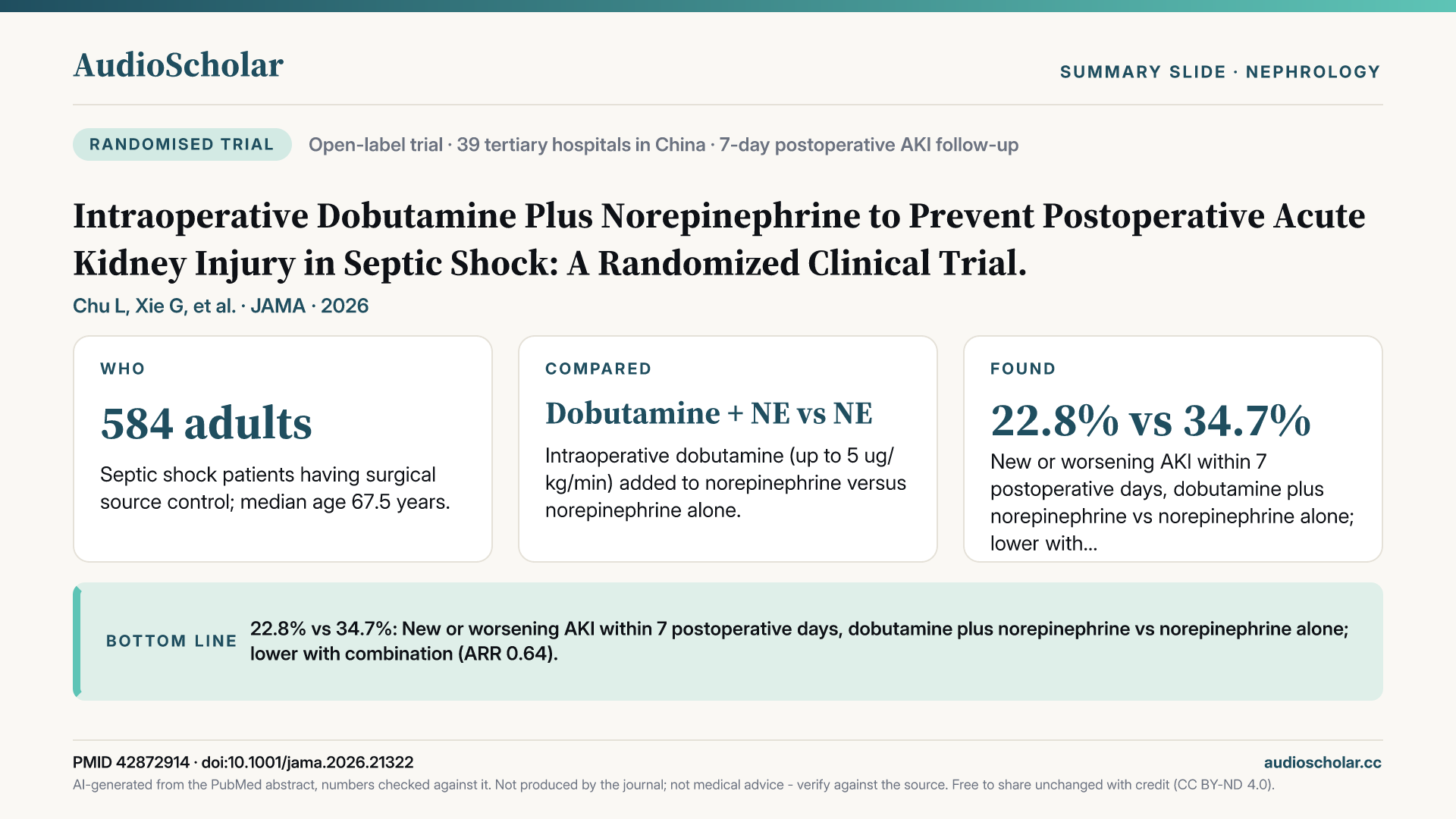
Intraoperative Dobutamine Plus Norepinephrine to Prevent Postoperative Acute Kidney Injury in Septic Shock: A Randomized Clinical Trial.
Adding intraoperative dobutamine to norepinephrine during surgical source control for septic shock cut new or worsening acute kidney injury from about 35 to 23 percent, with more tachycardia.
Chu L et al. · JAMA · 2026
From the briefingIf you only have time for one paper this week, make it the intraoperative dobutamine trial in JAMA [2]. It provides the first substantial randomized evidence behind a guideline recommendation that has rested on very low-certainty evidence, while leaving open whether the kidney benefit translates into survival and how it generalizes beyond surgical source control.
Written by AI from the published abstract, for healthcare professionals. Not medical advice; check the paper before acting on it.
- 03
What every intensivist should know about dynamic left ventricular outflow tract obstruction.
Dynamic left ventricular outflow tract obstruction is an underrecognized, often iatrogenic cause of ICU shock that inotropes can worsen, and is identifiable with bedside echocardiography and managed physiologically.
Rola P et al. · Journal of Critical Care · 2026
From the briefingThat inotrope signal sits in deliberate tension with a narrative review in the Journal of Critical Care by Rola and Augustin on dynamic left ventricular outflow tract obstruction [3]. They argue that this load-dependent obstruction is underrecognized in septic shock, hypovolaemia, postoperative states and right ventricular failure, and that standard escalation with inotropes and afterload reduction can paradoxically worsen it. Their account centres on bedside echocardiography, a small hyperdynamic left ventricle and a late-peaking Doppler profile, with management aimed at restoring preload, raising afterload and dampening contractility. It is expert review rather than trial evidence, but read alongside the dobutamine trial it is a reminder that the patients who benefit from added contractility and the patients harmed by it can look similar without imaging.
Written by AI from the published abstract, for healthcare professionals. Not medical advice; check the paper before acting on it.
- 04
Guidelines for the management of atrial fibrillation in adult patients admitted to an intensive care unit.
French Intensive Care Society guidelines issued 18 recommendations on ICU atrial fibrillation, but sixteen were expert opinion and six questions lacked sufficient evidence for any recommendation.
Labbé V et al. · Annals of Intensive Care · 2026
From the briefingArrhythmia in the shocked patient is the subject of new guidelines from the French Intensive Care Society, published in Annals of Intensive Care by Labbé and colleagues [4]. Using GRADE methodology across 24 questions, mostly on new-onset atrial fibrillation, the panel issued 18 recommendations covering echocardiography, reversible triggers such as fluid status, magnesium and potassium, rate and rhythm control, and anticoagulation. All reached strong agreement, but only two rested on even low-level evidence; the other sixteen were expert opinion, and for six further questions the panel judged the evidence too thin to recommend anything. The document is useful as a structured consensus, and equally useful as a map of how little trial evidence exists for atrial fibrillation in the intensive care unit.
Written by AI from the published abstract, for healthcare professionals. Not medical advice; check the paper before acting on it.
- 05
Isoflurane-Based Inhaled Sedation in Mechanically Ventilated Adults With Acute Hypoxemic Respiratory Failure: The SAVE-ICU Randomized Clinical Trial.
Isoflurane-based inhaled sedation did not lower hospital mortality versus intravenous sedation in ventilated adults with hypoxaemic respiratory failure and was associated with fewer delirium- and coma-free days.
Jerath A et al. · JAMA · 2026
- 06
Open Visiting Policy and Delirium in Adult Patients in ICUs: A Systematic Review and Meta-Analysis of Randomized Clinical Trials.
Across 13 randomized trials, open or flexible ICU visiting roughly halved delirium and slightly shortened ventilation without raising infections or mortality, though certainty of evidence was low.
Sella N et al. · Critical Care Medicine · 2026
From the briefingDelirium also features in a meta-analysis in Critical Care Medicine from Sella and colleagues, pooling 13 randomized trials and nearly four thousand patients comparing open or flexible family visiting with restricted policies [6]. Open visiting was associated with roughly halving delirium and shortening invasive ventilation by about a third of a day, with no increase in hospital-acquired infections and no change in mortality. The authors rate the certainty as low and heterogeneity as substantial, so this is a supportive but not definitive signal for a low-risk intervention.
Written by AI from the published abstract, for healthcare professionals. Not medical advice; check the paper before acting on it.
- 07
Weaning Strategies for High-Flow Nasal Cannula in Critically Ill Adults: A Randomized Clinical Trial.
In 87 critically ill adults, reducing flow first, oxygen first, or both together produced no statistically significant differences in high-flow nasal cannula weaning success or duration.
Kim T et al. · Critical Care Medicine · 2026
From the briefingOn the liberation side, a small three-arm trial in Critical Care Medicine from Kim and colleagues compared reducing flow first, reducing inspired oxygen first, or reducing both together when weaning high-flow nasal cannula in 87 patients [7]. Weaning success was 94 percent, 81 percent and 77 percent respectively, and weaning duration was about 30 hours in every arm; neither difference was statistically significant. The numerical lead for flow-first weaning is hypothesis-generating at most in a trial this size.
Written by AI from the published abstract, for healthcare professionals. Not medical advice; check the paper before acting on it.
- 08
Permissive versus conventional weaning from venovenous ECMO in patients with ARDS: a retrospective cohort study.
Decannulating ARDS patients from venovenous ECMO despite persistently impaired respiratory mechanics was associated with roughly four-fold higher 90-day mortality in a retrospective single-centre cohort.
Moyon Q et al. · Annals of Intensive Care · 2026
From the briefingMore concerning is a retrospective single-centre cohort in Annals of Intensive Care from Moyon and colleagues on weaning from venovenous ECMO in ARDS [8]. Of 280 patients successfully decannulated, about four in ten were weaned permissively, meaning decannulated despite persistently high plateau or driving pressure, high PEEP, or very low tidal volumes, provided oxygenation and carbon dioxide clearance were adequate. Permissive weaning was associated with roughly a four-fold higher hazard of death at 90 days after adjustment, though it did not delay liberation from mechanical ventilation. The permissive group had longer ECMO runs and more COVID-related ARDS, and residual confounding is likely in an observational design, but the findings suggest that gas exchange alone may be an incomplete readiness test and that respiratory mechanics deserve weight in future weaning criteria.
Written by AI from the published abstract, for healthcare professionals. Not medical advice; check the paper before acting on it.
- 09
Fluid Therapy in Mechanically Ventilated Critically Ill Adult Patients.
Across 206 ICUs in 41 countries, maintenance and creep fluids rather than resuscitation accounted for most fluid given to ventilated adults, with wide between-site variation.
Blok SG et al. · JAMA · 2026
From the briefingIn JAMA, Blok and colleagues report an international prospective cohort of 2454 ventilated adults across 206 units in 41 countries [9]. Daily fluid input peaked at about three litres on the first day after intubation and stayed above two and a half litres through the first week, while fluid balance became roughly neutral by day three. The striking finding is what that fluid was for: maintenance and replacement fluids each accounted for about a third of volume, creep fluid from drug diluents and line flushes accounted for nearly another third, and resuscitation for only about a sixth. Balanced crystalloids made up just under half of volume, saline about a quarter, and colloids were rare, with wide variation between sites even after adjusting for case mix. This is descriptive data, but it locates the largest modifiable fluid exposure outside resuscitation.
Written by AI from the published abstract, for healthcare professionals. Not medical advice; check the paper before acting on it.
- 10
Association of Oliguria With Acute Kidney Injury, Chronic Kidney Disease, and Mortality: Determining the Optimal Threshold in Critically Ill Patients.
Urine output thresholds linked to later chronic kidney disease and 90-day mortality were lower than the conventional 0.5 mL/kg/hr oliguria definition in nearly five thousand ICU patients.
Mossberg R et al. · Critical Care Medicine · 2026
From the briefingA retrospective Swedish study from Mossberg and colleagues in Critical Care Medicine then examined urine output thresholds in nearly five thousand patients without prior chronic kidney disease at Uppsala [10]. Thresholds linked to acute kidney injury sat close to the conventional 0.5 millilitres per kilogram per hour, but the thresholds linked to later chronic kidney disease and to 90-day mortality were considerably lower, around 0.2 over short windows. The authors argue that oliguria, filtration loss and tissue injury are separate dimensions of kidney injury, which is relevant to how the dobutamine trial's kidney endpoint and future definitions are framed; as single-centre observational work, it informs definitions rather than bedside targets.
Written by AI from the published abstract, for healthcare professionals. Not medical advice; check the paper before acting on it.
The full briefing
This AudioScholar briefing is generated by artificial intelligence for healthcare professionals and trainees. It is not medical advice.
Welcome to This Week in Critical Care. This week we're covering 10 notable papers spanning haemodynamic management in septic shock, sedation and liberation from respiratory support, and the everyday practices of fluids, urine output and family presence that shape outcomes on the unit. Let's dive in.
We start with shock, where two large randomized trials in JAMA ask when and how to add a second agent to norepinephrine, and arrive at very different answers. The VASSPR trial, led by Peltan, was a pragmatic cluster crossover study across 13 hospitals in Idaho and Utah, enrolling nearly four thousand patients with septic shock. Hospitals alternated monthly between a strategy recommending fixed-dose vasopressin once other vasopressors reached 0.1 micrograms per kilogram per minute of norepinephrine equivalent, and one recommending it at 0.4. The strategies did separate in practice: among patients sick enough to be affected, about two thirds of patients under the lower threshold received vasopressin, compared with roughly four in ten under the higher threshold. Yet 28-day mortality was essentially identical, about 32 percent versus 33 percent, a difference that was not statistically significant, and kidney replacement therapy-free days were the same in both arms [1]. This is a large, well-separated, but pragmatic strategy trial, and it does not support the idea that earlier vasopressin, by itself, improves survival. It neither argues against vasopressin nor endorses a particular threshold; it suggests the timing question matters less than many had hoped. The second JAMA trial, from Chu, Xie and colleagues, tested intraoperative dobutamine, up to 5 micrograms per kilogram per minute, added to norepinephrine in 584 patients with septic shock undergoing surgical source control at 39 hospitals in China. New or worsening acute kidney injury within seven days fell from about 35 percent to about 23 percent, roughly a one-third relative reduction, with fewer stage 2 and stage 3 injuries, a slightly lower organ failure score on day one, and better early urine output [2]. Tachycardia was more common with dobutamine, and the trial was open-label, conducted in one country, in a specific perioperative population, with a kidney endpoint rather than mortality. Still, international guidelines currently recommend dobutamine in this context on very low-certainty evidence, and this is the first substantial randomized signal behind it. The authors' findings apply to the operating theatre during source control, not to inotrope use across all septic shock.
That inotrope signal sits in deliberate tension with a narrative review in the Journal of Critical Care by Rola and Augustin on dynamic left ventricular outflow tract obstruction [3]. They argue that this load-dependent obstruction is underrecognized in septic shock, hypovolaemia, postoperative states and right ventricular failure, and that standard escalation with inotropes and afterload reduction can paradoxically worsen it. Their account centres on bedside echocardiography, a small hyperdynamic left ventricle and a late-peaking Doppler profile, with management aimed at restoring preload, raising afterload and dampening contractility. It is expert review rather than trial evidence, but read alongside the dobutamine trial it is a reminder that the patients who benefit from added contractility and the patients harmed by it can look similar without imaging. Arrhythmia in the shocked patient is the subject of new guidelines from the French Intensive Care Society, published in Annals of Intensive Care by Labbé and colleagues [4]. Using GRADE methodology across 24 questions, mostly on new-onset atrial fibrillation, the panel issued 18 recommendations covering echocardiography, reversible triggers such as fluid status, magnesium and potassium, rate and rhythm control, and anticoagulation. All reached strong agreement, but only two rested on even low-level evidence; the other sixteen were expert opinion, and for six further questions the panel judged the evidence too thin to recommend anything. The document is useful as a structured consensus, and equally useful as a map of how little trial evidence exists for atrial fibrillation in the intensive care unit.
Our second theme is sedation and liberation, where this week's trials mostly report neutral results, and one observational study raises a safety question. The SAVE-ICU trial in JAMA, led by Jerath, randomized 780 mechanically ventilated adults with acute hypoxaemic respiratory failure across 14 Canadian units to isoflurane-based inhaled sedation or usual intravenous sedation. Hospital mortality was about 42 percent with inhaled sedation and about 44 percent with intravenous sedation, a difference that was not statistically significant, with no subgroup signal by age, sex or COVID-19 status, and similar ventilator-free and ICU-free days [5]. The secondary findings lean the wrong way for isoflurane: the inhaled group needed more rescue therapies for hypoxaemia and had about one fewer day alive without delirium or coma. Interpretation is complicated by the fact that roughly half of patients in the inhaled arm also received intravenous sedation on any given day, so this was a test of a strategy rather than of pure isoflurane. As it stands, the trial does not support inhaled sedation as a way to improve survival in this population. Delirium also features in a meta-analysis in Critical Care Medicine from Sella and colleagues, pooling 13 randomized trials and nearly four thousand patients comparing open or flexible family visiting with restricted policies [6]. Open visiting was associated with roughly halving delirium and shortening invasive ventilation by about a third of a day, with no increase in hospital-acquired infections and no change in mortality. The authors rate the certainty as low and heterogeneity as substantial, so this is a supportive but not definitive signal for a low-risk intervention.
On the liberation side, a small three-arm trial in Critical Care Medicine from Kim and colleagues compared reducing flow first, reducing inspired oxygen first, or reducing both together when weaning high-flow nasal cannula in 87 patients [7]. Weaning success was 94 percent, 81 percent and 77 percent respectively, and weaning duration was about 30 hours in every arm; neither difference was statistically significant. The numerical lead for flow-first weaning is hypothesis-generating at most in a trial this size. More concerning is a retrospective single-centre cohort in Annals of Intensive Care from Moyon and colleagues on weaning from venovenous ECMO in ARDS [8]. Of 280 patients successfully decannulated, about four in ten were weaned permissively, meaning decannulated despite persistently high plateau or driving pressure, high PEEP, or very low tidal volumes, provided oxygenation and carbon dioxide clearance were adequate. Permissive weaning was associated with roughly a four-fold higher hazard of death at 90 days after adjustment, though it did not delay liberation from mechanical ventilation. The permissive group had longer ECMO runs and more COVID-related ARDS, and residual confounding is likely in an observational design, but the findings suggest that gas exchange alone may be an incomplete readiness test and that respiratory mechanics deserve weight in future weaning criteria.
Our final theme concerns the routine measurements and infusions that run in the background of every ICU day. In JAMA, Blok and colleagues report an international prospective cohort of 2454 ventilated adults across 206 units in 41 countries [9]. Daily fluid input peaked at about three litres on the first day after intubation and stayed above two and a half litres through the first week, while fluid balance became roughly neutral by day three. The striking finding is what that fluid was for: maintenance and replacement fluids each accounted for about a third of volume, creep fluid from drug diluents and line flushes accounted for nearly another third, and resuscitation for only about a sixth. Balanced crystalloids made up just under half of volume, saline about a quarter, and colloids were rare, with wide variation between sites even after adjusting for case mix. This is descriptive data, but it locates the largest modifiable fluid exposure outside resuscitation. A retrospective Swedish study from Mossberg and colleagues in Critical Care Medicine then examined urine output thresholds in nearly five thousand patients without prior chronic kidney disease at Uppsala [10]. Thresholds linked to acute kidney injury sat close to the conventional 0.5 millilitres per kilogram per hour, but the thresholds linked to later chronic kidney disease and to 90-day mortality were considerably lower, around 0.2 over short windows. The authors argue that oliguria, filtration loss and tissue injury are separate dimensions of kidney injury, which is relevant to how the dobutamine trial's kidney endpoint and future definitions are framed; as single-centre observational work, it informs definitions rather than bedside targets.
If you only have time for one paper this week, make it the intraoperative dobutamine trial in JAMA [2]. It provides the first substantial randomized evidence behind a guideline recommendation that has rested on very low-certainty evidence, while leaving open whether the kidney benefit translates into survival and how it generalizes beyond surgical source control.
Here is what this week's evidence adds up to in Critical Care. First, a large pragmatic trial shows that initiating vasopressin at a lower norepinephrine threshold does not reduce mortality in septic shock, which is firm evidence on timing but says nothing against vasopressin itself. Second, a multicentre open-label trial supports intraoperative dobutamine with norepinephrine for reducing kidney injury during surgical source control, though tachycardia increased, mortality was not the endpoint, and expert review cautions that inotropes can worsen dynamic outflow obstruction in some patients. Third, isoflurane-based inhaled sedation did not improve survival in hypoxaemic respiratory failure and showed more delirium and coma, while open family visiting may reduce delirium on low-certainty evidence. Fourth, observational data suggest that decannulation from venovenous ECMO despite poor respiratory mechanics is associated with higher mortality, a question that needs prospective testing. And finally, global cohort data show that maintenance and creep fluids, not resuscitation, dominate fluid exposure in ventilated patients, while lower urine output thresholds may better mark long-term kidney and survival risk than the current definition.
That's your roundup for This Week in Critical Care. The full transcript and references are available on the episode page. This is an AI-curated summary — for clinical decisions, always consult primary sources and current guidelines. See you next week.
If this weekly briefing is useful, follow the show in your podcast app so new episodes arrive automatically. And think of one colleague — in any specialty — who never has time to keep up with the literature. Tell them about AudioScholar: a free ten-minute weekly for every specialty, to listen to in any podcast app, or to read at audioscholar dot C C.
This is an automated summary generated by artificial intelligence, which can make mistakes. Always review the original source materials.
Spot something worth flagging?
Get this every week in your podcast app — free.
New critical_care episodes land in your feed automatically — listen on your commute.