This Week in Cardiology — Oct 12, 2026
Generated Oct 13, 2026 · 10:20
The week's practice-changing Cardiology research, summarized for clinicians.
If the audio fails to play, refresh the page to renew the link.
Get next week’s Cardiology briefing — free.
In your podcast app, or readable in your inbox with the audio one tap away.
Intensive vs Standard Blood Pressure Lowering in People With and Without Chronic Kidney Disease: A Systematic Review and Meta-Analysis.
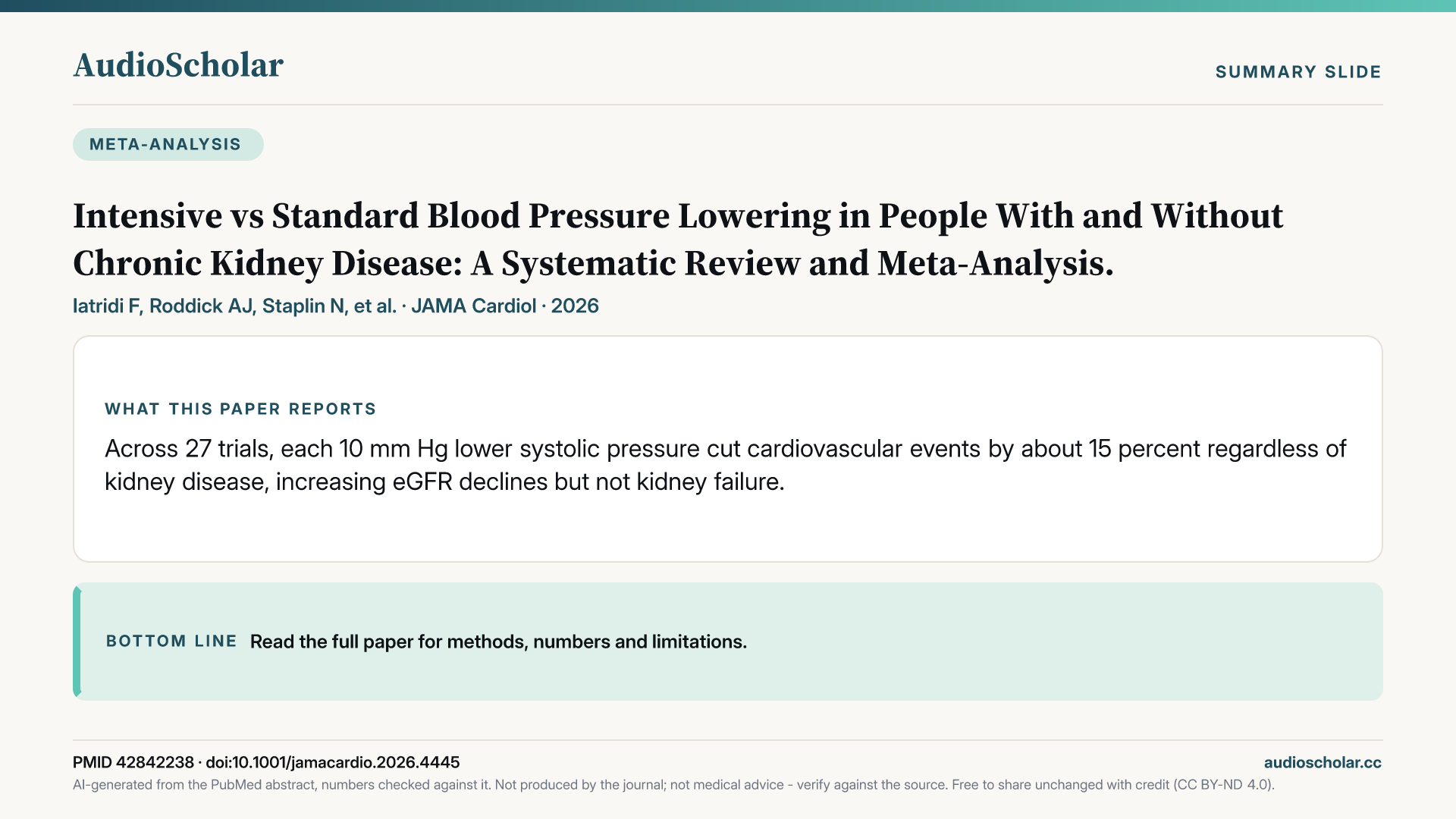
Across 27 trials, each 10 mm Hg lower systolic pressure cut cardiovascular events by about 15 percent regardless of kidney disease, increasing eGFR declines but not kidney failure.
JAMA Cardiology · 2026 · PubMed

This week’s papers
- 01
Biventricular vs conduction system pacing after atrioventricular node ablation for heart failure with atrial fibrillation: the CONDUCT-AF trial.
In 82 patients with refractory atrial fibrillation and heart failure undergoing node ablation, left bundle branch area pacing was non-inferior to biventricular pacing for six-month ejection fraction improvement, with shorter procedures.
Žižek D et al. · European Heart Journal · 2026
- 02
GDMT is Associated with Reduced Loop Diuretic Requirements, Whereas Diuretic Dose Does Not Modify GDMT Benefit in Heart Failure: STRONG-HF.
Reaching full target doses of all three guideline-directed heart failure drug classes was associated with substantially lower loop diuretic needs at 90 days, while diuretic dose did not modify the benefit of intensive care.
Biegus J et al. · European Journal of Heart Failure · 2026
- 03
Kidney function decline, heart failure hospitalization, and the effect of empagliflozin in heart failure: an EMPEROR-pooled analysis.
Across the ejection fraction spectrum, kidney function declined more than twice as fast before heart failure events and stayed rapid afterwards, and empagliflozin attenuated this decline without significant heterogeneity across periods.
Kobayashi M et al. · European Journal of Heart Failure · 2026
- 04
Heart Transplant for Advanced Heart Failure: A Review.
Heart transplantation offers roughly 92 percent one-year and 80 percent five-year survival in advanced heart failure, with allograft vasculopathy, infection and malignancy driving late mortality and requiring lifelong multidisciplinary care.
Amancherla K et al. · JAMA · 2026
- 05
Lipid Burden and Efficacy of Preventive PCI of Vulnerable Atherosclerotic Coronary Plaques: Post Hoc Analysis From the PREVENT Trial.
In a post hoc PREVENT analysis, preventive stenting of non-flow-limiting plaques was associated with markedly fewer events only when near-infrared spectroscopy showed lipid-rich plaque, not in large non-lipid-rich lesions.
Wee SB et al. · Circulation · 2026
- 06
Intravascular imaging from research tool to guidelines: a 35-year long journey.
Intravascular ultrasound and optical coherence tomography guidance now carry Class I, Level A recommendations for complex coronary intervention, yet remain grossly underused, with training, reimbursement and artificial intelligence proposed as remedies.
Di Mario C et al. · European Heart Journal · 2026
- 07
Intensive vs Standard Blood Pressure Lowering in People With and Without Chronic Kidney Disease: A Systematic Review and Meta-Analysis.
Across 27 trials, each 10 mm Hg lower systolic pressure cut cardiovascular events by about 15 percent regardless of kidney disease, increasing eGFR declines but not kidney failure.
Iatridi F et al. · JAMA Cardiology · 2026
- 08
Left Atrial Enlargement Identifies Risk of Stroke Independent of Atrial Fibrillation.
In about 10,000 Copenhagen adults without atrial fibrillation, CT-defined left atrial enlargement carried roughly 50 percent higher stroke hazard independent of incident atrial fibrillation, supporting it as a thromboembolic risk marker.
Loft JJ et al. · Journal of the American Heart Association · 2026
- 09
Cardiovascular Complications of Chronic Liver Disease.
Cardiovascular disease is a major and underrecognized driver of morbidity and mortality in chronic liver disease, especially steatotic liver disease, prompting calls for liver-informed risk models and integrated cardiohepatometabolic care.
Park S et al. · Circulation · 2026
- 10
Reducing the burden of heat-related impacts on cardiovascular health.
With 2024 the first year exceeding 1.5 degrees above pre-industrial levels, expert consensus offers practical advice for protecting people with cardiovascular disease before, during and after heat extremes.
Chaseling GK et al. · European Heart Journal · 2026
The full briefing
This AudioScholar briefing is generated by artificial intelligence for healthcare professionals and trainees. It is not medical advice.
Welcome to This Week in Cardiology. This week we're covering 10 notable papers spanning heart failure therapy and device strategy, coronary plaque and intravascular imaging, and cardiovascular risk across blood pressure, the atrium, the liver and a warming climate. Let's dive in.
Heart failure dominates the week, and the first question is how best to pace patients with atrial fibrillation and heart failure once the atrioventricular node has been ablated. In the European Heart Journal, Žižek and colleagues report CONDUCT-AF, a randomized trial across 10 European centres that enrolled 82 patients with refractory atrial fibrillation, an ejection fraction below 50 percent, a narrow QRS, and elevated natriuretic peptides [1]. Patients received either conduction system pacing via the left bundle branch area or biventricular pacing. At six months, ejection fraction rose by roughly ten to twelve points in both arms, landing at about 46 percent in each, and conduction system pacing met its non-inferiority margin with essentially no difference between groups. Ventricular volumes and the composite of worsening heart failure or cardiovascular death were comparable, while conduction system pacing produced a narrower paced QRS and shorter procedure and fluoroscopy times. The trial is small and its primary endpoint is a surrogate measured at six months, so it supports conduction system pacing as a reasonable alternative in this specific ablate-and-pace population rather than settling long-term clinical outcomes. Staying with heart failure management, the European Journal of Heart Failure carries two secondary analyses that speak to how disease-modifying therapy interacts with congestion and kidney function. Biegus and colleagues, in a post hoc analysis of STRONG-HF covering about 1,075 patients, found that patients who reached full target doses of all three guideline-directed classes needed substantially less loop diuretic by day 90, with a fall of about 22 milligrams of furosemide equivalent compared with almost no change in patients who did not reach targets [2]. Beta-blockers showed the largest single-class effect. Higher diuretic doses marked sicker patients but did not independently predict the primary outcome, and the benefit of high-intensity care was consistent regardless of diuretic dose. Only a doubling of diuretic dose was linked to higher mortality. Being post hoc and observational within a trial, this suggests rather than proves that optimized therapy acts as diuretic-sparing treatment. In the same journal, Kobayashi and colleagues pooled the EMPEROR-Reduced and EMPEROR-Preserved trials, about 9,500 patients, and found that kidney function declined more than twice as fast in the year before a heart failure hospitalization or heart failure death than in patients without events, and stayed rapid afterwards [3]. Empagliflozin slowed that decline compared with placebo, by roughly one unit of filtration rate per year, without significant differences across the periods before and after events. Together these two analyses frame worsening kidney function and rising diuretic needs as signals of disease trajectory, with both supporting the role of disease-modifying therapy across the ejection fraction spectrum. For patients who progress despite all of this, a JAMA review by Amancherla and colleagues summarizes heart transplantation, noting that about 4 to 5 percent of patients with heart failure reach advanced disease, that each additional criterion in the I NEED HELP referral mnemonic carries incremental risk, and that contemporary survival is about 92 percent at one year and about 80 percent at five years, with allograft vasculopathy the leading cause of late death [4].
Our second theme turns to coronary plaque, and specifically whether plaque composition, not just size, should guide intervention. In Circulation, Wee and colleagues report a post hoc analysis of the PREVENT trial, focusing on 598 patients with non-flow-limiting lesions that had a large plaque burden and a small lumen area on intravascular ultrasound, and who also underwent near-infrared spectroscopy [5]. Lipid-rich plaque was present in about 37 percent of these patients, and they had roughly double the event rate of patients without it over a median of nearly six years. Within the lipid-rich group, preventive stenting was associated with a much lower risk of the composite outcome, roughly a three-quarter relative reduction, with event rates of about 7 percent versus about 18 percent on medical therapy alone. In lesions that were large but not lipid-rich, preventive stenting showed no benefit at all, and the interaction between treatment and lipid content was statistically significant. This is hypothesis-generating: a subgroup analysis of a randomized trial, without randomization by plaque type, so it points toward composition as a selection tool but would need prospective confirmation before shaping practice. That work sits naturally beside a European Heart Journal review by Di Mario and colleagues tracing 35 years of intravascular ultrasound and optical coherence tomography from research tools to Class I, Level A guideline recommendations for guiding complex intervention [6]. The authors argue that imaging remains grossly underused, and cite reimbursement, mandatory training and artificial intelligence as routes to broader uptake. PREVENT illustrates their point that imaging now informs not only stent optimization but potentially which lesions to treat in the first place.
Our third theme covers cardiovascular risk in patients whose risk is often underestimated. The most consequential paper here appears in JAMA Cardiology, where Iatridi and colleagues meta-analysed 27 randomized trials with almost 89,000 participants comparing intensive and standard blood pressure lowering [7]. Each 10 millimetre lower systolic pressure cut major cardiovascular events by about 15 percent, with no difference in relative effect between people with and without chronic kidney disease. Because baseline risk is higher in kidney disease, the absolute benefit was at least as large there, about four fewer events per thousand person-years versus under three in people without kidney disease. Intensive lowering did not change the risk of kidney failure, although it increased sustained declines in filtration rate of 30 and 40 percent by roughly 40 to 50 percent, which the authors interpret as haemodynamic rather than progressive injury. They conclude that intensive targets should apply regardless of kidney status, a firm conclusion drawn from pooled trial data, though the meaning of those filtration declines over longer horizons remains a point of debate. In the Journal of the American Heart Association, Loft and colleagues used cardiac computed tomography in about 10,000 participants from the Copenhagen General Population Study without atrial fibrillation at baseline [8]. Left atrial enlargement, present in about 7 percent of participants, was linked to roughly a 50 percent higher hazard of stroke, and this held after modelling new-onset atrial fibrillation over time. Enlargement also more than tripled the risk of incident atrial fibrillation and heart failure, but was not associated with dementia or death. This observational work supports the atrium itself as a marker of thromboembolic risk, but it does not tell us whether anticoagulation helps these patients. Two broader documents round out the theme. A Circulation state-of-the-art review by Park and colleagues argues that cardiovascular disease is a major driver of illness and death in chronic liver disease, particularly metabolic dysfunction-associated steatotic liver disease, and that this risk is underrecognized; the authors call for liver-informed risk models and cardiovascular endpoints in liver trials [9]. And in the European Heart Journal, Chaseling and colleagues offer expert advice on protecting patients with cardiovascular disease during heat extremes, noting that 2024 was the first calendar year to exceed 1.5 degrees above pre-industrial levels; the guidance is expert consensus rather than trial-based [10].
If you only have time for one paper this week, make it the JAMA Cardiology blood pressure meta-analysis by Iatridi and colleagues [7]. It largely settles whether chronic kidney disease should temper intensive blood pressure targets, showing equal relative and at least equal absolute cardiovascular benefit without excess kidney failure.
Here is what this week's evidence adds up to in Cardiology. First, pooled trial data now show intensive blood pressure lowering reduces cardiovascular events similarly with or without kidney disease, with filtration declines but no rise in kidney failure; the long-term significance of those declines is still unsettled. Second, conduction system pacing matched biventricular pacing for ejection fraction recovery after node ablation in one small randomized trial, with simpler procedures, though hard outcomes over years are not yet known. Third, secondary analyses from STRONG-HF and EMPEROR suggest that disease-modifying therapy lowers diuretic needs and slows kidney decline around heart failure events, consistent but post hoc evidence. Fourth, lipid content on near-infrared spectroscopy may identify which non-flow-limiting plaques benefit from preventive stenting, a striking but exploratory subgroup finding. Fifth, left atrial enlargement appears to carry stroke risk independent of atrial fibrillation in observational data, without yet any evidence on treatment.
That's your roundup for This Week in Cardiology. The full transcript and references are available on the episode page. This is an AI-curated summary — for clinical decisions, always consult primary sources and current guidelines. See you next week.
If this weekly briefing is useful, follow the show in your podcast app so new episodes arrive automatically. And a quick rating on Apple Podcasts or Spotify helps other physicians discover the show.
This is an automated summary generated by artificial intelligence, which can make mistakes. Always review the original source materials.
Spot something worth flagging?
Get this every week in your podcast app — free.
New cardiology episodes land in your feed automatically — listen on your commute.