This Week in Otolaryngology — Oct 15, 2026
Generated Oct 16, 2026 · 11:34
The week's practice-changing Otolaryngology (ENT) research, summarized for clinicians.
If the audio fails to play, refresh the page to renew the link.
Get next week’s Otolaryngology (ENT) briefing — free.
In your podcast app, or readable in your inbox with the audio one tap away.
Effects of Isthmus-Sparing Lobectomy on Thyroid Function: A Prospective, Multicenter, Comparative Study.
Among 326 randomized lobectomy patients, sparing the isthmus preserved euthyroidism more often and cut hormone replacement from about 25 percent to under 9 percent, though overt hypothyroidism did not differ significantly.
Head & Neck · 2026 · PubMed

This week’s papers
- 01
Clinical Practice Guideline: Tinnitus Update.
The updated tinnitus guideline strongly recommends distinguishing bothersome tinnitus, screening for self-harm risk, and avoiding routine neuroimaging, while endorsing audiologic evaluation, hearing rehabilitation, and cognitive behavioral therapy.
Adams ME et al. · Otolaryngology-Head and Neck Surgery · 2026
From the briefingWe start with the documents that set the rules of the road, because two major guidance papers landed this week. In Otolaryngology-Head and Neck Surgery, Adams and colleagues published the updated American Academy of Otolaryngology clinical practice guideline on tinnitus, focused on adults whose tinnitus is both bothersome and persistent, meaning six months or longer [1]. The guideline group, which included audiologists, neurotologists, a psychiatrist, a radiologist and a consumer advocate, issued three strong recommendations. Clinicians should distinguish bothersome from non-bothersome tinnitus, should ask about risk of self-harm in patients with bothersome tinnitus, and should not obtain neuroradiologic imaging specifically to evaluate tinnitus unless concerning features are present. Beneath those sit recommendations for a targeted history and examination, a comprehensive audiological evaluation, patient education, hearing aid evaluation for those with hearing difficulty, cochlear implant referral when audiologic criteria are met, and cognitive behavioral therapy for persistent, bothersome tinnitus. Much of this restates existing practice, but the explicit self-harm screening statement and the firm stance against routine imaging carry the weight of a strong recommendation, and they are likely to shape how tinnitus visits are audited and documented.
Written by AI from the published abstract, for healthcare professionals. Not medical advice; check the paper before acting on it.
- 02
Surgery and/or biologics in chronic rhinosinusitis with nasal polyps: EUFOREA/EPOS consensus paper.
European expert consensus holds that diffuse nasal polyp disease warrants at least one complete sinus surgery, that simultaneous surgery and biologic initiation is unsupported, and that long-term systemic steroids are unacceptable.
de Corso E et al. · Rhinology · 2026
From the briefingThe second guidance document comes from Rhinology, where de Corso, Hellings, Fokkens and the EUFOREA and EPOS panel tackled the question that has dominated polyp clinics for six years: where surgery sits now that biologics exist [2]. Through multiple rounds of discussion and voting, the panel agreed that patients with diffuse disease should have had at least one primary complete endoscopic sinus surgery, that starting surgery and a biologic at the same time is not supported by current evidence, and that the biologic indications set out in earlier guidelines still stand. The panel also stated plainly that long-term systemic corticosteroid use is no longer acceptable, particularly where biologics are available. This is expert consensus rather than new trial data, so it frames practice rather than proving a sequence, but it pushes back against the idea that biologics make surgery optional for diffuse disease.
Written by AI from the published abstract, for healthcare professionals. Not medical advice; check the paper before acting on it.
- 03
Pocket guide Biologics in upper and lower airway diseases 2026 by EUFOREA.
A EUFOREA pocket guide frames biologics as established therapy for severe uncontrolled nasal polyps, asthma, and eosinophilic COPD, with clinical and complete remission emerging as treatment goals.
Verstappen G et al. · Rhinology · 2026
From the briefingA companion piece, also in Rhinology, is the 2026 EUFOREA pocket guide on biologics in upper and lower airway disease by Verstappen and colleagues [3]. Its abstract is brief, but it frames biologics as now routine for severe uncontrolled nasal polyps, asthma, and eosinophilic COPD, and points to clinical and even complete remission as emerging treatment goals. Taken together, the two Rhinology papers describe a field moving from asking whether to use biologics toward asking how to sequence them with surgery and what counts as success.
Written by AI from the published abstract, for healthcare professionals. Not medical advice; check the paper before acting on it.
- 04
Immediate Resumption of Positive Airway Pressure Following Sinus Surgery: A Prospective Controlled Multicenter Study.
In 100 sinus surgery patients, restarting positive airway pressure on the day of or after surgery was not linked to worse endoscopic healing, quality of life, epistaxis, or pressure-related complications.
Choby G et al. · Otolaryngology-Head and Neck Surgery · 2026
From the briefingStaying in the sinuses, two studies address perioperative risk, one at the routine end of practice and one at the extreme end. In Otolaryngology-Head and Neck Surgery, Choby and colleagues ran a multicenter prospective controlled study of 100 patients undergoing functional endoscopic sinus surgery [4]. Forty-nine patients with obstructive sleep apnea restarted positive airway pressure on the day of surgery or the day after, and they were compared with 51 patients without sleep apnea. After adjustment, early resumption of positive airway pressure was not associated with worse endoscopic healing scores, worse quality-of-life scores, or more epistaxis, and there were no pressure-related complications such as orbital emphysema or pneumocephalus. The comparison group did not have sleep apnea, so this is not a randomized test of early versus delayed resumption, and the sample is modest enough that rare complications could be missed. Still, it is the first prospective multicenter evidence on the question, and it weakens the rationale for routinely holding positive airway pressure after sinus surgery given the known cardiopulmonary risk of untreated apnea.
Written by AI from the published abstract, for healthcare professionals. Not medical advice; check the paper before acting on it.
- 05
Prior internal carotid artery embolization to optimize oncological and surgical outcomes in salvage endoscopic nasopharyngectomy for recurrent nasopharyngeal carcinoma.
In 50 matched pairs with recurrent nasopharyngeal carcinoma involving the carotid, preoperative embolization improved progression-free survival and clear margins and reduced fatal rupture, though overall survival was not significantly better.
Xu H et al. · Rhinology · 2026
From the briefingAt the other extreme, Xu and colleagues, also in Rhinology, examined salvage endoscopic nasopharyngectomy for recurrent nasopharyngeal carcinoma involving the internal carotid artery [5]. From 535 patients treated over sixteen years at a high-volume center, they built 50 propensity-matched pairs comparing preoperative carotid embolization with no embolization. Embolization was associated with significantly better progression-free survival, a significantly higher rate of clear-margin resection, a sharp reduction in fatal carotid rupture, and less postoperative cerebral ischemia. Overall survival trended better but was not statistically significant, and general adverse events, especially dysphagia, tended to be more frequent in the embolization group. The authors call the strategy transformative, but this is retrospective, matched data from a highly specialized program, so it supports embolization as a reasonable adjunct in expert hands rather than establishing a survival benefit.
Written by AI from the published abstract, for healthcare professionals. Not medical advice; check the paper before acting on it.
- 06
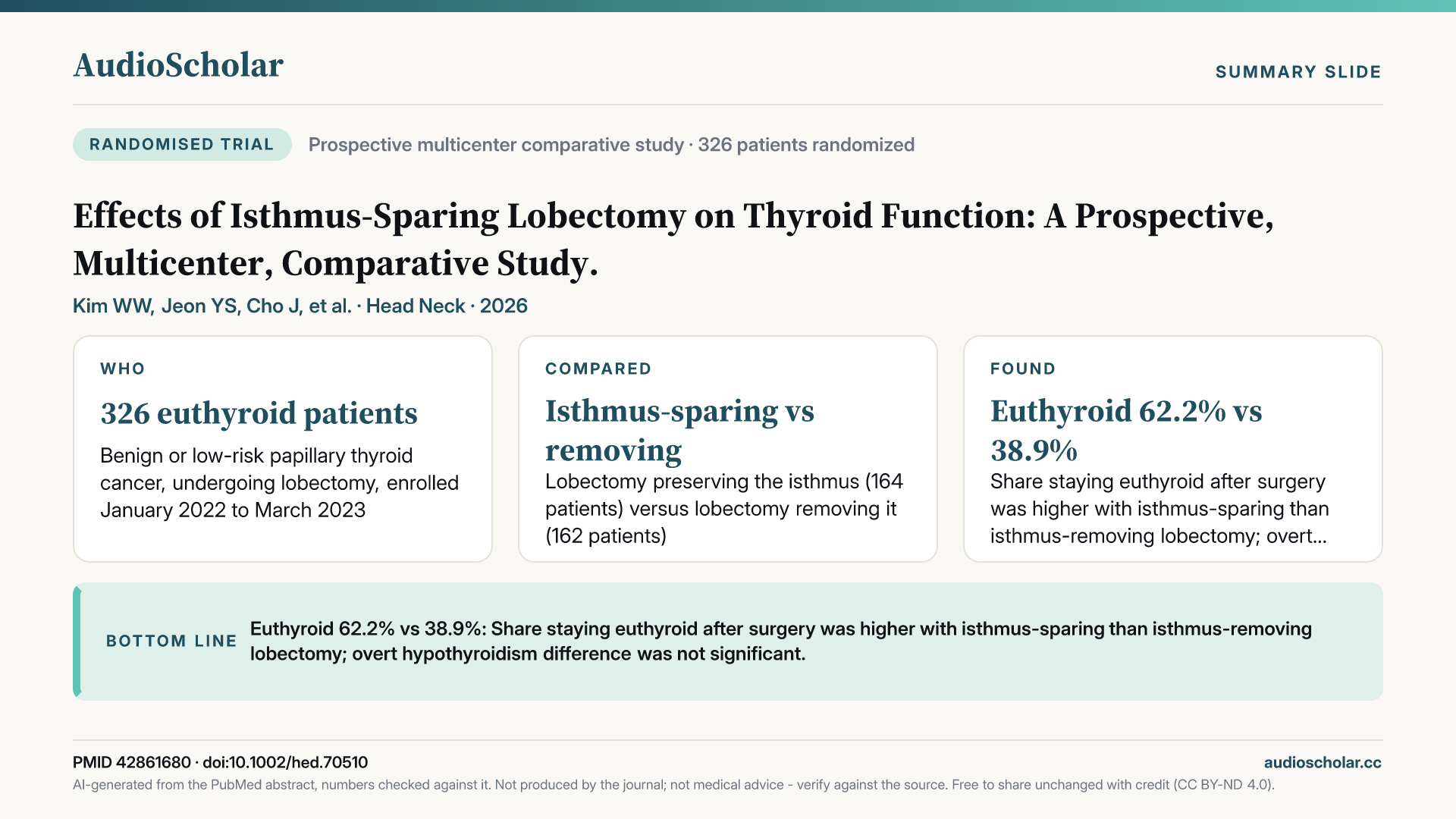
Effects of Isthmus-Sparing Lobectomy on Thyroid Function: A Prospective, Multicenter, Comparative Study.
Among 326 randomized lobectomy patients, sparing the isthmus preserved euthyroidism more often and cut hormone replacement from about 25 percent to under 9 percent, though overt hypothyroidism did not differ significantly.
Kim WW et al. · Head & Neck · 2026
From the briefingThe thyroid and parathyroid papers this week share a theme of preserving function, whether glandular, parathyroid, or laryngeal. The strongest design of the week comes from Head and Neck, where Kim and colleagues randomized 326 euthyroid patients with benign disease or low-risk papillary thyroid cancer to lobectomy that either spared or removed the isthmus [6]. Thyroid stimulating hormone stayed significantly lower in the isthmus-sparing group throughout eighteen months of follow-up. Roughly six in ten isthmus-sparing patients remained euthyroid, compared with under four in ten after isthmus removal, and the need for hormone replacement fell from about a quarter of patients to under one in ten. Overt hypothyroidism was also lower with isthmus sparing, about six percent versus twelve percent, but that difference did not reach statistical significance. The trial cannot speak to oncologic outcomes, and the low-risk cancer subgroup deserves separate scrutiny, but for patients counseled about the chance of lifelong levothyroxine after a lobectomy, this is randomized evidence that isthmus management matters.
If you only have time for one paper this week, make it the isthmus-sparing lobectomy trial from Kim and colleagues in Head and Neck [6]. It brings randomized evidence to a technical choice most thyroid surgeons make by habit, and it reopens how postoperative hypothyroidism risk after lobectomy is discussed with patients.
Written by AI from the published abstract, for healthcare professionals. Not medical advice; check the paper before acting on it.
- 07
Probe-Based Near-Infrared Autofluorescence for Parathyroid Identification During Thyroid Surgery: Clinical Outcomes, Surgeon Confidence, and Autofluorescence Thresholds.
A parathyroid autofluorescence probe reduced incidental parathyroid tissue on histology and confirmed low-confidence glands, but transient and permanent hypoparathyroidism rates were unchanged versus visual identification in a retrospective comparison.
Cheung AY et al. · Head & Neck · 2026
From the briefingAlso in Head and Neck, Cheung and colleagues looked at probe-based near-infrared autofluorescence for parathyroid identification during total thyroidectomy, comparing 84 patients operated with the probe against 103 historical controls [7]. Identification rates were similar, but about four in ten glands confirmed with the probe had initially been seen with only low or moderate visual confidence. Inadvertently removed parathyroid tissue found on histology fell from roughly one in six patients to about one in twenty, and postoperative calcium was modestly higher. However, transient and permanent hypoparathyroidism did not differ, nor did autotransplantation rates. The authors also found that an autofluorescence ratio cutoff of 2.5 improved specificity over the manufacturer's recommended 1.2. With a retrospective, historical-control design, the honest reading is that the probe adds confirmation in uncertain cases without yet showing a clinically meaningful reduction in hypoparathyroidism.
Written by AI from the published abstract, for healthcare professionals. Not medical advice; check the paper before acting on it.
- 08
Voice Outcomes Following Thermal Ablation for Thyroid Nodules: A Systematic Review.
Across 18 studies and over 5,000 patients, thyroid nodule thermal ablation carried a pooled vocal cord palsy rate of 1.4 percent, mostly transient, though inconsistent laryngeal assessment likely underestimates risk.
Mouratidou S et al. · Otolaryngology-Head and Neck Surgery · 2026
From the briefingRounding out the thyroid theme, Mouratidou and colleagues, in Otolaryngology-Head and Neck Surgery, systematically reviewed voice outcomes after thermal ablation of thyroid nodules across 18 studies and more than five thousand patients [8]. The pooled vocal cord palsy rate was about one and a half percent, mostly transient, with only two permanent cases. The more important finding may be methodological: objective vocal cord assessment before the procedure was reported in only about four in ten patients, and routine assessment afterward in a similar proportion. The authors argue the low complication figures are likely underestimates, and that standardized laryngeal evaluation is needed before these numbers can be used confidently in counseling.
Written by AI from the published abstract, for healthcare professionals. Not medical advice; check the paper before acting on it.
- 09
Celecoxib as a non-inferior alternative to ibuprofen in post-tonsillectomy pain and bleeding control.
In 1,144 retrospective pediatric tonsillectomies, celecoxib showed no significant differences from ibuprofen in pain, dehydration, hemorrhage, or reoperation, suggesting a possible platelet-sparing alternative pending prospective trials.
Maulsby L et al. · International Journal of Pediatric Otorhinolaryngology · 2026
From the briefingTwo final papers revisit long-standing comparisons where the evidence suggests advantage but stops short of proof. In the International Journal of Pediatric Otorhinolaryngology, Maulsby and colleagues reviewed 1,144 pediatric tonsillectomies, 157 managed with celecoxib and 987 with ibuprofen [9]. Overall complication rates were about three percent with celecoxib and seven percent with ibuprofen, but no individual outcome, including pain, dehydration, hemorrhage, or return to the operating room, differed significantly. The title frames celecoxib as non-inferior, but this was a single-institution retrospective cohort with a small celecoxib arm, not a formal non-inferiority trial, so it supports celecoxib as a plausible platelet-sparing alternative while leaving its bleeding advantage unproven.
Written by AI from the published abstract, for healthcare professionals. Not medical advice; check the paper before acting on it.
- 10
Mohs vs. Wide Local Excision for Early-Stage (AJCC 0-II) Cutaneous Head and Neck Melanoma: A Meta-Analysis.
Pooling 23 studies of early head and neck melanoma, Mohs surgery showed consistently lower recurrence, upstaging, and re-excision than wide local excision, but no difference reached statistical significance.
Ardoin A et al. · Head & Neck · 2026
From the briefingA similar pattern appears in Head and Neck, where Ardoin and colleagues meta-analyzed 23 studies and roughly seven thousand cases of early-stage cutaneous head and neck melanoma, comparing Mohs surgery with wide local excision [10]. For melanoma in situ, local recurrence was under two percent after Mohs versus about six percent after wide excision, with similar directional gaps in upstaging and secondary excision, and invasive stage one and two disease showed the same pattern. Yet none of the between-group differences reached statistical significance. The consistency of the trend is notable, but these are observational, heterogeneous data, so the authors frame Mohs as a consideration in selected patients rather than as superior.
Written by AI from the published abstract, for healthcare professionals. Not medical advice; check the paper before acting on it.
The full briefing
This AudioScholar briefing is generated by artificial intelligence for healthcare professionals and trainees. It is not medical advice.
Welcome to This Week in Otolaryngology. This week we're covering 10 notable papers spanning new guidance on tinnitus and nasal polyps, perioperative safety in rhinology and pediatric surgery, and a cluster of studies refining thyroid and parathyroid care. Let's dive in.
We start with the documents that set the rules of the road, because two major guidance papers landed this week. In Otolaryngology-Head and Neck Surgery, Adams and colleagues published the updated American Academy of Otolaryngology clinical practice guideline on tinnitus, focused on adults whose tinnitus is both bothersome and persistent, meaning six months or longer [1]. The guideline group, which included audiologists, neurotologists, a psychiatrist, a radiologist and a consumer advocate, issued three strong recommendations. Clinicians should distinguish bothersome from non-bothersome tinnitus, should ask about risk of self-harm in patients with bothersome tinnitus, and should not obtain neuroradiologic imaging specifically to evaluate tinnitus unless concerning features are present. Beneath those sit recommendations for a targeted history and examination, a comprehensive audiological evaluation, patient education, hearing aid evaluation for those with hearing difficulty, cochlear implant referral when audiologic criteria are met, and cognitive behavioral therapy for persistent, bothersome tinnitus. Much of this restates existing practice, but the explicit self-harm screening statement and the firm stance against routine imaging carry the weight of a strong recommendation, and they are likely to shape how tinnitus visits are audited and documented.
The second guidance document comes from Rhinology, where de Corso, Hellings, Fokkens and the EUFOREA and EPOS panel tackled the question that has dominated polyp clinics for six years: where surgery sits now that biologics exist [2]. Through multiple rounds of discussion and voting, the panel agreed that patients with diffuse disease should have had at least one primary complete endoscopic sinus surgery, that starting surgery and a biologic at the same time is not supported by current evidence, and that the biologic indications set out in earlier guidelines still stand. The panel also stated plainly that long-term systemic corticosteroid use is no longer acceptable, particularly where biologics are available. This is expert consensus rather than new trial data, so it frames practice rather than proving a sequence, but it pushes back against the idea that biologics make surgery optional for diffuse disease. A companion piece, also in Rhinology, is the 2026 EUFOREA pocket guide on biologics in upper and lower airway disease by Verstappen and colleagues [3]. Its abstract is brief, but it frames biologics as now routine for severe uncontrolled nasal polyps, asthma, and eosinophilic COPD, and points to clinical and even complete remission as emerging treatment goals. Taken together, the two Rhinology papers describe a field moving from asking whether to use biologics toward asking how to sequence them with surgery and what counts as success.
Staying in the sinuses, two studies address perioperative risk, one at the routine end of practice and one at the extreme end. In Otolaryngology-Head and Neck Surgery, Choby and colleagues ran a multicenter prospective controlled study of 100 patients undergoing functional endoscopic sinus surgery [4]. Forty-nine patients with obstructive sleep apnea restarted positive airway pressure on the day of surgery or the day after, and they were compared with 51 patients without sleep apnea. After adjustment, early resumption of positive airway pressure was not associated with worse endoscopic healing scores, worse quality-of-life scores, or more epistaxis, and there were no pressure-related complications such as orbital emphysema or pneumocephalus. The comparison group did not have sleep apnea, so this is not a randomized test of early versus delayed resumption, and the sample is modest enough that rare complications could be missed. Still, it is the first prospective multicenter evidence on the question, and it weakens the rationale for routinely holding positive airway pressure after sinus surgery given the known cardiopulmonary risk of untreated apnea.
At the other extreme, Xu and colleagues, also in Rhinology, examined salvage endoscopic nasopharyngectomy for recurrent nasopharyngeal carcinoma involving the internal carotid artery [5]. From 535 patients treated over sixteen years at a high-volume center, they built 50 propensity-matched pairs comparing preoperative carotid embolization with no embolization. Embolization was associated with significantly better progression-free survival, a significantly higher rate of clear-margin resection, a sharp reduction in fatal carotid rupture, and less postoperative cerebral ischemia. Overall survival trended better but was not statistically significant, and general adverse events, especially dysphagia, tended to be more frequent in the embolization group. The authors call the strategy transformative, but this is retrospective, matched data from a highly specialized program, so it supports embolization as a reasonable adjunct in expert hands rather than establishing a survival benefit.
The thyroid and parathyroid papers this week share a theme of preserving function, whether glandular, parathyroid, or laryngeal. The strongest design of the week comes from Head and Neck, where Kim and colleagues randomized 326 euthyroid patients with benign disease or low-risk papillary thyroid cancer to lobectomy that either spared or removed the isthmus [6]. Thyroid stimulating hormone stayed significantly lower in the isthmus-sparing group throughout eighteen months of follow-up. Roughly six in ten isthmus-sparing patients remained euthyroid, compared with under four in ten after isthmus removal, and the need for hormone replacement fell from about a quarter of patients to under one in ten. Overt hypothyroidism was also lower with isthmus sparing, about six percent versus twelve percent, but that difference did not reach statistical significance. The trial cannot speak to oncologic outcomes, and the low-risk cancer subgroup deserves separate scrutiny, but for patients counseled about the chance of lifelong levothyroxine after a lobectomy, this is randomized evidence that isthmus management matters.
Also in Head and Neck, Cheung and colleagues looked at probe-based near-infrared autofluorescence for parathyroid identification during total thyroidectomy, comparing 84 patients operated with the probe against 103 historical controls [7]. Identification rates were similar, but about four in ten glands confirmed with the probe had initially been seen with only low or moderate visual confidence. Inadvertently removed parathyroid tissue found on histology fell from roughly one in six patients to about one in twenty, and postoperative calcium was modestly higher. However, transient and permanent hypoparathyroidism did not differ, nor did autotransplantation rates. The authors also found that an autofluorescence ratio cutoff of 2.5 improved specificity over the manufacturer's recommended 1.2. With a retrospective, historical-control design, the honest reading is that the probe adds confirmation in uncertain cases without yet showing a clinically meaningful reduction in hypoparathyroidism.
Rounding out the thyroid theme, Mouratidou and colleagues, in Otolaryngology-Head and Neck Surgery, systematically reviewed voice outcomes after thermal ablation of thyroid nodules across 18 studies and more than five thousand patients [8]. The pooled vocal cord palsy rate was about one and a half percent, mostly transient, with only two permanent cases. The more important finding may be methodological: objective vocal cord assessment before the procedure was reported in only about four in ten patients, and routine assessment afterward in a similar proportion. The authors argue the low complication figures are likely underestimates, and that standardized laryngeal evaluation is needed before these numbers can be used confidently in counseling.
Two final papers revisit long-standing comparisons where the evidence suggests advantage but stops short of proof. In the International Journal of Pediatric Otorhinolaryngology, Maulsby and colleagues reviewed 1,144 pediatric tonsillectomies, 157 managed with celecoxib and 987 with ibuprofen [9]. Overall complication rates were about three percent with celecoxib and seven percent with ibuprofen, but no individual outcome, including pain, dehydration, hemorrhage, or return to the operating room, differed significantly. The title frames celecoxib as non-inferior, but this was a single-institution retrospective cohort with a small celecoxib arm, not a formal non-inferiority trial, so it supports celecoxib as a plausible platelet-sparing alternative while leaving its bleeding advantage unproven.
A similar pattern appears in Head and Neck, where Ardoin and colleagues meta-analyzed 23 studies and roughly seven thousand cases of early-stage cutaneous head and neck melanoma, comparing Mohs surgery with wide local excision [10]. For melanoma in situ, local recurrence was under two percent after Mohs versus about six percent after wide excision, with similar directional gaps in upstaging and secondary excision, and invasive stage one and two disease showed the same pattern. Yet none of the between-group differences reached statistical significance. The consistency of the trend is notable, but these are observational, heterogeneous data, so the authors frame Mohs as a consideration in selected patients rather than as superior.
If you only have time for one paper this week, make it the isthmus-sparing lobectomy trial from Kim and colleagues in Head and Neck [6]. It brings randomized evidence to a technical choice most thyroid surgeons make by habit, and it reopens how postoperative hypothyroidism risk after lobectomy is discussed with patients.
Here is what this week's evidence adds up to in Otolaryngology. First, the updated tinnitus guideline elevates self-harm screening and avoidance of routine imaging to strong recommendations, and endorses cognitive behavioral therapy and hearing rehabilitation as core management. Second, European consensus holds that diffuse nasal polyp disease warrants complete primary surgery and that biologics remain governed by existing criteria, though the optimal sequencing is still expert opinion rather than trial-proven. Third, prospective multicenter data suggest early resumption of positive airway pressure after sinus surgery does not worsen healing or bleeding, though rare complications cannot be excluded at this sample size. Fourth, randomized evidence shows that preserving the isthmus during lobectomy roughly halves the need for hormone replacement, while oncologic implications remain unaddressed. Finally, celecoxib after tonsillectomy, Mohs for head and neck melanoma, and autofluorescence probes for parathyroid identification all show favorable trends without statistically proven advantages in hard outcomes, so each remains an open question awaiting prospective comparison.
That's your roundup for This Week in Otolaryngology. The full transcript and references are available on the episode page. This is an AI-curated summary — for clinical decisions, always consult primary sources and current guidelines. See you next week.
If this weekly briefing is useful, follow the show in your podcast app so new episodes arrive automatically. And a quick rating on Apple Podcasts or Spotify helps other physicians discover the show.
This is an automated summary generated by artificial intelligence, which can make mistakes. Always review the original source materials.
Spot something worth flagging?
Get this every week in your podcast app — free.
New otolaryngology episodes land in your feed automatically — listen on your commute.