This Week in Oncology — Oct 14, 2026
Generated Oct 14, 2026 · 11:49
The week's practice-changing Oncology research, summarized for clinicians.
If the audio fails to play, refresh the page to renew the link.
Get next week’s Oncology briefing — free.
In your podcast app, or readable in your inbox with the audio one tap away.
Randomized Trial of Hypofractionated Postmastectomy Radiation Therapy in Women With Breast Reconstruction (RT CHARM, Alliance A221505).
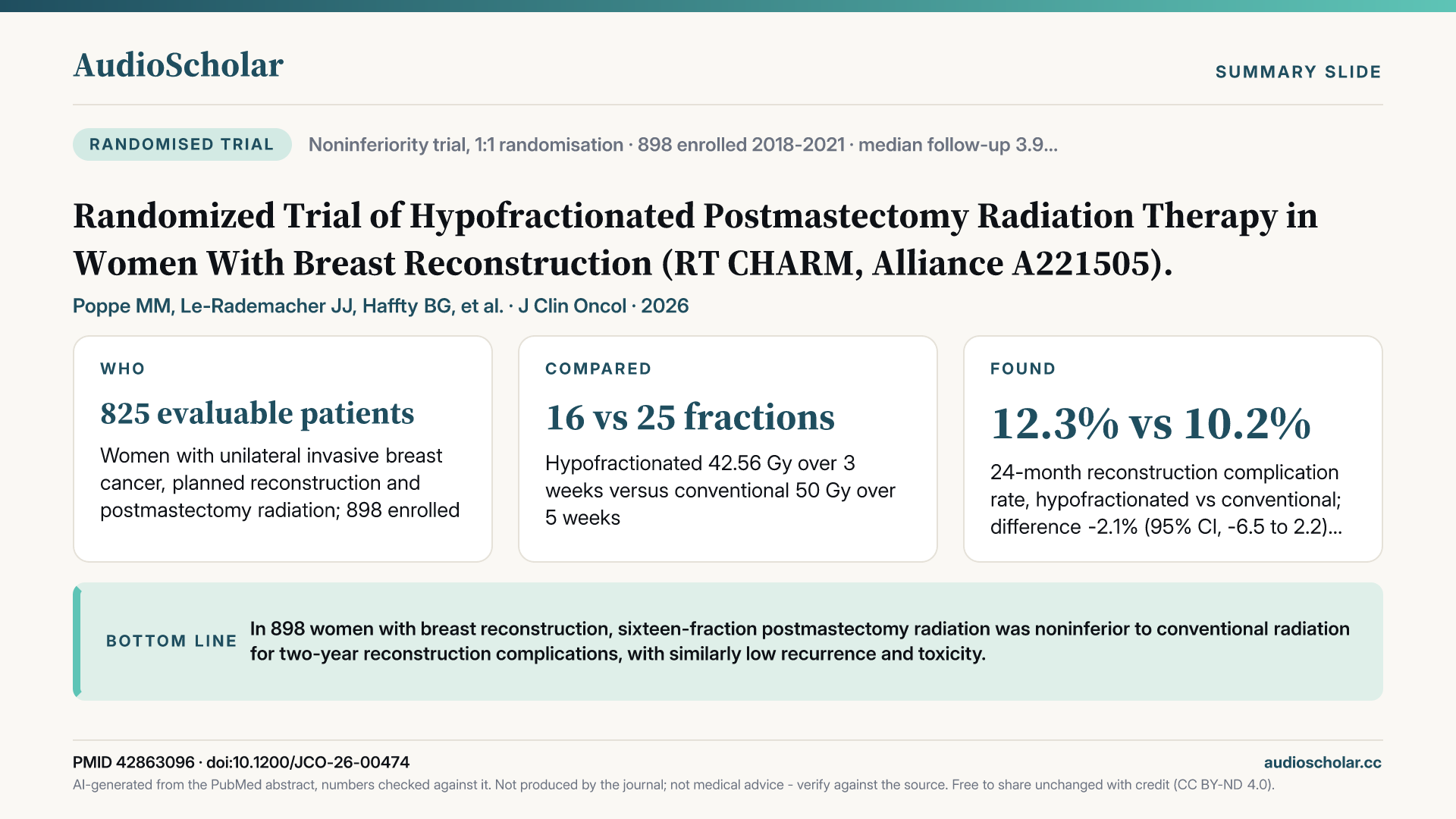
In 898 women with breast reconstruction, sixteen-fraction postmastectomy radiation was noninferior to conventional radiation for two-year reconstruction complications, with similarly low recurrence and toxicity.
Journal of Clinical Oncology · 2026 · PubMed

This week’s papers
- 01
Randomized Trial of Hypofractionated Postmastectomy Radiation Therapy in Women With Breast Reconstruction (RT CHARM, Alliance A221505).
In 898 women with breast reconstruction, sixteen-fraction postmastectomy radiation was noninferior to conventional radiation for two-year reconstruction complications, with similarly low recurrence and toxicity.
Poppe MM et al. · Journal of Clinical Oncology · 2026
- 02
NRG-BR002: A Randomized Phase II/III Trial of Metastasis-Directed Ablation With First-Line Systemic Therapy for Oligometastatic Breast Cancer.
Adding metastasis-directed ablation, mostly stereotactic radiation, to first-line systemic therapy for oligometastatic breast cancer did not improve progression-free or overall survival in a randomized phase II trial.
Chmura SJ et al. · Journal of Clinical Oncology · 2026
- 03
Invasive interval breast cancer rates after digital breast tomosynthesis plus synthesised mammography versus digital mammography screening (TOSYMA): 24-month follow-up of the multicentre, open-label, randomised, controlled, superiority trial.
Tomosynthesis screening in nearly 100,000 German women lowered two-year invasive interval cancers by about a quarter versus digital mammography, but this primary endpoint was not statistically significant.
Weigel S et al. · The Lancet Oncology · 2026
- 04
Universal Germline Genetic Testing after a Diagnosis of Cancer.
Germline sequencing of over 39,000 unselected solid tumour patients showed that an age-50 testing cutoff would miss about 72 percent of pathogenic variant carriers, supporting universal testing.
Stadler ZK et al. · Cancer Discovery · 2026
- 05
Neoadjuvant niraparib monotherapy for unresectable, homologous recombination deficiency-positive, high-grade serous ovarian cancer (NANT): a multicentre, single-arm, phase 2 trial.
Chemotherapy-free neoadjuvant niraparib produced a 63 percent response rate and 80 percent R0 resection in HRD-positive advanced ovarian cancer, but thrombocytopenia was common and randomized validation is needed.
Liu D et al. · The Lancet Oncology · 2026
- 06
Sofetabart mipitecan, an antibody drug conjugate targeting folate receptor alpha, in high grade ovarian cancer: Results from the first-in-human phase 1 study.
The folate receptor alpha antibody-drug conjugate sofetabart mipitecan achieved about 50 percent responses in heavily pretreated ovarian cancer regardless of expression level or prior mirvetuximab, without keratopathy.
Ray-Coquard I et al. · Annals of Oncology · 2026
- 07
Disitamab Vedotin Plus Tislelizumab in Transurethrally Unresectable, ERBB2-Positive, Non-Muscle-Invasive Bladder Cancer: A Nonrandomized Clinical Trial.
In 28 patients with unresectable HER2-positive very high-risk non-muscle-invasive bladder cancer avoiding cystectomy, disitamab vedotin plus tislelizumab achieved about 73 percent complete response in a small single-arm trial.
Qie Y et al. · JAMA Oncology · 2026
- 08
Phase I/II Study of Bavdegalutamide, a Proteolysis-Targeting Chimera Androgen Receptor Degrader, in Metastatic Castration-Resistant Prostate Cancer.
The oral androgen receptor degrader bavdegalutamide produced PSA50 responses in 60 percent of castration-resistant prostate cancers with AR T878 or H875 mutations, but rarely in other molecular subgroups.
Gao X et al. · Journal of Clinical Oncology · 2026
- 09
VERIFY: A Phase III Trial of Rusfertide Versus Placebo in Phlebotomy-Dependent Patients With Polycythemia Vera Receiving Standard-of-Care Therapy.
In phlebotomy-dependent polycythemia vera, the hepcidin mimetic rusfertide achieved clinical response in 77 percent versus 33 percent on placebo, reducing phlebotomies and modestly improving symptoms over 32 weeks.
Kuykendall AT et al. · Journal of Clinical Oncology · 2026
- 10
RINGSIDE Phase II Study of Varegacestat for Treatment of Desmoid Tumors: A Randomized Dose-Finding Clinical Trial.
The oral gamma-secretase inhibitor varegacestat at 1.2 mg daily roughly halved desmoid tumour volume by week 16, with responses rising to 57 percent on extended treatment and mostly low-grade toxicity.
Chugh R et al. · Journal of Clinical Oncology · 2026
The full briefing
This AudioScholar briefing is generated by artificial intelligence for healthcare professionals and trainees. It is not medical advice.
Welcome to This Week in Oncology. This week we're covering 10 notable papers spanning breast cancer radiation, ablation and screening, the reach of germline testing, and a wave of novel targeted agents across gynaecologic, genitourinary and rarer tumours. Let's dive in.
We start with breast cancer, where three large trials test long-held assumptions about radiation, metastasis-directed therapy and screening technology. In the Journal of Clinical Oncology, Poppe and colleagues report RT CHARM, the Alliance noninferiority trial asking whether short-course postmastectomy radiation is safe for women with breast reconstruction [1]. Fear of reconstruction complications has kept many centres on five weeks of conventional fractionation, so the investigators randomized 898 women to 50 Gray in 25 fractions or 42.56 Gray in 16 fractions over three weeks. At two years, reconstruction complications occurred in about 12 percent of women on the hypofractionated schedule versus about 10 percent on the conventional schedule, comfortably inside the prespecified ten-point noninferiority margin. Locoregional recurrence at three years was low and similar in both arms, at around two percent or less, and acute and late toxicity did not differ. Regardless of schedule, implant-only reconstruction carried roughly two thirds higher odds of complications than autologous reconstruction. With median follow-up just under four years, this is randomized, multicentre evidence that directly addresses the main objection to hypofractionation in reconstructed patients, though longer follow-up on late cosmetic and recurrence outcomes will still matter. Also in the Journal of Clinical Oncology, Chmura and colleagues report NRG-BR002, and here the result is negative [2]. Across United States and Canadian institutions, 125 evaluable patients with up to four metastases, most with hormone receptor-positive, HER2-negative disease, were randomized to first-line systemic therapy alone or with metastasis-directed ablation, nearly always stereotactic radiation. Ablation did not improve progression-free survival, with medians of about 23 months without ablation and about 19 and a half months with it, and overall survival did not differ, so the trial did not proceed to phase three. An exploratory signal suggested possible benefit in patients with few or no circulating tumour cells, but that is hypothesis-generating only. The authors conclude that ablation in this setting belongs within trials or for palliation, which sits uncomfortably against its growing routine use. Rounding out the theme, The Lancet Oncology publishes the second primary endpoint of the German TOSYMA trial from Weigel and colleagues, comparing tomosynthesis plus synthesised two-dimensional mammography with digital mammography in nearly one hundred thousand women aged 50 to 70 [3]. Over 24 months, invasive interval cancers occurred in about 14 per ten thousand screen-negative women with tomosynthesis versus about 19 per ten thousand with digital mammography, a reduction of roughly a quarter that did not reach statistical significance. A prespecified secondary look at the first twelve months did favour tomosynthesis. So the primary endpoint is formally negative, and the authors frame the trial as supportive rather than definitive evidence for tomosynthesis screening.
Staying with the question of who carries hidden risk, Cancer Discovery publishes a striking germline analysis from Stadler and colleagues [4]. They sequenced more than 90 predisposition genes in over 39,000 unselected patients with solid tumours spanning 32 cancer types. Pathogenic variant prevalence fell with age at diagnosis relative to each tumour's typical age, from about 18 percent in early-onset cases to about 12 percent in late-onset cases, with high and moderate penetrance genes driving the early-onset excess. The headline figure is this: restricting testing to patients diagnosed before age 50 would have missed 4,601 carriers, roughly seven in ten of all variants detected. The cohort comes from a single large institution's sequencing programme, but the scale is considerable, and the authors argue it supports universal germline testing for everyone diagnosed with cancer, a position many guidelines have not yet fully adopted across all tumour types.
Our next theme is biomarker-directed therapy in gynaecologic cancers, where two papers push targeted agents earlier and into broader populations. In The Lancet Oncology, Liu and colleagues report NANT, a single-arm phase two trial at six Chinese hospitals testing two cycles of neoadjuvant niraparib alone, without chemotherapy, in 67 women with homologous recombination deficient, stage three or four high-grade ovarian cancer unsuitable for primary debulking [5]. Just under two thirds of response-evaluable patients responded, and among the 40 women who went to surgery, eight in ten achieved complete resection. The cost was haematologic: grade three or four thrombocytopenia affected close to half of treated patients. The authors are explicit that this chemotherapy-free strategy remains investigational and needs randomized comparison against platinum and taxane chemotherapy. In Annals of Oncology, Ray-Coquard and colleagues present the first-in-human study of sofetabart mipitecan, a folate receptor alpha antibody-drug conjugate, in 105 heavily pretreated, mostly platinum-resistant patients with a median of five prior lines [6]. About half of patients responded overall, and responses held up both in tumours with lower folate receptor expression and in patients previously treated with mirvetuximab, at close to six in ten in that group. Median progression-free survival was about eight months. Notably, no keratopathy and no high-grade neuropathy were seen, though grade three or higher treatment-related events were common at the higher doses. Three milligrams per kilogram has been chosen for the phase three FRAmework-01 trial; for now this is uncontrolled phase one activity.
The final theme gathers novel mechanisms in genitourinary and rarer tumours, much of it early-phase. In JAMA Oncology, Qie and colleagues tested disitamab vedotin, a HER2-directed antibody-drug conjugate, plus the checkpoint inhibitor tislelizumab in 28 patients with transurethrally unresectable, HER2-positive, very high-risk non-muscle-invasive bladder cancer who were ineligible for or declined cystectomy [7]. Roughly seven in ten evaluable patients achieved a complete response of high-risk disease, responses were largely sustained at two years, and no patient progressed to muscle-invasive or metastatic disease. This is a single-centre, single-arm study with a small sample, so it supports randomized trials rather than a new standard. In the Journal of Clinical Oncology, Gao and colleagues report the first human study of bavdegalutamide, an oral PROTAC androgen receptor degrader, in metastatic castration-resistant prostate cancer after prior androgen pathway inhibitors [8]. The activity was strongly genotype-dependent: in tumours carrying AR T878 or H875 mutations, six in ten patients had a PSA decline of at least half, with median radiographic progression-free survival around 11 months, whereas responses were rare in wild-type tumours and in those with L702H mutations or splice variant 7. The degrader concept is validated, but the benefit appears confined to a molecularly defined minority. Two further Journal of Clinical Oncology papers address diseases with limited options. Kuykendall and colleagues report VERIFY, a double-blind phase three trial of rusfertide, an injectable hepcidin mimetic, in 293 phlebotomy-dependent patients with polycythemia vera [9]. About three quarters of patients on rusfertide achieved clinical response, against about a third on placebo, phlebotomy needs fell substantially, hematocrit control below 45 percent was achieved by roughly four times as many patients, and fatigue and symptom scores improved modestly. Follow-up so far covers 32 weeks, so durability and thrombotic outcomes remain open. Finally, Chugh and colleagues report the randomized dose-finding RINGSIDE phase two trial of varegacestat, an oral gamma-secretase inhibitor, in 42 adults with progressing desmoid tumours [10]. The 1.2 milligram once-daily dose produced a median tumour volume reduction of about half at 16 weeks, clearly more than the intermittent schedules, and with longer exposure in the extension, response rates rose to just under six in ten. Toxicity was frequent but mostly low grade, and that dose now moves into phase three.
If you only have time for one paper this week, make it RT CHARM [1]. It is a large randomized trial that directly answers the question that has held back three-week postmastectomy radiation in women with reconstruction, a common and practical decision in breast cancer care.
Here is what this week's evidence adds up to in Oncology. First, randomized data now show that sixteen-fraction postmastectomy radiation is noninferior for reconstruction complications, with similar early recurrence, though longer follow-up is still awaited. Second, NRG-BR002 adds a negative randomized result for adding metastasis-directed ablation to first-line therapy in oligometastatic breast cancer, leaving its routine use without trial support outside palliation. Third, tomosynthesis screening lowered interval cancers by about a quarter in TOSYMA, but the primary endpoint was not statistically significant, so the case is strengthened rather than settled. Fourth, large-scale sequencing indicates that age-based germline testing criteria miss most inherited predisposition, adding weight to universal testing that guidelines have only partly embraced. And fifth, several novel agents, from niraparib before surgery to new antibody-drug conjugates, an androgen receptor degrader, rusfertide and varegacestat, show real activity, but outside the phase three rusfertide trial the evidence remains single-arm or dose-finding and awaits randomized confirmation.
That's your roundup for This Week in Oncology. The full transcript and references are available on the episode page. This is an AI-curated summary — for clinical decisions, always consult primary sources and current guidelines. See you next week.
If this weekly briefing is useful, follow the show in your podcast app so new episodes arrive automatically. And a quick rating on Apple Podcasts or Spotify helps other physicians discover the show.
This is an automated summary generated by artificial intelligence, which can make mistakes. Always review the original source materials.
Spot something worth flagging?
Get this every week in your podcast app — free.
New oncology episodes land in your feed automatically — listen on your commute.