This Week in Nephrology — Jul 22, 2026
Generated Jul 22, 2026 · 8:01
The week's practice-changing Nephrology research, summarized for clinicians.
If the audio fails to play, refresh the page to renew the link.
Get next week’s Nephrology briefing — free.
In your podcast app, or readable in your inbox with the audio one tap away.
Intradialytic Kinetics of Cardiac Biomarkers During High-Flux Hemodialysis and Post-Dilution Hemodiafiltration: A Randomized Crossover Trial
Kidney360 · 2026 · PubMed

This week’s papers
- 01
BCMA-Targeted Therapy Enables Combined Haploidentical Stem Cell and Kidney Transplantation in a Highly Sensitized Patient
Safa K, Pattanayak V, Yee AJ, et al. · American Journal of Transplantation · 2026
- 02
VEGFR1-Blocking Antibody Improves Endothelial Structure, Kidney Function, and GFR in Diabetic Mice
Li J, Gonzalez Villalobos RA, Rutkoski TJ, et al. · Journal of the American Society of Nephrology · 2026
- 03
Time-Updated Hematuria and Kidney Disease Progression in IgAN
Tang C, Si FL, Chen P, et al. · Kidney International Reports · 2026
- 04
Genetic Evaluation Practices in Living Kidney Donor Candidates
Caliskan Y, Oto OA, Alhamad T, et al. · Kidney International Reports · 2026
- 05
Intradialytic Kinetics of Cardiac Biomarkers During High-Flux Hemodialysis and Post-Dilution Hemodiafiltration: A Randomized Crossover Trial
Drivsholm CL, Nygaard L, Dam-Dalgeir G, et al. · Kidney360 · 2026
- 06
The Nephrologist's Guide to Lower Urinary Tract Conditions: A Urology-Based Review
Maddra K, Manoj A, Klausner A · American Journal of Kidney Diseases · 2026
- 07
Perceptions of Hispanic Patients with Advanced CKD About Communication and Engagement Regarding Kidney Transplantation: A Qualitative Study
Gupta A, Bansal A, Fielding-Gebhardt H, et al. · American Journal of Kidney Diseases · 2026
- 08
Topical Timolol for Peritoneal Dialysis Catheter Exit-Site Granulomas: First Report of Successful Use in CAPD Patients
S VM, Parthasarathy R, N P, et al. · Seminars in Dialysis · 2026
The full briefing
Welcome to This Week in Nephrology. This week we're covering 8 notable papers spanning transplant immunology and genetics, glomerular disease mechanisms, dialysis management, and clinical practice guides. Let's dive in.
We begin with transplant medicine and genetics, where several studies address significant barriers to transplantation. In the American Journal of Transplantation, Safa and colleagues report the case of a 64-year-old woman with multiple myeloma and end-stage kidney disease who was ineligible for a combined haploidentical stem cell and kidney transplantation due to a positive flow cytometry crossmatch from high levels of donor-specific anti-HLA antibodies [1]. Treatment with elranatamab, a B Cell Maturation Antigen targeted bispecific antibody, induced a deeper myeloma remission and reduced her calculated panel reactive antibodies from 97% to 24% [1]. Once her donor-specific antibodies fell below 1000 mean fluorescence intensity, she underwent a successful combined transplantation with full donor chimerism and excellent renal function at one year [1]. Shifting to donor evaluation, Caliskan and colleagues published a study in Kidney International Reports examining international genetic testing practices among 1259 living kidney donor evaluations across 24 centres in the United States and international sites [4]. Genetic testing was performed in nearly a quarter of candidates, with United States centers favoring direct candidate testing at 61.5% compared to international centers which predominantly used a recipient-first approach at 92.1% [4]. Among tested candidates, 20.7% were not approved for donation, with genetic findings accounting for 7.8% of those non-acceptances [4]. Furthermore, younger donor age was independently associated with a higher likelihood of non-acceptance [4].
Turning to glomerular disease and diabetic kidney disease pathophysiology, two studies offer new mechanistic insights. In the Journal of the American Society of Nephrology, Li and colleagues investigated the role of vascular endothelial growth factor receptor 1 signaling in diabetic kidney disease [2]. Analyzing plasma samples from the CREDENCE trial, the researchers found that circulating soluble vascular endothelial growth factor receptor 1 and placental growth factor increased while intrarenal vascular endothelial growth factor messenger RNA decreased as the glomerular filtration rate declined [2]. In a uninephrectomy diabetic mouse model, blockade of vascular endothelial growth factor receptor 1 with a specific monoclonal antibody improved overall sinistrin clearance, serum creatinine, albuminuria, blood pressure, and kidney structure, while uniquely increasing glomerular endothelial fenestrae and glycocalyx-related genes compared to lisinopril [2]. In Kidney International Reports, Tang and colleagues evaluated the longitudinal association between time-updated hematuria and kidney disease progression in 1771 participants with biopsy-proven IgA nephropathy using marginal structural models [3]. While baseline hematuria showed no significant association with disease progression in conventional models, time-updated marginal structural models revealed that persistent hematuria of 100 red blood cells per microliter or greater was significantly associated with an increased risk of the composite kidney outcome, exhibiting a hazard ratio of 1.53 [3]. This adverse impact was especially pronounced in patients with a baseline estimated glomerular filtration rate below 60 milliliters per minute per 1.73 square meters and those with baseline proteinuria of 0.5 grams per day or greater [3].
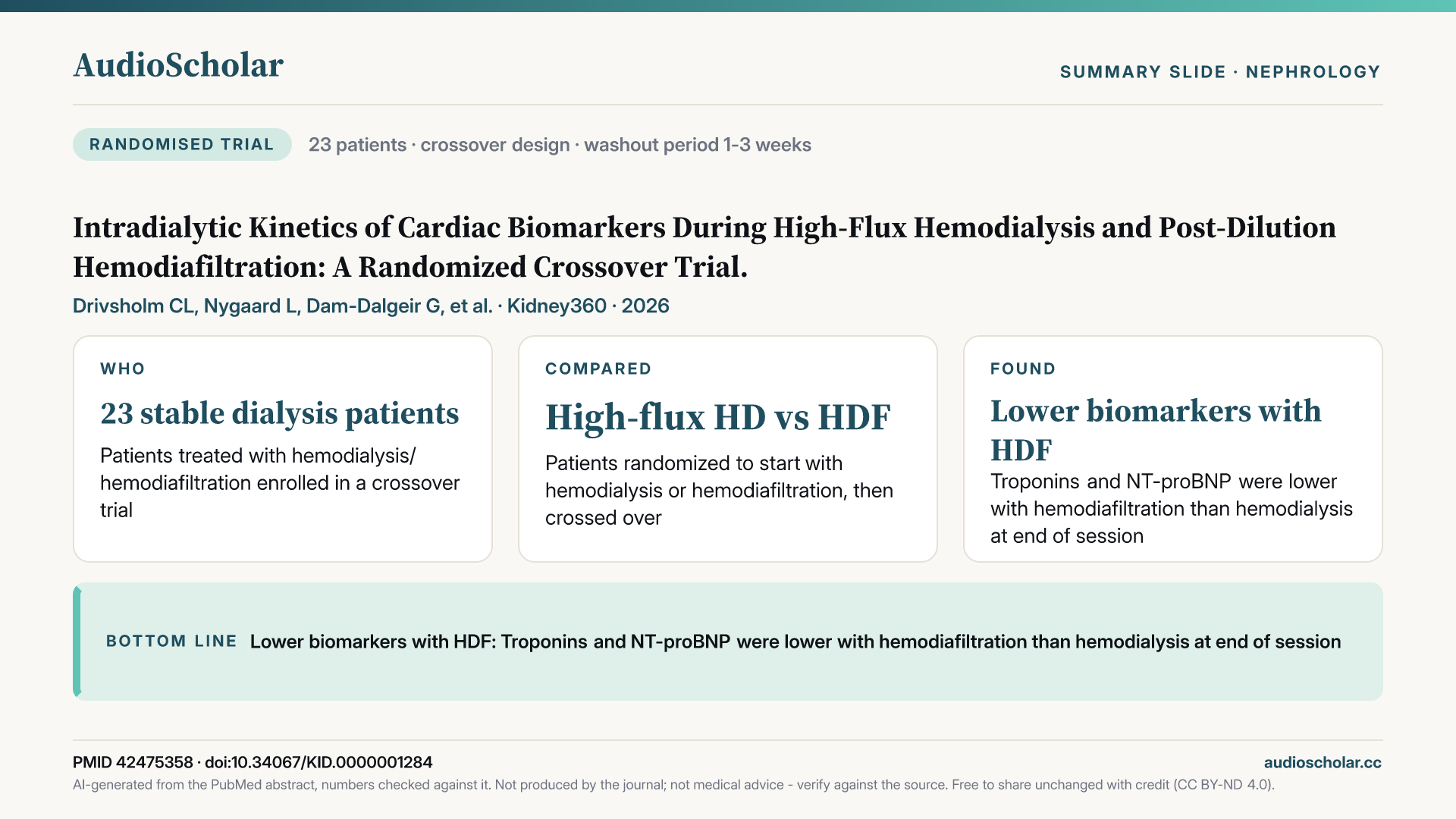
In dialysis care, recent investigations highlight biomarker kinetics and exit-site management. Drivsholm and colleagues published a randomized crossover trial in Kidney360 evaluating intradialytic kinetics of cardiac biomarkers in 23 stable dialysis patients comparing high-flux hemodialysis and post-dilution hemodiafiltration [5]. High-sensitivity troponin I and T were not influenced by conventional hemodialysis, but hemodiafiltration resulted in a significant decline in both biomarkers, and N-terminal pro-B-type natriuretic peptide was significantly reduced by both modalities with greater reductions seen during hemodiafiltration [5]. These findings indicate that the timing of blood draws relative to dialysis sessions can significantly impact cardiac biomarker interpretation [5]. For peritoneal dialysis patients, S and colleagues reported in Seminars in Dialysis the successful use of topical 0.5% timolol maleate ophthalmic solution applied three times weekly for exit-site granulomas in two continuous ambulatory peritoneal dialysis patients [8]. Complete resolution of the granuloma was achieved within 3 weeks in one patient and within 2 months in the other, with no local or systemic adverse effects or exit-site infections [8].
Finally, two clinical guidance and communication reviews round out our coverage. In the American Journal of Kidney Diseases, Maddra and colleagues provided a urology-based review for nephrologists covering lower urinary tract symptoms, the identification of unsafe bladders, and indications for urology referral and urodynamic testing [6]. In the same journal, Gupta and colleagues conducted a qualitative study exploring communication and engagement regarding kidney transplantation among 20 Spanish-speaking Hispanic patients with advanced chronic kidney disease [7]. Participants reported that information regarding transplant eligibility provided outside the transplant clinic was often insufficient for informed decision-making and that providers inadequately considered their socioemotional well-being, though language barriers were largely mitigated by interpreters [7].
If you only have time for one paper this week, make it the randomized crossover trial by Drivsholm and colleagues in Kidney360 on intradialytic cardiac biomarker kinetics [5]. It is a crucial reminder that dialysis modality and timing relative to the blood draw can drastically alter high-sensitivity troponin and N-terminal pro-B-type natriuretic peptide levels, potentially preventing clinical misinterpretation in your patients [5].
Here are the key takeaways from this week in Nephrology. BCMA-targeted therapy with elranatamab can successfully reduce donor-specific antibodies and enable haploidentical transplantation in highly sensitized patients. Time-updated hematuria of 100 red blood cells per microliter or greater significantly increases the risk of disease progression in IgA nephropathy, especially in patients with reduced baseline estimated glomerular filtration rate. Dialysis modality significantly alters circulating cardiac biomarker concentrations, meaning time since the last treatment must be factored into diagnostic interpretations. Topical timolol maleate offers a non-invasive and effective option for managing peritoneal dialysis exit-site granulomas.
That's your roundup for This Week in Nephrology. The full transcript and references are available on the episode page in your AudioScholar library. This is an AI-curated summary — for clinical decisions, always consult primary sources and current guidelines. See you next week.
If this weekly briefing is useful, follow the show in your podcast app so new episodes arrive automatically. And for audio briefings on your own clinical questions and papers, visit audioscholar dot C C.
This is an automated summary generated by artificial intelligence, which can make mistakes. Always review the original source materials.
Spot something worth flagging?
Get this every week in your podcast app — free.
New nephrology episodes land in your feed automatically — listen on your commute.