This Week in Pediatrics — Oct 26, 2026
Generated Oct 26, 2026 · 9:12
The week's practice-changing Pediatrics research, summarized for clinicians.
If the audio fails to play, refresh the page to renew the link.
Get next week’s Pediatrics briefing — free.
In your podcast app, or readable in your inbox with the audio one tap away.
Mobile Subthreshold Exercise Program (MSTEP) for Youth With Prolonged Concussion Recovery: A Randomized Clinical Trial.
In 210 youth with concussion, remotely coached aerobic exercise sped recovery versus stretching at three months, with benefit limited to those within three months of injury and no six-month difference.
JAMA Pediatrics · 2026 · PubMed

This week’s papers
- 01
Projected Effect of 2026 Federal Changes to the Childhood Immunization Schedule on Chronic Hepatitis B Virus Infections in the United States.
Modelling projects that replacing universal hepatitis B birth-dose vaccination with shared decision making would raise chronic childhood infections by about 83 percent and leave most young adults susceptible.
Mohareb AM et al. · Annals of Internal Medicine · 2026
From the briefingIn Annals of Internal Medicine, Mohareb and colleagues built a Markov model of a single United States birth cohort of about 3.6 million infants to project what proposed 2026 federal changes to hepatitis B vaccination would mean over twenty years [1]. Against the universal birth-dose strategy, which the model estimated would still leave roughly 255 childhood chronic infections, deferring the first dose to two months increased chronic infections by about a fifth. A shared decision-making approach, assumed to reach only half of infants, increased them by more than four fifths, to roughly 467. Under that approach, between half and seventy percent of children entering adulthood each year would remain susceptible to the virus. Under less favourable assumptions of lower coverage and higher maternal prevalence, chronic infections climbed into the low thousands. This is modelling, and the authors flag uncertainty about horizontal transmission risk, but the direction is consistent across scenarios, and the authors conclude that universal birth-dose vaccination should be reinstated.
Written by AI from the published abstract, for healthcare professionals. Not medical advice; check the paper before acting on it.
- 02
Beyond RSV: why the bronchiolitis burden in infants will not simply disappear.
Despite real reductions in RSV admissions from nirsevimab and maternal vaccination, other viruses and host susceptibility mean infant bronchiolitis remains a syndrome needing broad surveillance and pan-respiratory vaccines.
Mariani F et al. · European Journal of Pediatrics · 2026
From the briefingA commentary in the European Journal of Pediatrics by Mariani and colleagues makes a complementary point about respiratory infection [2]. Nirsevimab and maternal vaccination are cutting RSV bronchiolitis admissions, but the authors argue that bronchiolitis is a syndrome of the infant airway rather than a single-pathogen disease. Rhinovirus, metapneumovirus, adenovirus and bocavirus already cause substantial illness, host genetic susceptibility appears to drive severity, and while current evidence does not show viral replacement, they call for broad surveillance and note that low- and middle-income countries carry over 97 percent of RSV deaths. This is opinion rather than new data, but it is a useful frame for interpreting quieter RSV seasons.
Written by AI from the published abstract, for healthcare professionals. Not medical advice; check the paper before acting on it.
- 03
Childhood Cancer Risk After Assisted Reproductive Technology.
In over a million Danish children, frozen embryo transfer and sperm injection were associated with higher childhood cancer risk while conventional IVF was not, though absolute risks stayed low.
Mose K et al. · JAMA · 2026
From the briefingIn JAMA, Mose and colleagues followed more than a million Danish children for a median of twenty years [3]. Children conceived with assisted reproduction had about a quarter higher cancer risk than other children, but the signal was confined to specific procedures. Frozen embryo transfer roughly doubled the risk, with associations for leukaemia, lymphoma and soft tissue sarcoma, and intracytoplasmic sperm injection raised it by about half, while conventional in vitro fertilisation showed no increase at all. Results held when comparing against children of mothers with infertility, which the authors read as pointing toward procedure-related rather than infertility-related factors. Absolute risks remain low, and this is observational, so it raises a mechanistic question rather than settling causation.
Written by AI from the published abstract, for healthcare professionals. Not medical advice; check the paper before acting on it.
- 04
¿Aumenta la exposición prenatal al paracetamol el riesgo de trastorno del espectro autista y trastorno por déficit de atención con hiperactividad? Una revisión paraguas y un meta-meta-análisis.
Small crude associations between prenatal paracetamol and autism or ADHD largely disappear in high-quality, low-bias analyses, leaving no solid epidemiological evidence of a causal link.
Tayebi-Hillali H et al. · Developmental Medicine and Child Neurology · 2026
From the briefingIn contrast, a umbrella review and meta-meta-analysis in Developmental Medicine and Child Neurology by Tayebi-Hillali and colleagues examined prenatal paracetamol and autism or ADHD [4]. Crude analyses showed small associations, but these attenuated considerably when restricted to high-quality meta-analyses and low risk-of-bias studies, and the authors conclude there is no solid epidemiological evidence for a causal link. That is a timely counterweight to recent public claims.
Written by AI from the published abstract, for healthcare professionals. Not medical advice; check the paper before acting on it.
- 05
Children and Families Affected by Parental Substance Use: Clinical Report.
A clinical report outlines risks to children of parents with substance use disorders and guides pediatric screening, toxicology interpretation, anticipatory guidance, and recognition of abuse or neglect concerns.
Schiff DM et al. · Pediatrics · 2026
From the briefingRounding out the theme, a clinical report in Pediatrics from Schiff and colleagues addresses children of parents with substance use disorders [5]. It covers epidemiology, the role of bias and structural inequity, interpretation of toxicology testing, screening, anticipatory guidance, and when presentations should raise concern for abuse or neglect, positioning the pediatric clinician as a support for the whole family.
Written by AI from the published abstract, for healthcare professionals. Not medical advice; check the paper before acting on it.
- 06
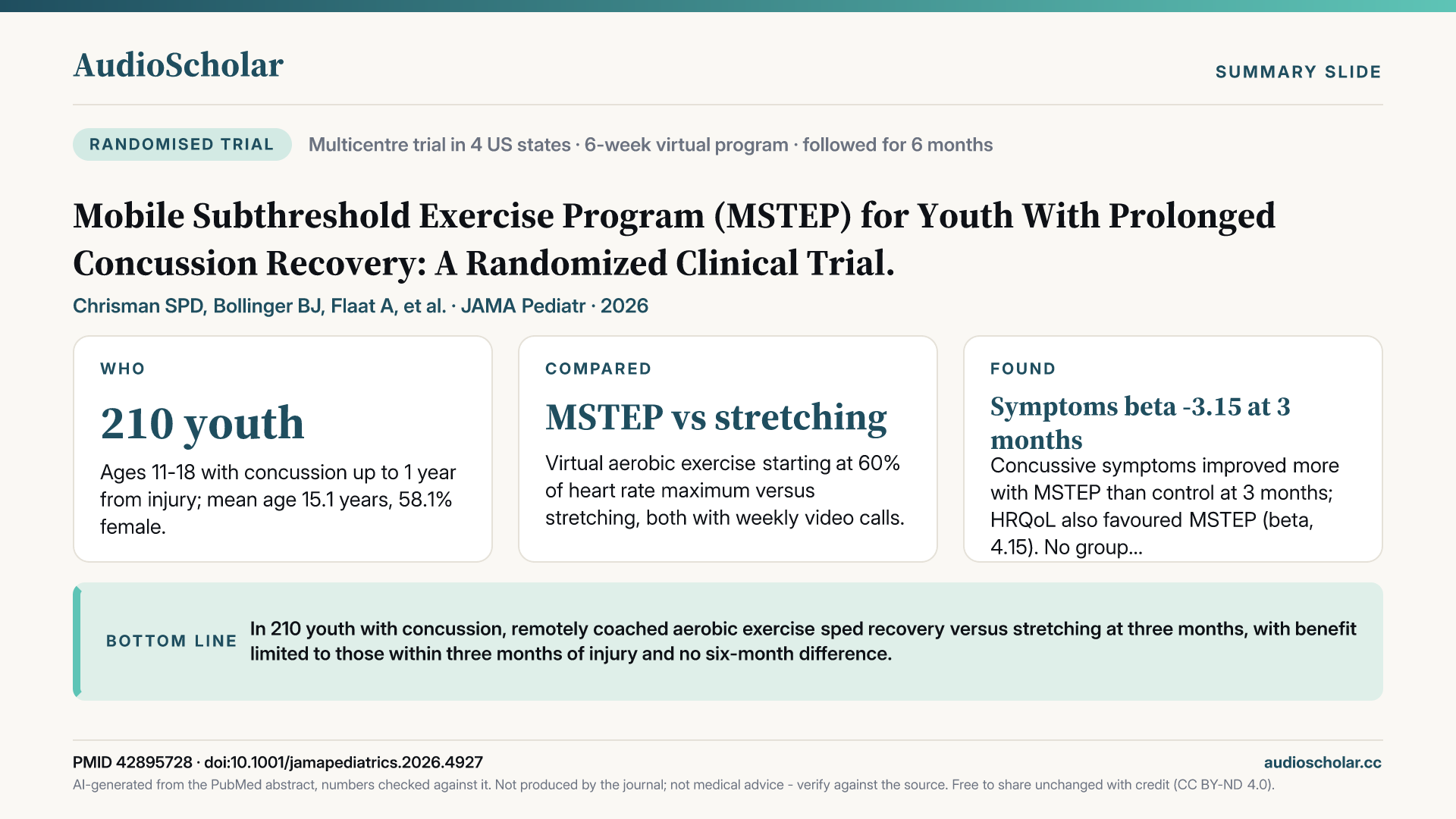
Mobile Subthreshold Exercise Program (MSTEP) for Youth With Prolonged Concussion Recovery: A Randomized Clinical Trial.
In 210 youth with concussion, remotely coached aerobic exercise sped recovery versus stretching at three months, with benefit limited to those within three months of injury and no six-month difference.
Chrisman SPD et al. · JAMA Pediatrics · 2026
From the briefingIn JAMA Pediatrics, Chrisman and colleagues randomised 210 youth aged 11 to 18 with concussion up to a year from injury to a six-week, remotely coached aerobic exercise program starting at 60 percent of maximum heart rate, or to stretching with matched weekly video calls [6]. Both groups improved, but the exercise group recovered faster, with better symptom and quality-of-life scores at three months. By six months the groups had converged, and sleep, mood and anxiety did not differ. The benefit was significant only for youth fewer than three months from injury, which suggests a window for this approach, though that subgroup finding needs confirmation.
If you only have time for one paper this week, make it the MSTEP concussion trial in JAMA Pediatrics [6]. It is a randomised trial in a common pediatric problem showing that remotely delivered aerobic exercise speeds recovery, and it reopens the question of timing by suggesting the benefit is concentrated in the first three months.
Written by AI from the published abstract, for healthcare professionals. Not medical advice; check the paper before acting on it.
- 07
Evening Phone Use and Sleep Outcomes Among Youth.
Objectively measured phone use after 10 pm above an adolescent's own average was linked to sleep starting about an hour later and roughly twenty fewer minutes of sleep.
Zhao Y et al. · JAMA Pediatrics · 2026
From the briefingAlso in JAMA Pediatrics, Zhao, Hale and Christakis used passively sensed phone data and Fitbit sleep measures from 425 adolescents in the Adolescent Brain Cognitive Development Study [7]. On nights when teens used their phones after 10 pm more than their own average, they fell asleep about an hour later and slept about twenty minutes less. Use in the final minutes before sleep was linked to extra wakefulness early in the night. The within-person design strengthens the case beyond self-report, though it remains observational.
Written by AI from the published abstract, for healthcare professionals. Not medical advice; check the paper before acting on it.
- 08
Oral Health for Adolescents: Clinical Report.
A first pediatric clinical report on adolescent oral health covers sports injury prevention, orthodontic issues and risk behaviours, with recommendations for incorporating oral care into health supervision visits.
Fisher-Owens SA et al. · Pediatrics · 2026
From the briefingA Pediatrics clinical report from Fisher-Owens and colleagues completes the picture, the first from the pediatrician's perspective on adolescent oral health, covering sports mouth injury prevention, orthodontic issues and risk behaviours, with recommendations for the health supervision visit [8].
Written by AI from the published abstract, for healthcare professionals. Not medical advice; check the paper before acting on it.
- 09
Obesity in Children Aged 2 to 12 Years: A Review.
Intensive lifestyle treatment modestly lowers BMI in children aged 2 to 12, and liraglutide reduced BMI about 7 percent in a trial, though long-term pharmacotherapy safety data remain limited.
Fox CK et al. · JAMA · 2026
From the briefingA JAMA review by Fox, Armstrong and Kelly summarises obesity care for children aged 2 to 12 [9]. Obesity affects about 15 percent of preschoolers and 22 percent of school-age children, and intensive behaviour and lifestyle treatment, at least 26 contact hours, produces modest BMI reductions. Setmelanotide is the only approved drug under age 12, limited to rare genetic and hypothalamic forms, though a trial of liraglutide in 6 to 11 year olds reduced BMI by about 7 percent; the authors stress that long-term safety data remain limited.
Written by AI from the published abstract, for healthcare professionals. Not medical advice; check the paper before acting on it.
- 10
Prehospital Pediatric Ventilation Quality Following Use of a Feedback Device: A Randomized Study.
In a simulation with 123 EMS clinicians, real-time feedback raised guideline-adherent tidal volumes from about 16 percent to 87 percent of breaths during pediatric manual ventilation.
Finney JD et al. · Pediatrics · 2026
From the briefingIn Pediatrics, Finney and colleagues ran a randomised crossover simulation with 123 emergency medical services clinicians ventilating a toddler manikin [10]. Without feedback, guideline tidal volumes were reached in only about one in six breaths; with a real-time feedback device that rose to almost nine in ten, with smaller gains in rate and mask seal. It is a simulation, so patient outcomes remain untested, but the baseline gap is striking.
Written by AI from the published abstract, for healthcare professionals. Not medical advice; check the paper before acting on it.
The full briefing
This AudioScholar briefing is generated by artificial intelligence for healthcare professionals and trainees. It is not medical advice.
Welcome to This Week in Pediatrics. This week we're covering 10 notable papers spanning vaccine policy and infection prevention, prenatal and family exposures, and adolescent health from sleep to concussion. Let's dive in.
We start with prevention, where one paper models the cost of weakening an established program and another warns against declaring victory too early. In Annals of Internal Medicine, Mohareb and colleagues built a Markov model of a single United States birth cohort of about 3.6 million infants to project what proposed 2026 federal changes to hepatitis B vaccination would mean over twenty years [1]. Against the universal birth-dose strategy, which the model estimated would still leave roughly 255 childhood chronic infections, deferring the first dose to two months increased chronic infections by about a fifth. A shared decision-making approach, assumed to reach only half of infants, increased them by more than four fifths, to roughly 467. Under that approach, between half and seventy percent of children entering adulthood each year would remain susceptible to the virus. Under less favourable assumptions of lower coverage and higher maternal prevalence, chronic infections climbed into the low thousands. This is modelling, and the authors flag uncertainty about horizontal transmission risk, but the direction is consistent across scenarios, and the authors conclude that universal birth-dose vaccination should be reinstated. A commentary in the European Journal of Pediatrics by Mariani and colleagues makes a complementary point about respiratory infection [2]. Nirsevimab and maternal vaccination are cutting RSV bronchiolitis admissions, but the authors argue that bronchiolitis is a syndrome of the infant airway rather than a single-pathogen disease. Rhinovirus, metapneumovirus, adenovirus and bocavirus already cause substantial illness, host genetic susceptibility appears to drive severity, and while current evidence does not show viral replacement, they call for broad surveillance and note that low- and middle-income countries carry over 97 percent of RSV deaths. This is opinion rather than new data, but it is a useful frame for interpreting quieter RSV seasons.
Our second theme concerns what children are exposed to before birth and at home, with one reassuring finding and one that warrants careful counselling. In JAMA, Mose and colleagues followed more than a million Danish children for a median of twenty years [3]. Children conceived with assisted reproduction had about a quarter higher cancer risk than other children, but the signal was confined to specific procedures. Frozen embryo transfer roughly doubled the risk, with associations for leukaemia, lymphoma and soft tissue sarcoma, and intracytoplasmic sperm injection raised it by about half, while conventional in vitro fertilisation showed no increase at all. Results held when comparing against children of mothers with infertility, which the authors read as pointing toward procedure-related rather than infertility-related factors. Absolute risks remain low, and this is observational, so it raises a mechanistic question rather than settling causation. In contrast, a umbrella review and meta-meta-analysis in Developmental Medicine and Child Neurology by Tayebi-Hillali and colleagues examined prenatal paracetamol and autism or ADHD [4]. Crude analyses showed small associations, but these attenuated considerably when restricted to high-quality meta-analyses and low risk-of-bias studies, and the authors conclude there is no solid epidemiological evidence for a causal link. That is a timely counterweight to recent public claims. Rounding out the theme, a clinical report in Pediatrics from Schiff and colleagues addresses children of parents with substance use disorders [5]. It covers epidemiology, the role of bias and structural inequity, interpretation of toxicology testing, screening, anticipatory guidance, and when presentations should raise concern for abuse or neglect, positioning the pediatric clinician as a support for the whole family.
Our third theme is the adolescent, where two well-designed studies add objective data to common clinical questions. In JAMA Pediatrics, Chrisman and colleagues randomised 210 youth aged 11 to 18 with concussion up to a year from injury to a six-week, remotely coached aerobic exercise program starting at 60 percent of maximum heart rate, or to stretching with matched weekly video calls [6]. Both groups improved, but the exercise group recovered faster, with better symptom and quality-of-life scores at three months. By six months the groups had converged, and sleep, mood and anxiety did not differ. The benefit was significant only for youth fewer than three months from injury, which suggests a window for this approach, though that subgroup finding needs confirmation. Also in JAMA Pediatrics, Zhao, Hale and Christakis used passively sensed phone data and Fitbit sleep measures from 425 adolescents in the Adolescent Brain Cognitive Development Study [7]. On nights when teens used their phones after 10 pm more than their own average, they fell asleep about an hour later and slept about twenty minutes less. Use in the final minutes before sleep was linked to extra wakefulness early in the night. The within-person design strengthens the case beyond self-report, though it remains observational. A Pediatrics clinical report from Fisher-Owens and colleagues completes the picture, the first from the pediatrician's perspective on adolescent oral health, covering sports mouth injury prevention, orthodontic issues and risk behaviours, with recommendations for the health supervision visit [8].
Finally, two papers on the tools of practice, one in chronic care and one in emergencies. A JAMA review by Fox, Armstrong and Kelly summarises obesity care for children aged 2 to 12 [9]. Obesity affects about 15 percent of preschoolers and 22 percent of school-age children, and intensive behaviour and lifestyle treatment, at least 26 contact hours, produces modest BMI reductions. Setmelanotide is the only approved drug under age 12, limited to rare genetic and hypothalamic forms, though a trial of liraglutide in 6 to 11 year olds reduced BMI by about 7 percent; the authors stress that long-term safety data remain limited. In Pediatrics, Finney and colleagues ran a randomised crossover simulation with 123 emergency medical services clinicians ventilating a toddler manikin [10]. Without feedback, guideline tidal volumes were reached in only about one in six breaths; with a real-time feedback device that rose to almost nine in ten, with smaller gains in rate and mask seal. It is a simulation, so patient outcomes remain untested, but the baseline gap is striking.
If you only have time for one paper this week, make it the MSTEP concussion trial in JAMA Pediatrics [6]. It is a randomised trial in a common pediatric problem showing that remotely delivered aerobic exercise speeds recovery, and it reopens the question of timing by suggesting the benefit is concentrated in the first three months.
Here is what this week's evidence adds up to in Pediatrics. First, modelling indicates that moving away from universal hepatitis B birth-dose vaccination would increase chronic childhood infections, substantially so under shared decision making, though these are projections rather than observed outcomes. Second, randomised data support remote aerobic exercise for adolescent concussion within three months of injury, with no lasting difference at six months and the timing effect still needing replication. Third, the best-quality evidence does not support a causal link between prenatal paracetamol and autism or ADHD, while frozen embryo transfer and sperm injection carry a small, observational association with childhood cancer that warrants investigation rather than alarm. Fourth, objective sensor data strengthen the association between late-evening phone use and shorter adolescent sleep, though causation is not proven. And fifth, simulation evidence suggests prehospital pediatric ventilation often misses guidelines and that feedback devices close much of the gap, pending clinical outcome data.
That's your roundup for This Week in Pediatrics. The full transcript and references are available on the episode page. This is an AI-curated summary — for clinical decisions, always consult primary sources and current guidelines. See you next week.
If this weekly briefing is useful, follow the show in your podcast app so new episodes arrive automatically. And if it saves you time, a quick rating in your podcast app helps other physicians find the show.
This is an automated summary generated by artificial intelligence, which can make mistakes. Always review the original source materials.
Spot something worth flagging?
Get this every week in your podcast app — free.
New pediatrics episodes land in your feed automatically — listen on your commute.