This Week in Nephrology — Oct 21, 2026
Generated Oct 21, 2026 · 11:07
The week's practice-changing Nephrology research, summarized for clinicians.
If the audio fails to play, refresh the page to renew the link.
Get next week’s Nephrology briefing — free.
In your podcast app, or readable in your inbox with the audio one tap away.
Intermittent or Continuous Renal-Replacement Therapy in Acute Kidney Injury.
In critically ill adults needing dialysis for acute kidney injury, initial intermittent hemodialysis was not noninferior to continuous therapy and was associated with higher 90-day mortality, prompting early trial termination.
New England Journal of Medicine · 2026 · PubMed

This week’s papers
- 01
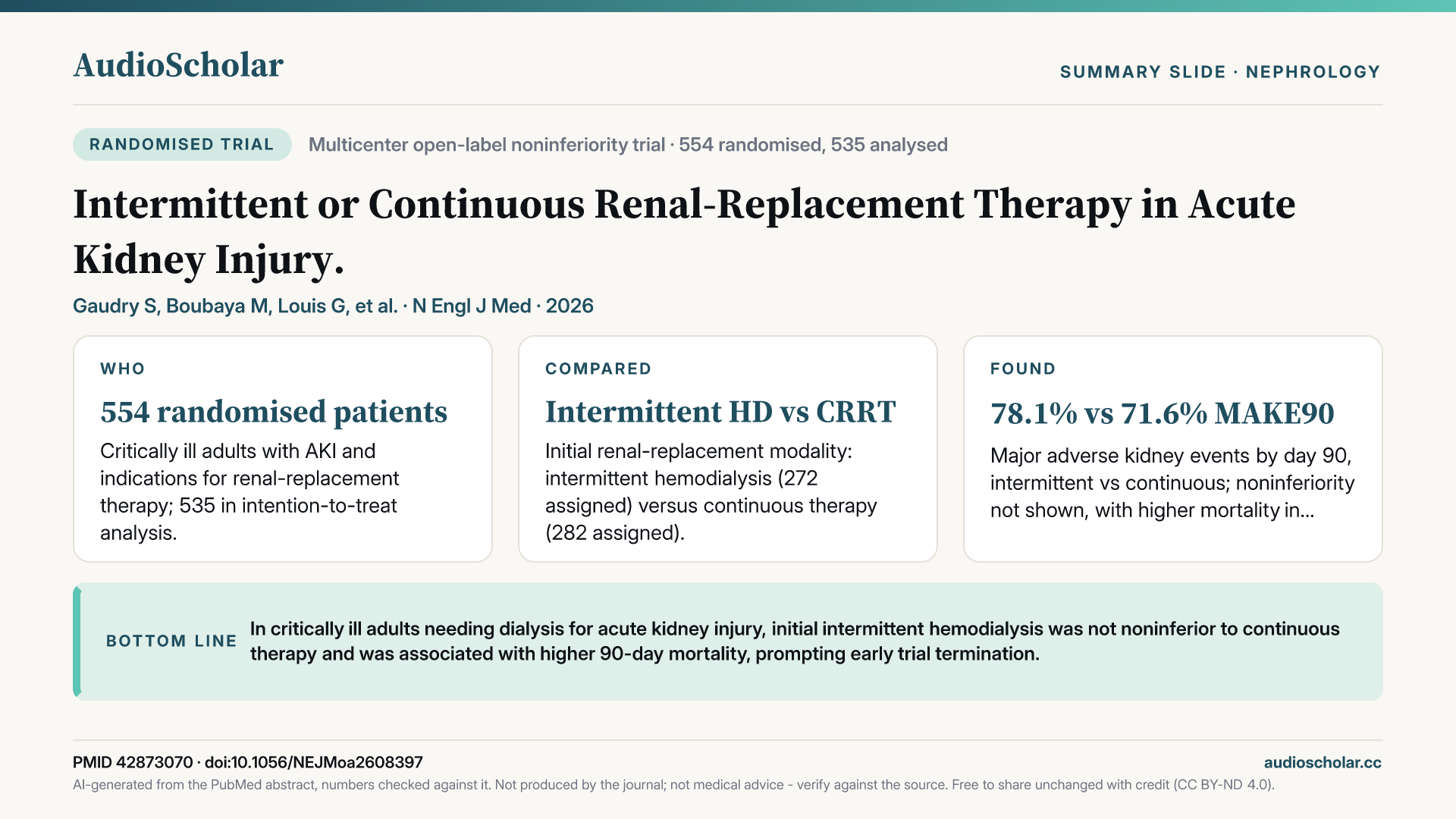
Intermittent or Continuous Renal-Replacement Therapy in Acute Kidney Injury.
In critically ill adults needing dialysis for acute kidney injury, initial intermittent hemodialysis was not noninferior to continuous therapy and was associated with higher 90-day mortality, prompting early trial termination.
Gaudry S, Boubaya M, Louis G, et al. · New England Journal of Medicine · 2026
From the briefingIn the New England Journal of Medicine, Gaudry and colleagues report a multicenter French noninferiority trial that randomized critically ill adults with acute kidney injury and an indication for dialysis to start with either intermittent hemodialysis or continuous renal-replacement therapy [1]. The trial was stopped early because interim analyses kept showing a mortality signal against intermittent therapy. Among roughly 535 analyzed patients, intermittent hemodialysis failed to show noninferiority on the composite of death, dialysis dependence, or persistent creatinine elevation at 90 days. More strikingly, death by day 90 occurred in about 63 percent of the intermittent group versus about 54 percent of the continuous group, which translates to roughly a 30 percent higher hazard of dying. Hypotension was common in both arms and did not differ meaningfully. The caveats matter: the trial was open label and stopped early, which can exaggerate effect sizes, and mortality was not the primary endpoint. Still, this reopens a question many considered settled by older trials showing equivalence, and it is the strongest randomized signal to date favoring continuous therapy as the initial modality in this population.
If you only have time for one paper this week, make it the ICRAKI trial in the New England Journal of Medicine [1]. It reopens what many considered a closed question about initial dialysis modality in critically ill patients, with a mortality signal large enough to stop the trial early.
Written by AI from the published abstract, for healthcare professionals. Not medical advice; check the paper before acting on it.
- 02
Intraoperative Dobutamine Plus Norepinephrine to Prevent Postoperative Acute Kidney Injury in Septic Shock: A Randomized Clinical Trial.
Adding intraoperative dobutamine to norepinephrine during septic shock source-control surgery cut new or worsening acute kidney injury from about 35 to 23 percent, with more tachycardia.
Chu L, Xie G, et al. · JAMA · 2026
From the briefingIn JAMA, Chu and colleagues tackle prevention rather than support [2]. Across 39 Chinese hospitals, 584 adults with septic shock undergoing surgical source control received intraoperative norepinephrine alone or with dobutamine up to 5 micrograms per kilogram per minute. New or worsening acute kidney injury within a week fell from about 35 percent to about 23 percent, roughly a third fewer cases, and the more severe stage 2 and stage 3 injuries were also less frequent. Most secondary outcomes did not differ, and tachycardia was more common with dobutamine. This is the first randomized evidence behind a guideline recommendation that has rested on very low-certainty data, though it comes from an open-label design in a single country and in a specific surgical setting, so replication would firm up its generalizability.
Written by AI from the published abstract, for healthcare professionals. Not medical advice; check the paper before acting on it.
- 03
Randomized Clinical Trial of Ringer's Lactate Versus Chloride-Reduced Saline-Dextrose in Postoperative Kidney Transplantation.
After kidney transplantation, Ringer's lactate maintained higher bicarbonate, sharply reduced rescue bicarbonate use, and was associated with better one-month eGFR than a chloride-reduced saline-dextrose protocol.
Sawasdichai K, Rakpithayanon C, Konwai S, et al. · Kidney International Reports · 2026
From the briefingIn Kidney International Reports, Sawasdichai and colleagues randomized 134 kidney transplant recipients to Ringer's lactate or a chloride-reduced protocol of normal saline alternating with five percent dextrose, titrated to hourly urine output [3]. By day four, serum bicarbonate was about two milliequivalents per liter higher with Ringer's lactate, and rescue bicarbonate was needed in under a fifth of the Ringer's group compared with well over half of the saline-dextrose group. One-month eGFR was about eight points higher with Ringer's lactate, though that was a secondary outcome, and the biomarker findings were mixed and hypothesis-generating. The authors note the results apply mainly to grafts with immediate or early function.
Written by AI from the published abstract, for healthcare professionals. Not medical advice; check the paper before acting on it.
- 04
Claims-Based Phenotyping of Acute Kidney Transplant Rejection in a National Medicare Cohort.
A Medicare claims algorithm classified acute kidney transplant rejection by type and severity, revealing three-year graft survival falling from about 88 percent in mild cellular to 68 percent in mixed rejection.
Ekanayake C, Yu M, Natarajan K, et al. · Kidney International Reports · 2026
From the briefingAlso in Kidney International Reports, Ekanayake and colleagues used United States Renal Data System Medicare claims covering nearly 93,000 recipients to build an algorithm that classifies acute rejection by type and severity from treatment patterns [4]. Among biopsy-associated episodes, three-year death-censored graft survival stepped down from about 88 percent for mild cellular rejection to about 68 percent for mixed cellular and antibody-mediated rejection, a gradient that persisted after adjustment. This is a surveillance tool rather than a clinical one, but it opens national-scale study of rejection heterogeneity.
Written by AI from the published abstract, for healthcare professionals. Not medical advice; check the paper before acting on it.
- 05
Microvascular inflammation in kidney transplants: finally an effective treatment?
Editorialists argue that targeting CD38 on plasma cells and natural killer cells shows great promise against microvascular inflammation, a graft-damaging transplant lesion that has long resisted effective treatment.
Haas M, Hou J, Fogo AB · Kidney International · 2026
From the briefingFinally, in Kidney International, an editorial by Haas, Hou, and Fogo comments on a separate study targeting CD38, which is expressed on both plasma cells and natural killer cells, in kidney transplants with microvascular inflammation [5]. The editorialists frame microvascular inflammation, with or without donor-specific antibodies, as a lesion that drives graft loss and has resisted treatment, and they describe CD38 targeting as showing great promise, while the title's question mark signals that confirmation is still needed.
Written by AI from the published abstract, for healthcare professionals. Not medical advice; check the paper before acting on it.
- 06
Safety outcomes of semaglutide by chronic kidney disease severity in the FLOW trial.
In FLOW, semaglutide had fewer serious adverse events than placebo across all eGFR levels including below 30, though gastrointestinal discontinuations were about four times more frequent.
Tuttle KR, Andersen MR, Arici M, et al. · Kidney International · 2026
From the briefingIn Kidney International, Tuttle and colleagues present a prespecified safety analysis of the FLOW trial of once-weekly semaglutide 1 milligram in 3,533 people with type 2 diabetes and chronic kidney disease, broken down by baseline eGFR [6]. Serious adverse events were reported less often with semaglutide than placebo in every eGFR band, including below 30. Discontinuation for any adverse event rose as kidney function fell, but equally in both arms, while discontinuation for gastrointestinal effects was about four times more common with semaglutide, at roughly four and a half percent versus one percent. The analysis is descriptive, but it offers reassurance that tolerability does not deteriorate disproportionately in advanced disease.
Written by AI from the published abstract, for healthcare professionals. Not medical advice; check the paper before acting on it.
- 07
Glucagon-Like Peptide-1 Receptor Agonists and Multi-hormone Receptor Modulators for Kidney Protection in Nondiabetic Kidney Disease.
Kidney protection from GLP-1 and multi-hormone agents in people without diabetes is supported so far only by secondary endpoints, with dedicated kidney outcome trials still underway.
Pasricha SV, Faruque LI, Mohsen M, et al. · Journal of the American Society of Nephrology · 2026
From the briefingExtending that line of thinking beyond diabetes, a review in the Journal of the American Society of Nephrology by Pasricha and colleagues summarizes how GLP-1 receptor agonists and newer multi-hormone agents targeting GIP, glucagon, and amylin may protect the kidney through natriuresis, glomerular hemodynamic effects, and reduced inflammation, alongside weight and blood pressure effects [7]. The authors stress that evidence in people without diabetes currently comes from secondary kidney endpoints in obesity and cardiovascular trials, and that dedicated outcome trials are still underway.
Written by AI from the published abstract, for healthcare professionals. Not medical advice; check the paper before acting on it.
- 08
Aldosterone and Residual Cardiorenal Risk: Pathophysiology and Emerging Therapeutic Strategies.
Mineralocorticoid receptor antagonists have established benefit in defined chronic kidney disease populations, whereas aldosterone synthase inhibitor outcome benefit remains unproven after EASi-KIDNEY stopped early with results pending.
Kanbay M, AlShiab R, Shah E, et al. · Nephrology Dialysis Transplantation · 2026
From the briefingA companion review in Nephrology Dialysis Transplantation by Kanbay and colleagues examines aldosterone and residual cardiorenal risk [8]. Its central argument is that benefit from mineralocorticoid receptor blockade should not be read as proof of aldosterone excess in every patient, and it proposes separating established antagonist indications, evaluation for primary aldosteronism, and the still unestablished outcome role of aldosterone synthase inhibitors, noting that the EASi-KIDNEY trial was discontinued early with results pending.
Written by AI from the published abstract, for healthcare professionals. Not medical advice; check the paper before acting on it.
- 09
A study using the REIN registry suggests a statin therapy benefits for secondary prevention in patients receiving dialysis.
In 5,534 French dialysis patients after an atherosclerotic event, statin initiation was associated with lower mortality and about 135 days of added survival over ten years, without hepatic or muscle harm.
Letourneau P, Koppe L, Couchoud C, et al. · Kidney International · 2026
From the briefingRounding out this theme, Letourneau and colleagues, in Kidney International, used the French REIN registry linked to national health data to emulate a target trial in 5,534 dialysis patients who had just had an atherosclerotic cardiovascular event [9]. Statin initiation was associated with about six fewer deaths per hundred patients at four years and a mean survival gain of about 135 days at ten years, with no excess rhabdomyolysis or toxic hepatitis. Because older randomized trials in dialysis were largely neutral and excluded recent events, this observational evidence fills a specific gap for secondary prevention, although residual confounding cannot be excluded.
Written by AI from the published abstract, for healthcare professionals. Not medical advice; check the paper before acting on it.
- 10
Microangiopathic lesions associated with poor immunosuppressive therapy response in IgA nephropathy.
In IgA nephropathy with persistent proteinuria, arteriolar microangiopathic lesions affected a quarter of patients and roughly quadrupled the odds of not responding to immunosuppressive therapy.
Zhong Z, Zhao H, Jia N, et al. · Nephrology Dialysis Transplantation · 2026
From the briefingOur final paper concerns glomerular disease. In Nephrology Dialysis Transplantation, Zhong and colleagues followed 620 patients with IgA nephropathy and persistent proteinuria of at least one gram per day despite optimized renin-angiotensin blockade, all of whom then received immunosuppression [10]. About a quarter of patients had arteriolar microangiopathic lesions on biopsy, and those patients failed to respond to immunosuppression far more often, about 61 percent versus 26 percent, roughly quadrupling the odds of non-response after adjustment and propensity matching. Patients with these lesions also had higher blood pressure and worse baseline kidney function, so the lesion may partly mark more advanced disease. The cohort is from a single national setting, and the findings identify a subgroup that may need different strategies rather than establishing an alternative treatment.
Written by AI from the published abstract, for healthcare professionals. Not medical advice; check the paper before acting on it.
The full briefing
This AudioScholar briefing is generated by artificial intelligence for healthcare professionals and trainees. It is not medical advice.
Welcome to This Week in Nephrology. This week we're covering 10 notable papers spanning acute kidney injury in the critically ill, kidney transplantation, and cardiometabolic and glomerular strategies in chronic kidney disease. Let's dive in.
We start in the intensive care unit, where two large randomized trials challenge long-held assumptions about how we support and protect the injured kidney. In the New England Journal of Medicine, Gaudry and colleagues report a multicenter French noninferiority trial that randomized critically ill adults with acute kidney injury and an indication for dialysis to start with either intermittent hemodialysis or continuous renal-replacement therapy [1]. The trial was stopped early because interim analyses kept showing a mortality signal against intermittent therapy. Among roughly 535 analyzed patients, intermittent hemodialysis failed to show noninferiority on the composite of death, dialysis dependence, or persistent creatinine elevation at 90 days. More strikingly, death by day 90 occurred in about 63 percent of the intermittent group versus about 54 percent of the continuous group, which translates to roughly a 30 percent higher hazard of dying. Hypotension was common in both arms and did not differ meaningfully. The caveats matter: the trial was open label and stopped early, which can exaggerate effect sizes, and mortality was not the primary endpoint. Still, this reopens a question many considered settled by older trials showing equivalence, and it is the strongest randomized signal to date favoring continuous therapy as the initial modality in this population. In JAMA, Chu and colleagues tackle prevention rather than support [2]. Across 39 Chinese hospitals, 584 adults with septic shock undergoing surgical source control received intraoperative norepinephrine alone or with dobutamine up to 5 micrograms per kilogram per minute. New or worsening acute kidney injury within a week fell from about 35 percent to about 23 percent, roughly a third fewer cases, and the more severe stage 2 and stage 3 injuries were also less frequent. Most secondary outcomes did not differ, and tachycardia was more common with dobutamine. This is the first randomized evidence behind a guideline recommendation that has rested on very low-certainty data, though it comes from an open-label design in a single country and in a specific surgical setting, so replication would firm up its generalizability.
Turning to transplantation, three papers address perioperative care, how we measure rejection, and how we might finally treat microvascular inflammation. In Kidney International Reports, Sawasdichai and colleagues randomized 134 kidney transplant recipients to Ringer's lactate or a chloride-reduced protocol of normal saline alternating with five percent dextrose, titrated to hourly urine output [3]. By day four, serum bicarbonate was about two milliequivalents per liter higher with Ringer's lactate, and rescue bicarbonate was needed in under a fifth of the Ringer's group compared with well over half of the saline-dextrose group. One-month eGFR was about eight points higher with Ringer's lactate, though that was a secondary outcome, and the biomarker findings were mixed and hypothesis-generating. The authors note the results apply mainly to grafts with immediate or early function. Also in Kidney International Reports, Ekanayake and colleagues used United States Renal Data System Medicare claims covering nearly 93,000 recipients to build an algorithm that classifies acute rejection by type and severity from treatment patterns [4]. Among biopsy-associated episodes, three-year death-censored graft survival stepped down from about 88 percent for mild cellular rejection to about 68 percent for mixed cellular and antibody-mediated rejection, a gradient that persisted after adjustment. This is a surveillance tool rather than a clinical one, but it opens national-scale study of rejection heterogeneity. Finally, in Kidney International, an editorial by Haas, Hou, and Fogo comments on a separate study targeting CD38, which is expressed on both plasma cells and natural killer cells, in kidney transplants with microvascular inflammation [5]. The editorialists frame microvascular inflammation, with or without donor-specific antibodies, as a lesion that drives graft loss and has resisted treatment, and they describe CD38 targeting as showing great promise, while the title's question mark signals that confirmation is still needed.
Our third theme is the expanding toolkit for cardiorenal risk in chronic kidney disease, from incretin therapies to aldosterone pathways to statins on dialysis. In Kidney International, Tuttle and colleagues present a prespecified safety analysis of the FLOW trial of once-weekly semaglutide 1 milligram in 3,533 people with type 2 diabetes and chronic kidney disease, broken down by baseline eGFR [6]. Serious adverse events were reported less often with semaglutide than placebo in every eGFR band, including below 30. Discontinuation for any adverse event rose as kidney function fell, but equally in both arms, while discontinuation for gastrointestinal effects was about four times more common with semaglutide, at roughly four and a half percent versus one percent. The analysis is descriptive, but it offers reassurance that tolerability does not deteriorate disproportionately in advanced disease. Extending that line of thinking beyond diabetes, a review in the Journal of the American Society of Nephrology by Pasricha and colleagues summarizes how GLP-1 receptor agonists and newer multi-hormone agents targeting GIP, glucagon, and amylin may protect the kidney through natriuresis, glomerular hemodynamic effects, and reduced inflammation, alongside weight and blood pressure effects [7]. The authors stress that evidence in people without diabetes currently comes from secondary kidney endpoints in obesity and cardiovascular trials, and that dedicated outcome trials are still underway. A companion review in Nephrology Dialysis Transplantation by Kanbay and colleagues examines aldosterone and residual cardiorenal risk [8]. Its central argument is that benefit from mineralocorticoid receptor blockade should not be read as proof of aldosterone excess in every patient, and it proposes separating established antagonist indications, evaluation for primary aldosteronism, and the still unestablished outcome role of aldosterone synthase inhibitors, noting that the EASi-KIDNEY trial was discontinued early with results pending. Rounding out this theme, Letourneau and colleagues, in Kidney International, used the French REIN registry linked to national health data to emulate a target trial in 5,534 dialysis patients who had just had an atherosclerotic cardiovascular event [9]. Statin initiation was associated with about six fewer deaths per hundred patients at four years and a mean survival gain of about 135 days at ten years, with no excess rhabdomyolysis or toxic hepatitis. Because older randomized trials in dialysis were largely neutral and excluded recent events, this observational evidence fills a specific gap for secondary prevention, although residual confounding cannot be excluded.
Our final paper concerns glomerular disease. In Nephrology Dialysis Transplantation, Zhong and colleagues followed 620 patients with IgA nephropathy and persistent proteinuria of at least one gram per day despite optimized renin-angiotensin blockade, all of whom then received immunosuppression [10]. About a quarter of patients had arteriolar microangiopathic lesions on biopsy, and those patients failed to respond to immunosuppression far more often, about 61 percent versus 26 percent, roughly quadrupling the odds of non-response after adjustment and propensity matching. Patients with these lesions also had higher blood pressure and worse baseline kidney function, so the lesion may partly mark more advanced disease. The cohort is from a single national setting, and the findings identify a subgroup that may need different strategies rather than establishing an alternative treatment.
If you only have time for one paper this week, make it the ICRAKI trial in the New England Journal of Medicine [1]. It reopens what many considered a closed question about initial dialysis modality in critically ill patients, with a mortality signal large enough to stop the trial early.
Here is what this week's evidence adds up to in Nephrology. First, randomized evidence now suggests intermittent hemodialysis is not noninferior to continuous therapy as the starting modality for critically ill patients with acute kidney injury, with higher mortality, though the early stopping and open-label design warrant cautious interpretation. Second, intraoperative dobutamine added to norepinephrine reduced postoperative kidney injury in septic shock surgery in one large Chinese trial, giving the first randomized support to a weakly evidenced guideline recommendation, with replication still needed. Third, in transplantation, a small trial favors Ringer's lactate over a chloride-reduced saline strategy for acid-base control, and CD38 targeting for microvascular inflammation is promising but early. Fourth, semaglutide's safety profile in FLOW holds across eGFR levels, while kidney benefit in people without diabetes and the role of aldosterone synthase inhibitors remain unsettled pending dedicated trials. Fifth, observational data support statins after a cardiovascular event in dialysis patients, and microangiopathic lesions mark poor immunosuppression response in IgA nephropathy, both findings strong enough to inform discussion but not definitive.
That's your roundup for This Week in Nephrology. The full transcript and references are available on the episode page. This is an AI-curated summary — for clinical decisions, always consult primary sources and current guidelines. See you next week.
If this weekly briefing is useful, follow the show in your podcast app so new episodes arrive automatically. And think of one colleague — in any specialty — who never has time to keep up with the literature. Tell them about AudioScholar: a free ten-minute weekly for every specialty, to listen to in any podcast app, or to read at audioscholar dot C C.
This is an automated summary generated by artificial intelligence, which can make mistakes. Always review the original source materials.
Spot something worth flagging?
Get this every week in your podcast app — free.
New nephrology episodes land in your feed automatically — listen on your commute.