This Week in Oncology — Oct 21, 2026
Generated Oct 21, 2026 · 12:02
The week's practice-changing Oncology research, summarized for clinicians.
If the audio fails to play, refresh the page to renew the link.
Get next week’s Oncology briefing — free.
In your podcast app, or readable in your inbox with the audio one tap away.
Ponatinib-Blinatumomab or Imatinib-Chemotherapy for Adult Ph-Positive ALL.
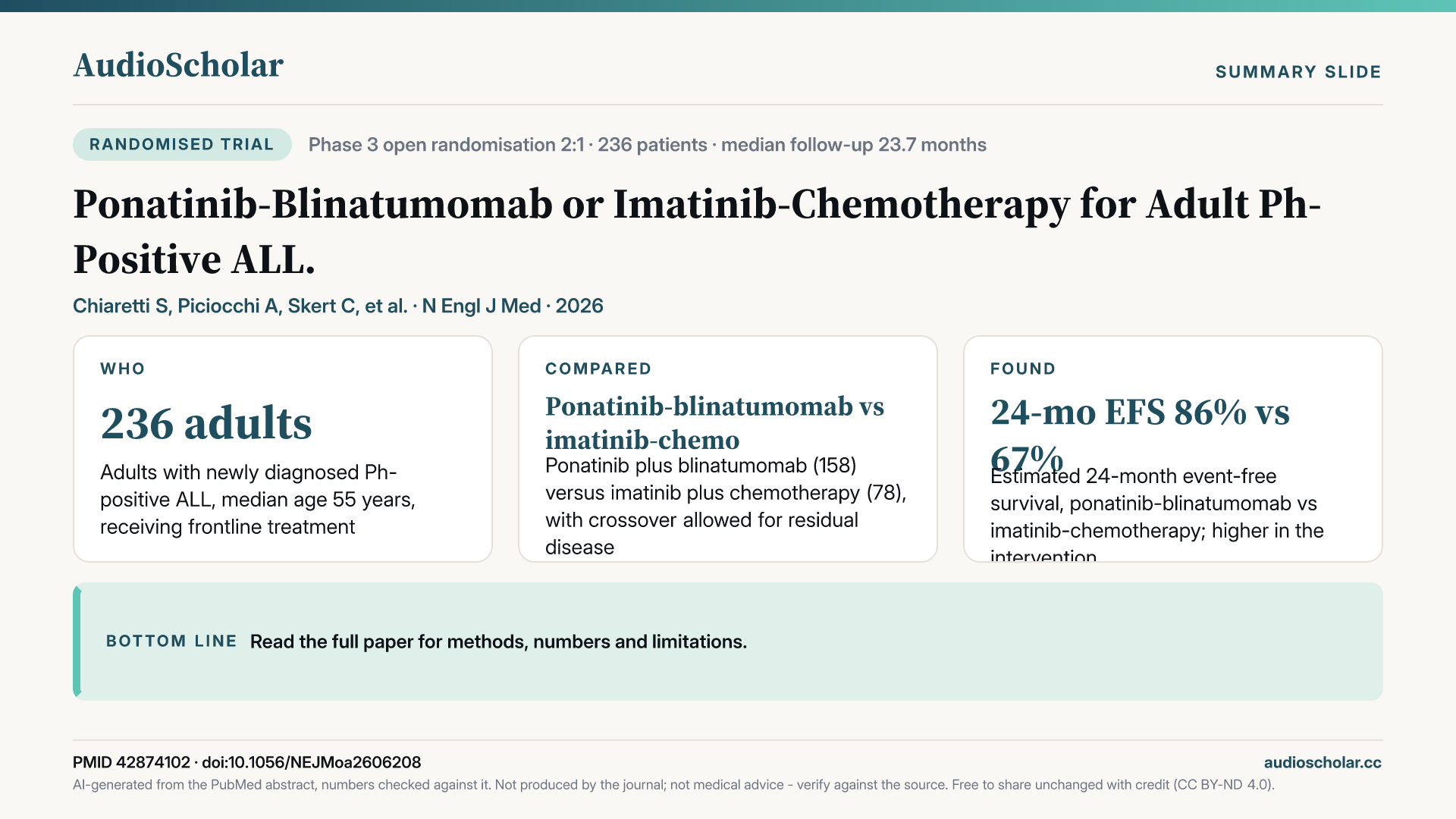
Frontline chemotherapy-free ponatinib plus blinatumomab raised two-year event-free survival to 86 percent versus 67 percent with imatinib-chemotherapy in adult Philadelphia-positive ALL, with few patients needing transplant.
New England Journal of Medicine · 2026 · PubMed

This week’s papers
- 01
Ponatinib-Blinatumomab or Imatinib-Chemotherapy for Adult Ph-Positive ALL.
Frontline chemotherapy-free ponatinib plus blinatumomab raised two-year event-free survival to 86 percent versus 67 percent with imatinib-chemotherapy in adult Philadelphia-positive ALL, with few patients needing transplant.
Chiaretti S et al. · New England Journal of Medicine · 2026
From the briefingThe headline paper comes from the New England Journal of Medicine, where Chiaretti and colleagues in the Italian GIMEMA group report a phase 3 trial in adults with Philadelphia-positive acute lymphoblastic leukemia [1]. Two hundred thirty-six patients, with a median age of 55, were randomized two to one to frontline ponatinib plus blinatumomab, with no conventional chemotherapy, or to imatinib plus chemotherapy, with crossover allowed for patients whose measurable residual disease persisted or returned. At about two years of follow-up, event-free survival was 86 percent with the chemotherapy-free regimen versus 67 percent with the control, and molecular responses after blinatumomab consolidation were roughly twenty points higher. Relapse was less common, at about 5 percent versus 13 percent. Overall survival was numerically similar, 90 versus 85 percent, which likely reflects the crossover design, so the survival question is not yet settled. Perhaps most striking, only about one in five patients in the intervention group had gone on to transplant in first remission. This is a single randomized trial with relatively short follow-up, but it is the strongest evidence yet that a targeted, immunotherapy-based backbone can outperform chemotherapy in this disease, and it raises real questions about who still needs transplant.
If you only have time for one paper this week, make it the GIMEMA trial of ponatinib plus blinatumomab in the New England Journal of Medicine [1]. It is the first phase 3 evidence that a chemotherapy-free frontline approach beats imatinib-chemotherapy in adult Philadelphia-positive ALL, and it reopens the question of how many of these patients truly need transplant in first remission.
Written by AI from the published abstract, for healthcare professionals. Not medical advice; check the paper before acting on it.
- 02
First-In-Human Study of 211At-CD45 Radioimmunotherapy With Nonmyeloablative Conditioning Hematopoietic Cell Transplantation for Adults With Hematologic Malignancies.
Astatine-211 anti-CD45 radioimmunotherapy added to nonmyeloablative transplant conditioning was feasible up to 500 microcuries per kilogram, cleared circulating blasts, but liver veno-occlusive disease limited dosing.
Vo PT et al. · Journal of Clinical Oncology · 2026
From the briefingAt the other end of the transplant spectrum, the Journal of Clinical Oncology publishes a first-in-human study from Vo and colleagues of an alpha-emitting radioimmunotherapy, astatine-211 linked to an anti-CD45 antibody, given before nonmyeloablative conditioning in 45 high-risk adults with myeloid malignancies or acute leukemia [2]. The maximum tolerated dose was set at 500 microcuries per kilogram after veno-occlusive disease at the highest dose, and in the expansion stage six patients developed veno-occlusive disease, all of them receiving sirolimus for graft-versus-host prophylaxis, which flags a possible interaction worth watching. Engraftment, chimerism and graft-versus-host rates were not adversely affected, and circulating blasts cleared in 12 of 13 patients before conditioning even began. One-year relapse-free survival was about 42 percent. This is early dose-finding work in a very high-risk group, supporting phase 2 evaluation rather than any change in practice.
Written by AI from the published abstract, for healthcare professionals. Not medical advice; check the paper before acting on it.
- 03
Hypofractionated Versus Conventionally Fractionated Postmastectomy Radiotherapy With Internal Mammary Node Irradiation for High-Risk Breast Cancer (HypoMast-IMNI): A Randomized Phase III Trial.
Sixteen-fraction hypofractionated postmastectomy radiotherapy including internal mammary nodes was noninferior for five-year locoregional recurrence and sharply reduced severe acute skin toxicity versus conventional 25 fractions.
Wang X et al. · Journal of Clinical Oncology · 2026
From the briefingIn the Journal of Clinical Oncology, Wang and colleagues report HypoMast-IMNI, a phase 3 noninferiority trial of nearly 1,500 high-risk patients after mastectomy who needed radiotherapy including the internal mammary nodes [3]. A 16-fraction hypofractionated schedule of 42.56 Gray was compared with the conventional 50 Gray in 25 fractions. Five-year locoregional recurrence was low in both arms, under about 2 percent with the shorter course and just over 2 percent with the conventional one, meeting the noninferiority criterion, with no differences in distant metastasis-free, disease-free or overall survival. Severe acute skin toxicity fell from about 12 percent to under 2 percent, and lung toxicity was low and comparable, with no ischemic cardiac events. Internal mammary coverage has been one of the main settings where hypofractionation lacked randomized data, and this trial fills much of that gap, though longer follow-up for late cardiac effects will matter.
Written by AI from the published abstract, for healthcare professionals. Not medical advice; check the paper before acting on it.
- 04
Efficacy and safety of camrelizumab plus docetaxel and carboplatin as neoadjuvant therapy for stage II-III triple-negative breast cancer: the HELEN-Trio 011 randomized clinical trial.
Adding camrelizumab to anthracycline-free docetaxel-carboplatin raised pathological complete response in stage II-III triple-negative breast cancer from about 45 to 58 percent with manageable added toxicity.
Jiao D et al. · Annals of Oncology · 2026
From the briefingTurning to triple-negative disease, Annals of Oncology publishes HELEN-Trio 011 from Jiao and colleagues, a Chinese phase 3 trial testing whether an anthracycline-free backbone of docetaxel and carboplatin can carry checkpoint inhibition [4]. Among 352 evaluable women with stage two to three disease, adding camrelizumab raised the pathological complete response rate by about twelve points, to just under 58 percent, with only a modest rise in severe treatment-related adverse events and no treatment-related deaths. The comparator was chemotherapy alone, not current anthracycline-containing chemoimmunotherapy, and event-free survival data are not yet available, so as the authors themselves note, a head-to-head comparison is the next step.
Written by AI from the published abstract, for healthcare professionals. Not medical advice; check the paper before acting on it.
- 05
DNA-Based Biomarkers as Predictors of Carboplatin Response in Neoadjuvant Treatment for Hormone Receptor Positive and Triple-Negative Breast Cancer.
Neoadjuvant carboplatin improved complete response and event-free survival in triple-negative breast cancer, especially with low loss-of-heterozygosity, while homologous recombination deficiency flagged responsive hormone receptor-positive tumors.
Pladsen AV et al. · Clinical Cancer Research · 2026
From the briefingComplementing that, Clinical Cancer Research publishes a randomized neoadjuvant study from Pladsen and colleagues looking at which patients benefit from carboplatin [5]. In 187 women with high-risk HER2-negative disease, adding carboplatin to weekly paclitaxel raised the complete response rate in triple-negative tumors from about 43 to 69 percent and prolonged event-free survival, with the benefit concentrated in tumors with a low genomic loss of heterozygosity fraction. In hormone receptor-positive disease, carboplatin did not significantly raise complete responses overall, but tumors with homologous recombination deficiency responded strikingly, with five of eight patients reaching complete response. These are hypothesis-generating biomarker analyses in small subgroups that need independent validation before they could guide carboplatin selection.
Written by AI from the published abstract, for healthcare professionals. Not medical advice; check the paper before acting on it.
- 06
Firmonertinib in advanced non-small cell lung cancer with epidermal growth factor receptor P-loop and αC-helix compressing mutations.
First-line firmonertinib 240 mg achieved a 68 percent response rate and 16-month median progression-free survival in EGFR PACC-mutant lung cancer, with intracranial activity, in a phase 1b study.
Le X et al. · Cancer Cell · 2026
From the briefingIn Cancer Cell, Le and colleagues describe firmonertinib in non-small cell lung cancer harbouring EGFR P-loop and alpha-C helix compressing mutations, a structurally distinct group with few good options [6]. In the phase 1b FURTHER study, the 240 milligram dose produced a confirmed response rate of about two thirds and median progression-free survival of 16 months, versus 43 percent and 11 months at 160 milligrams, with intracranial responses in close to half of patients with brain metastases. These are small randomized dose cohorts, supportive of further study rather than definitive.
Written by AI from the published abstract, for healthcare professionals. Not medical advice; check the paper before acting on it.
- 07
Selpercatinib in Pediatric and Adolescent Patients With RET-Altered Solid Tumors: Safety and Efficacy Results From the Phase I/II LIBRETTO-121 Study.
Selpercatinib produced a 53 percent independently reviewed response rate with durable responses and no toxicity-related discontinuations in children and adolescents with RET-altered tumors, mostly thyroid cancers.
Laetsch TW et al. · Journal of Clinical Oncology · 2026
From the briefingIn pediatrics, the Journal of Clinical Oncology reports LIBRETTO-121 from Laetsch and colleagues, testing selpercatinib in 36 children and young people with RET-altered solid tumors, mostly thyroid cancers [7]. Just over half of patients responded on independent review, every responder was still responding at two years, and no patient stopped treatment for drug-related toxicity, extending the adult experience with RET inhibition into younger patients.
Written by AI from the published abstract, for healthcare professionals. Not medical advice; check the paper before acting on it.
- 08
Treatment of Advanced Biliary Tract Cancer: ASCO Living Guideline, Version 2026.1.0.
The updated ASCO guideline recommends broad tissue sequencing at diagnosis, checkpoint inhibitor plus chemotherapy first-line for proficient mismatch repair disease, and biomarker-directed second-line options for advanced biliary cancer.
Shroff RT et al. · Journal of Clinical Oncology · 2026
From the briefingThe same journal carries the updated ASCO living guideline on advanced biliary tract cancer from Shroff and colleagues [8], which recommends broad tissue DNA and RNA sequencing at diagnosis at any stage, reserves plasma testing for when tissue is unavailable, endorses checkpoint inhibitor plus chemotherapy as first-line therapy for mismatch repair-proficient disease, and lists biomarker-directed second-line options spanning IDH1, FGFR2, BRAF V600E, HER2, RET, NTRK and NRG1 alterations. Not every targeted combination earns its place, though.
Written by AI from the published abstract, for healthcare professionals. Not medical advice; check the paper before acting on it.
- 09
Talazoparib plus enzalutamide in high-volume metastatic hormone-naive prostate cancer: a randomized phase 2 trial.
Talazoparib plus enzalutamide showed no clear benefit over enzalutamide alone in unselected high-volume metastatic hormone-naive prostate cancer, while roughly doubling severe toxicity and causing two fatal myeloid neoplasms.
Zacchi F et al. · Nature Medicine · 2026
From the briefingIn Nature Medicine, Zacchi and colleagues report a randomized phase 2 trial of talazoparib plus enzalutamide in 54 men with high-volume metastatic hormone-naive prostate cancer unselected for repair gene alterations [9]. The combination met its single-arm efficacy threshold, with about three quarters of patients reaching a PSA below 0.2 at 12 months, but the enzalutamide-alone arm did nearly as well and the difference was not significant. Severe adverse events roughly doubled with the combination, and there were two fatal therapy-related myeloid neoplasms. The authors conclude there was no clear added benefit in this unselected population.
Written by AI from the published abstract, for healthcare professionals. Not medical advice; check the paper before acting on it.
- 10
Nivolumab-Ipilimumab for Localized Microsatellite Instability-High Gastric/Gastroesophageal Junction Adenocarcinoma: The Phase 2 NEONIPIGA Nonrandomized Clinical Trial.
Neoadjuvant nivolumab-ipilimumab in localized MSI-high gastric cancer yielded about 84 percent four-year survival and frequent complete responses, but no clear survival advantage over historical surgery-alone outcomes.
Samaille T et al. · JAMA Oncology · 2026
From the briefingA similarly measured message comes from JAMA Oncology, where Samaille and colleagues report long-term follow-up of NEONIPIGA, a single-arm French phase 2 trial of neoadjuvant nivolumab plus ipilimumab in 32 patients with microsatellite instability-high gastric or gastroesophageal junction adenocarcinoma [10]. Four-year overall survival was about 84 percent, close to six in ten operated patients had a pathological complete response, and the three patients who skipped surgery all had clinical complete responses. Yet the authors state plainly that there is no clear evidence of better survival than historical surgery-alone series, positioning these data as groundwork for randomized organ-preservation trials rather than proof of benefit.
Written by AI from the published abstract, for healthcare professionals. Not medical advice; check the paper before acting on it.
The full briefing
This AudioScholar briefing is generated by artificial intelligence for healthcare professionals and trainees. It is not medical advice.
Welcome to This Week in Oncology. This week we're covering 10 notable papers spanning chemotherapy-free and transplant-sparing strategies in blood cancers, de-escalation and refinement in early breast cancer, and the expanding, sometimes sobering, reach of precision and immune therapy in solid tumors. Let's dive in.
We start in hematologic malignancies, where two papers push in opposite directions: one away from chemotherapy and transplant, the other trying to make transplant conditioning more potent. The headline paper comes from the New England Journal of Medicine, where Chiaretti and colleagues in the Italian GIMEMA group report a phase 3 trial in adults with Philadelphia-positive acute lymphoblastic leukemia [1]. Two hundred thirty-six patients, with a median age of 55, were randomized two to one to frontline ponatinib plus blinatumomab, with no conventional chemotherapy, or to imatinib plus chemotherapy, with crossover allowed for patients whose measurable residual disease persisted or returned. At about two years of follow-up, event-free survival was 86 percent with the chemotherapy-free regimen versus 67 percent with the control, and molecular responses after blinatumomab consolidation were roughly twenty points higher. Relapse was less common, at about 5 percent versus 13 percent. Overall survival was numerically similar, 90 versus 85 percent, which likely reflects the crossover design, so the survival question is not yet settled. Perhaps most striking, only about one in five patients in the intervention group had gone on to transplant in first remission. This is a single randomized trial with relatively short follow-up, but it is the strongest evidence yet that a targeted, immunotherapy-based backbone can outperform chemotherapy in this disease, and it raises real questions about who still needs transplant. At the other end of the transplant spectrum, the Journal of Clinical Oncology publishes a first-in-human study from Vo and colleagues of an alpha-emitting radioimmunotherapy, astatine-211 linked to an anti-CD45 antibody, given before nonmyeloablative conditioning in 45 high-risk adults with myeloid malignancies or acute leukemia [2]. The maximum tolerated dose was set at 500 microcuries per kilogram after veno-occlusive disease at the highest dose, and in the expansion stage six patients developed veno-occlusive disease, all of them receiving sirolimus for graft-versus-host prophylaxis, which flags a possible interaction worth watching. Engraftment, chimerism and graft-versus-host rates were not adversely affected, and circulating blasts cleared in 12 of 13 patients before conditioning even began. One-year relapse-free survival was about 42 percent. This is early dose-finding work in a very high-risk group, supporting phase 2 evaluation rather than any change in practice.
Breast cancer brings three papers, each refining how established treatments are delivered and to whom. In the Journal of Clinical Oncology, Wang and colleagues report HypoMast-IMNI, a phase 3 noninferiority trial of nearly 1,500 high-risk patients after mastectomy who needed radiotherapy including the internal mammary nodes [3]. A 16-fraction hypofractionated schedule of 42.56 Gray was compared with the conventional 50 Gray in 25 fractions. Five-year locoregional recurrence was low in both arms, under about 2 percent with the shorter course and just over 2 percent with the conventional one, meeting the noninferiority criterion, with no differences in distant metastasis-free, disease-free or overall survival. Severe acute skin toxicity fell from about 12 percent to under 2 percent, and lung toxicity was low and comparable, with no ischemic cardiac events. Internal mammary coverage has been one of the main settings where hypofractionation lacked randomized data, and this trial fills much of that gap, though longer follow-up for late cardiac effects will matter. Turning to triple-negative disease, Annals of Oncology publishes HELEN-Trio 011 from Jiao and colleagues, a Chinese phase 3 trial testing whether an anthracycline-free backbone of docetaxel and carboplatin can carry checkpoint inhibition [4]. Among 352 evaluable women with stage two to three disease, adding camrelizumab raised the pathological complete response rate by about twelve points, to just under 58 percent, with only a modest rise in severe treatment-related adverse events and no treatment-related deaths. The comparator was chemotherapy alone, not current anthracycline-containing chemoimmunotherapy, and event-free survival data are not yet available, so as the authors themselves note, a head-to-head comparison is the next step. Complementing that, Clinical Cancer Research publishes a randomized neoadjuvant study from Pladsen and colleagues looking at which patients benefit from carboplatin [5]. In 187 women with high-risk HER2-negative disease, adding carboplatin to weekly paclitaxel raised the complete response rate in triple-negative tumors from about 43 to 69 percent and prolonged event-free survival, with the benefit concentrated in tumors with a low genomic loss of heterozygosity fraction. In hormone receptor-positive disease, carboplatin did not significantly raise complete responses overall, but tumors with homologous recombination deficiency responded strikingly, with five of eight patients reaching complete response. These are hypothesis-generating biomarker analyses in small subgroups that need independent validation before they could guide carboplatin selection.
Our final theme is precision and immune therapy in solid tumors, where this week's evidence ranges from encouraging early signals to frank null results. In Cancer Cell, Le and colleagues describe firmonertinib in non-small cell lung cancer harbouring EGFR P-loop and alpha-C helix compressing mutations, a structurally distinct group with few good options [6]. In the phase 1b FURTHER study, the 240 milligram dose produced a confirmed response rate of about two thirds and median progression-free survival of 16 months, versus 43 percent and 11 months at 160 milligrams, with intracranial responses in close to half of patients with brain metastases. These are small randomized dose cohorts, supportive of further study rather than definitive. In pediatrics, the Journal of Clinical Oncology reports LIBRETTO-121 from Laetsch and colleagues, testing selpercatinib in 36 children and young people with RET-altered solid tumors, mostly thyroid cancers [7]. Just over half of patients responded on independent review, every responder was still responding at two years, and no patient stopped treatment for drug-related toxicity, extending the adult experience with RET inhibition into younger patients. The same journal carries the updated ASCO living guideline on advanced biliary tract cancer from Shroff and colleagues [8], which recommends broad tissue DNA and RNA sequencing at diagnosis at any stage, reserves plasma testing for when tissue is unavailable, endorses checkpoint inhibitor plus chemotherapy as first-line therapy for mismatch repair-proficient disease, and lists biomarker-directed second-line options spanning IDH1, FGFR2, BRAF V600E, HER2, RET, NTRK and NRG1 alterations. Not every targeted combination earns its place, though. In Nature Medicine, Zacchi and colleagues report a randomized phase 2 trial of talazoparib plus enzalutamide in 54 men with high-volume metastatic hormone-naive prostate cancer unselected for repair gene alterations [9]. The combination met its single-arm efficacy threshold, with about three quarters of patients reaching a PSA below 0.2 at 12 months, but the enzalutamide-alone arm did nearly as well and the difference was not significant. Severe adverse events roughly doubled with the combination, and there were two fatal therapy-related myeloid neoplasms. The authors conclude there was no clear added benefit in this unselected population. A similarly measured message comes from JAMA Oncology, where Samaille and colleagues report long-term follow-up of NEONIPIGA, a single-arm French phase 2 trial of neoadjuvant nivolumab plus ipilimumab in 32 patients with microsatellite instability-high gastric or gastroesophageal junction adenocarcinoma [10]. Four-year overall survival was about 84 percent, close to six in ten operated patients had a pathological complete response, and the three patients who skipped surgery all had clinical complete responses. Yet the authors state plainly that there is no clear evidence of better survival than historical surgery-alone series, positioning these data as groundwork for randomized organ-preservation trials rather than proof of benefit.
If you only have time for one paper this week, make it the GIMEMA trial of ponatinib plus blinatumomab in the New England Journal of Medicine [1]. It is the first phase 3 evidence that a chemotherapy-free frontline approach beats imatinib-chemotherapy in adult Philadelphia-positive ALL, and it reopens the question of how many of these patients truly need transplant in first remission.
Here is what this week's evidence adds up to in Oncology. First, in adult Philadelphia-positive ALL, randomized data now favour a ponatinib-blinatumomab backbone for event-free survival, though overall survival and long-term transplant-free outcomes remain to be confirmed with longer follow-up. Second, a randomized trial supports 16-fraction hypofractionation even when internal mammary nodes are treated after mastectomy, with equivalent local control and less skin toxicity, while late cardiac outcomes still need time. Third, anthracycline-free chemoimmunotherapy and biomarker-guided carboplatin use in early breast cancer are promising but rest on surrogate endpoints, non-standard comparators, or small subgroups. Fourth, targeted therapy continues to widen, from uncommon EGFR mutations to pediatric RET-altered tumors to an expanding biomarker list in biliary cancer, but the talazoparib prostate trial is a reminder that unselected combinations can add toxicity without clear benefit. And finally, neoadjuvant immunotherapy in microsatellite instability-high gastric cancer produces durable responses, yet without randomized evidence of survival gain, organ preservation remains an investigational question.
That's your roundup for This Week in Oncology. The full transcript and references are available on the episode page. This is an AI-curated summary — for clinical decisions, always consult primary sources and current guidelines. See you next week.
If this weekly briefing is useful, follow the show in your podcast app so new episodes arrive automatically. And think of one colleague — in any specialty — who never has time to keep up with the literature. Tell them about AudioScholar: a free ten-minute weekly for every specialty, to listen to in any podcast app, or to read at audioscholar dot C C.
This is an automated summary generated by artificial intelligence, which can make mistakes. Always review the original source materials.
Spot something worth flagging?
Get this every week in your podcast app — free.
New oncology episodes land in your feed automatically — listen on your commute.