This Week in Ophthalmology — Oct 11, 2026
Generated Oct 11, 2026 · 10:30
The week's practice-changing Ophthalmology research, summarized for clinicians.
If the audio fails to play, refresh the page to renew the link.
Get next week’s Ophthalmology briefing — free.
In your podcast app, or readable in your inbox with the audio one tap away.
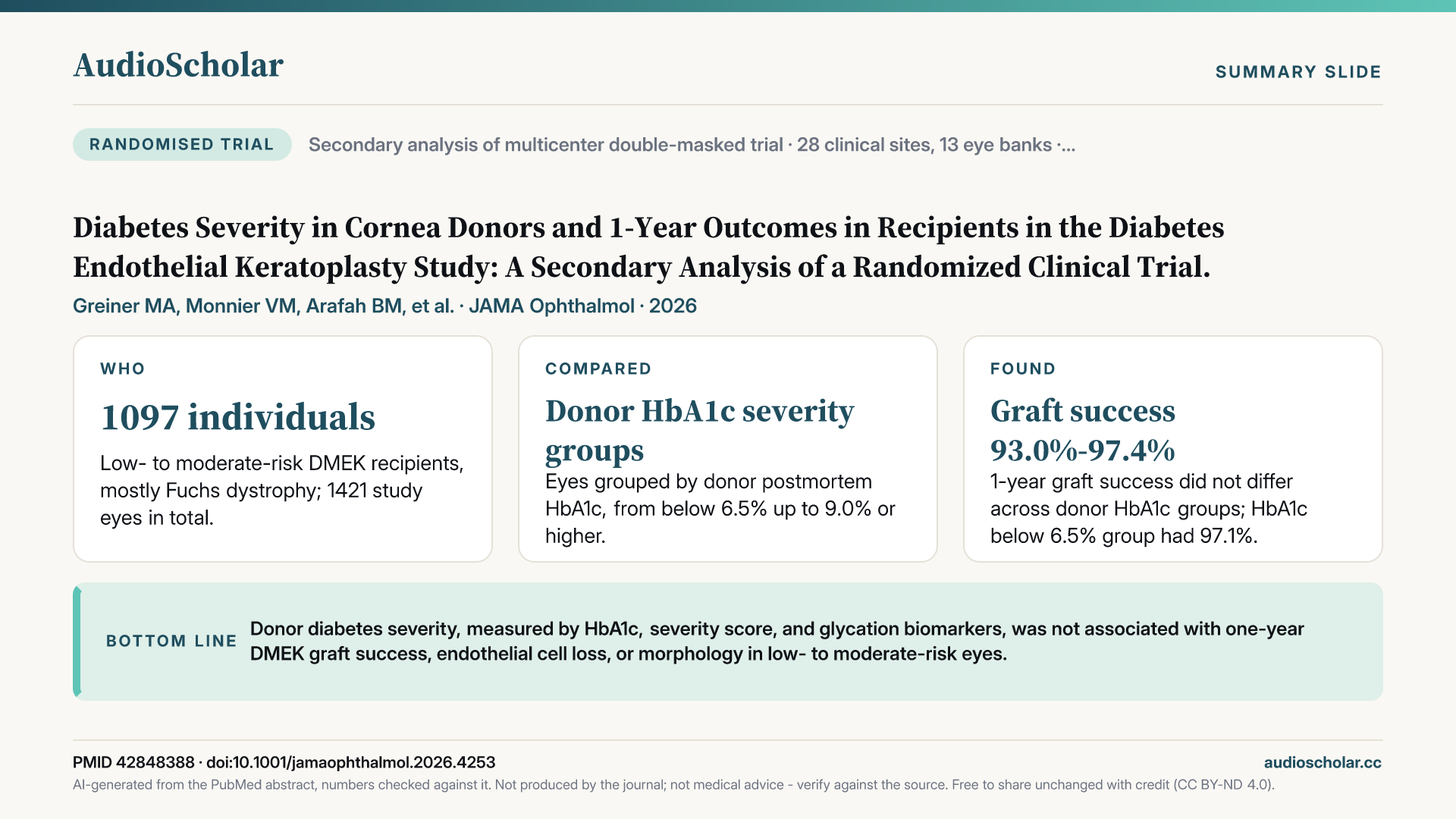
Diabetes Severity in Cornea Donors and 1-Year Outcomes in Recipients in the Diabetes Endothelial Keratoplasty Study: A Secondary Analysis of a Randomized Clinical Trial.
Donor diabetes severity, measured by HbA1c, severity score, and glycation biomarkers, was not associated with one-year DMEK graft success, endothelial cell loss, or morphology in low- to moderate-risk eyes.
JAMA Ophthalmology · 2026 · PubMed

This week’s papers
- 01
Optogenetic Therapy for Restoring Aspects of Visual Function.
A single intravitreal ChrimsonR gene-therapy injection with stimulating goggles was judged safe in 10 blind retinitis pigmentosa patients, and six showed meaningful light-sensitivity gains in an uncontrolled study.
Sahel JA et al. · New England Journal of Medicine · 2026
- 02
Management of Neovascular Age-Related Macular Degeneration in Routine US Clinical Practice: Impact of Delayed Treatment Initiation.
Among over 90,000 neovascular AMD eyes, about a quarter were not treated within 29 days, and delayed starts were associated with vision loss versus gains with prompt anti-VEGF therapy.
Pitcher JD et al. · Ophthalmology Retina · 2026
- 03
Pooled Data Meta-Analysis of Pneumatic Vitreolysis for Treatment of Vitreomacular Traction Syndrome With, And Without Full Thickness Macular Holes.
Pooled data from 637 eyes show pneumatic vitreolysis releases vitreomacular traction in about three quarters of eyes but closes coexisting macular holes in only about 40 percent.
Brice NA et al. · Retina · 2026
- 04
Incidence of Retinal Artery Occlusion After Carotid Endarterectomy Versus Carotid Artery Stenting.
In propensity-matched observational data, carotid stenting carried higher one-year risk of retinal artery occlusion, stroke, and death than endarterectomy, though absolute retinal occlusion rates remained below half a percent.
Zaidi Z et al. · Retina · 2026
- 05
Diabetes Severity in Cornea Donors and 1-Year Outcomes in Recipients in the Diabetes Endothelial Keratoplasty Study: A Secondary Analysis of a Randomized Clinical Trial.
Donor diabetes severity, measured by HbA1c, severity score, and glycation biomarkers, was not associated with one-year DMEK graft success, endothelial cell loss, or morphology in low- to moderate-risk eyes.
Greiner MA et al. · JAMA Ophthalmology · 2026
- 06
Surgical Management Patterns and Outcomes in Recurrent Corneal Erosion: An IRIS Registry Study.
In IRIS Registry data, anterior stromal puncture for recurrent corneal erosion carried about 2.5 times the repeat-surgery hazard of phototherapeutic keratectomy, with procedure choice rather than etiology predicting failure.
Whitcomb N et al. · Cornea · 2026
- 07
Mitomycin C Application during Trabeculectomy-Injection versus Sponge: A Report by the American Academy of Ophthalmology.
An Academy evidence review found injected and sponge-applied mitomycin C in trabeculectomy yield similar pressure control and safety, with injection possibly producing more favourable, diffuse bleb morphology.
Lim MC et al. · Ophthalmology · 2026
- 08
Endphthalmitis after cataract surgery in Sweden 2018-2024: associations with preoperative visual acuity and intracameral antibiotic regimens.
Across nearly a million Swedish cataract operations, endophthalmitis occurred in 0.013 percent, and no intracameral antibiotic regimen showed statistically significant superiority over cefuroxime alone.
Bro T et al. · British Journal of Ophthalmology · 2026
- 09
Assessment of the Necessity for High-Level Disinfection (HLD) of Reusable Ophthalmic Devices: A Multisociety Position Paper.
A multisociety task force found no evidence that routine high-level disinfection of tonometer tips and contact lenses reduces infection, recommending it only in higher-risk circumstances.
Kuo IC et al. · Ophthalmology · 2026
- 10
Diagnostic Accuracy and Clinical Impact of Ocular Fundus Imaging in the Emergency Department: A Systematic Review and Meta-Analysis.
Low-certainty pooled evidence shows emergency department fundus imaging has moderate-to-good accuracy and high gradability, avoiding in-person ophthalmology consultation in roughly four in ten requests.
Al-Ani A et al. · Survey of Ophthalmology · 2026
The full briefing
This AudioScholar briefing is generated by artificial intelligence for healthcare professionals and trainees. It is not medical advice.
Welcome to This Week in Ophthalmology. This week we're covering 10 notable papers spanning retinal disease from gene-based vision restoration to real-world anti-VEGF care, anterior segment and glaucoma surgery, and infection control and care delivery. Let's dive in.
We start in the retina, where this week's papers run from experimental therapy to the gaps in everyday treatment. In the New England Journal of Medicine, Sahel and colleagues report the PIONEER study, an open-label safety trial of ganglion cell-directed optogenetic therapy in 10 people blind from advanced retinitis pigmentosa [1]. Each participant received a single intravitreal injection of an adeno-associated viral vector carrying the red-shifted channelrhodopsin ChrimsonR, then used light-stimulating goggles designed to activate it. Nine of the ten participants had ocular adverse events, mostly mild or moderate, and there was one severe event, a transient central retinal artery occlusion immediately after injection that resolved within minutes. Light sensitivity improved in seven participants, by anywhere from about twofold to roughly sixtyfold, and six of them crossed a threshold for clinically meaningful change. That threshold was drawn from the literature and was not prespecified in the protocol, so this is a small, uncontrolled safety signal rather than evidence of efficacy, and the authors themselves call for further study. At the other end of the spectrum, Pitcher and colleagues in Ophthalmology Retina examined more than ninety thousand treatment-naive eyes with neovascular age-related macular degeneration in the Vestrum database [2]. Roughly a quarter of eyes were not treated within 29 days of diagnosis, and even at three years about one in eight eyes had never received anti-VEGF therapy. Eyes diagnosed with bilateral disease at the same visit, and eyes presenting worse than 20/400, were far less likely to be treated. Eyes treated promptly gained about five letters at one year, while eyes whose treatment started three to twelve months later lost about three. Notably, eyes starting below 20/400 that received more than nine injections gained around 27 letters, which challenges the assumption that very poor presenting vision means little to gain. This is retrospective data with obvious confounding, but it strengthens the case that delays and undertreatment are real and consequential in routine practice.
Two papers in Retina round out this theme. Brice and colleagues pooled 33 studies covering 637 eyes treated with pneumatic vitreolysis for vitreomacular traction [3]. Traction released in about three quarters of eyes overall, with expansile gases like C3F8 outperforming filtered air, which worked in only about half of eyes. When a full-thickness macular hole was present, traction released in most eyes but the hole closed in only about 40 percent. New macular holes developed in about five percent of traction-only eyes, and retinal detachment in about two percent overall. The authors conclude the procedure is a reasonable, cost-effective option for traction without a hole, with only modest value when a hole is present; pooled data from heterogeneous, largely uncontrolled studies limit firmness. Also in Retina, Zaidi and colleagues used the TriNetX network to compare nearly eighteen thousand propensity-matched patients after carotid endarterectomy versus stenting [4]. Stenting was linked to about sixty percent higher odds of retinal artery occlusion at one year, though absolute rates stayed under half a percent, along with higher stroke and mortality. Most events occurred within 72 hours. This is observational, and the authors frame targeted post-procedure eye evaluation in selected high-risk patients as reasonable only pending prospective confirmation.
Turning to the anterior segment, three papers address long-standing surgical questions. In JAMA Ophthalmology, Greiner and colleagues report a secondary analysis of the Diabetes Endothelial Keratoplasty Study, covering more than fourteen hundred eyes undergoing low- to moderate-risk DMEK, nearly all for Fuchs dystrophy [5]. One-year graft success hovered around 93 to 97 percent across every donor hemoglobin A1c group, with no meaningful differences, and neither a diabetes severity score nor glycation and oxidation biomarkers predicted graft failure, endothelial cell loss, or cell morphology. The authors conclude that corneas from donors with diabetes can be used without extra testing or risk stratification. This rests on randomized-trial infrastructure but is a secondary analysis limited to one year and to lower-risk eyes. In Cornea, Whitcomb and colleagues used the IRIS Registry to study nearly 190 thousand eyes with recurrent corneal erosion, about seven percent of which had surgery [6]. Two-year repeat surgery was about 12 percent after phototherapeutic keratectomy, 17 percent after epithelial debridement, and 29 percent after anterior stromal puncture, which carried about two and a half times the hazard of repeat surgery compared with laser treatment. The underlying cause, including basement membrane dystrophy, did not predict failure; the initial procedure did. As registry data, selection effects cannot be excluded, but it questions anterior stromal puncture's role as a first-line procedure. In glaucoma, an American Academy of Ophthalmology technology assessment in Ophthalmology, led by Lim, reviewed 11 studies comparing injected versus sponge-applied mitomycin C during trabeculectomy [7]. Both methods produced similar pressure lowering, medication reduction, and complication rates, while injection was associated with more diffuse, less vascular blebs and, in a couple of studies, fewer 5-fluorouracil injections. The level one and two evidence supports either technique, with no clear superiority.
Our final theme concerns infection risk and how eye care is delivered. In the British Journal of Ophthalmology, Bro and colleagues analysed nearly a million cataract procedures in the Swedish National Cataract Register [8]. Endophthalmitis occurred in about one in eight thousand cases. Better preoperative vision and immediate sequential bilateral surgery were associated with lower odds, but the authors attribute this to favourable case mix rather than true protection. Rates were numerically lower with moxifloxacin or cefuroxime plus ampicillin than with cefuroxime alone, yet no intracameral regimen was statistically superior. Enterococci were more common with cefuroxime, and moxifloxacin cases more often recovered to 20/40, though with only 131 cases these comparisons are fragile. On device reprocessing, a multisociety position paper in Ophthalmology led by Kuo, approved by the Academy's Board of Trustees, found no published evidence that tonometer tips, gonioscopy lenses, or laser lenses transmit sight-threatening infection, or that high-level disinfection reduces transmission compared with simpler methods [9]. In a survey of more than a thousand ophthalmologists, alcohol wiping was the most common method, transmission was exceedingly rare and mostly self-limited adenoviral conjunctivitis, and many clinicians using chemical disinfection reported ocular surface toxicity or device damage. The task force concludes high-level disinfection should be discretionary for higher-risk situations rather than routine, putting it at odds with current regulatory citations. Finally, in Survey of Ophthalmology, Al-Ani and colleagues meta-analysed 33 studies of fundus imaging in emergency departments [10]. Pooled sensitivity was just under 80 percent and specificity about 90 percent, images were gradable in most cases, and roughly four in ten consultation requests avoided an in-person ophthalmology visit. The certainty of this evidence was rated low to very low, so it supports further evaluation of imaging-based emergency pathways rather than settled adoption.
If you only have time for one paper this week, make it the Diabetes Endothelial Keratoplasty Study analysis in JAMA Ophthalmology [5]. It uses randomized-trial data to address a question that has quietly shaped donor tissue allocation for years, and its answer bears directly on corneal supply.
Here is what this week's evidence adds up to in Ophthalmology. First, donor diabetes, even when poorly controlled, does not appear to affect one-year DMEK outcomes in low- to moderate-risk eyes, though longer follow-up and higher-risk eyes remain unstudied. Second, real-world data suggest roughly a quarter of neovascular AMD eyes face treatment delays, with worse outcomes, and that even very poor presenting vision can respond to sustained therapy; this is observational and confounded. Third, in recurrent corneal erosion, registry data favour laser or debridement over stromal puncture for durability, while in trabeculectomy, injected and sponge mitomycin perform similarly. Fourth, the case for routine high-level disinfection of contact devices lacks supporting evidence according to a multisociety review, but regulatory standards have not yet changed. And finally, optogenetic vision restoration has cleared an early safety hurdle in a tiny open-label study, with efficacy still unproven.
That's your roundup for This Week in Ophthalmology. The full transcript and references are available on the episode page. This is an AI-curated summary — for clinical decisions, always consult primary sources and current guidelines. See you next week.
If this weekly briefing is useful, follow the show in your podcast app so new episodes arrive automatically. And if you have a paper you have been meaning to read, upload the PDF, or paste any link, at audioscholar dot C C. We will turn it into audio like this one, in any of thirty-one languages.
This is an automated summary generated by artificial intelligence, which can make mistakes. Always review the original source materials.
Spot something worth flagging?
Get this every week in your podcast app — free.
New ophthalmology episodes land in your feed automatically — listen on your commute.