This Week in Radiology — Oct 10, 2026
Generated Oct 10, 2026 · 11:58
The week's practice-changing Radiology research, summarized for clinicians.
If the audio fails to play, refresh the page to renew the link.
Get next week’s Radiology briefing — free.
In your podcast app, or readable in your inbox with the audio one tap away.
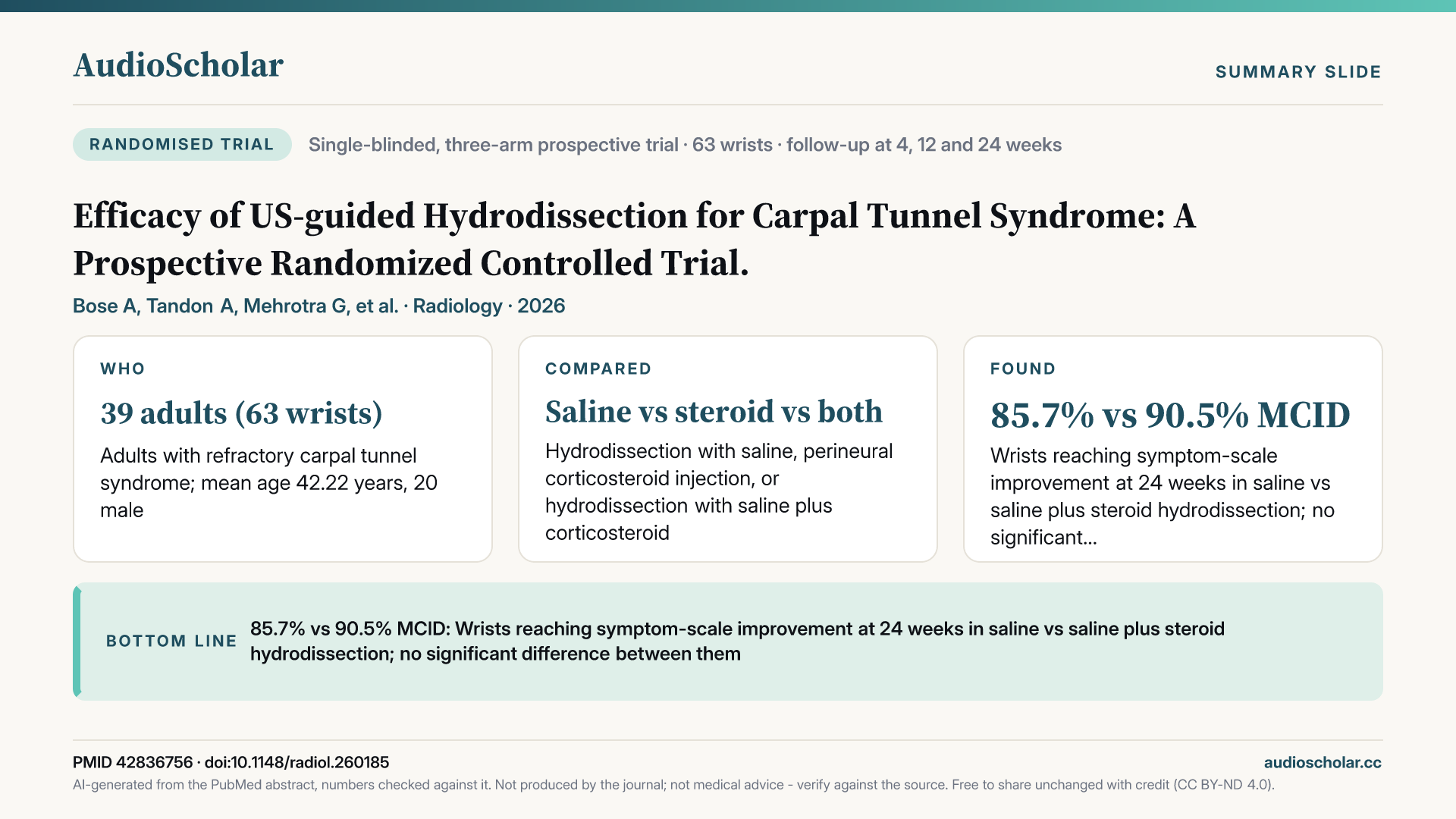
Efficacy of US-guided Hydrodissection for Carpal Tunnel Syndrome: A Prospective Randomized Controlled Trial.
In a small randomized trial, ultrasound-guided saline hydrodissection gave sustained six-month improvement in carpal tunnel syndrome, adding corticosteroid gave no extra benefit, and steroid injection alone lost its effect.
Radiology · 2026 · PubMed

This week’s papers
- 01
Preoperative radioembolization versus chemoembolization and upfront resection for resectable hepatocellular carcinoma beyond the Milan criteria.
In resectable hepatocellular carcinoma beyond Milan criteria, preoperative radioembolization matched upfront resection for survival, whereas preoperative chemoembolization was linked to nearly tripled mortality hazard in weighted retrospective analysis.
Park J, Lim GS, Ko Y, et al. · European Radiology · 2026
- 02
Transarterial Radioembolization Versus Chemoembolization for Unresectable Large Single Hepatocellular Carcinoma.
For unresectable solitary hepatocellular carcinoma of 6 cm or more, radioembolization was associated with longer survival, better local control and fewer serious adverse events than chemoembolization, though selection bias may contribute.
Lee M, Kim M, Kim J, et al. · Korean Journal of Radiology · 2026
- 03
Efficacy of US-guided Hydrodissection for Carpal Tunnel Syndrome: A Prospective Randomized Controlled Trial.
In a small randomized trial, ultrasound-guided saline hydrodissection gave sustained six-month improvement in carpal tunnel syndrome, adding corticosteroid gave no extra benefit, and steroid injection alone lost its effect.
Bose A, Tandon A, Mehrotra G, et al. · Radiology · 2026
- 04
Standardizing Liver MR Elastography: Guidelines for Reliable Stiffness Measurement in Chronic Liver Disease.
Standardized liver MR elastography guidelines define acquisition, reconstruction and analysis requirements, and set a stiffness change of at least 19 percent as indicating true biologic change with 95 percent confidence.
Serai SD, Pepin K, Chen J, et al. · Radiology · 2026
- 05
Cardiovascular Magnetic Resonance derived Myocardial Strain: Applications, Acquisition Techniques, Analysis, and Reporting. A Scientific Statement of the Society for Cardiovascular Magnetic Resonance, Radiological Society of North America, and European Association of Cardiovascular Imaging of the ESC.
A joint international scientific statement provides consensus guidance on acquiring, analyzing and reporting cardiac MR myocardial strain, addressing protocol variability and scarce normative reference ranges that have limited routine clinical use.
Gulsin GS, Ambale-Venkatesh B, Axel L, et al. · Radiology · 2026
- 06
Soft Tissue Reporting and Data System (Soft Tissue-RADS): preliminary validation among fellowship-trained musculoskeletal radiologists.
Among ten expert musculoskeletal radiologists, Soft Tissue-RADS showed good-to-excellent agreement and about 82 percent accuracy for benign versus suspicious lesions, versus 61 percent for qualitative diagnosis, pending routine-workflow validation.
Chhabra A, Subhawong T, He A, et al. · European Radiology · 2026
- 07
Critical appraisal of artificial intelligence studies for prostate cancer detection on MRI.
Near-perfect reported performance of prostate MRI artificial intelligence tools can stem from spectrum bias, pathway bias, weak reference standards and confounded comparisons rather than genuine technical advances, per this structured appraisal.
Pooch E, Agrotis G, Schoots IG, et al. · European Radiology · 2026
- 08
ACR Appropriateness Criteria® Postmenopausal Acute Pelvic Pain: 2026 Update.
The 2026 ACR update for postmenopausal acute pelvic pain rates ultrasound as the initial imaging modality, with MRI and CT reserved for inconclusive sonographic findings given atypical presentations and malignancy risk.
Melamud K, Dave HB, et al. · Journal of the American College of Radiology · 2026
- 09
Trajectories of pulmonary subsolid nodules in children and adolescents: a retrospective multicenter cohort study.
About one in ten persistent subsolid lung nodules in children and adolescents grew, nearly all resected nodules were early-stage adenocarcinoma, and part-solid morphology predicted growth and cancer diagnosis.
Ren H, Sun F, Liu H, et al. · European Radiology · 2026
- 10
Quantitative Chest CT-derived Fibrosis and Vascular Remodeling and Acute Exacerbation Risk in Mild Idiopathic Pulmonary Fibrosis.
In mild idiopathic pulmonary fibrosis, CT-measured fibrosis and venous remodeling were associated with acute exacerbation risk, with venous changes mediating over half the fibrosis effect, while greater small-artery volume was protective.
Yang M, Kim S, Lee SM, et al. · Radiology · 2026
The full briefing
This AudioScholar briefing is generated by artificial intelligence for healthcare professionals and trainees. It is not medical advice.
Welcome to This Week in Radiology. This week we're covering 10 notable papers spanning image-guided therapy in the liver and the wrist, the push to standardize quantitative imaging and reporting, and new evidence on chest CT risk prediction. Let's dive in.
We start with interventional oncology, where two retrospective studies from Korean centres put radioembolization and chemoembolization head to head for large or advanced hepatocellular carcinoma. In European Radiology, Park and colleagues looked at 226 patients with resectable tumours beyond the Milan criteria who had either upfront resection, preoperative chemoembolization, or preoperative radioembolization before surgery [1]. After weighting to balance baseline characteristics, patients who had chemoembolization before surgery had nearly triple the hazard of death compared with those resected upfront, along with significantly worse recurrence outcomes. Patients who had radioembolization first, by contrast, showed survival and recurrence that were statistically indistinguishable from primary resection. The authors frame preoperative radioembolization as a reasonable alternative when immediate surgery is not feasible, though the groups were modest in size and treatment allocation was not randomized. The Korean Journal of Radiology adds a complementary picture in unresectable disease. Lee and colleagues studied 306 patients with a single tumour of at least 6 centimetres and found that, after weighting, radioembolization was associated with longer overall survival, a median of roughly 80 months versus about 53 months, and much longer local control [2]. Overall progression-free survival was numerically longer but did not reach statistical significance. The safety signal was clearer: serious adverse events occurred in about one in ten patients after radioembolization versus roughly a quarter after chemoembolization, and prolonged hospitalization was rare with radioembolization. The authors are candid about a key caveat. Patients excluded from radioembolization because of a high lung shunt fraction were placed in the chemoembolization group and did particularly poorly, so biological selection may explain part of the survival gap. Taken together, the two papers point in the same direction, favouring radioembolization over chemoembolization in large-volume disease, but both are single-country observational analyses, and neither settles the question the way a randomized trial would.
Staying with image-guided therapy but moving to the wrist, Radiology published a randomized trial from Bose and colleagues that isolates the effect of hydrodissection for carpal tunnel syndrome [3]. Prior studies typically mixed hydrodissection with steroid or dextrose, so its independent effect was unclear. Here, 39 adults with refractory symptoms, 63 wrists in total, were randomized to ultrasound-guided hydrodissection with normal saline alone, perineural corticosteroid injection alone, or hydrodissection with saline plus steroid. At 24 weeks, a clinically meaningful improvement in symptom severity was reached in roughly 86 percent of wrists treated with saline hydrodissection and about 90 percent of wrists treated with saline plus steroid, a difference that was not significant. The steroid-only group improved early, but symptoms recurred and were back near baseline by six months. Median nerve swelling on ultrasound also fell by more than 40 percent in both hydrodissection groups, compared with about 11 percent with steroid alone, and there were no major complications. The trial supports the mechanical separation of the nerve, rather than the steroid, as the driver of durable benefit. It is a small, single-blinded trial, so replication in larger cohorts would firm up the finding before it reshapes practice broadly.
Our second theme is standardization, a thread running through several papers aimed at making quantitative imaging and structured reporting reproducible. In Radiology, Serai and colleagues present the Quantitative Imaging Biomarkers Alliance technical guidelines for liver MR elastography, covering acquisition, reconstruction, quality assurance, and analysis across vendors [4]. The practically useful number is this: with a within-subject variability of about 7 percent, a change in liver stiffness of at least 19 percent is the threshold the guidelines identify as a true biologic change rather than measurement noise. That gives a concrete anchor for longitudinal monitoring and multicentre trials. Also in Radiology, a joint scientific statement from the Society for Cardiovascular Magnetic Resonance, the Radiological Society of North America, and the European Association of Cardiovascular Imaging, led by Gulsin, tackles cardiac MR myocardial strain [5]. The statement acknowledges that strain adds diagnostic and prognostic value beyond conventional parameters, but that routine use has been held back by inconsistent protocols, noise sensitivity, and a lack of robust normative ranges by age, sex, and ethnicity. It assembles research, guidelines, and expert opinion into guidance on acquisition, analysis, and reporting. Both documents are consensus and technical frameworks rather than outcome studies, and their value will depend on adoption.
Structured reporting is the focus in European Radiology, where Chhabra and colleagues offer preliminary validation of Soft Tissue-RADS, a six-category MRI scoring system for soft tissue tumours [6]. Ten fellowship-trained musculoskeletal radiologists from ten institutions read 150 cases with known diagnoses. Agreement between readers was good to excellent, and accuracy for separating benign from suspicious lesions was about 82 percent with the scoring system versus about 61 percent for readers' own qualitative diagnoses, with slightly higher reader confidence. The cases all came from one centre and were read by experts under curated conditions, and the authors themselves call for validation in routine workflows. A counterpoint on rigour comes from a perspective piece in European Radiology by Pooch and colleagues, who critically appraise artificial intelligence studies for detecting clinically significant prostate cancer on MRI [7]. They argue that near-perfect reported performance can arise from preventable design choices, including spectrum and pathway bias, imperfect reference standards, and confounded comparisons, rather than from genuine technical advances. They organize their critique around six domains aligned with the PI-RADS Steering Committee's requirements for AI development and reporting. It is an opinion piece rather than new data, but it offers a useful lens for reading vendor and research claims. Rounding out this theme, the Journal of the American College of Radiology published the 2026 update of the ACR Appropriateness Criteria for postmenopausal acute pelvic pain, by Melamud and colleagues [8]. The panel emphasizes that gynecologic causes such as torsion, pelvic inflammatory disease, and fibroid complications can present atypically in this age group and carry a higher potential for malignancy, and it continues to rate ultrasound as the initial modality, with MRI and CT reserved for inconclusive sonographic findings.
Our final theme is risk prediction on chest CT, in two populations at opposite ends of life. In European Radiology, Ren and colleagues report a multicentre retrospective cohort of 333 incidental persistent subsolid nodules in 241 children and adolescents, with a median age of 17 [9]. Over a median follow-up of nearly three years, about one in ten nodules grew, mostly pure ground-glass nodules enlarging or developing a small solid component. Of the 21 nodules that were resected, 20 were early-stage lung adenocarcinoma, and there were no deaths or metastases. Part-solid morphology predicted growth, and part-solid morphology plus a size of 10 millimetres or more predicted a later cancer diagnosis. The authors propose follow-up of two years or longer for pure ground-glass nodules and annual or shorter intervals for part-solid nodules, filling a gap where adult Fleischner guidance has been borrowed by default. This is retrospective evidence, and the proposed intervals are the authors' suggestion rather than an established guideline. In Radiology, Yang and colleagues studied 313 patients with mild idiopathic pulmonary fibrosis and used deep learning software to quantify fibrosis and pulmonary vessels on baseline CT [10]. Over a median of about six years, just over a quarter of patients had an acute exacerbation. Higher fibrosis scores were linked to greater exacerbation risk, but the more striking signal was vascular: venous dilatation was associated with roughly an eightfold higher risk, while greater small-artery volume was protective. Venous remodeling appeared to account for more than half of the effect of fibrosis on exacerbation risk. It is a single-centre retrospective study, so these vascular metrics are promising prognostic markers rather than validated tools.
If you only have time for one paper this week, make it the hydrodissection trial from Bose and colleagues in Radiology [3]. It is randomized evidence that separates the mechanical effect of hydrodissection from the steroid that usually accompanies it, and it reopens the question of whether perineural steroid adds anything durable for carpal tunnel syndrome.
Here is what this week's evidence adds up to in Radiology. First, for carpal tunnel syndrome, a small randomized trial suggests saline hydrodissection alone gives sustained six-month benefit and steroid adds nothing further, though larger trials would strengthen that conclusion. Second, two observational studies favour radioembolization over chemoembolization in large or advanced hepatocellular carcinoma, with comparable survival to upfront resection in one study and fewer serious complications in the other, but selection effects remain a real caveat without randomized data. Third, standardization is maturing, with a defined 19 percent threshold for real change in liver stiffness and consensus guidance for cardiac strain, while Soft Tissue-RADS shows promising accuracy among experts that still needs testing in everyday practice. Fourth, the prostate AI critique is a reminder that headline accuracy figures often reflect study design. And finally, quantitative chest CT is extending risk prediction, from growth patterns of subsolid nodules in young patients to vascular markers of exacerbation risk in early pulmonary fibrosis, both based on retrospective data that is not yet in guidelines.
That's your roundup for This Week in Radiology. The full transcript and references are available on the episode page. This is an AI-curated summary — for clinical decisions, always consult primary sources and current guidelines. See you next week.
If this weekly briefing is useful, follow the show in your podcast app so new episodes arrive automatically. And if you have a paper you have been meaning to read, upload the PDF, or paste any link, at audioscholar dot C C. We will turn it into audio like this one, in any of thirty-one languages.
This is an automated summary generated by artificial intelligence, which can make mistakes. Always review the original source materials.
Spot something worth flagging?
Get this every week in your podcast app — free.
New radiology episodes land in your feed automatically — listen on your commute.