This Week in Psychiatry — Oct 26, 2026
Generated Oct 26, 2026 · 10:59
The week's practice-changing Psychiatry research, summarized for clinicians.
If the audio fails to play, refresh the page to renew the link.
Get next week’s Psychiatry briefing — free.
In your podcast app, or readable in your inbox with the audio one tap away.
Metabolic biomarker levels before and after initiation of GLP-1 receptor agonist treatment among individuals with schizophrenia: interrupted time-series analysis.
Among 3,042 Danish patients with schizophrenia, starting a GLP-1 receptor agonist was followed by significant falls in HbA1c, LDL and triglycerides, supporting real-world transfer of trial metabolic benefits.
British Journal of Psychiatry · 2026 · PubMed

This week’s papers
- 01
Multimodal Machine Learning-Based Prediction of Relapse in Major Depressive Disorder.
In 564 patients with depression, multimodal machine learning predicted two-year relapse with only about 64 percent balanced accuracy, and imaging, genetic and microbiome data added nothing beyond clinical risk factors.
Teutenberg L et al. · JAMA Psychiatry · 2026
From the briefingIn JAMA Psychiatry, Teutenberg and colleagues used the Marburg-Münster Affective Disorders Cohort to predict relapse over two years in 564 patients with current or lifetime major depression [1]. Just under half of the cohort relapsed. The team fed machine learning models an unusually broad set of baseline data from nine modalities: clinical and psychometric measures, four types of structural and functional brain imaging, genetics, neurocognition, blood markers, and even the gut microbiome. The best balanced accuracy reached only about 64 percent, and the top model relied on a handful of established clinical risk factors. Adding imaging, genetic, and microbiome data did not improve it. The authors conclude this level of accuracy offers limited scope for individual decisions. They suggest that tracking markers repeatedly over time may work better than a single baseline snapshot. It is a sobering negative result, and an honest one.
Written by AI from the published abstract, for healthcare professionals. Not medical advice; check the paper before acting on it.
- 02
Clinical and genetic correlates of a circadian subtype of depression in the Australian Genetics of Depression Study.
About a quarter of Australian depression study participants met criteria for a circadian subtype, linked to earlier onset, greater severity, weaker self-reported SSRI and SNRI response and distinct polygenic risk.
Tonini E et al. · British Journal of Psychiatry · 2026
From the briefingA quite different approach to heterogeneity comes from the British Journal of Psychiatry, where Tonini and colleagues defined a circadian subtype of depression in the Australian Genetics of Depression Study [2]. Participants qualified if they had at least three features such as social jetlag, seasonality, evening chronotype, delayed sleep timing, morning tiredness, or hypersomnia. About 2,600 people, roughly a quarter of the sample, met these criteria. Compared with other participants, those with the subtype reported earlier onset and more severe illness, including suicidality, psychotic-like and hypomanic-like experiences, and weight gain during episodes. They also reported somewhat poorer response to SSRIs and SNRIs and more side effects. These people carried modestly higher polygenic scores for ADHD, bipolar disorder, insulin resistance, inflammation, and later chronotype. The data are cross-sectional, medication response was self-reported, and the effect sizes are small, so the authors frame this as a clinical profile awaiting replication rather than a validated subtype.
Written by AI from the published abstract, for healthcare professionals. Not medical advice; check the paper before acting on it.
- 03
Shared cortical morphometry and molecular signatures across depression and physical diseases.
Depression, asthma, fibromyalgia, reflux disease and type 2 diabetes shared a replicated cortical morphometric similarity pattern tied to synaptic signalling genes, suggesting common neurobiology underlying their comorbidity.
Jiang C et al. · Molecular Psychiatry · 2026
From the briefingAlso on the biology of comorbidity, Jiang and colleagues in Molecular Psychiatry compared brain morphometry in depression with asthma, fibromyalgia, reflux disease, and type 2 diabetes [3]. In 577 patients and 275 controls, they found a shared cortical pattern across all five conditions. Similarity rose in visual and somatomotor regions and fell in limbic, default mode, and ventral attention networks, and the pattern replicated in independent cohorts. It mapped onto genes for synaptic signalling and onto specific neurotransmitter systems. This is hypothesis-generating work on why depression and physical illness travel together, not a clinical tool.
Written by AI from the published abstract, for healthcare professionals. Not medical advice; check the paper before acting on it.
- 04
Repetitive transcranial magnetic stimulation (rTMS) combined with antidepressant pharmacotherapy for depression: state-dependent mechanisms, clinical evidence, and translational challenges.
A narrative review finds that combining rTMS with antidepressants may speed improvement and reduce relapse, but benefits are heterogeneous, blinding is imperfect and the interaction appears state-dependent rather than additive.
Deng J et al. · Molecular Psychiatry · 2026
From the briefingFinally, Molecular Psychiatry also carries a narrative review by Deng and colleagues on combining repetitive transcranial magnetic stimulation with antidepressants [4]. The review describes evidence that combined treatment may speed early improvement, raise response and remission, and lower relapse. The authors caution that the benefits vary from patient to patient and that expectancy effects and imperfect sham blinding cloud the trials. They argue that the interaction between the two treatments is state-dependent rather than reliably additive, which leaves sequencing and patient selection as open questions.
Written by AI from the published abstract, for healthcare professionals. Not medical advice; check the paper before acting on it.
- 05
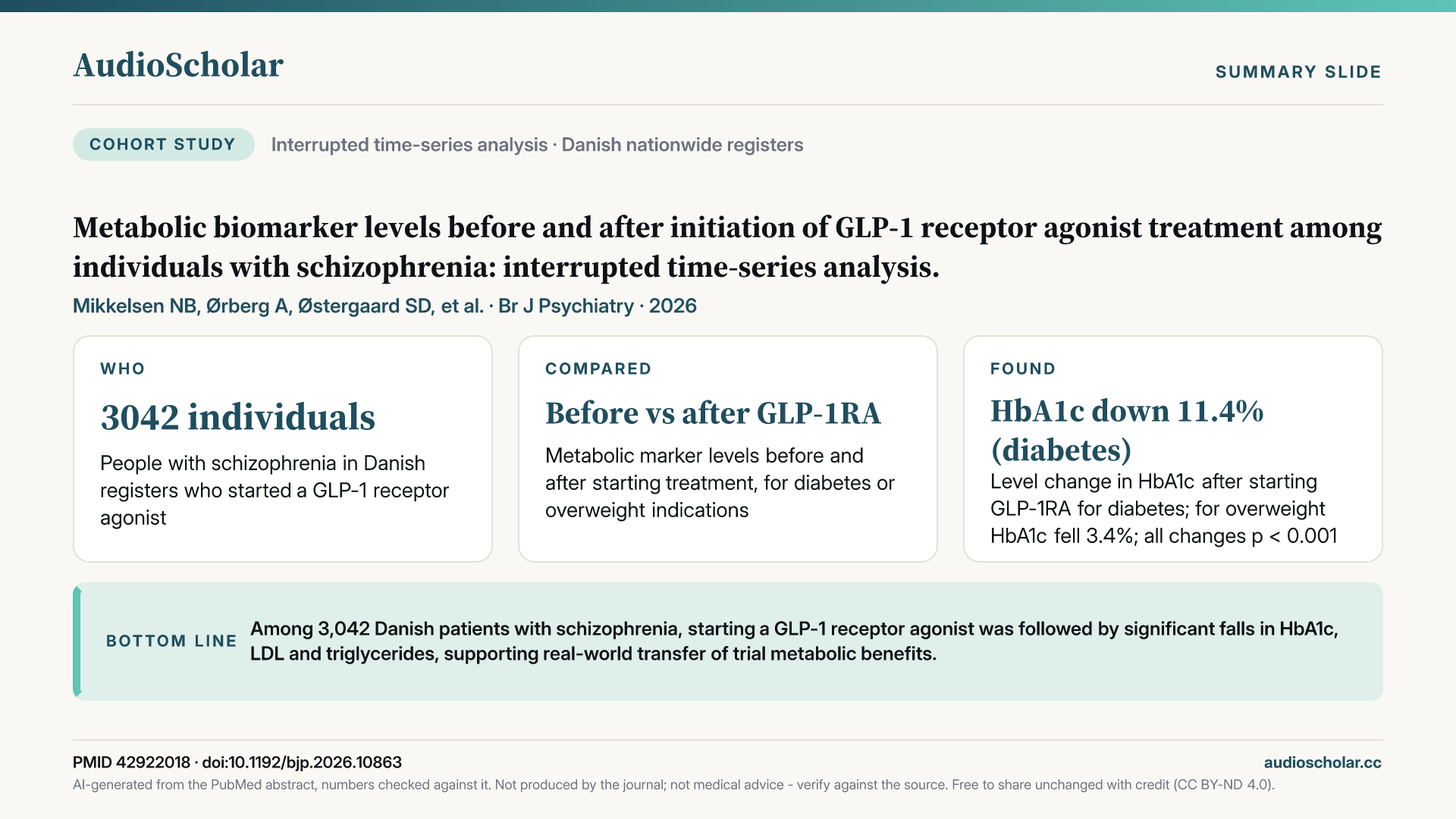
Metabolic biomarker levels before and after initiation of GLP-1 receptor agonist treatment among individuals with schizophrenia: interrupted time-series analysis.
Among 3,042 Danish patients with schizophrenia, starting a GLP-1 receptor agonist was followed by significant falls in HbA1c, LDL and triglycerides, supporting real-world transfer of trial metabolic benefits.
Mikkelsen NB et al. · British Journal of Psychiatry · 2026
From the briefingThe most immediately clinical is a Danish nationwide register study by Mikkelsen, Østergaard and colleagues in the British Journal of Psychiatry [5]. They identified 3,042 people with schizophrenia who started a GLP-1 receptor agonist, and they used interrupted time-series analysis to track blood markers before and after initiation. Among patients who started treatment for diabetes, HbA1c fell by about 11 percent and triglycerides by about 15 percent, with a smaller fall in LDL. In those treated for overweight, triglycerides fell by roughly 13 percent, with smaller reductions in HbA1c and LDL. Lipids served as stand-ins for weight loss because weight itself was not available in the registers. The study is observational without a comparison group, but it suggests that the metabolic benefits seen in randomised trials carry over to routine care for a population that trials often under-represent.
If you only have time for one paper this week, make it the Danish register study of GLP-1 receptor agonists in schizophrenia [5]. It takes a question that randomised trials had answered only in selected participants and shows that the metabolic benefits appear to hold across a national population of people with schizophrenia in routine care.
Written by AI from the published abstract, for healthcare professionals. Not medical advice; check the paper before acting on it.
- 06
Simultaneous measurement of Midbrain and Striatal Dopamine in Schizophrenia using an agonist radiotracer.
Using the agonist tracer PHNO in 28 patients and 29 controls, amphetamine-induced dopamine release was not greater in schizophrenia, challenging findings from earlier antagonist-tracer imaging studies.
Slifstein M et al. · Biological Psychiatry · 2026
From the briefingIn Biological Psychiatry, Slifstein and colleagues revisited one of the field's most replicated findings, which is increased amphetamine-induced dopamine release in schizophrenia [6]. Earlier work used antagonist radiotracers. Here the team used the agonist tracer PHNO in 28 patients and 29 controls, which also let them measure the midbrain at the same time. They found no significant group differences in baseline binding or in the amphetamine response, only trend-level lower values in patients, driven mainly by the dorsal striatum. The result agrees with a previous agonist-tracer study and raises a real controversy about whether tracer pharmacology shaped the classic presynaptic dopamine story. The small sample means the question is reopened rather than resolved.
Written by AI from the published abstract, for healthcare professionals. Not medical advice; check the paper before acting on it.
- 07
Thalamocortical dysconnectivity shapes cortical hierarchy disruption across illness durations in schizophrenia.
Across 12 datasets with about 2,400 participants, reduced thalamic-salience connectivity in schizophrenia appeared at all illness stages, grew larger in longer-duration cohorts and accompanied flattened cortical hierarchy.
Huang H et al. · Biological Psychiatry · 2026
From the briefingAlso in Biological Psychiatry, Huang, Palaniyappan and colleagues pooled resting-state imaging from about 1,200 patients and as many controls across 12 datasets [7]. They grouped cohorts by early, middle, and late illness stage. Thalamic connectivity with salience regions was reduced at every stage, more so in longer-duration cohorts, and it tracked symptoms. This coincided with a flattening of the cortical hierarchy over the course of illness. The design compares cohorts rather than following individuals over time, so it cannot show progression directly.
Written by AI from the published abstract, for healthcare professionals. Not medical advice; check the paper before acting on it.
- 08
Positive-affective and negative-cognitive brain-behavior axes in clinical high risk for psychosis.
In 720 people at clinical high risk for psychosis, two generalisable brain-behaviour dimensions emerged: a positive-affective axis linked to cannabis use and a negative-cognitive axis suggesting neurodevelopmental vulnerability.
Vieira S et al. · Biological Psychiatry · 2026
From the briefingMoving earlier in the course of illness, a third Biological Psychiatry paper from Vieira and colleagues analysed 720 people at clinical high risk for psychosis in the AMP Schizophrenia programme [8]. They identified two brain-behaviour dimensions that generalised across networks. The first was a positive-affective axis linking depression, anxiety, and attenuated positive symptoms with frontal, cingulate, and insular volume reductions, and it was associated with cannabis use and a family history of affective illness. The second was a negative-cognitive axis linking negative symptoms and poorer cognition with smaller cerebellar and parietal volumes, suggesting neurodevelopmental vulnerability. The correlations were modest, but they offer a way to parse a heterogeneous group.
Written by AI from the published abstract, for healthcare professionals. Not medical advice; check the paper before acting on it.
- 09
From Protective Factors to Mechanisms: Charting the Neurobiology of Schizophrenia Resilience.
A narrative review proposes that common genetic variants may protect against schizophrenia by enhancing plasticity, fluid intelligence and visual cognition, while immune and obstetric links remain unconfirmed.
Bittner RA et al. · Schizophrenia Bulletin · 2026
From the briefingRounding out the theme, Bittner and colleagues in Schizophrenia Bulletin review the genetics of resilience to schizophrenia [9]. They argue that common protective variants may buffer high polygenic liability through neural plasticity, fluid intelligence, and visual cognition. Immune and obstetric pathways remain plausible, but direct links to these variants have not yet been established.
Written by AI from the published abstract, for healthcare professionals. Not medical advice; check the paper before acting on it.
- 10
Medical assistance in dying on psychiatric versus somatic grounds: survey on the experiences of relatives.
Dutch relatives after psychiatric assisted dying reported largely similar experiences to those after somatic assisted dying, but more guilt and powerlessness, and more often found the process too long.
van den Bosch A et al. · British Journal of Psychiatry · 2026
From the briefingOur final paper addresses an ethically charged area of practice, which is how families experience medical assistance in dying for psychiatric conditions. In the British Journal of Psychiatry, van den Bosch and colleagues surveyed 616 Dutch relatives, 110 of whom had experienced assisted dying for psychiatric reasons and 506 for somatic illness [10]. Relatives in the psychiatric group most strongly reported gratitude, resignation, relief, and sadness. More than four in five respondents in both groups judged the due care criteria positively. More than a quarter of respondents felt insufficiently involved, with no difference between groups. Relatives in the psychiatric group did report more powerlessness and guilt, and about two thirds of them felt the process took too long, compared with about a fifth of relatives in the somatic group. Recruitment through social media and newspapers invites self-selection, so the findings may not represent all families. The authors interpret them as a case for closer involvement and support of relatives.
Written by AI from the published abstract, for healthcare professionals. Not medical advice; check the paper before acting on it.
The full briefing
This AudioScholar briefing is generated by artificial intelligence for healthcare professionals and trainees. It is not medical advice.
Welcome to This Week in Psychiatry. This week we're covering 10 notable papers spanning prediction and subtyping in depression, metabolic care and circuit biology in schizophrenia, and the experiences of families after psychiatric assisted dying. Let's dive in.
We start with depression, where several papers test whether richer data and sharper subtypes can tell us more about individual patients. In JAMA Psychiatry, Teutenberg and colleagues used the Marburg-Münster Affective Disorders Cohort to predict relapse over two years in 564 patients with current or lifetime major depression [1]. Just under half of the cohort relapsed. The team fed machine learning models an unusually broad set of baseline data from nine modalities: clinical and psychometric measures, four types of structural and functional brain imaging, genetics, neurocognition, blood markers, and even the gut microbiome. The best balanced accuracy reached only about 64 percent, and the top model relied on a handful of established clinical risk factors. Adding imaging, genetic, and microbiome data did not improve it. The authors conclude this level of accuracy offers limited scope for individual decisions. They suggest that tracking markers repeatedly over time may work better than a single baseline snapshot. It is a sobering negative result, and an honest one. A quite different approach to heterogeneity comes from the British Journal of Psychiatry, where Tonini and colleagues defined a circadian subtype of depression in the Australian Genetics of Depression Study [2]. Participants qualified if they had at least three features such as social jetlag, seasonality, evening chronotype, delayed sleep timing, morning tiredness, or hypersomnia. About 2,600 people, roughly a quarter of the sample, met these criteria. Compared with other participants, those with the subtype reported earlier onset and more severe illness, including suicidality, psychotic-like and hypomanic-like experiences, and weight gain during episodes. They also reported somewhat poorer response to SSRIs and SNRIs and more side effects. These people carried modestly higher polygenic scores for ADHD, bipolar disorder, insulin resistance, inflammation, and later chronotype. The data are cross-sectional, medication response was self-reported, and the effect sizes are small, so the authors frame this as a clinical profile awaiting replication rather than a validated subtype. Also on the biology of comorbidity, Jiang and colleagues in Molecular Psychiatry compared brain morphometry in depression with asthma, fibromyalgia, reflux disease, and type 2 diabetes [3]. In 577 patients and 275 controls, they found a shared cortical pattern across all five conditions. Similarity rose in visual and somatomotor regions and fell in limbic, default mode, and ventral attention networks, and the pattern replicated in independent cohorts. It mapped onto genes for synaptic signalling and onto specific neurotransmitter systems. This is hypothesis-generating work on why depression and physical illness travel together, not a clinical tool. Finally, Molecular Psychiatry also carries a narrative review by Deng and colleagues on combining repetitive transcranial magnetic stimulation with antidepressants [4]. The review describes evidence that combined treatment may speed early improvement, raise response and remission, and lower relapse. The authors caution that the benefits vary from patient to patient and that expectancy effects and imperfect sham blinding cloud the trials. They argue that the interaction between the two treatments is state-dependent rather than reliably additive, which leaves sequencing and patient selection as open questions.
Turning to schizophrenia, this week's papers range from real-world metabolic outcomes to dopamine and circuit-level imaging. The most immediately clinical is a Danish nationwide register study by Mikkelsen, Østergaard and colleagues in the British Journal of Psychiatry [5]. They identified 3,042 people with schizophrenia who started a GLP-1 receptor agonist, and they used interrupted time-series analysis to track blood markers before and after initiation. Among patients who started treatment for diabetes, HbA1c fell by about 11 percent and triglycerides by about 15 percent, with a smaller fall in LDL. In those treated for overweight, triglycerides fell by roughly 13 percent, with smaller reductions in HbA1c and LDL. Lipids served as stand-ins for weight loss because weight itself was not available in the registers. The study is observational without a comparison group, but it suggests that the metabolic benefits seen in randomised trials carry over to routine care for a population that trials often under-represent. In Biological Psychiatry, Slifstein and colleagues revisited one of the field's most replicated findings, which is increased amphetamine-induced dopamine release in schizophrenia [6]. Earlier work used antagonist radiotracers. Here the team used the agonist tracer PHNO in 28 patients and 29 controls, which also let them measure the midbrain at the same time. They found no significant group differences in baseline binding or in the amphetamine response, only trend-level lower values in patients, driven mainly by the dorsal striatum. The result agrees with a previous agonist-tracer study and raises a real controversy about whether tracer pharmacology shaped the classic presynaptic dopamine story. The small sample means the question is reopened rather than resolved. Also in Biological Psychiatry, Huang, Palaniyappan and colleagues pooled resting-state imaging from about 1,200 patients and as many controls across 12 datasets [7]. They grouped cohorts by early, middle, and late illness stage. Thalamic connectivity with salience regions was reduced at every stage, more so in longer-duration cohorts, and it tracked symptoms. This coincided with a flattening of the cortical hierarchy over the course of illness. The design compares cohorts rather than following individuals over time, so it cannot show progression directly. Moving earlier in the course of illness, a third Biological Psychiatry paper from Vieira and colleagues analysed 720 people at clinical high risk for psychosis in the AMP Schizophrenia programme [8]. They identified two brain-behaviour dimensions that generalised across networks. The first was a positive-affective axis linking depression, anxiety, and attenuated positive symptoms with frontal, cingulate, and insular volume reductions, and it was associated with cannabis use and a family history of affective illness. The second was a negative-cognitive axis linking negative symptoms and poorer cognition with smaller cerebellar and parietal volumes, suggesting neurodevelopmental vulnerability. The correlations were modest, but they offer a way to parse a heterogeneous group. Rounding out the theme, Bittner and colleagues in Schizophrenia Bulletin review the genetics of resilience to schizophrenia [9]. They argue that common protective variants may buffer high polygenic liability through neural plasticity, fluid intelligence, and visual cognition. Immune and obstetric pathways remain plausible, but direct links to these variants have not yet been established.
Our final paper addresses an ethically charged area of practice, which is how families experience medical assistance in dying for psychiatric conditions. In the British Journal of Psychiatry, van den Bosch and colleagues surveyed 616 Dutch relatives, 110 of whom had experienced assisted dying for psychiatric reasons and 506 for somatic illness [10]. Relatives in the psychiatric group most strongly reported gratitude, resignation, relief, and sadness. More than four in five respondents in both groups judged the due care criteria positively. More than a quarter of respondents felt insufficiently involved, with no difference between groups. Relatives in the psychiatric group did report more powerlessness and guilt, and about two thirds of them felt the process took too long, compared with about a fifth of relatives in the somatic group. Recruitment through social media and newspapers invites self-selection, so the findings may not represent all families. The authors interpret them as a case for closer involvement and support of relatives.
If you only have time for one paper this week, make it the Danish register study of GLP-1 receptor agonists in schizophrenia [5]. It takes a question that randomised trials had answered only in selected participants and shows that the metabolic benefits appear to hold across a national population of people with schizophrenia in routine care.
Here is what this week's evidence adds up to in Psychiatry. First, real-world data now support the metabolic benefit of GLP-1 receptor agonists in schizophrenia, although the evidence is observational, uses lipids as a proxy for weight, and lacks a comparison group. Second, a large multimodal machine learning effort found that imaging, genetics, and microbiome data added nothing to a few clinical risk factors for predicting depressive relapse, and accuracy remained too modest for individual decisions. Third, a circadian profile of depression linked to earlier onset, greater severity, and somewhat weaker self-reported antidepressant response is emerging, but it rests on cross-sectional data and still needs replication. Fourth, the classic finding of excess striatal dopamine release in schizophrenia did not reproduce with an agonist tracer, which reopens a mechanistic debate on the basis of a small study. Fifth, relatives after psychiatric assisted dying broadly report experiences similar to relatives after somatic assisted dying, but with more guilt and powerlessness, in a sample that may be self-selected.
That's your roundup for This Week in Psychiatry. The full transcript and references are available on the episode page. This is an AI-curated summary — for clinical decisions, always consult primary sources and current guidelines. See you next week.
If this weekly briefing is useful, follow the show in your podcast app so new episodes arrive automatically. And if it saves you time, a quick rating in your podcast app helps other physicians find the show.
This is an automated summary generated by artificial intelligence, which can make mistakes. Always review the original source materials.
Spot something worth flagging?
Get this every week in your podcast app — free.
New psychiatry episodes land in your feed automatically — listen on your commute.