This Week in Dermatology — Oct 9, 2026
Generated Oct 10, 2026 · 10:23
The week's practice-changing Dermatology research, summarized for clinicians.
If the audio fails to play, refresh the page to renew the link.
Get next week’s Dermatology briefing — free.
In your podcast app, or readable in your inbox with the audio one tap away.
Cutaneous Lymphoma International Prognostic Index and Risk Stratification in Advanced Mycosis Fungoides and Sézary Syndrome.
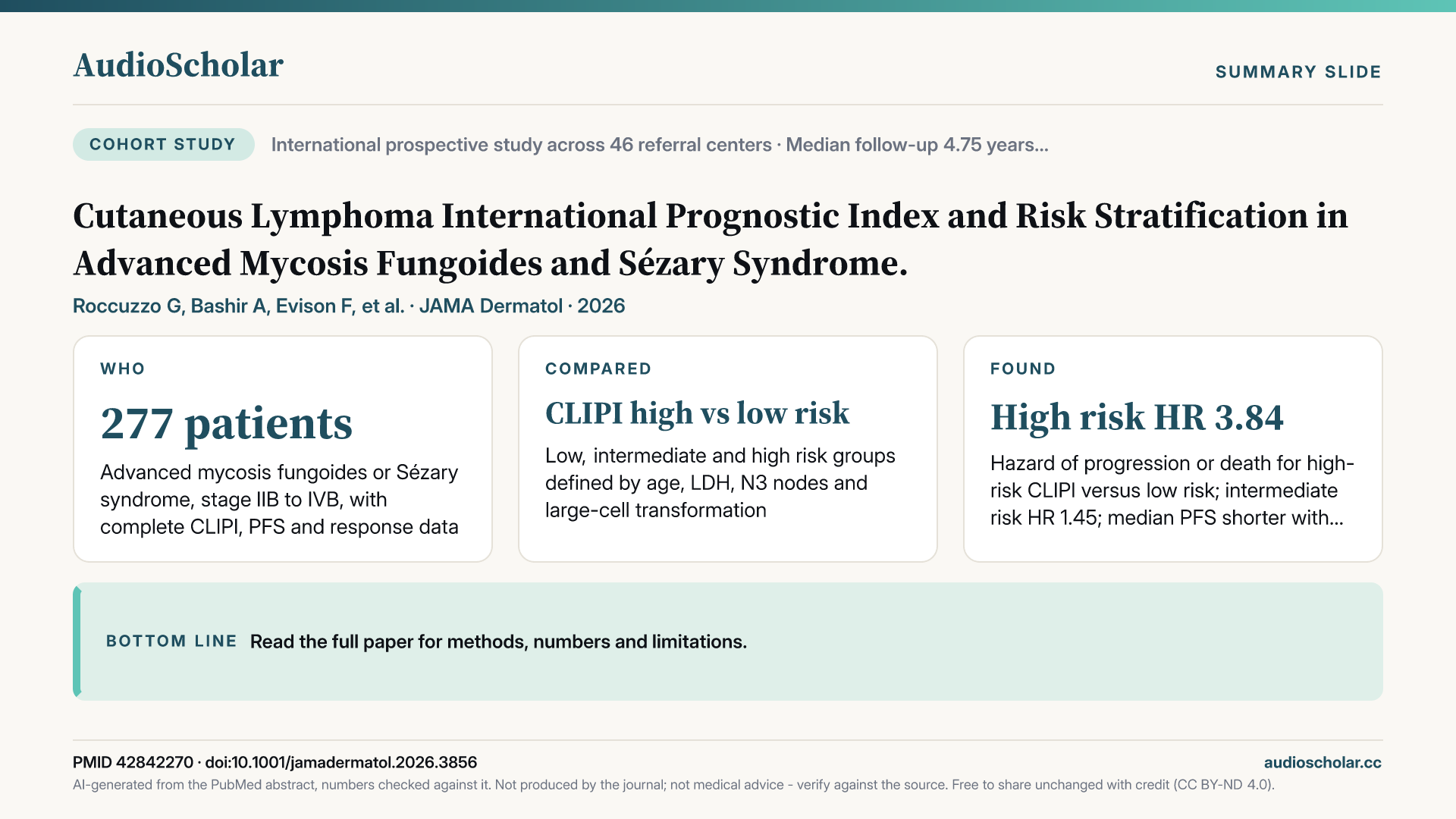
In 277 patients with advanced mycosis fungoides or Sézary syndrome, the four-factor CLIPI score separated progression-free survival from over four years to under one year, outperforming stage alone.
JAMA Dermatology · 2026 · PubMed

This week’s papers
- 01
Cutaneous Lymphoma International Prognostic Index and Risk Stratification in Advanced Mycosis Fungoides and Sézary Syndrome.
In 277 patients with advanced mycosis fungoides or Sézary syndrome, the four-factor CLIPI score separated progression-free survival from over four years to under one year, outperforming stage alone.
Roccuzzo G, Bashir A, Evison F, et al. · JAMA Dermatology · 2026
- 02
Comparison of efficacy and tolerability of hedgehog pathway inhibitors for locally advanced basal cell carcinoma: An expert opinion in the new age of immunotherapy.
Expert review suggests sonidegib offers more durable response and later-onset side effects than vismodegib for locally advanced basal cell carcinoma, though without head-to-head trial evidence.
Millan SH, Sun KH, Tan M, et al. · Journal of the American Academy of Dermatology · 2026
- 03
Melanoma Prevention Among Children of Melanoma Survivors: A Randomized Clinical Trial.
A telehealth family intervention for children of melanoma survivors improved sun-protective behaviour but failed to reduce child sunburn over time versus an active educational control in 364 families.
Wu YP, Stump TK, Deboeck PR, et al. · JAMA Dermatology · 2026
- 04
Pemphigoid After Immune Checkpoint Inhibitors and Other Anti-Neoplastic Medications: A Danish Nationwide Case-Control Study.
Danish nationwide data linked recent immune checkpoint inhibitor treatment to roughly tenfold higher odds of incident pemphigoid, persisting after adjustment for chemotherapy and targeted therapy exposure.
Erichsen PA, Heerfordt IM, Mogensen M, et al. · Clinical and Experimental Dermatology · 2026
- 05
Targeted therapies in pemphigus vulgaris: Emerging horizons beyond rituximab.
For rituximab-refractory pemphigus, emerging anti-CD20, BAFF, BTK, FcRn and CAAR T-cell approaches show biological promise, but pivotal rilzabrutinib and efgartigimod phase 3 trials missed primary endpoints.
Ahuja R, Murrell D · Journal of the European Academy of Dermatology and Venereology · 2026
- 06
Assessment of the Sustained Response to Systemic Treatment for Atopic Dermatitis in Patients Who Achieved Disease Remission: A Systematic Review and Network Meta-Analysis Comparing Withdrawal, Dose Reduction and Dosing Interval Extension Versus Continuation Therapy.
Network meta-analysis found atopic dermatitis relapsed early after stopping oral systemic drugs, while biologics, especially lebrikizumab, better sustained remission after withdrawal or dosing interval extension.
Nakano J, Barroso LF, de Carvalho Mesquita K, et al. · British Journal of Dermatology · 2026
- 07
Efficacy and Safety of Delgocitinib and Its Impact on Patient's Perspective for Moderate-to-severe Chronic Hand Eczema in Adults: A 16-week Real-world Prospective Multicentre Study.
In 149 Italian adults with chronic hand eczema, delgocitinib achieved 75 percent severity improvement in 88 percent by week 16, with no severe adverse events reported.
Pezzolo E, Luyo Saboya RA, Ortoncelli M, et al. · Acta Dermato-Venereologica · 2026
- 08
Effect of Biologic Therapy on Depression and Anxiety Symptoms in Patients With Moderate-to-Severe Plaque Psoriasis: A Systematic Review and Network Meta-Analysis.
Across 4,319 psoriasis patients, all biologic classes improved short-term depression and anxiety symptoms versus placebo, though comparative rankings between drugs remained uncertain due to sparse data.
Tang J, Wen Y, Chen K, et al. · British Journal of Dermatology · 2026
- 09
Upcoming novel treatments for hidradenitis suppurativa: An overview of the pipeline.
The hidradenitis suppurativa pipeline spans cytokine, JAK, TYK2, complement and B-cell targets, but trial results are heterogeneous and several agents have missed primary endpoints.
Tzellos T, Liakou AI, Garbayo-Salmons P, et al. · Journal of the European Academy of Dermatology and Venereology · 2026
- 10
Dupilumab as Add-On Therapy for JAK Inhibitor-Relapsed Pediatric Alopecia Areata: A Case Series.
In 15 children with severe alopecia areata relapsing on JAK inhibitors, add-on dupilumab produced complete regrowth in 84.6 percent of completers at 24 weeks, an uncontrolled finding.
Fang S, Wang X, Wang H, et al. · Pediatric Dermatology · 2026
The full briefing
This AudioScholar briefing is generated by artificial intelligence for healthcare professionals and trainees. It is not medical advice.
Welcome to This Week in Dermatology. This week we're covering 10 notable papers spanning cutaneous oncology and prevention, autoimmune blistering disease, and the expanding therapeutic toolkit for chronic inflammatory skin disease. Let's dive in.
We start with skin cancer, where this week's papers look at better ways to judge prognosis, choose drugs, and prevent disease in high-risk families. In JAMA Dermatology, Roccuzzo and colleagues tested the Cutaneous Lymphoma International Prognostic Index, known as CLIPI, in 277 patients with advanced mycosis fungoides and Sézary syndrome drawn from the international PROCLIPI cohort across 46 referral centres [1]. The score is simple, counting four factors at diagnosis: age over sixty, raised lactate dehydrogenase, N3 nodal disease, and large-cell transformation in the skin. Median progression-free survival was about four and a half years in the low-risk group, under three years in the intermediate group, and under one year in the high-risk group, where the hazard of progression or death was nearly four times that of low-risk patients. Each additional point also lowered the odds of a better treatment response by roughly forty percent, and adding the score improved prediction beyond stage alone. This is prospective, multinational data, which makes it firmer than most prognostic work in a rare lymphoma, and the authors argue it supports bringing CLIPI into clinical decision-making and trial design, though the treatment-effect analyses were exploratory. Staying with drug selection, a narrative review and expert opinion piece in the Journal of the American Academy of Dermatology by Millan and colleagues compared the two Smoothened inhibitors for locally advanced basal cell carcinoma [2]. In the authors' view, sonidegib offers longer duration of response, later-onset side effects, and deeper tissue penetration, favouring it for infiltrative or high-risk disease, while vismodegib's shorter half-life complicates treatment interruptions. Because these conclusions rest on cross-trial comparison and expert judgement rather than head-to-head data, they are best read as informed opinion. Turning to prevention, Wu and colleagues reported a randomized trial in JAMA Dermatology of a telehealth family intervention called FLARE for 364 melanoma survivors and their children aged eight to seventeen, all of whom had been sunburned in the prior year [3]. The primary outcome was negative: FLARE did not reduce the rate of child sunburn over time compared with an active education control. Children in the FLARE group did report fewer sunburns at the first follow-up and showed larger gains in sun-protective behaviour, but the authors conclude that sustained sunburn reduction in this high-risk group will need additional strategies.
Our second theme is autoimmune blistering disease, with one paper on a drug-induced trigger and one on what comes after rituximab. In Clinical and Experimental Dermatology, Erichsen and colleagues used Danish national registries to compare 951 people with new pemphigoid against 95,100 matched controls [4]. Recent immune checkpoint inhibitor exposure was associated with roughly ten times the odds of incident pemphigoid, and that association held after accounting for other cancer drugs. Conventional chemotherapy showed a much smaller signal of around double the odds, and targeted therapy showed no significant association. The absolute numbers are small, only seven exposed cases, and the design is observational, but the result reinforces pemphigoid as a recognisable immune-related adverse event in patients on checkpoint inhibitors. For pemphigus vulgaris, Ahuja and Murrell, writing in the Journal of the European Academy of Dermatology and Venereology, review options for the estimated twenty to thirty percent of patients who relapse or fail rituximab [5]. They walk through next-generation anti-CD20 antibodies, BAFF and APRIL inhibitors, Bruton tyrosine kinase inhibitors, FcRn antagonists such as efgartigimod, and desmoglein-3 targeted CAAR T cells. Notably, both the pivotal rilzabrutinib trial and the phase 3 efgartigimod trial missed their primary endpoints; the authors attribute the latter partly to corticosteroid confounding, an interpretation rather than a finding. Much of the remaining evidence is at case or cohort level, so refractory pemphigus remains an area of genuine unmet need.
Our third and largest theme covers chronic inflammatory disease, from eczema through psoriasis, hidradenitis, and alopecia. In the British Journal of Dermatology, Nakano and colleagues ran a systematic review and network meta-analysis of 55 studies asking what happens to atopic dermatitis remission when systemic therapy is withdrawn, reduced, or spaced out [6]. Oral therapies were associated with early relapse after discontinuation, whereas biologics tended to sustain remission even after prolonged withdrawal or interval extension, and lebrikizumab withdrawal or extension carried the lowest risk of losing a seventy-five percent eczema score response. The network rests on only nine studies for the main comparison, so the ranking should be held lightly, but it adds evidence to the conversation about tapering in pregnancy, around vaccination, or for patient preference. For chronic hand eczema, Pezzolo and colleagues in Acta Dermato-Venereologica reported a real-world prospective study of topical delgocitinib in 149 adults across 20 Italian centres [7]. By week sixteen, around three quarters of patients reached clear or almost clear on physician assessment, and close to nine in ten patients achieved a seventy-five percent improvement in hand eczema severity, with responses consistent across vesicular and atopic subtypes and no severe adverse events. Occupationally exposed patients responded more slowly early on, though that gap narrowed by week sixteen. This is uncontrolled, short-term data, but it broadly mirrors trial results in routine practice. Also in the British Journal of Dermatology, Tang and colleagues pooled eight studies of 4,319 patients with moderate-to-severe psoriasis and found that every biologic class improved depression and anxiety symptoms compared with placebo, with IL-12/23 and IL-23 inhibitors showing the largest estimates [8]. Psychological improvement generally tracked skin improvement, but not in strict proportion, and drug-level rankings were uncertain because the network was sparse. The finding supports viewing mental health as part of treatment benefit, while any claim that one class is better for mood awaits larger, longer trials. In hidradenitis suppurativa, Tzellos and colleagues in the Journal of the European Academy of Dermatology and Venereology survey a crowded pipeline spanning IL-17, IL-1, JAK and TYK2 inhibitors, bispecifics, complement and B-cell approaches [9]. Some agents show responses at higher thresholds, but results are heterogeneous and several trials have missed their primary endpoints, a reminder that mechanistic rationale has not reliably translated into benefit. Finally, in Pediatric Dermatology, Fang and colleagues described 15 children with severe alopecia areata who relapsed after initial success on JAK inhibitors and then received add-on dupilumab [10]. Median scalp hair score improved by about sixty percent at twelve weeks, and eleven of the thirteen children who completed twenty-four weeks achieved complete regrowth. As a small retrospective case series without a control group, this is hypothesis-generating only.
If you only have time for one paper this week, make it the CLIPI validation in JAMA Dermatology [1]. It offers prospective international evidence that four bedside variables separate advanced mycosis fungoides and Sézary syndrome into groups with markedly different outcomes, addressing a long-standing weakness of stage-based prognosis.
Here is what this week's evidence adds up to in Dermatology. First, prognosis in advanced cutaneous T-cell lymphoma can now be refined beyond stage with a simple, prospectively validated score, though how it should alter treatment choice is not yet tested. Second, checkpoint inhibitor exposure carries a strong association with new-onset pemphigoid in national data, but absolute risk is small and causality is not proven. Third, in atopic dermatitis, pooled evidence suggests remission after stopping biologics is more durable than after stopping oral agents, based on a limited network of trials. Fourth, biologic therapy for psoriasis appears to improve depression and anxiety in the short term, with comparative claims between classes still unsettled. And fifth, in prevention, a well-designed family intervention changed behaviour without sustaining fewer childhood sunburns, so effective prevention in high-risk children remains an open question.
That's your roundup for This Week in Dermatology. The full transcript and references are available on the episode page. This is an AI-curated summary — for clinical decisions, always consult primary sources and current guidelines. See you next week.
If this weekly briefing is useful, follow the show in your podcast app so new episodes arrive automatically. And if you have a paper you have been meaning to read, upload the PDF, or paste any link, at audioscholar dot C C. We will turn it into audio like this one, in any of thirty-one languages.
This is an automated summary generated by artificial intelligence, which can make mistakes. Always review the original source materials.
Spot something worth flagging?
Get this every week in your podcast app — free.
New dermatology episodes land in your feed automatically — listen on your commute.