This Week in Cardiology — Oct 19, 2026
Generated Oct 20, 2026 · 11:28
The week's practice-changing Cardiology research, summarized for clinicians.
If the audio fails to play, refresh the page to renew the link.
Get next week’s Cardiology briefing — free.
In your podcast app, or readable in your inbox with the audio one tap away.
Early Discharge Strategy Including Subcutaneous Furosemide in Hospitalized Heart Failure.
Early discharge with a wearable subcutaneous furosemide minipump added about four days alive and out of hospital at 30 days, though heart failure readmissions were numerically more frequent.
Journal of the American College of Cardiology · 2026 · PubMed

This week’s papers
- 01
ICare-FASTER (Improving Care by Faster Risk Stratification Through Use of High-Sensitivity Point-of-Care Troponin in Patients Presenting With Possible Acute Coronary Syndrome in the Emergency Department): A Stepped-Wedge Cluster-Randomized Trial.
Point-of-care high-sensitivity troponin within an accelerated pathway cut emergency department stays by about 47 minutes across nearly 60,000 presentations, with unchanged 30-day myocardial infarction or cardiac death.
Than M et al. · Circulation · 2026
From the briefingIn Circulation, Than and colleagues report ICare-FASTER, a pragmatic stepped-wedge cluster-randomized trial across six emergency departments covering nearly sixty thousand presentations with possible acute coronary syndrome [1]. Both arms used the same accelerated diagnostic pathway with a single-sample rule-out step; the only difference was whether high-sensitivity troponin I was run at the point of care on whole blood or sent to the central laboratory. Point-of-care testing cut emergency department length of stay by about 13 percent, which works out to roughly 47 minutes off an average stay of just over six hours, and the thirty-day rate of myocardial infarction or cardiac death was identical in both arms at about four in a thousand. The design is real-world and the sample is very large, which makes the safety signal reassuring, though the result applies to a pathway already built around rapid rule-out and to the specific assay tested.
Written by AI from the published abstract, for healthcare professionals. Not medical advice; check the paper before acting on it.
- 02
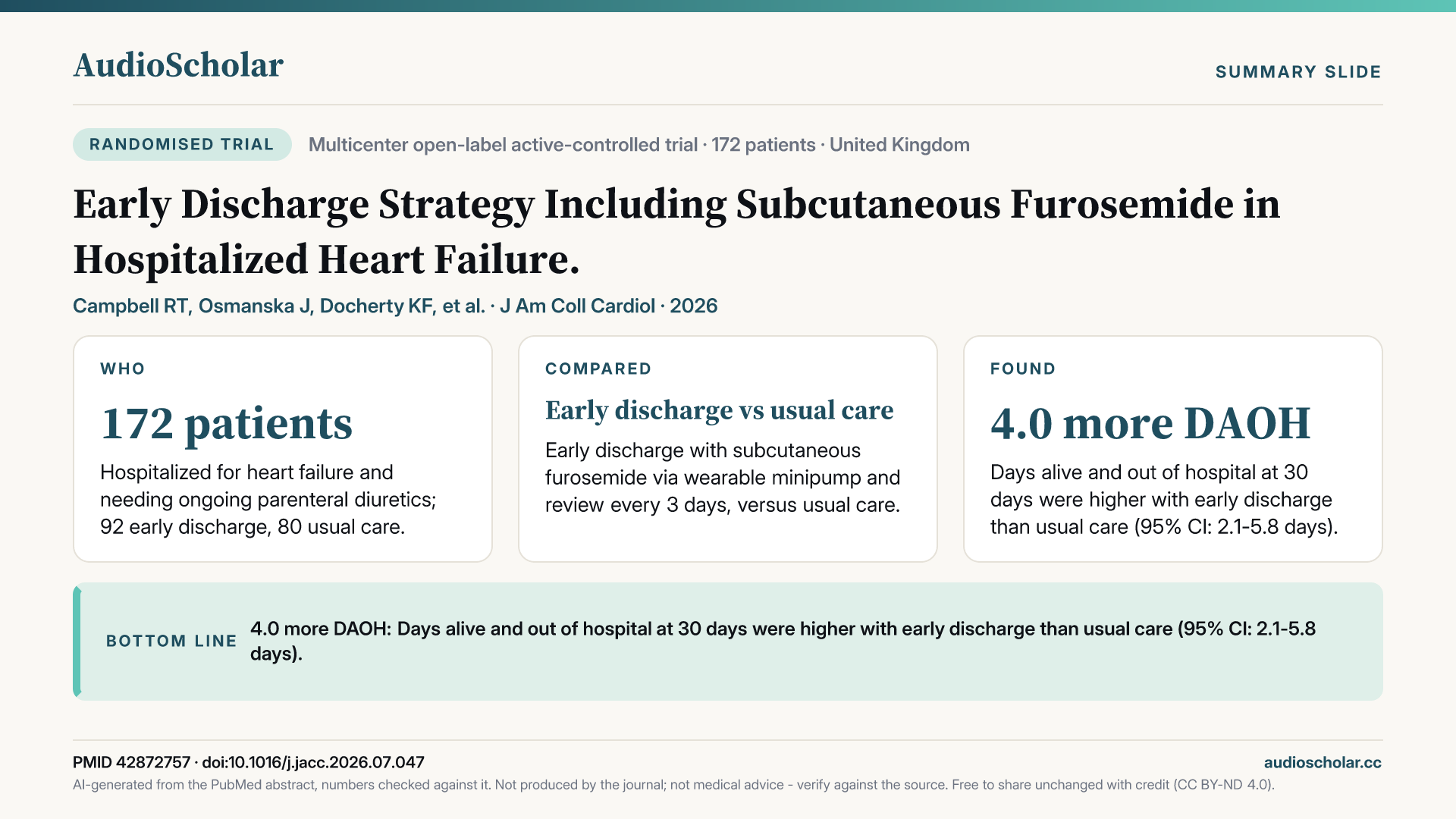
Early Discharge Strategy Including Subcutaneous Furosemide in Hospitalized Heart Failure.
Early discharge with a wearable subcutaneous furosemide minipump added about four days alive and out of hospital at 30 days, though heart failure readmissions were numerically more frequent.
Campbell RT et al. · Journal of the American College of Cardiology · 2026
From the briefingStaying with the theme of getting patients home sooner, the Journal of the American College of Cardiology publishes SUBCUT-HF II from Campbell and colleagues in the United Kingdom [2]. In this open-label trial, 172 patients hospitalized for heart failure who still needed parenteral diuretics were randomized either to usual care or to early discharge with pH-neutral subcutaneous furosemide delivered by a wearable, patient-operated minipump, with a review every three days. The early discharge strategy added about four days alive and out of hospital at thirty days, shortened the index admission by around five and a half days, and the gain held at sixty days. The trade-off deserves attention: heart failure readmissions were more frequent in the early discharge group, about 14 percent versus 6 percent, although that difference was not statistically conclusive, and serious adverse events were similar. Device problems were uncommon and none were serious. This is a modest, single-country trial with an unblinded design, so it supports the feasibility of hospital-at-home diuresis rather than settling its safety at scale.
If you only have time for one paper this week, make it SUBCUT-HF II in the Journal of the American College of Cardiology [2]. It is randomized evidence that a meaningful share of inpatient heart failure diuresis can move home, while openly raising the readmission question that larger trials will need to answer.
Written by AI from the published abstract, for healthcare professionals. Not medical advice; check the paper before acting on it.
- 03
Temporary mechanical circulatory support in cardiogenic shock.
European consensus update favours phenotype-guided device selection in infarct-related cardiogenic shock, noting a microaxial pump mortality signal while routine VA-ECMO has not improved survival.
Chieffo A et al. · European Heart Journal · 2026
From the briefingAt the sickest end of acute care, the European Heart Journal carries an updated consensus statement on temporary mechanical circulatory support in cardiogenic shock from Chieffo and colleagues, on behalf of two European Society of Cardiology associations [3]. It notes that one recent trial suggested a mortality benefit for a microaxial flow pump in infarct-related shock with ST elevation, while routine veno-arterial ECMO in infarct-related shock has not improved survival and carries more complications. The statement's emphasis falls on phenotype-driven device selection using SCAI and SHARC classifications, multidisciplinary shock teams, hub-and-spoke networks, and explicit protocols for escalation and futility.
Written by AI from the published abstract, for healthcare professionals. Not medical advice; check the paper before acting on it.
- 04
Transseptal Transcatheter Mitral Valve Replacement for Mitral Annular Calcification: ENCIRCLE MAC Registry 1-Year Outcomes.
Transseptal SAPIEN M3 mitral replacement in annular calcification nearly eliminated regurgitation and improved symptoms at one year, but about a third of patients died or were hospitalized for heart failure.
Guerrero ME et al. · Journal of the American College of Cardiology · 2026
From the briefingIn the Journal of the American College of Cardiology, Guerrero and colleagues report one-year results from the ENCIRCLE MAC Registry, a single-arm study of fully transseptal transcatheter mitral valve replacement with the SAPIEN M3 system in patients with mitral annular calcification deemed unsuitable for surgery or transcatheter repair [4]. Of 364 patients screened, the procedure was attempted in 100, a reminder of how selective this pathway is. At one year, about a third of patients had died or been hospitalized for heart failure, with all-cause mortality around 21 percent. Among implanted patients, nearly all had mild or less residual regurgitation, and symptoms, quality of life, and walk distance improved. Complications were not trivial, with disabling stroke in about 5 percent, hemolysis requiring transfusion or reintervention in about 9 percent, and mitral reintervention in about 11 percent. Without a control group, this is evidence of a feasible option for a population with few alternatives, not proof of benefit over medical therapy.
Written by AI from the published abstract, for healthcare professionals. Not medical advice; check the paper before acting on it.
- 05
Definition and Prognosis of Mitral Regurgitation in Transthyretin Amyloid Cardiomyopathy: A Multicenter International Cohort Study.
In transthyretin amyloid cardiomyopathy, prognostically important mitral regurgitation thresholds are far below guideline cutoffs, and a validated composite grading scheme better predicted mortality and heart failure hospitalization.
Hauptmann L et al. · Circulation · 2026
From the briefingAlso on the mitral valve, Hauptmann and colleagues in Circulation examined regurgitation in more than a thousand patients with newly diagnosed transthyretin amyloid cardiomyopathy, with blinded core laboratory analysis and an external validation cohort [5]. Because restrictive, low-flow physiology shrinks regurgitant volumes, they found that prognostically meaningful thresholds sit well below guideline cutoffs; for example, high risk began at a regurgitant volume above 38 milliliters and a regurgitant fraction above 35 percent. Their composite grading scheme labelled about a fifth of patients as having severe regurgitation, compared with roughly one in eight under guideline definitions, and it predicted death and heart failure hospitalization better. This is observational and prognostic work, so it supports disease-specific grading but does not yet tell us whether intervening on regurgitation defined this way changes outcomes.
Written by AI from the published abstract, for healthcare professionals. Not medical advice; check the paper before acting on it.
- 06
Dapagliflozin After Transcatheter Aortic Valve Implantation According to Frailty in DapaTAVI Trial.
In a post hoc DapaTAVI analysis, dapagliflozin after aortic valve implantation was associated with roughly halved death or worsening heart failure in frail patients, but not in prefrail or robust patients.
Gonzalez-Manzanares R et al. · Journal of the American Heart Association · 2026
From the briefingRounding out the theme, the Journal of the American Heart Association publishes a post hoc analysis of the DapaTAVI trial by Gonzalez-Manzanares and colleagues [6]. Among 1222 patients after transcatheter aortic valve implantation, just under half of the patients were frail, and frailty independently predicted death or worsening heart failure at one year. Dapagliflozin was associated with roughly halving that risk in frail patients, but showed no benefit in prefrail or robust patients, and frailty did not alter safety. As a subgroup analysis, this is hypothesis-generating, though it suggests the patients at highest risk may be the ones who gain most.
Written by AI from the published abstract, for healthcare professionals. Not medical advice; check the paper before acting on it.
- 07
Genotype and arrhythmic risk in dilated cardiomyopathy.
Pathogenic variants in high-arrhythmogenic genes roughly tripled major ventricular arrhythmia risk in dilated cardiomyopathy, independent of ejection fraction and persisting even when ejection fraction was 50 percent or higher.
Padalia K et al. · European Heart Journal · 2026
From the briefingIn the European Heart Journal, Padalia and colleagues used the international SHaRe registry to study 2660 genotyped adults with dilated cardiomyopathy [7]. Patients carrying a pathogenic variant in a high-arrhythmogenic gene such as LMNA, DSP, FLNC, RBM20, PLN, SCN5A, DES, or TMEM43 had roughly three times the risk of major ventricular arrhythmia compared with gene-elusive patients, along with more than double the risk of atrial fibrillation and heart failure events, independent of age, sex, and ejection fraction. Strikingly, even carriers with an ejection fraction of 50 percent or higher still had more than double the arrhythmic risk. This registry evidence strengthens the case for genotype as a core input to sudden death risk assessment, particularly where ejection fraction alone would offer false reassurance, though prospective testing of genotype-guided device decisions is still needed.
Written by AI from the published abstract, for healthcare professionals. Not medical advice; check the paper before acting on it.
- 08
Intracoronary imaging to assess atherosclerosis and to guide percutaneous coronary intervention.
Randomized evidence summarized in this review shows intravascular ultrasound or OCT-guided PCI reduces cardiac death, myocardial infarction, and repeat revascularization, particularly in complex lesions and acute coronary syndrome.
Vergallo R et al. · European Heart Journal · 2026
From the briefingAlso in the European Heart Journal, Vergallo, Stone, and colleagues provide a state-of-the-art review of intravascular ultrasound and optical coherence tomography [8], summarizing randomized evidence that imaging-guided PCI reduces cardiac death, myocardial infarction, and repeat revascularization, especially in left main and bifurcation disease, calcified and long lesions, and acute coronary syndrome. Two further statements focus on team-based care.
Written by AI from the published abstract, for healthcare professionals. Not medical advice; check the paper before acting on it.
- 09
Multidisciplinary Approach to Antiplatelet Management in Coronary Syndromes: A Scientific Statement From the American Heart Association.
American Heart Association statement argues that individualized antiplatelet therapy and frequent care transitions raise prescribing and adherence risks, positioning multidisciplinary teams including pharmacists as antithrombotic stewards.
Beavers CJ et al. · Circulation · 2026
From the briefingIn Circulation, an American Heart Association scientific statement led by Beavers addresses antiplatelet management in acute and chronic coronary disease [9], arguing that increasingly individualized choices about agent, intensity, and duration, combined with frequent care transitions, raise the risk of inappropriate prescribing and nonadherence, and positioning interventional and general cardiologists, pharmacists, and advanced practice nurses as joint stewards.
Written by AI from the published abstract, for healthcare professionals. Not medical advice; check the paper before acting on it.
- 10
Exercise Prescriptions for Cardiovascular Health in Adults: 2026 ACC Scientific Statement: A Report of the American College of Cardiology.
American College of Cardiology statement holds that the largest cardiovascular gains come when inactive people start exercising and that routine preparticipation testing is unnecessary for most asymptomatic adults.
Myers J et al. · Journal of the American College of Cardiology · 2026
From the briefingAnd in the Journal of the American College of Cardiology, a 2026 American College of Cardiology statement led by Myers on exercise prescription [10] reiterates that the largest absolute gains come when inactive people start moving, that routine preparticipation testing is not required for most asymptomatic individuals, and that cardiac rehabilitation in supervised, home-based, hybrid, and virtual forms deserves wider use. These documents synthesize existing evidence rather than generating new data, but they signal where professional societies expect practice to go.
Written by AI from the published abstract, for healthcare professionals. Not medical advice; check the paper before acting on it.
The full briefing
This AudioScholar briefing is generated by artificial intelligence for healthcare professionals and trainees. It is not medical advice.
Welcome to This Week in Cardiology. This week we're covering 10 notable papers spanning faster and leaner acute care pathways, structural and valvular disease in older and frailer patients, and sharper risk stratification backed by a cluster of new scientific statements. Let's dive in.
Our first theme is about moving patients through acute care more efficiently without giving up safety. In Circulation, Than and colleagues report ICare-FASTER, a pragmatic stepped-wedge cluster-randomized trial across six emergency departments covering nearly sixty thousand presentations with possible acute coronary syndrome [1]. Both arms used the same accelerated diagnostic pathway with a single-sample rule-out step; the only difference was whether high-sensitivity troponin I was run at the point of care on whole blood or sent to the central laboratory. Point-of-care testing cut emergency department length of stay by about 13 percent, which works out to roughly 47 minutes off an average stay of just over six hours, and the thirty-day rate of myocardial infarction or cardiac death was identical in both arms at about four in a thousand. The design is real-world and the sample is very large, which makes the safety signal reassuring, though the result applies to a pathway already built around rapid rule-out and to the specific assay tested. Staying with the theme of getting patients home sooner, the Journal of the American College of Cardiology publishes SUBCUT-HF II from Campbell and colleagues in the United Kingdom [2]. In this open-label trial, 172 patients hospitalized for heart failure who still needed parenteral diuretics were randomized either to usual care or to early discharge with pH-neutral subcutaneous furosemide delivered by a wearable, patient-operated minipump, with a review every three days. The early discharge strategy added about four days alive and out of hospital at thirty days, shortened the index admission by around five and a half days, and the gain held at sixty days. The trade-off deserves attention: heart failure readmissions were more frequent in the early discharge group, about 14 percent versus 6 percent, although that difference was not statistically conclusive, and serious adverse events were similar. Device problems were uncommon and none were serious. This is a modest, single-country trial with an unblinded design, so it supports the feasibility of hospital-at-home diuresis rather than settling its safety at scale. At the sickest end of acute care, the European Heart Journal carries an updated consensus statement on temporary mechanical circulatory support in cardiogenic shock from Chieffo and colleagues, on behalf of two European Society of Cardiology associations [3]. It notes that one recent trial suggested a mortality benefit for a microaxial flow pump in infarct-related shock with ST elevation, while routine veno-arterial ECMO in infarct-related shock has not improved survival and carries more complications. The statement's emphasis falls on phenotype-driven device selection using SCAI and SHARC classifications, multidisciplinary shock teams, hub-and-spoke networks, and explicit protocols for escalation and futility.
Our second theme turns to valvular disease in patients who are older, frailer, or carry infiltrative disease, where standard approaches often fall short. In the Journal of the American College of Cardiology, Guerrero and colleagues report one-year results from the ENCIRCLE MAC Registry, a single-arm study of fully transseptal transcatheter mitral valve replacement with the SAPIEN M3 system in patients with mitral annular calcification deemed unsuitable for surgery or transcatheter repair [4]. Of 364 patients screened, the procedure was attempted in 100, a reminder of how selective this pathway is. At one year, about a third of patients had died or been hospitalized for heart failure, with all-cause mortality around 21 percent. Among implanted patients, nearly all had mild or less residual regurgitation, and symptoms, quality of life, and walk distance improved. Complications were not trivial, with disabling stroke in about 5 percent, hemolysis requiring transfusion or reintervention in about 9 percent, and mitral reintervention in about 11 percent. Without a control group, this is evidence of a feasible option for a population with few alternatives, not proof of benefit over medical therapy. Also on the mitral valve, Hauptmann and colleagues in Circulation examined regurgitation in more than a thousand patients with newly diagnosed transthyretin amyloid cardiomyopathy, with blinded core laboratory analysis and an external validation cohort [5]. Because restrictive, low-flow physiology shrinks regurgitant volumes, they found that prognostically meaningful thresholds sit well below guideline cutoffs; for example, high risk began at a regurgitant volume above 38 milliliters and a regurgitant fraction above 35 percent. Their composite grading scheme labelled about a fifth of patients as having severe regurgitation, compared with roughly one in eight under guideline definitions, and it predicted death and heart failure hospitalization better. This is observational and prognostic work, so it supports disease-specific grading but does not yet tell us whether intervening on regurgitation defined this way changes outcomes. Rounding out the theme, the Journal of the American Heart Association publishes a post hoc analysis of the DapaTAVI trial by Gonzalez-Manzanares and colleagues [6]. Among 1222 patients after transcatheter aortic valve implantation, just under half of the patients were frail, and frailty independently predicted death or worsening heart failure at one year. Dapagliflozin was associated with roughly halving that risk in frail patients, but showed no benefit in prefrail or robust patients, and frailty did not alter safety. As a subgroup analysis, this is hypothesis-generating, though it suggests the patients at highest risk may be the ones who gain most.
Our third theme is about refining who is at risk and organizing care around that risk, with one large registry and several new guidance documents. In the European Heart Journal, Padalia and colleagues used the international SHaRe registry to study 2660 genotyped adults with dilated cardiomyopathy [7]. Patients carrying a pathogenic variant in a high-arrhythmogenic gene such as LMNA, DSP, FLNC, RBM20, PLN, SCN5A, DES, or TMEM43 had roughly three times the risk of major ventricular arrhythmia compared with gene-elusive patients, along with more than double the risk of atrial fibrillation and heart failure events, independent of age, sex, and ejection fraction. Strikingly, even carriers with an ejection fraction of 50 percent or higher still had more than double the arrhythmic risk. This registry evidence strengthens the case for genotype as a core input to sudden death risk assessment, particularly where ejection fraction alone would offer false reassurance, though prospective testing of genotype-guided device decisions is still needed. Also in the European Heart Journal, Vergallo, Stone, and colleagues provide a state-of-the-art review of intravascular ultrasound and optical coherence tomography [8], summarizing randomized evidence that imaging-guided PCI reduces cardiac death, myocardial infarction, and repeat revascularization, especially in left main and bifurcation disease, calcified and long lesions, and acute coronary syndrome. Two further statements focus on team-based care. In Circulation, an American Heart Association scientific statement led by Beavers addresses antiplatelet management in acute and chronic coronary disease [9], arguing that increasingly individualized choices about agent, intensity, and duration, combined with frequent care transitions, raise the risk of inappropriate prescribing and nonadherence, and positioning interventional and general cardiologists, pharmacists, and advanced practice nurses as joint stewards. And in the Journal of the American College of Cardiology, a 2026 American College of Cardiology statement led by Myers on exercise prescription [10] reiterates that the largest absolute gains come when inactive people start moving, that routine preparticipation testing is not required for most asymptomatic individuals, and that cardiac rehabilitation in supervised, home-based, hybrid, and virtual forms deserves wider use. These documents synthesize existing evidence rather than generating new data, but they signal where professional societies expect practice to go.
If you only have time for one paper this week, make it SUBCUT-HF II in the Journal of the American College of Cardiology [2]. It is randomized evidence that a meaningful share of inpatient heart failure diuresis can move home, while openly raising the readmission question that larger trials will need to answer.
Here is what this week's evidence adds up to in Cardiology. First, faster pathways can be safe: point-of-care high-sensitivity troponin shortened emergency stays by nearly an hour with no rise in thirty-day events in a very large pragmatic trial, while subcutaneous furosemide at home added days out of hospital in a smaller trial whose readmission signal remains unresolved. Second, genotype now carries quantified arrhythmic weight in dilated cardiomyopathy, with high-risk variants roughly tripling ventricular arrhythmia risk even when ejection fraction is preserved, though this is registry rather than trial evidence. Third, standard thresholds may mislead in special populations, as mitral regurgitation in transthyretin amyloidosis appears prognostically important at volumes well below guideline cutoffs; whether treatment based on these thresholds helps is unknown. Fourth, for high-risk structural patients, transseptal mitral replacement in annular calcification is feasible but carries substantial one-year mortality and complications without a comparator, and the signal that dapagliflozin helps frail patients after valve implantation comes from a post hoc subgroup. Finally, new statements on shock support, antiplatelet stewardship, intracoronary imaging, and exercise converge on individualized, team-based care rather than uniform protocols.
That's your roundup for This Week in Cardiology. The full transcript and references are available on the episode page. This is an AI-curated summary — for clinical decisions, always consult primary sources and current guidelines. See you next week.
If this weekly briefing is useful, follow the show in your podcast app so new episodes arrive automatically. And think of one colleague — in any specialty — who never has time to keep up with the literature. Tell them about AudioScholar: a free ten-minute weekly for every specialty, to listen to in any podcast app, or to read at audioscholar dot C C.
This is an automated summary generated by artificial intelligence, which can make mistakes. Always review the original source materials.
Spot something worth flagging?
Get this every week in your podcast app — free.
New cardiology episodes land in your feed automatically — listen on your commute.