This Week in Orthopedics — Oct 15, 2026
Generated Oct 15, 2026 · 10:09
The week's practice-changing Orthopedics research, summarized for clinicians.
If the audio fails to play, refresh the page to renew the link.
Get next week’s Orthopedics briefing — free.
In your podcast app, or readable in your inbox with the audio one tap away.
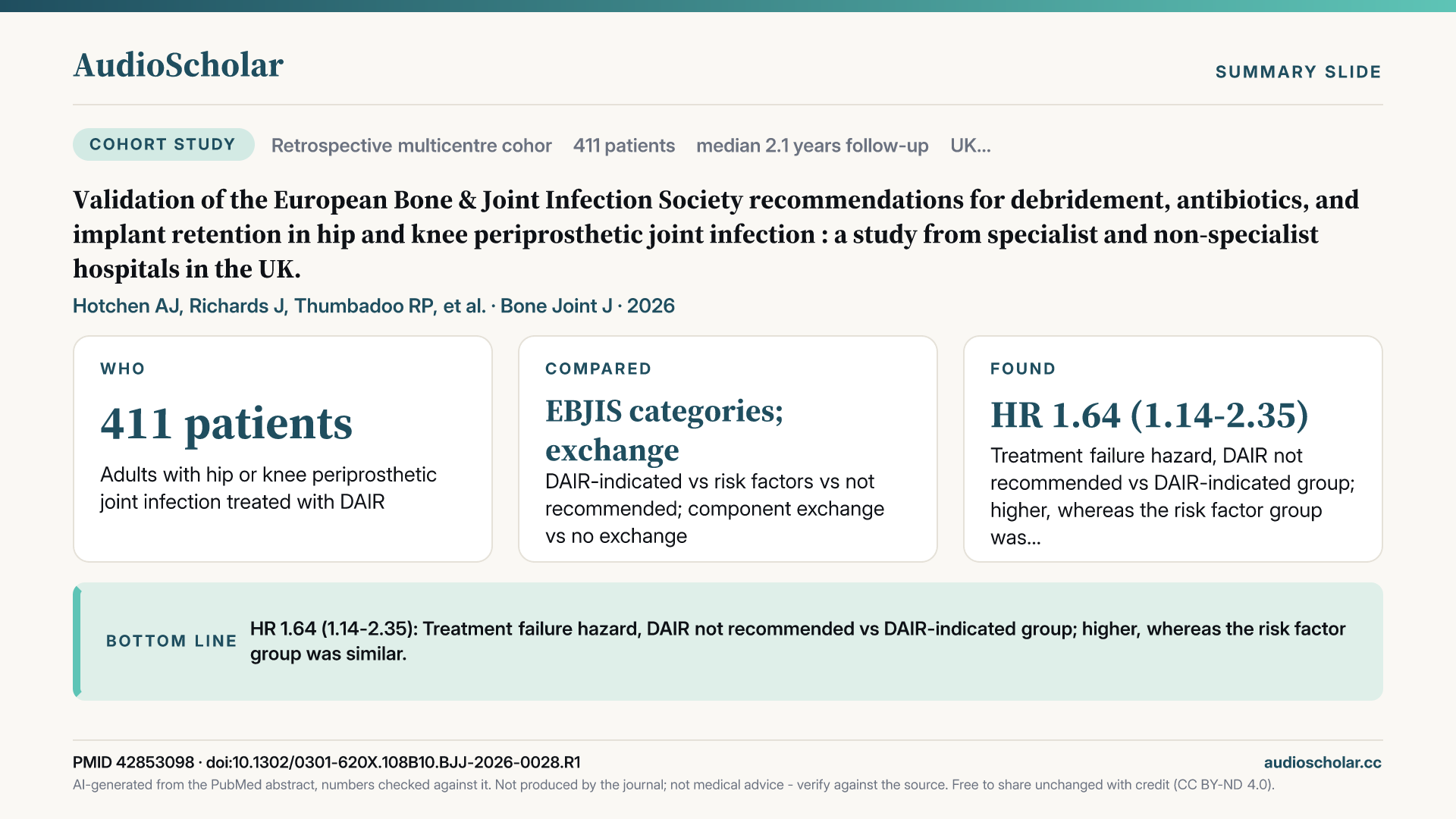
Validation of the European Bone & Joint Infection Society recommendations for debridement, antibiotics, and implant retention in hip and knee periprosthetic joint infection : a study from specialist and non-specialist hospitals in the UK.
Across seven United Kingdom hospitals, non-recommended DAIR candidates and DAIR without modular component exchange both had higher failure, with success ranging from about 79 to 28 percent.
Bone & Joint Journal · 2026 · PubMed

This week’s papers
- 01
Validation of the European Bone & Joint Infection Society recommendations for debridement, antibiotics, and implant retention in hip and knee periprosthetic joint infection : a study from specialist and non-specialist hospitals in the UK.
Across seven United Kingdom hospitals, non-recommended DAIR candidates and DAIR without modular component exchange both had higher failure, with success ranging from about 79 to 28 percent.
Hotchen AJ et al. · Bone & Joint Journal · 2026
From the briefingInfection after joint replacement leads the week, with three papers looking at who keeps their implant, what hides behind a low-risk workup, and how prevention guidance has shifted. In the Bone & Joint Journal, Hotchen and colleagues externally validated the European Bone and Joint Infection Society recommendations for debridement, antibiotics and implant retention, known as DAIR, in hip and knee periprosthetic infection [1]. The retrospective cohort spanned seven United Kingdom hospitals, both specialist and non-specialist, and included 411 patients. Under the framework, only one in five patients was classed as a good DAIR candidate, while more than half of the patients fell into the not-recommended group. Failure was common overall, affecting just under half of the cohort over a median of about two years. Patients in the not-recommended group had roughly a two-thirds higher risk of failure than ideal candidates, while patients with risk factors fared similarly to ideal candidates. The strongest signal was surgical technique: performing DAIR without exchanging modular components was associated with well over double the risk of failure. Those two factors combined produce a striking spread, from about 79 percent success in ideal candidates who had components exchanged down to 28 percent in non-recommended patients without exchange. This is observational data, so selection effects cannot be excluded, but it supports the framework as a practical tool for shared decision-making and strengthens the case that component exchange is central to the procedure.
If you only have time for one paper this week, make it the external validation of the European DAIR recommendations by Hotchen and colleagues in the Bone & Joint Journal [1]. It shows across both specialist and non-specialist hospitals that patient selection and component exchange each track with whether implant retention succeeds, reopening the question of how often DAIR is attempted in patients the framework would steer away from.
Written by AI from the published abstract, for healthcare professionals. Not medical advice; check the paper before acting on it.
- 02
Occult Infection Risk with Stem Retention in Revision Anatomic to Reverse Shoulder Arthroplasty.
Retaining convertible humeral stems in low-suspicion anatomic-to-reverse revisions led to reoperation for infection in about three percent, despite unexpected positive cultures in roughly one in seven patients.
Shenoy DA et al. · Journal of Shoulder and Elbow Surgery · 2026
From the briefingMoving to the shoulder, Shenoy and colleagues in the Journal of Shoulder and Elbow Surgery reported a single-institution series of 65 patients converted from anatomic to reverse shoulder arthroplasty with a retained convertible humeral stem, all of whom were rated unlikely to have infection on preoperative scoring [2]. Even so, roughly one in seven patients had unexpected positive intraoperative cultures, mostly Cutibacterium acnes. Reassuringly, only two patients, about three percent, needed reoperation for infection, and neither had positive cultures at the index revision. The authors conclude that stem retention carries a low infection rate in this low-suspicion group, while cautioning that preoperative scores did not predict reoperation for infection; the series is small and uncontrolled.
Written by AI from the published abstract, for healthcare professionals. Not medical advice; check the paper before acting on it.
- 03
New guidelines for the prevention of periprosthetic joint infection : a ten-year update.
A narrative annotation updates periprosthetic joint infection prevention strategies a decade after major guidelines, noting that high-quality evidence still remains limited for many perioperative measures.
Ferrini A et al. · Bone & Joint Journal · 2026
From the briefingRounding out the theme, Ferrini and colleagues offer a Bone & Joint Journal annotation updating prevention strategies a decade after the major guidelines [3]. It is a narrative overview rather than new data, and the authors themselves note that high-quality evidence remains limited across many perioperative measures.
Written by AI from the published abstract, for healthcare professionals. Not medical advice; check the paper before acting on it.
- 04
Higher femoral periprosthetic fracture rate with dual-mobility compared with single-mobility total hip arthroplasty : a retrospective propensity-matched study of 780 uncemented hips.
In matched uncemented hips, dual-mobility bearings sharply reduced dislocation but carried roughly three and a half times the odds of periprosthetic femoral fracture versus ceramic-on-ceramic bearings.
Komat M et al. · Bone & Joint Journal · 2026
From the briefingThe second theme is about implant choices in hip and knee arthroplasty and the trade-offs they carry. Also in the Bone & Joint Journal, Komat and colleagues compared dual-mobility with ceramic-on-ceramic bearings in uncemented hips at a single centre, with a propensity-matched cohort of 780 hips [4]. Dual mobility did what it is designed to do, cutting dislocation dramatically, from about four percent to well under one percent. But periprosthetic femoral fracture was more frequent with dual mobility, roughly three and a half times the odds after matching. Femoral neck fracture as the indication independently raised the risk of both fracture and dislocation. The authors frame this as a trade-off to weigh, especially in patients treated for femoral neck fracture; it is retrospective, single-centre work with modest event counts, so it raises a signal rather than settling the question.
Written by AI from the published abstract, for healthcare professionals. Not medical advice; check the paper before acting on it.
- 05
Ten-year insert wear and the migration of uncemented tibial and femoral components with either conventional polyethylene or sequentially annealed highly crosslinked polyethylene: a blinded randomized controlled trial using radiostereometric analysis.
In a ten-year randomized trial of uncemented knees, crosslinked polyethylene wear plateaued after five years while conventional polyethylene wear doubled, with no meaningful migration or outcome differences.
de Ridder R et al. · Bone & Joint Journal · 2026
From the briefingOn the knee side, de Ridder and colleagues report ten-year results from a double-blinded randomized trial of 96 uncemented cruciate-retaining knees, comparing sequentially annealed highly crosslinked polyethylene with conventional polyethylene using radiostereometric analysis [5]. Wear in the crosslinked group did not progress after five years, staying around a tenth of a millimetre, whereas wear in the conventional group roughly doubled between five and ten years. Component migration and patient-reported outcomes did not differ meaningfully, and both components remained stable after initial settling. This is a small trial with a surrogate endpoint, but it adds long-term reassurance that crosslinked inserts are safe in uncemented knees.
Written by AI from the published abstract, for healthcare professionals. Not medical advice; check the paper before acting on it.
- 06
To Lengthen or Revise: Reevaluating Anterior Acetabular Overhang Thresholds in Iliopsoas Impingement After Total Hip Arthroplasty.
Arthroscopic iliopsoas fractional lengthening after hip replacement gave similar outcomes regardless of whether acetabular overhang exceeded eight millimetres, challenging that revision threshold in a small case series.
Clark DS et al. · Journal of Bone and Joint Surgery · 2026
From the briefingFinally, in the Journal of Bone and Joint Surgery, Clark and colleagues revisit the long-standing eight millimetre anterior acetabular overhang threshold for iliopsoas impingement after hip replacement [6]. Across 86 hips treated with arthroscopic iliopsoas fractional lengthening, outcomes for pain, function and satisfaction did not differ significantly between hips above and below that threshold, and acetabular revision was rare in both groups. The authors argue that lengthening can be a first-line surgical option even with substantial overhang, but this is a Level four case series with only 19 hips in the larger-overhang group, so the absence of a difference may reflect limited power rather than true equivalence.
Written by AI from the published abstract, for healthcare professionals. Not medical advice; check the paper before acting on it.
- 07
Defining Long-Term Success After Anatomic Total Shoulder Arthroplasty: Survivorship and Clinically Important Outcomes.
Anatomic shoulder replacement showed about 96 percent ten-year survivorship, but function gradually declined and only about half of shoulders achieved substantial clinical benefit at ten years.
Kucharik MP et al. · Journal of Bone and Joint Surgery · 2026
From the briefingThe third theme turns to the shoulder and elbow, where several papers ask what durable success actually looks like. In the Journal of Bone and Joint Surgery, Kucharik and colleagues followed 791 anatomic total shoulder replacements and found implant survivorship of about 96 percent at ten years and about 94 percent at fifteen [7]. Yet survivorship tells only part of the story. Function gradually attenuated, and at ten years roughly seven in ten shoulders reached an acceptable symptom state, while just over half of the shoulders achieved substantial clinical benefit. Younger age and Walch B glenoid morphology were linked to revision. The paper offers patient-centred benchmarks and a reminder that revision-free survival overstates durable benefit, though it comes from a single retrospective cohort.
Written by AI from the published abstract, for healthcare professionals. Not medical advice; check the paper before acting on it.
- 08
Radial Head Arthroplasty for Radial Head Fracture Is Associated with a Lower Rate of Reoperation Than Open Reduction Internal Fixation: A Population-Based Cohort Study.
In an Ontario population cohort, radial head arthroplasty had lower ten-year reoperation than internal fixation, about ten versus sixteen percent, and overnight fixation raised reoperation in younger patients.
Carroll PJ et al. · Journal of Shoulder and Elbow Surgery · 2026
From the briefingFrom a population-based Ontario cohort of more than three thousand patients, Carroll and colleagues in the Journal of Shoulder and Elbow Surgery found that radial head arthroplasty was associated with fewer reoperations than open reduction and internal fixation, with ten-year cumulative reoperation of about ten percent versus about sixteen percent [8]. The difference held across age groups, and the most common secondary procedure was hardware removal. In patients under 40, overnight fixation between midnight and seven in the morning was linked to more reoperations. Administrative data cannot capture fracture pattern in detail, so confounding by indication is a real concern, and the authors call for longer follow-up in younger patients.
Written by AI from the published abstract, for healthcare professionals. Not medical advice; check the paper before acting on it.
- 09
Biologic Graft Augmentation Is Associated With Lower Retear Rates and Greater Tendon Thickness Compared With Arthroscopic Rotator Cuff Repair Without Augmentation: A Systematic Review and Meta-analysis of Randomized Controlled Trials.
Pooling nine randomized trials, biologic graft augmentation of rotator cuff repair cut retear risk by roughly two thirds and thickened tendons, though clinical score gains were inconsistent.
Amin V et al. · Arthroscopy · 2026
From the briefingIn Arthroscopy, Amin and colleagues pooled nine randomized trials with 556 patients on biologic graft augmentation of arthroscopic rotator cuff repair [9]. Augmentation was associated with roughly a two-thirds reduction in retear risk and about a millimetre of additional tendon thickness. Clinical scores, however, improved less consistently, and graft types varied widely. The structural signal is strong, but whether it translates into better function remains unsettled.
Written by AI from the published abstract, for healthcare professionals. Not medical advice; check the paper before acting on it.
- 10
Strengthening health systems to prioritise, provide care, and prevent osteoarthritis: a roadmap for global health policy.
A global policy roadmap argues osteoarthritis, projected to affect almost a billion people by 2050, needs surveillance, integrated person-centred care, and prevention targeting body weight and joint injury.
Briggs AM et al. · The Lancet · 2026
From the briefingOur last paper zooms out. In The Lancet, Briggs and colleagues present a co-created global policy roadmap for osteoarthritis, which they project will affect almost a billion people by 2050 [10]. They describe an identity problem in which osteoarthritis is seen as inevitable with ageing and is sidelined in health policy. Their three priorities are national surveillance and embedding musculoskeletal health in policy, scaling up person-centred care integrated into primary and chronic disease services, and prevention targeting excess body weight and joint injury. It is a policy document rather than evidence on outcomes, but it frames the system in which every procedure this week takes place.
Written by AI from the published abstract, for healthcare professionals. Not medical advice; check the paper before acting on it.
The full briefing
This AudioScholar briefing is generated by artificial intelligence for healthcare professionals and trainees. It is not medical advice.
Welcome to This Week in Orthopedics. This week we're covering 10 notable papers spanning periprosthetic joint infection, implant choices and durability in hip, knee and shoulder arthroplasty, and the wider question of how health systems handle osteoarthritis. Let's dive in.
Infection after joint replacement leads the week, with three papers looking at who keeps their implant, what hides behind a low-risk workup, and how prevention guidance has shifted. In the Bone & Joint Journal, Hotchen and colleagues externally validated the European Bone and Joint Infection Society recommendations for debridement, antibiotics and implant retention, known as DAIR, in hip and knee periprosthetic infection [1]. The retrospective cohort spanned seven United Kingdom hospitals, both specialist and non-specialist, and included 411 patients. Under the framework, only one in five patients was classed as a good DAIR candidate, while more than half of the patients fell into the not-recommended group. Failure was common overall, affecting just under half of the cohort over a median of about two years. Patients in the not-recommended group had roughly a two-thirds higher risk of failure than ideal candidates, while patients with risk factors fared similarly to ideal candidates. The strongest signal was surgical technique: performing DAIR without exchanging modular components was associated with well over double the risk of failure. Those two factors combined produce a striking spread, from about 79 percent success in ideal candidates who had components exchanged down to 28 percent in non-recommended patients without exchange. This is observational data, so selection effects cannot be excluded, but it supports the framework as a practical tool for shared decision-making and strengthens the case that component exchange is central to the procedure. Moving to the shoulder, Shenoy and colleagues in the Journal of Shoulder and Elbow Surgery reported a single-institution series of 65 patients converted from anatomic to reverse shoulder arthroplasty with a retained convertible humeral stem, all of whom were rated unlikely to have infection on preoperative scoring [2]. Even so, roughly one in seven patients had unexpected positive intraoperative cultures, mostly Cutibacterium acnes. Reassuringly, only two patients, about three percent, needed reoperation for infection, and neither had positive cultures at the index revision. The authors conclude that stem retention carries a low infection rate in this low-suspicion group, while cautioning that preoperative scores did not predict reoperation for infection; the series is small and uncontrolled. Rounding out the theme, Ferrini and colleagues offer a Bone & Joint Journal annotation updating prevention strategies a decade after the major guidelines [3]. It is a narrative overview rather than new data, and the authors themselves note that high-quality evidence remains limited across many perioperative measures.
The second theme is about implant choices in hip and knee arthroplasty and the trade-offs they carry. Also in the Bone & Joint Journal, Komat and colleagues compared dual-mobility with ceramic-on-ceramic bearings in uncemented hips at a single centre, with a propensity-matched cohort of 780 hips [4]. Dual mobility did what it is designed to do, cutting dislocation dramatically, from about four percent to well under one percent. But periprosthetic femoral fracture was more frequent with dual mobility, roughly three and a half times the odds after matching. Femoral neck fracture as the indication independently raised the risk of both fracture and dislocation. The authors frame this as a trade-off to weigh, especially in patients treated for femoral neck fracture; it is retrospective, single-centre work with modest event counts, so it raises a signal rather than settling the question. On the knee side, de Ridder and colleagues report ten-year results from a double-blinded randomized trial of 96 uncemented cruciate-retaining knees, comparing sequentially annealed highly crosslinked polyethylene with conventional polyethylene using radiostereometric analysis [5]. Wear in the crosslinked group did not progress after five years, staying around a tenth of a millimetre, whereas wear in the conventional group roughly doubled between five and ten years. Component migration and patient-reported outcomes did not differ meaningfully, and both components remained stable after initial settling. This is a small trial with a surrogate endpoint, but it adds long-term reassurance that crosslinked inserts are safe in uncemented knees. Finally, in the Journal of Bone and Joint Surgery, Clark and colleagues revisit the long-standing eight millimetre anterior acetabular overhang threshold for iliopsoas impingement after hip replacement [6]. Across 86 hips treated with arthroscopic iliopsoas fractional lengthening, outcomes for pain, function and satisfaction did not differ significantly between hips above and below that threshold, and acetabular revision was rare in both groups. The authors argue that lengthening can be a first-line surgical option even with substantial overhang, but this is a Level four case series with only 19 hips in the larger-overhang group, so the absence of a difference may reflect limited power rather than true equivalence.
The third theme turns to the shoulder and elbow, where several papers ask what durable success actually looks like. In the Journal of Bone and Joint Surgery, Kucharik and colleagues followed 791 anatomic total shoulder replacements and found implant survivorship of about 96 percent at ten years and about 94 percent at fifteen [7]. Yet survivorship tells only part of the story. Function gradually attenuated, and at ten years roughly seven in ten shoulders reached an acceptable symptom state, while just over half of the shoulders achieved substantial clinical benefit. Younger age and Walch B glenoid morphology were linked to revision. The paper offers patient-centred benchmarks and a reminder that revision-free survival overstates durable benefit, though it comes from a single retrospective cohort. From a population-based Ontario cohort of more than three thousand patients, Carroll and colleagues in the Journal of Shoulder and Elbow Surgery found that radial head arthroplasty was associated with fewer reoperations than open reduction and internal fixation, with ten-year cumulative reoperation of about ten percent versus about sixteen percent [8]. The difference held across age groups, and the most common secondary procedure was hardware removal. In patients under 40, overnight fixation between midnight and seven in the morning was linked to more reoperations. Administrative data cannot capture fracture pattern in detail, so confounding by indication is a real concern, and the authors call for longer follow-up in younger patients. In Arthroscopy, Amin and colleagues pooled nine randomized trials with 556 patients on biologic graft augmentation of arthroscopic rotator cuff repair [9]. Augmentation was associated with roughly a two-thirds reduction in retear risk and about a millimetre of additional tendon thickness. Clinical scores, however, improved less consistently, and graft types varied widely. The structural signal is strong, but whether it translates into better function remains unsettled.
Our last paper zooms out. In The Lancet, Briggs and colleagues present a co-created global policy roadmap for osteoarthritis, which they project will affect almost a billion people by 2050 [10]. They describe an identity problem in which osteoarthritis is seen as inevitable with ageing and is sidelined in health policy. Their three priorities are national surveillance and embedding musculoskeletal health in policy, scaling up person-centred care integrated into primary and chronic disease services, and prevention targeting excess body weight and joint injury. It is a policy document rather than evidence on outcomes, but it frames the system in which every procedure this week takes place.
If you only have time for one paper this week, make it the external validation of the European DAIR recommendations by Hotchen and colleagues in the Bone & Joint Journal [1]. It shows across both specialist and non-specialist hospitals that patient selection and component exchange each track with whether implant retention succeeds, reopening the question of how often DAIR is attempted in patients the framework would steer away from.
Here is what this week's evidence adds up to in Orthopedics. First, observational multicentre data now support the European framework for selecting DAIR candidates, with failure without component exchange standing out most strongly, though randomized confirmation is lacking. Second, dual-mobility hips appear to trade a large reduction in dislocation for a higher rate of periprosthetic femoral fracture, a single-centre signal that needs replication. Third, ten-year randomized data add reassurance on crosslinked polyethylene in uncemented knees, while long-term shoulder data show high survivorship but more modest and gradually fading patient-reported benefit. Fourth, biologic augmentation of rotator cuff repair consistently lowers retear rates in pooled trials, yet clinical benefit remains less certain. And finally, low-risk infection workups in shoulder revision still miss positive cultures in roughly one in seven patients, although that did not translate into a high infection rate in a small series.
That's your roundup for This Week in Orthopedics. The full transcript and references are available on the episode page. This is an AI-curated summary — for clinical decisions, always consult primary sources and current guidelines. See you next week.
If this weekly briefing is useful, follow the show in your podcast app so new episodes arrive automatically. And a quick rating on Apple Podcasts or Spotify helps other physicians discover the show.
This is an automated summary generated by artificial intelligence, which can make mistakes. Always review the original source materials.
Spot something worth flagging?
Get this every week in your podcast app — free.
New orthopedics episodes land in your feed automatically — listen on your commute.