This Week in Dermatology — Oct 23, 2026
Generated Oct 24, 2026 · 11:04
The week's practice-changing Dermatology research, summarized for clinicians.
If the audio fails to play, refresh the page to renew the link.
Get next week’s Dermatology briefing — free.
In your podcast app, or readable in your inbox with the audio one tap away.
Joint American Academy of Dermatology-Hidradenitis Suppurativa Foundation guidelines of care for the management of hidradenitis suppurativa.
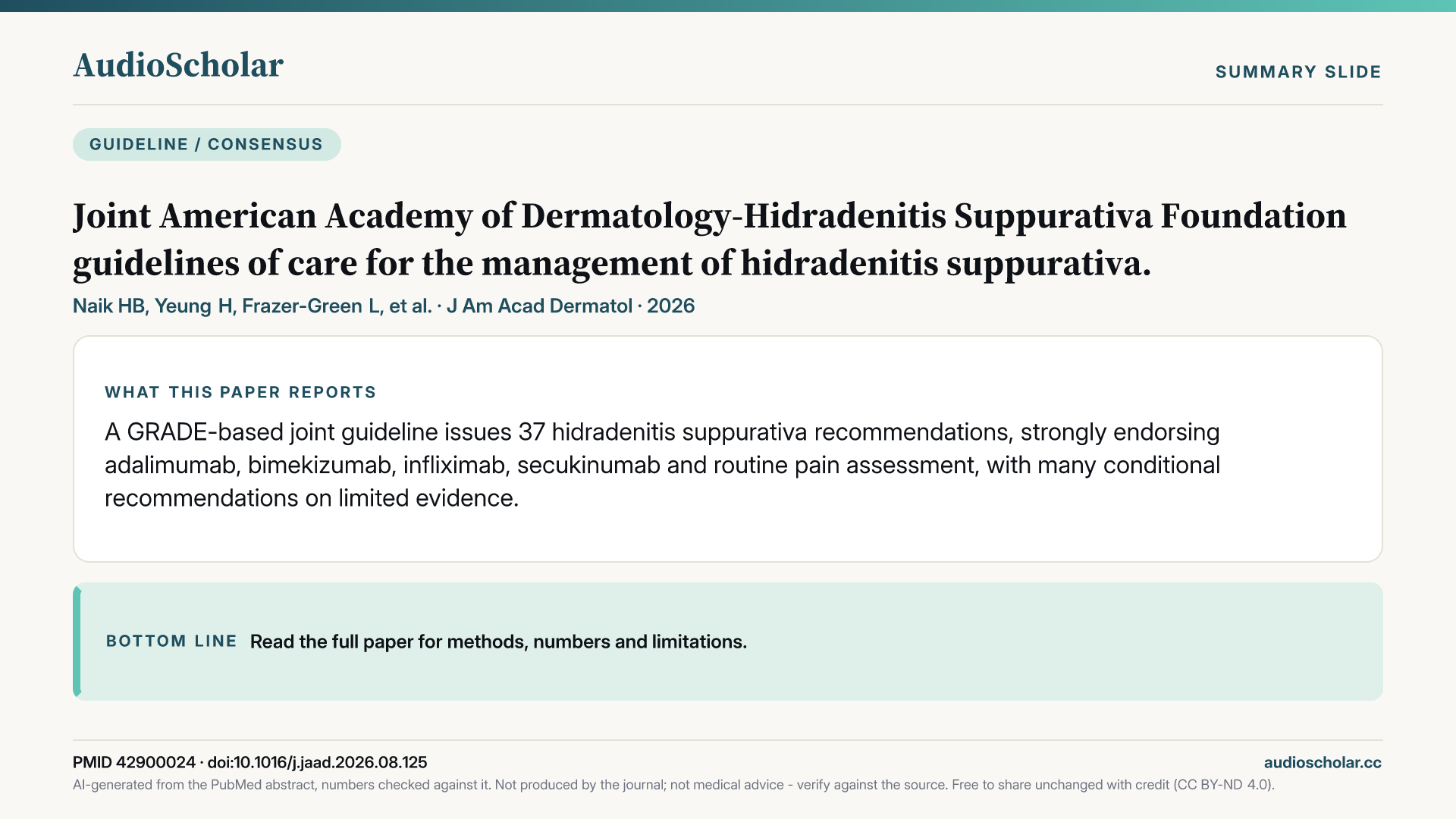
A GRADE-based joint guideline issues 37 hidradenitis suppurativa recommendations, strongly endorsing adalimumab, bimekizumab, infliximab, secukinumab and routine pain assessment, with many conditional recommendations on limited evidence.
Journal of the American Academy of Dermatology · 2026 · PubMed

This week’s papers
- 01
Joint American Academy of Dermatology-Hidradenitis Suppurativa Foundation guidelines of care for the management of hidradenitis suppurativa.
A GRADE-based joint guideline issues 37 hidradenitis suppurativa recommendations, strongly endorsing adalimumab, bimekizumab, infliximab, secukinumab and routine pain assessment, with many conditional recommendations on limited evidence.
Naik HB, Yeung H, Frazer-Green L, et al. · Journal of the American Academy of Dermatology · 2026
From the briefingThe anchor is the joint American Academy of Dermatology and Hidradenitis Suppurativa Foundation guideline, published in the Journal of the American Academy of Dermatology, from Naik and colleagues [1]. Using a systematic review and the GRADE approach, the workgroup issued 37 recommendations. Strong recommendations go to four biologics, adalimumab, bimekizumab, infliximab and secukinumab, and notably to routine pain assessment, which puts the patient's experience on the same footing as drug choice. A long list of conditional recommendations covers topical clindamycin, resorcinol and ruxolitinib cream, oral doxycycline, tetracycline, and the clindamycin plus rifampin combination, intravenous ertapenem, spironolactone, short courses of systemic steroids, upadacitinib, specific procedures, tobacco cessation, supportive pain management, and zinc and vitamin D repletion. The authors acknowledge that many of these conditional items rest on limited evidence, so the guideline formalizes much of current practice while marking where the data remain thin.
If you only have time for one paper this week, make it the joint American Academy of Dermatology and Hidradenitis Suppurativa Foundation guideline [1]. It consolidates a rapidly changing evidence base into a single graded framework for a common, disabling disease, and it formally elevates pain assessment to a strong recommendation.
Written by AI from the published abstract, for healthcare professionals. Not medical advice; check the paper before acting on it.
- 02
HiSQOL-mini: Development and Validation of a Shortened Version of the Hidradenitis Suppurativa Quality of Life (HiSQOL) Instrument.
A four-item hidradenitis quality of life questionnaire covering pain, depressed mood, walking and dressing proved valid, reliable and responsive, with a three-point drop marking minimal important change.
Ingram JR, Espy J, Garg A, et al. · British Journal of Dermatology · 2026
From the briefingFittingly, the emphasis on pain lines up with a paper in the British Journal of Dermatology from Ingram and colleagues, who developed a shortened version of the hidradenitis-specific quality of life questionnaire, called HiSQOL-mini [2]. Drawing on data from an observational cohort and the bimekizumab phase 3 programme, and with patient research partners leading two consensus workshops, the team cut the 17-item instrument down to four items: pain, feeling down or depressed, walking, and getting dressed. The short form showed good validity, reliability and responsiveness, scores run from zero to sixteen, and a three-point drop marks the minimal important difference while a five-point drop marks clinically meaningful change. It was validated largely in trial data, so performance in busy routine clinics is still to be shown, but it offers a practical way to capture what the new guideline asks clinicians to measure.
Written by AI from the published abstract, for healthcare professionals. Not medical advice; check the paper before acting on it.
- 03
Optimizing surgery in hidradenitis suppurativa.
An expert narrative review argues hidradenitis surgery works best when imaging-guided, matched to disease extent, timed to medically controlled disease, and combined with systemic therapy.
Vilarrasa E, Guillem P, Horváth B, et al. · Journal of the European Academy of Dermatology and Venereology · 2026
From the briefingVilarrasa and colleagues offer a narrative review on optimizing surgery [3], matching technique to disease extent, from deroofing for isolated tunnels, through skin-tissue-sparing excision with electrosurgical peeling for confluent tunnels, to wide excision for extensive disease. They describe a surgical window of opportunity, in which operating on medically controlled but irreversibly damaged tissue gives the best results, and they highlight pre-operative high-frequency ultrasound, with MRI for deep or anogenital disease, to map tunnels and reduce incomplete excision. Secondary intention healing remains the workhorse for large defects. They note emerging randomized and observational data suggesting that combining surgery with systemic therapy improves response without a consistent rise in adverse events, though this is expert synthesis rather than new trial evidence.
Written by AI from the published abstract, for healthcare professionals. Not medical advice; check the paper before acting on it.
- 04
Hidradenitis suppurativa skin microbiome: In-depth analysis and modulation by systemic therapies.
Hidradenitis skin showed commensal loss and anaerobic expansion; in small treated groups, clindamycin-rifampicin partly reversed dysbiosis while adalimumab and secukinumab did not reduce pathogen abundance.
Amar Y, Baumann D, Niedermeier S, et al. · Journal of the European Academy of Dermatology and Venereology · 2026
From the briefingAlongside it, Amar and colleagues sequenced 251 skin swabs from 52 patients and 31 matched controls [4]. Hidradenitis skin showed depletion of protective commensals such as Cutibacterium acnes and Staphylococcus epidermidis, with expansion of anaerobic organisms, particularly Gram-positive anaerobic cocci like Finegoldia magna. In a small treated subgroup of 28 patients, twelve weeks of clindamycin and rifampicin reduced pathogen loads and increased microbial diversity, while adalimumab and secukinumab did not change pathogen abundance and were linked to a slight decline in protective commensals. With only eight to twelve patients per treatment arm, this is hypothesis-generating, but it offers a biological rationale for why antibiotics and biologics may play complementary roles, and the authors argue for microbiome-directed adjuncts.
Written by AI from the published abstract, for healthcare professionals. Not medical advice; check the paper before acting on it.
- 05
Efficacy and safety of litifilimab in cutaneous lupus erythematosus: 24-week results of the randomized phase 2 study, AMETHYST.
In a phase 2 trial, litifilimab achieved clear or almost clear cutaneous lupus erythema in about 15 percent versus 3 percent on placebo at week 16, with good tolerability.
Merola JF, Werth VP, Chong BF, et al. · Journal of the American Academy of Dermatology · 2026
From the briefingIn cutaneous lupus, where there is still no approved targeted treatment, Merola and colleagues report 24-week results from part A of the phase 2 AMETHYST study of litifilimab in the Journal of the American Academy of Dermatology [5]. Litifilimab, given at 225 milligrams every four weeks, produced clear or almost clear erythema in about 15 percent of participants at week 16, compared with about 3 percent on placebo, a statistically significant difference on the primary endpoint. At week 24, roughly a fifth of treated participants reached a 70 percent improvement in disease activity score, against about one in seventeen on placebo, though the study was not powered for secondary endpoints. The drug was generally well tolerated. The absolute response rates are modest, and this is a phase 2 result, so it signals a plausible first targeted option rather than settling efficacy.
Written by AI from the published abstract, for healthcare professionals. Not medical advice; check the paper before acting on it.
- 06
Efficacy and safety of QY201, an oral dual Janus kinase 1/tyrosine kinase 2 inhibitor, in adults with moderate-to-severe atopic dermatitis: a multicenter, randomized, double-blind, placebo-controlled phase 2 dose-finding trial.
The oral JAK1/TYK2 inhibitor QY201 produced EASI-75 responses in roughly 73 to 85 percent of adults with atopic dermatitis versus 19 percent on placebo over twelve weeks.
Wang T, Li J, Liang Y, et al. · Journal of the American Academy of Dermatology · 2026
From the briefingIn atopic dermatitis, also in the Journal of the American Academy of Dermatology, Wang and colleagues tested QY201, an oral dual JAK1 and TYK2 inhibitor, in a dose-finding trial of 200 adults in China [6]. At week 12, a 75 percent improvement in eczema area and severity was reached by roughly three quarters to just over four fifths of patients across the three doses, versus under a fifth on placebo. Adverse events were common in every arm, reaching about 90 percent at the top dose of 20 milligrams twice daily, compared with about 70 percent on placebo, though most were mild or moderate. With twelve weeks of follow-up and a single-country population, the authors frame this as support for phase 3 testing at 10 and 20 milligrams twice daily, not as evidence of long-term safety.
Written by AI from the published abstract, for healthcare professionals. Not medical advice; check the paper before acting on it.
- 07
Psoriasis: Which therapy for which patient, updated, part I. Focus on Psoriasis Comorbidities and Preferred Systemic Agents.
An updated expert review guides selection of systemic psoriasis therapy according to inflammatory comorbidities and malignancy history amid a rapidly expanding range of available agents.
Pasumarthi A, Karpoff K, Lebwohl M · Journal of the American Academy of Dermatology · 2026
From the briefingPart one, led by Pasumarthi, addresses systemic choice in patients with inflammatory comorbidities or a history of malignancy [7].
Written by AI from the published abstract, for healthcare professionals. Not medical advice; check the paper before acting on it.
- 08
Psoriasis: Which therapy for which patient, updated, part II. Focus on special populations and chronic infections.
An expert review summarizes systemic psoriasis treatment choices in pregnancy, children, chronic infections and difficult phenotypes, relying on expert opinion where comparative trial data are lacking.
Karpoff K, Pasumarthi A, Lebwohl M · Journal of the American Academy of Dermatology · 2026
From the briefingPart two, led by Karpoff, covers populations underrepresented in trials, including pregnancy, children, hepatitis, HIV and latent tuberculosis, along with nail, erythrodermic, generalized pustular and palmoplantar disease [8]. These are expert-opinion reviews where comparative data are scarce, so their value lies in organized reasoning across IL-17, IL-23, IL-36, TNF, TYK2 and JAK agents rather than new evidence.
Written by AI from the published abstract, for healthcare professionals. Not medical advice; check the paper before acting on it.
- 09
Evaluating the Performance of Melanoma Risk Prediction Models.
In an Australian cohort of about 43,000 adults, six melanoma risk models showed moderate discrimination but mostly underestimated melanoma incidence, indicating recalibration is needed for absolute risk.
Reyes-Marcelino G, Espinoza D, Smit AK, et al. · JAMA Dermatology · 2026
From the briefingIn JAMA Dermatology, Reyes-Marcelino and colleagues externally validated six published melanoma risk prediction models in the Australian 45 and Up cohort, with up to about 43,000 participants and 946 invasive melanomas over ten years [9]. Discrimination was moderate, with the best models correctly ranking a case above a non-case about 70 percent of the time, similar to their original studies, but most models underestimated how many melanomas actually occurred. The authors see potential for risk-stratified prevention and early detection, while noting that recalibration is needed before absolute risk estimates can be trusted, and the response rate to the follow-up survey was just over half, which may limit generalizability.
Written by AI from the published abstract, for healthcare professionals. Not medical advice; check the paper before acting on it.
- 10
Extramammary Paget's Disease With Bilateral Sentinel Lymph Node Biopsy: a Multicenter Study of Lymphatic Patterns and Outcomes.
Among 147 extramammary Paget's patients, bilateral sentinel node positivity was rare, confined to male genital lesions, and carried no worse outcomes than unilateral positivity.
Sakai Y, Nakano E, Horisaki K, et al. · Clinical and Experimental Dermatology · 2026
From the briefingIn Clinical and Experimental Dermatology, Sakai and colleagues retrospectively reviewed 147 patients with extramammary Paget's disease who underwent bilateral sentinel node biopsy at three Japanese institutions [10]. Bilateral positivity occurred in only eight patients, all men with nodular genital lesions, and contralateral nodes were often negative even when lesions crossed the midline. Patients with negative nodes on both sides did significantly better, but bilateral positivity carried no worse recurrence or disease-free outcome than unilateral positivity, suggesting tumour location rather than intrinsic aggressiveness drives bilateral spread. As a retrospective series in a rare disease, it informs but does not settle when bilateral sampling is warranted.
Written by AI from the published abstract, for healthcare professionals. Not medical advice; check the paper before acting on it.
The full briefing
This AudioScholar briefing is generated by artificial intelligence for healthcare professionals and trainees. It is not medical advice.
Welcome to This Week in Dermatology. This week we're covering 10 notable papers spanning a major push in hidradenitis suppurativa, new targeted therapies and treatment selection in inflammatory skin disease, and risk stratification and staging in skin cancer. Let's dive in.
Hidradenitis suppurativa dominates the week, with four papers that together move from formal guidance to the operating room to the skin microbiome. The anchor is the joint American Academy of Dermatology and Hidradenitis Suppurativa Foundation guideline, published in the Journal of the American Academy of Dermatology, from Naik and colleagues [1]. Using a systematic review and the GRADE approach, the workgroup issued 37 recommendations. Strong recommendations go to four biologics, adalimumab, bimekizumab, infliximab and secukinumab, and notably to routine pain assessment, which puts the patient's experience on the same footing as drug choice. A long list of conditional recommendations covers topical clindamycin, resorcinol and ruxolitinib cream, oral doxycycline, tetracycline, and the clindamycin plus rifampin combination, intravenous ertapenem, spironolactone, short courses of systemic steroids, upadacitinib, specific procedures, tobacco cessation, supportive pain management, and zinc and vitamin D repletion. The authors acknowledge that many of these conditional items rest on limited evidence, so the guideline formalizes much of current practice while marking where the data remain thin. Fittingly, the emphasis on pain lines up with a paper in the British Journal of Dermatology from Ingram and colleagues, who developed a shortened version of the hidradenitis-specific quality of life questionnaire, called HiSQOL-mini [2]. Drawing on data from an observational cohort and the bimekizumab phase 3 programme, and with patient research partners leading two consensus workshops, the team cut the 17-item instrument down to four items: pain, feeling down or depressed, walking, and getting dressed. The short form showed good validity, reliability and responsiveness, scores run from zero to sixteen, and a three-point drop marks the minimal important difference while a five-point drop marks clinically meaningful change. It was validated largely in trial data, so performance in busy routine clinics is still to be shown, but it offers a practical way to capture what the new guideline asks clinicians to measure.
Two papers in the Journal of the European Academy of Dermatology and Venereology fill in what drugs alone cannot. Vilarrasa and colleagues offer a narrative review on optimizing surgery [3], matching technique to disease extent, from deroofing for isolated tunnels, through skin-tissue-sparing excision with electrosurgical peeling for confluent tunnels, to wide excision for extensive disease. They describe a surgical window of opportunity, in which operating on medically controlled but irreversibly damaged tissue gives the best results, and they highlight pre-operative high-frequency ultrasound, with MRI for deep or anogenital disease, to map tunnels and reduce incomplete excision. Secondary intention healing remains the workhorse for large defects. They note emerging randomized and observational data suggesting that combining surgery with systemic therapy improves response without a consistent rise in adverse events, though this is expert synthesis rather than new trial evidence. Alongside it, Amar and colleagues sequenced 251 skin swabs from 52 patients and 31 matched controls [4]. Hidradenitis skin showed depletion of protective commensals such as Cutibacterium acnes and Staphylococcus epidermidis, with expansion of anaerobic organisms, particularly Gram-positive anaerobic cocci like Finegoldia magna. In a small treated subgroup of 28 patients, twelve weeks of clindamycin and rifampicin reduced pathogen loads and increased microbial diversity, while adalimumab and secukinumab did not change pathogen abundance and were linked to a slight decline in protective commensals. With only eight to twelve patients per treatment arm, this is hypothesis-generating, but it offers a biological rationale for why antibiotics and biologics may play complementary roles, and the authors argue for microbiome-directed adjuncts.
Our second theme is the expanding toolkit of targeted therapy in inflammatory skin disease. In cutaneous lupus, where there is still no approved targeted treatment, Merola and colleagues report 24-week results from part A of the phase 2 AMETHYST study of litifilimab in the Journal of the American Academy of Dermatology [5]. Litifilimab, given at 225 milligrams every four weeks, produced clear or almost clear erythema in about 15 percent of participants at week 16, compared with about 3 percent on placebo, a statistically significant difference on the primary endpoint. At week 24, roughly a fifth of treated participants reached a 70 percent improvement in disease activity score, against about one in seventeen on placebo, though the study was not powered for secondary endpoints. The drug was generally well tolerated. The absolute response rates are modest, and this is a phase 2 result, so it signals a plausible first targeted option rather than settling efficacy. In atopic dermatitis, also in the Journal of the American Academy of Dermatology, Wang and colleagues tested QY201, an oral dual JAK1 and TYK2 inhibitor, in a dose-finding trial of 200 adults in China [6]. At week 12, a 75 percent improvement in eczema area and severity was reached by roughly three quarters to just over four fifths of patients across the three doses, versus under a fifth on placebo. Adverse events were common in every arm, reaching about 90 percent at the top dose of 20 milligrams twice daily, compared with about 70 percent on placebo, though most were mild or moderate. With twelve weeks of follow-up and a single-country population, the authors frame this as support for phase 3 testing at 10 and 20 milligrams twice daily, not as evidence of long-term safety.
For psoriasis, Lebwohl's group updates its well-known continuing education series on which therapy suits which patient, again in the Journal of the American Academy of Dermatology. Part one, led by Pasumarthi, addresses systemic choice in patients with inflammatory comorbidities or a history of malignancy [7]. Part two, led by Karpoff, covers populations underrepresented in trials, including pregnancy, children, hepatitis, HIV and latent tuberculosis, along with nail, erythrodermic, generalized pustular and palmoplantar disease [8]. These are expert-opinion reviews where comparative data are scarce, so their value lies in organized reasoning across IL-17, IL-23, IL-36, TNF, TYK2 and JAK agents rather than new evidence.
Our final theme turns to skin cancer risk and staging. In JAMA Dermatology, Reyes-Marcelino and colleagues externally validated six published melanoma risk prediction models in the Australian 45 and Up cohort, with up to about 43,000 participants and 946 invasive melanomas over ten years [9]. Discrimination was moderate, with the best models correctly ranking a case above a non-case about 70 percent of the time, similar to their original studies, but most models underestimated how many melanomas actually occurred. The authors see potential for risk-stratified prevention and early detection, while noting that recalibration is needed before absolute risk estimates can be trusted, and the response rate to the follow-up survey was just over half, which may limit generalizability. In Clinical and Experimental Dermatology, Sakai and colleagues retrospectively reviewed 147 patients with extramammary Paget's disease who underwent bilateral sentinel node biopsy at three Japanese institutions [10]. Bilateral positivity occurred in only eight patients, all men with nodular genital lesions, and contralateral nodes were often negative even when lesions crossed the midline. Patients with negative nodes on both sides did significantly better, but bilateral positivity carried no worse recurrence or disease-free outcome than unilateral positivity, suggesting tumour location rather than intrinsic aggressiveness drives bilateral spread. As a retrospective series in a rare disease, it informs but does not settle when bilateral sampling is warranted.
If you only have time for one paper this week, make it the joint American Academy of Dermatology and Hidradenitis Suppurativa Foundation guideline [1]. It consolidates a rapidly changing evidence base into a single graded framework for a common, disabling disease, and it formally elevates pain assessment to a strong recommendation.
Here is what this week's evidence adds up to in Dermatology. First, hidradenitis suppurativa now has a GRADE-based guideline with strong support for four biologics and routine pain assessment, though many conditional recommendations rest on limited evidence. Second, a validated four-item quality of life tool and expert surgical guidance give practical structure to the guideline, while early microbiome data hint that antibiotics and biologics act on different parts of the disease, a finding from very small treatment groups. Third, phase 2 data support litifilimab as a possible first targeted therapy for cutaneous lupus and QY201 as a candidate oral agent for atopic dermatitis, but neither has phase 3 or long-term safety evidence yet. Fourth, melanoma risk models discriminate moderately well in an independent Australian cohort but underestimate absolute risk, so recalibration remains unsettled. And finally, bilateral nodal spread in extramammary Paget's disease appears rare and location-driven, based on retrospective data.
That's your roundup for This Week in Dermatology. The full transcript and references are available on the episode page. This is an AI-curated summary — for clinical decisions, always consult primary sources and current guidelines. See you next week.
If this weekly briefing is useful, follow the show in your podcast app so new episodes arrive automatically. And think of one colleague — in any specialty — who never has time to keep up with the literature. Tell them about AudioScholar: a free ten-minute weekly for every specialty, to listen to in any podcast app, or to read at audioscholar dot C C.
This is an automated summary generated by artificial intelligence, which can make mistakes. Always review the original source materials.
Spot something worth flagging?
Get this every week in your podcast app — free.
New dermatology episodes land in your feed automatically — listen on your commute.