This Week in Pediatrics — Oct 12, 2026
Generated Oct 12, 2026 · 11:01
The week's practice-changing Pediatrics research, summarized for clinicians.
If the audio fails to play, refresh the page to renew the link.
Get next week’s Pediatrics briefing — free.
In your podcast app, or readable in your inbox with the audio one tap away.
Evaluation of a Commercial Pediatric Sepsis Early Detection Alert in the Emergency Department.
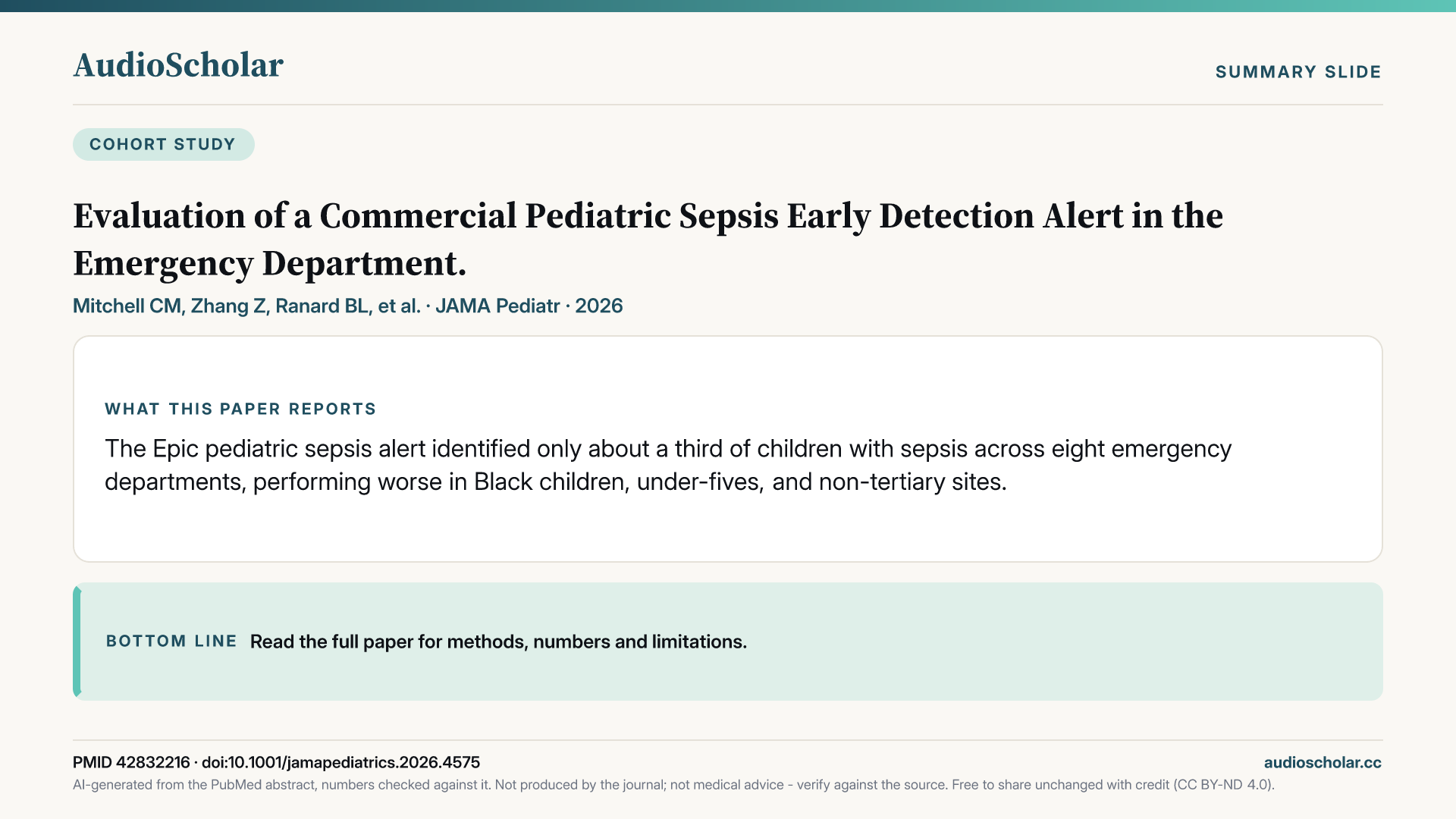
The Epic pediatric sepsis alert identified only about a third of children with sepsis across eight emergency departments, performing worse in Black children, under-fives, and non-tertiary sites.
JAMA Pediatrics · 2026 · PubMed

This week’s papers
- 01
Evaluation of a Commercial Pediatric Sepsis Early Detection Alert in the Emergency Department.
The Epic pediatric sepsis alert identified only about a third of children with sepsis across eight emergency departments, performing worse in Black children, under-fives, and non-tertiary sites.
Mitchell CM et al. · JAMA Pediatrics · 2026
- 02
Short- versus long-course antibiotic therapy in non-severe CAP in children: a systematic review and meta-analysis.
Across ten randomized trials of nearly 9,000 children with non-severe pneumonia, courses of five days or fewer matched longer courses for failure and relapse while sharply reducing non-adherence.
Klapas A et al. · European Journal of Pediatrics · 2026
- 03
Antibiotic Choice for Community-Acquired Pneumonia in Children With Medical Complexity.
In children with medical complexity hospitalized with non-severe pneumonia, initial broad-spectrum antibiotics did not shorten stay or reduce progression or revisits compared with aminopenicillins in observational analysis.
Ekambaram M et al. · Pediatrics · 2026
- 04
Feasibility and clinical outcomes of short-course intravenous antibiotic therapy in neonates under 28 days with urinary tract infection.
In a single-centre retrospective series, low-risk neonates under 28 days with urinary infection given four days or fewer of intravenous antibiotics had only one early recurrence.
Baudin M et al. · European Journal of Pediatrics · 2026
- 05
Nirsevimab reduced acute otitis media infections in infants-a nationwide interrupted time-series analysis.
After Finland introduced nirsevimab, infant RSV detections fell by more than four fifths and acute otitis media diagnoses fell by about 44 percent, most in the youngest infants.
Leskinen N et al. · European Journal of Pediatrics · 2026
- 06
Streptococcus pneumoniae haemolytic uraemic syndrome in Aotearoa New Zealand across changing pneumococcal conjugate vaccine eras.
Pneumococcal haemolytic uraemic syndrome in New Zealand rose after 2020, driven by serotype 19A, with most children needing dialysis and many survivors developing chronic kidney disease.
Humphrey AB et al. · Archives of Disease in Childhood · 2026
- 07
Safety, antiviral activity, and pharmacokinetics of long-acting cabotegravir plus long-acting rilpivirine in virologically suppressed adolescents living with HIV-1 (IMPAACT 2017/MOCHA): week 96 and end-of-study results from a multinational, phase 1/2, single-arm trial.
Long-acting injectable cabotegravir plus rilpivirine every eight weeks produced no confirmed virological failures over 96 weeks in suppressed adolescents, with adult-like drug levels and strong preference for injections.
Moore CB et al. · The Lancet Child & Adolescent Health · 2026
- 08
Oral Propranolol Versus Topical Timolol for the Treatment of Infantile Haemangiomas: A Systematic Review and Meta-Analysis of Randomized Controlled Trials.
Pooled data from seven small randomized trials showed topical timolol matched oral propranolol for superficial infantile haemangiomas while cutting systemic adverse events by about two thirds.
Weng L et al. · Acta Paediatrica · 2026
- 09
Who fails the egg ladder? Predictors of reactions and clinical outcomes with individualized entry-step selection in 197 children with IgE-mediated egg allergy.
In 197 egg-allergic children on an individualised egg ladder, most achieved tolerance, and previous egg anaphylaxis independently predicted reactions and failure to complete the ladder.
Caka C et al. · European Journal of Pediatrics · 2026
- 10
Therapeutic Horseback Riding for Youth With Autism and Psychiatric Comorbidities: A Randomized Trial.
In a randomized trial of autistic youth with psychiatric comorbidity, horseback riding and barn activities both reduced caregiver-rated irritability and hyperactivity versus waitlist, with riding adding modest hyperactivity benefit.
Gabriels RL et al. · Pediatrics · 2026
The full briefing
This AudioScholar briefing is generated by artificial intelligence for healthcare professionals and trainees. It is not medical advice.
Welcome to This Week in Pediatrics. This week we're covering 10 notable papers spanning infection detection and antibiotic stewardship, immunisation and its downstream effects, and the management of chronic and developmental conditions from HIV to egg allergy. Let's dive in.
We start with acute infection, where this week's papers ask how well we detect serious illness and how much antibiotic it actually takes to treat it. In JAMA Pediatrics, Mitchell and colleagues offer the first independent evaluation of the Epic Pediatric Sepsis Early Detection Model, an alert already widely deployed in emergency departments across the United States [1]. Across eight emergency departments in a New York health system and nearly 167,000 pediatric encounters, there were 189 cases of sepsis by Phoenix criteria within the first 24 hours. The alert caught only about a third of those children, and only about three in every hundred alerts pointed to a child who actually had sepsis. When the analysis was restricted to alerts firing before sepsis onset, sensitivity dropped to roughly 30 percent. The performance was worse still in Black children, in children under five, and in emergency departments outside tertiary children's hospitals, where sensitivity fell to between about a fifth and a quarter. The authors conclude the tool does not support timely or equitable sepsis screening. This is a retrospective cohort in one health system, but it is the kind of external validation that commercial algorithms have largely escaped, and it raises a real question about relying on this alert as a safety net.
Turning to treatment, three papers converge on the same message: less antibiotic, or narrower antibiotic, appears to do as well. In the European Journal of Pediatrics, Klapas and colleagues pooled ten randomized trials involving nearly 9,000 immunocompetent children with non-severe community-acquired pneumonia, comparing courses of five days or fewer against longer therapy [2]. They found no meaningful difference in treatment failure or relapse, and adverse events were comparable, though that estimate was inconsistent across trials. The clearest signal was adherence: shorter regimens cut non-adherence by roughly two thirds. The authors are careful to note the analysis was not designed to formally establish non-inferiority, but it adds weight to an already substantial trial base favouring short courses. A complementary question comes from Pediatrics, where Ekambaram and colleagues used target trial emulation to study children with medical complexity hospitalized with non-severe pneumonia, a group for whom guidelines are silent [3]. Among roughly 750 weighted encounters, initial broad-spectrum antibiotics did not shorten time to discharge, reduce progression to severe pneumonia, or reduce revisits compared with aminopenicillins. Children with tracheostomies, chronic lung disease and immunosuppression were excluded, so the finding applies to a carefully defined subset, and it is observational, but it supports aminopenicillins as a reasonable default for many of these children. Finally, Baudin and colleagues, also in the European Journal of Pediatrics, examined 138 neonates under 28 days with culture-proven urinary tract infection at a single centre [4]. Among the 97 low-risk neonates, nearly all received four days or fewer of intravenous antibiotics before switching to oral therapy, and only one early recurrence occurred, linked to poor oral intake during a viral illness. Even neonates under two weeks did no worse. This is retrospective and single-centre, and the authors explicitly call for prospective multicentre validation, so it is hypothesis-generating rather than practice-defining for this youngest group.
Our second theme is prevention, and what immunisation programmes achieve, or miss, at the population level. In the European Journal of Pediatrics, Leskinen and colleagues used nationwide Finnish register data across four RSV seasons in an interrupted time-series design covering about 182,000 infants [5]. After nirsevimab was introduced, RSV detections in infants fell by more than four fifths, and acute otitis media diagnoses fell by about 44 percent, with the largest drop in infants up to two months old. Because otitis media is the leading reason for antibiotic prescribing in this age group, the implication extends beyond RSV hospitalisation into stewardship. The usual caveat applies: this is an ecological before-and-after comparison, so secular trends cannot be fully excluded, but the size of the effect is striking. The flip side of vaccine programmes comes from Archives of Disease in Childhood, where Humphrey and colleagues describe pneumococcal haemolytic uraemic syndrome in Aotearoa New Zealand from 2008 to 2024 [6]. Of 39 cases, two thirds of the cases occurred in just the last five years, almost all presented with complicated pneumonia, and every typed case since 2020 was serotype 19A. Most of the affected children were vaccinated, yet fewer than a fifth of the typed cases involved vaccine-covered serotypes, reflecting the local schedule. The disease was severe: nine in ten children needed intensive care, about four in five needed kidney replacement therapy, and among survivors with follow-up, more than four in ten children had chronic kidney disease. Māori and Pacific children carried a disproportionate share of the burden. This is a small case series, but it is a clear argument for vaccine strategies that track local serotype epidemiology.
Our final theme covers long-term management, where several papers look at gentler or more acceptable options. In The Lancet Child and Adolescent Health, Moore and colleagues report end-of-study results from the IMPAACT 2017 MOCHA trial of long-acting injectable cabotegravir plus rilpivirine every eight weeks in 144 virologically suppressed adolescents across Africa, Thailand and the United States [7]. Through 96 weeks there were no confirmed virological failures, drug-related severe adverse events occurred in just three adolescents, drug levels approximated those in adults, and at least 97 percent of participants preferred injections to daily pills. As a single-arm, non-comparative study it cannot show superiority over oral therapy, but it supports the ongoing use of this regimen in adolescents, a group where daily adherence is notoriously difficult. In Acta Paediatrica, Weng and colleagues pooled seven randomized trials with 428 infants comparing topical timolol with oral propranolol for superficial infantile haemangiomas [8]. Response rates were statistically indistinguishable, while timolol cut systemic adverse events by about two thirds. The trials were small and the finding is limited to superficial lesions, so it does not speak to deep, segmental or high-risk haemangiomas. In allergy, Caka and colleagues in the European Journal of Pediatrics followed 197 children with IgE-mediated egg allergy through an individualised egg ladder at one tertiary centre [9]. Just over 80 percent of children with completion data reached whole egg tolerance over a median of about thirteen months, about one in eight children had at least one reaction, and about one in sixteen had anaphylaxis during a supervised challenge. Previous egg anaphylaxis independently predicted both reactions and failure to complete, while higher egg white specific IgE predicted only non-completion. Starting before 18 months looked favourable in crude comparisons, but that advantage disappeared after adjustment, so early start is not established as protective. Lastly, in Pediatrics, Gabriels and colleagues randomized 236 youth with autism and psychiatric comorbidity to therapeutic horseback riding, a barn activity without horse contact, or a waitlist [10]. Both active arms produced large reductions in caregiver-rated irritability and hyperactivity compared with waitlist, and horseback riding added a modest further reduction in hyperactivity over barn activity. Only 169 participants completed at least one lesson, the waitlist group was small, and outcomes were largely caregiver-reported without blinding, so the size of the benefit deserves cautious interpretation.
If you only have time for one paper this week, make it the independent evaluation of the Epic pediatric sepsis alert in JAMA Pediatrics [1]. It reopens the question of whether a widely deployed commercial tool is actually catching sick children, and shows its blind spots fall hardest on the youngest, on Black children, and on community emergency departments.
Here is what this week's evidence adds up to in Pediatrics. First, a widely used sepsis alert missed most children with sepsis in a large multicentre cohort, and while this is retrospective data from one health system, it challenges confidence in algorithmic screening and highlights equity gaps. Second, the case for short and narrow antibiotic courses keeps strengthening, with consistent randomized evidence in non-severe pneumonia, observational support for aminopenicillins in many medically complex children, and early single-centre data for short intravenous courses in low-risk neonates that still needs prospective confirmation. Third, nirsevimab's benefit appears to extend to fewer ear infections and likely fewer antibiotic prescriptions, although that evidence is ecological. Fourth, serotype replacement can drive severe pneumococcal disease despite high vaccine coverage, as seen with serotype 19A haemolytic uraemic syndrome in New Zealand. And finally, gentler options are accumulating evidence, from long-acting injectable HIV therapy in adolescents to topical timolol for superficial haemangiomas, though both rest on single-arm or small trials.
That's your roundup for This Week in Pediatrics. The full transcript and references are available on the episode page. This is an AI-curated summary — for clinical decisions, always consult primary sources and current guidelines. See you next week.
If this weekly briefing is useful, follow the show in your podcast app so new episodes arrive automatically. And a quick rating on Apple Podcasts or Spotify helps other physicians discover the show.
This is an automated summary generated by artificial intelligence, which can make mistakes. Always review the original source materials.
Spot something worth flagging?
Get this every week in your podcast app — free.
New pediatrics episodes land in your feed automatically — listen on your commute.