This Week in Nephrology — Aug 5, 2026
Generated Aug 5, 2026 · 11:14
The week's practice-changing Nephrology research, summarized for clinicians.
If the audio fails to play, refresh the page to renew the link.
Get next week’s Nephrology briefing — free.
In your podcast app, or readable in your inbox with the audio one tap away.
Peritoneal Dialysis Outcomes in Autosomal Dominant Polycystic Kidney Disease
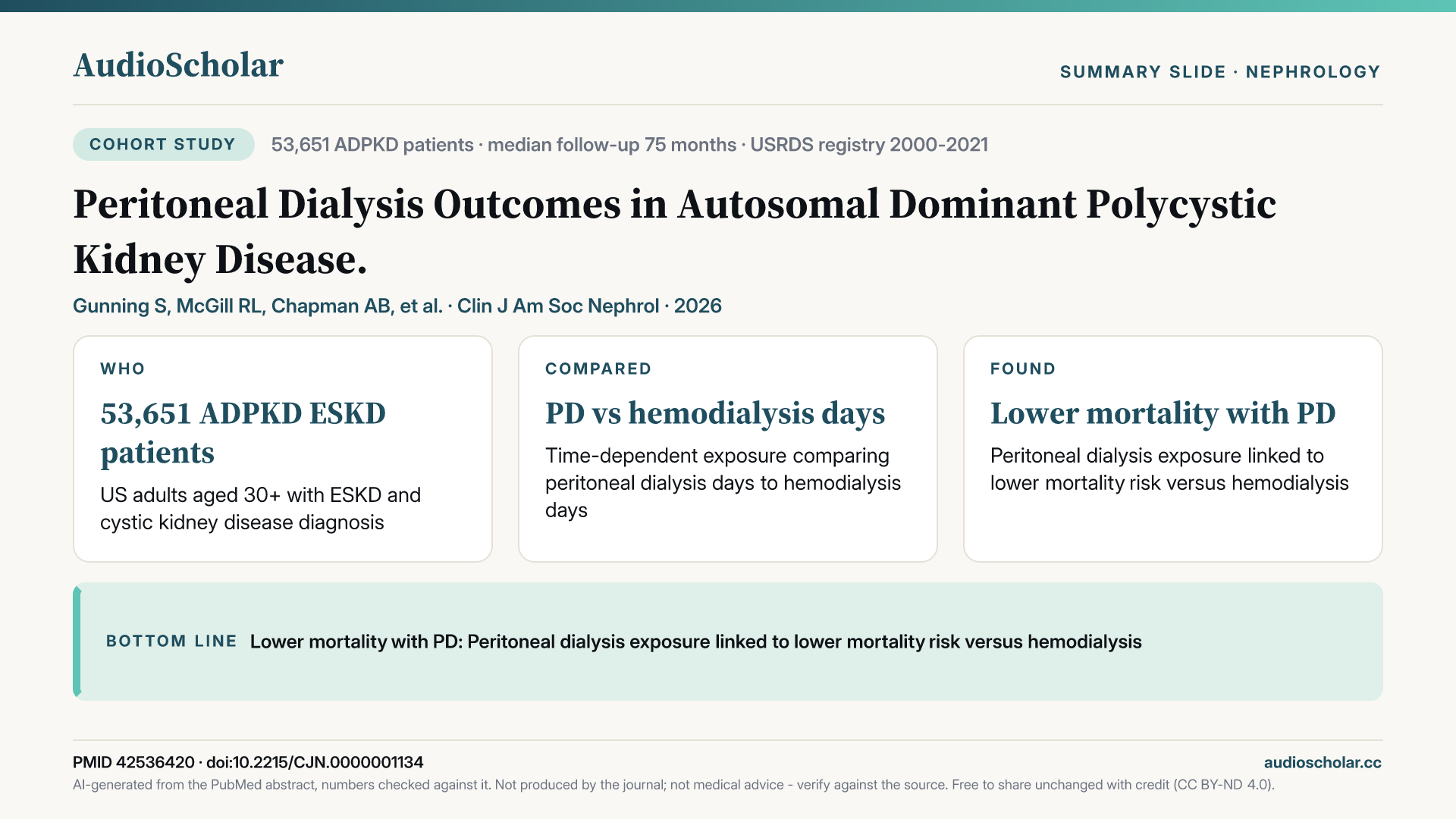
Among nearly 54,000 patients with polycystic kidney disease on dialysis, peritoneal dialysis was associated with about 16% lower mortality and 12% higher transplantation rates than haemodialysis.
Clinical Journal of the American Society of Nephrology · 2026 · PubMed

This week’s papers
- 01
Immune Checkpoint Inhibitor-Associated Acute Kidney Injury: A Report from the 34th Acute Disease Quality Initiative (ADQI) Consensus Conference
Kidney biopsy remains the diagnostic gold standard for checkpoint inhibitor kidney injury, glucocorticoids started within three days improve recovery, and rechallenge recurs in fewer than one in five patients.
Gupta S, Fenoglio R, Murakami N, et al. · Journal of the American Society of Nephrology · 2026
- 02
Accelerating Evidence-Based Practices in Acute Kidney Injury: A Consensus Statement from the XXXV ADQI Conference
An international panel produced a consensus roadmap for applying implementation science to acute kidney care, including digital tools, resource-limited settings, and criteria for abandoning outdated practices.
Brown JR, Rewa OG, Rabin BA, et al. · Clinical Journal of the American Society of Nephrology · 2026
- 03
Peritoneal Dialysis Outcomes in Autosomal Dominant Polycystic Kidney Disease
Among nearly 54,000 patients with polycystic kidney disease on dialysis, peritoneal dialysis was associated with about 16% lower mortality and 12% higher transplantation rates than haemodialysis.
Gunning S, McGill RL, Chapman AB, et al. · Clinical Journal of the American Society of Nephrology · 2026
- 04
Peritoneal Dialysis Modality and Outcomes in the Peritoneal Dialysis Outcomes and Practice Patterns Study
Automated and continuous ambulatory peritoneal dialysis gave comparable survival and technique survival, but automated therapy carried roughly 17% lower peritonitis risk, especially gram-positive and culture-negative infections.
de Moraes T, Bieber B, Zhao J, et al. · Kidney International Reports · 2026
- 05
Hypertension Management in Pregnancy and Postpartum
Postpartum hypertension peaks three to six days after delivery and is under-recognised, making the postpartum visit a critical opportunity to start renoprotective therapy and prevent maternal death.
Malha L, August P · Journal of the American Society of Nephrology · 2026
- 06
Glucocorticoid-Modulated Molecular Signatures and Prediction of Treatment Efficacy in IgA Nephropathy
In samples from the TESTING trial, glucocorticoids failed to modulate complement and endothelial injury pathways, while baseline leptin and C1QTNF5 levels modestly improved prediction of steroid benefit.
Wang L, He Y, Tian W, et al. · Journal of the American Society of Nephrology · 2026
- 07
Beyond Trough Levels: Tacrolimus Dose Requirements and Individualized Monitoring in Kidney Transplantation
A low tacrolimus concentration-to-dose ratio flags recipients at higher risk of rejection, BK virus, graft failure and death, though intervening on the ratio has not yet been shown to help.
Reuter S, Kuypers DRJ · American Journal of Transplantation · 2026
- 08
Skeletal Muscle Cramp Prevalence among Patients Receiving Dialysis: A Global Systematic Review and Meta-Analysis
Roughly 55% of dialysis patients worldwide experience skeletal muscle cramps and a third have intradialytic cramps, confirming a highly prevalent and largely unaddressed symptom burden.
Babroudi S, Tuttle M, Lacson EK · Clinical Journal of the American Society of Nephrology · 2026
- 09
Monoclonal gammopathy of clinical significance: a guide for nephrologists
Beyond renal-significant gammopathies, nephrologists should recognise POEMS, TEMPI and monoclonal gammopathy-associated capillary leak syndrome, where the paraprotein itself drives disease irrespective of clonal burden.
Hofmann P, Shah SI, Rennke HG, et al. · Nephrology Dialysis Transplantation · 2026
- 10
Primary Prevention of CKD for Heart and Kidney Health: Ready for Primetime?
SGLT2 inhibitors show the most consistent slowing of eGFR decline and reduced albuminuria in people without kidney disease, but no trial has yet targeted incident chronic kidney disease directly.
Dorjee T, Hawkins N, Moghaddam N, et al. · Clinical Journal of the American Society of Nephrology · 2026
The full briefing
Welcome to This Week in Nephrology. This week we're covering 10 notable papers spanning acute kidney injury consensus work and onco-nephrology, dialysis modality decisions and patient-reported symptoms, and prevention and precision medicine across glomerular disease, pregnancy and transplantation. Let's dive in.
We start with two consensus statements from the Acute Disease Quality Initiative, both addressing gaps that clinicians meet weekly. In the Journal of the American Society of Nephrology, the 34th ADQI panel tackled immune checkpoint inhibitor-associated acute kidney injury [1]. Their appraisal of the observational literature is that acute kidney injury occurs in up to one in five patients receiving checkpoint inhibitors, but only a small minority of those episodes, roughly two to five percent, are actually caused by the drug itself. Acute tubulointerstitial nephritis dominates the biopsy findings, present in eighty to ninety percent of specimens, though glomerular lesions are increasingly recognised. The practical messages are blunt: no clinical feature reliably separates checkpoint inhibitor kidney injury from the many other causes in a patient with cancer, so kidney biopsy remains the diagnostic gold standard, and the promising urinary, circulating and imaging biomarkers are not yet ready for routine use. Where the panel does offer actionable guidance is on timing — starting glucocorticoids within three days of diagnosis, rather than later, was associated with better kidney recovery, even though dose and duration remain unsettled. And importantly for oncology colleagues who fear permanent drug discontinuation, recurrent kidney injury after rechallenge occurred in fewer than one in five patients, supporting cautious rechallenge in selected people. Transplant recipients, patients with autoimmune disease, and those with advanced chronic kidney disease still need individualised multidisciplinary decisions. Alongside this, CJASN publishes the 35th ADQI conference statement, which turns the lens on ourselves and asks why evidence in acute kidney care so often fails to reach the bedside [2]. Using a modified Delphi process with eighty percent agreement thresholds, five workgroups mapped implementation science methods for acute kidney injury, including digital tools, social determinants of health, resource-limited settings, and — notably — criteria for de-implementing practices that should be abandoned. There are no patient outcomes here; it is a research and quality-improvement roadmap. But the framing is useful: the next gain in acute kidney injury outcomes may come less from a new biomarker than from reliably delivering what we already know.
Our second theme is dialysis — who should be offered which modality, and what our patients actually feel. Two papers converge on peritoneal dialysis. In CJASN, a United States Renal Data System cohort of nearly fifty-four thousand incident patients with autosomal dominant polycystic kidney disease and end-stage kidney disease directly challenges the reluctance to offer peritoneal dialysis to this group [3]. Only about a quarter ever received peritoneal dialysis, yet in time-dependent adjusted models peritoneal dialysis exposure was associated with roughly a sixteen percent lower risk of death and about a twelve percent higher likelihood of transplantation compared with haemodialysis, and those associations strengthened over the study years. This is observational, and patients selected for peritoneal dialysis were younger, more often female and healthier — the authors adjusted extensively, but residual confounding by selection cannot be excluded. Still, the concern that enlarged cystic kidneys make peritoneal dialysis mechanically unwise is not supported here. Complementing that, Kidney International Reports presents modality comparisons within the Peritoneal Dialysis Outcomes and Practice Patterns Study, nearly ninety-five hundred patients across six countries [4]. Automated and continuous ambulatory peritoneal dialysis showed comparable patient survival and comparable risk of permanent transfer to haemodialysis — the survival difference was not statistically significant. What did differ was infection: automated peritoneal dialysis carried roughly a seventeen percent lower risk of peritonitis overall, with larger reductions in gram-positive and culture-negative peritonitis, consistent with fewer connection events. Automated peritoneal dialysis also appeared to have lower mortality specifically in assisted peritoneal dialysis, suggesting it suits patients who need support. Then there is symptom burden, which we chronically under-address. A CJASN systematic review and meta-analysis of ninety-four studies covering more than thirty-two thousand dialysis patients across thirty-six countries found a pooled prevalence of skeletal muscle cramps of fifty-five percent overall, and thirty-three percent for intradialytic cramps specifically [8]. Cramps were more common on haemodialysis than peritoneal dialysis and in incident rather than prevalent patients. The heterogeneity was substantial and half the studies carried moderate risk of bias, so the point estimate should be held loosely — but the direction is unambiguous. If you are not asking about cramps at every visit, you are missing a symptom that affects roughly half your dialysis population.
Our third theme is prediction, prevention and personalisation. In JASN, a proteomic analysis nested within the TESTING randomised trial asks a question that matters every time we consider steroids in IgA nephropathy: who will actually benefit [6]. Analysing four hundred and seventy-nine longitudinal serum samples from two hundred and forty-one Chinese participants randomised to methylprednisolone or placebo, the investigators found three hundred and two glucocorticoid-modulated proteins, enriched in cytoskeletal stabilisation and immunometabolism pathways. Revealingly, the pathways most tied to long-term eGFR decline — complement activation and endothelial injury — were not modulated by steroids at all, which may explain their ceiling of benefit. A model adding two validated baseline proteins, leptin and C1QTNF5, modestly outperformed clinical variables alone for five-year prediction of treatment efficacy, with overlapping confidence intervals, so this is hypothesis-generating and needs external validation rather than immediate adoption. Sitting alongside that, a CJASN narrative review asks whether we are ready for primary prevention of chronic kidney disease in people with normal eGFR and no albuminuria [10]. The honest answer is that no trial has been designed for incident chronic kidney disease as a primary endpoint; the evidence comes from secondary and post hoc analyses of cardiovascular outcome trials. Within those limits, SGLT2 inhibitors show the most consistent attenuation of eGFR decline and reduced incident albuminuria even in participants without kidney disease at baseline; GLP-1 receptor agonists show similar but less uniform effects driven largely by albuminuria; and evidence for mineralocorticoid receptor antagonists and ARNIs is more limited. The suggested path is selective, risk-based early intervention rather than population-wide treatment. Three shorter pieces round out the theme. A JASN review on hypertension in pregnancy and postpartum reminds us that hypertensive disorders complicate about nine percent of United States pregnancies, that chronic kidney disease is among the strongest risk factors for preeclampsia, and that postpartum hypertension peaks on days three to six after delivery — the window carrying the greatest risk of preventable maternal death, with cardiovascular causes behind more than a third of pregnancy-related deaths [5]. The call to action is that delivery is not an endpoint, and the postpartum visit is an underused opportunity to start renoprotective therapy and arrange nephrology follow-up. In the American Journal of Transplantation, a review argues for looking beyond the tacrolimus trough to the concentration-to-dose ratio, a free, routinely derivable phenotype [7]. Low ratios — fast metabolisers needing high doses — track with worse kidney function, rejection, BK virus complications, graft failure and death in registry data, with graded risk and better outcomes when a low ratio normalises. But the authors are careful: no trial has shown that intervening on the ratio improves outcomes, so treat it as risk stratification, not an algorithm. Finally, Nephrology Dialysis Transplantation offers a practical guide to monoclonal gammopathies of clinical significance, extending our thinking beyond monoclonal gammopathy of renal significance to entities such as POEMS, TEMPI, and monoclonal gammopathy-associated systemic capillary leak syndrome, classified by whether the paraprotein itself is pathogenic rather than by clonal burden [9].
If you only have time for one paper this week, make it the polycystic kidney disease peritoneal dialysis cohort in CJASN [3]. It directly overturns a common bedside hesitation and should change how you counsel a young ADPKD patient approaching kidney failure next week.
Here are the key takeaways from this week in Nephrology. First, in suspected checkpoint inhibitor kidney injury, biopsy remains the gold standard, start steroids within three days of diagnosis if you are treating, and do not assume rechallenge is off the table. Second, peritoneal dialysis should be actively offered in autosomal dominant polycystic kidney disease, and where automated therapy is available it delivers equivalent survival with fewer episodes of peritonitis. Third, ask every dialysis patient about muscle cramps — roughly half have them. Fourth, in IgA nephropathy, steroids do not touch the complement and endothelial pathways driving long-term decline, and baseline proteomics may eventually help select who benefits. Fifth, use the postpartum visit and the tacrolimus concentration-to-dose ratio as low-cost risk-stratification tools you already have access to. And sixth, primary prevention of chronic kidney disease remains plausible but unproven — the SGLT2 inhibitor signal is the most consistent, and dedicated trials are needed.
That's your roundup for This Week in Nephrology. The full transcript and references are available on the episode page in your AudioScholar library. This is an AI-curated summary — for clinical decisions, always consult primary sources and current guidelines. See you next week.
If this weekly briefing is useful, follow the show in your podcast app so new episodes arrive automatically. And if you have a paper you have been meaning to read, upload the PDF, or paste any link, at audioscholar dot C C. We will turn it into audio like this one, in any of thirty-one languages.
This is an automated summary generated by artificial intelligence, which can make mistakes. Always review the original source materials.
Spot something worth flagging?
Get this every week in your podcast app — free.
New nephrology episodes land in your feed automatically — listen on your commute.