This Week in Infectious Disease — Oct 9, 2026
Generated Oct 10, 2026 · 12:36
The week's practice-changing Infectious Disease research, summarized for clinicians.
If the audio fails to play, refresh the page to renew the link.
Get next week’s Infectious Disease briefing — free.
In your podcast app, or readable in your inbox with the audio one tap away.
Evidence of artemisinin partial resistance in Zambia: a molecular epidemiology and clinical study.
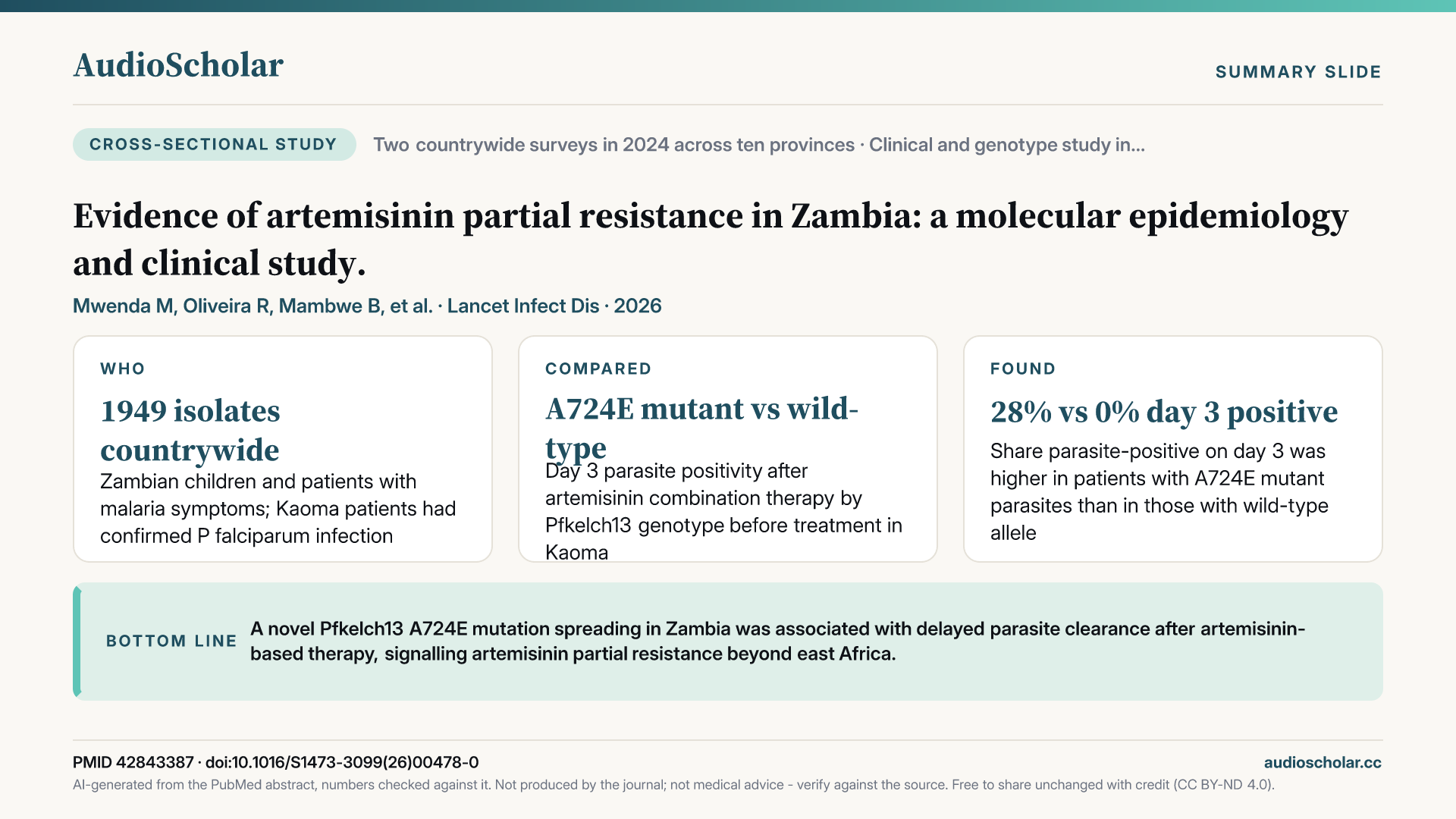
A novel Pfkelch13 A724E mutation spreading in Zambia was associated with delayed parasite clearance after artemisinin-based therapy, signalling artemisinin partial resistance beyond east Africa.
The Lancet Infectious Diseases · 2026 · PubMed

This week’s papers
- 01
Evidence of artemisinin partial resistance in Zambia: a molecular epidemiology and clinical study.
A novel Pfkelch13 A724E mutation spreading in Zambia was associated with delayed parasite clearance after artemisinin-based therapy, signalling artemisinin partial resistance beyond east Africa.
Mwenda M, Oliveira R, Mambwe B, et al. · The Lancet Infectious Diseases · 2026
- 02
Hospital-based prevalence of culture-confirmed melioidosis among high-risk patients in India, 2023-25: a multicentre prospective study.
Nearly nine percent of hospitalised Indian adults with diabetes or kidney disease and community-acquired infection had culture-confirmed melioidosis, with monsoon clustering, groundwater exposure, and nineteen percent in-hospital mortality.
Gupta N, Ashiq M, Kumar TP, et al. · The Lancet Global Health · 2026
- 03
HIV service delivery after the PEPFAR and USAID HIV funding withdrawal in Uganda and Zimbabwe: an interrupted time-series study.
HIV prevention, pre-exposure prophylaxis, testing and treatment volumes at key-population organisations in Uganda and Zimbabwe fell sharply after the 2025 United States funding freeze and stayed depressed a year later.
Cust H, Chabata ST · The Lancet Global Health · 2027
- 04
A Systematic Review and Network Meta-analysis of Empirical Antibiotics for Complicated Urinary Tract Infections.
Ceftriaxone achieved clinical response rates comparable to broader-spectrum agents for complicated urinary tract infection where about fifteen percent of Enterobacterales were non-susceptible, supporting narrower-spectrum empiric choices.
Cohen-Yatziv L, Gilbert E, Zhou R, et al. · Open Forum Infectious Diseases · 2026
- 05
Shorter Antibiotic Duration for Pseudomonas Bacteremia: A Call for Future Trials.
A post-hoc Bayesian reanalysis suggests seven-day antibiotic courses may perform differently in Pseudomonas aeruginosa bacteraemia than in other Gram-negative bloodstream infections, a hypothesis requiring dedicated trials.
Albuquerque AM, Santolia C, Zampieri FG, et al. · Clinical Infectious Diseases · 2026
- 06
Antibiotic exposure and the emergence of multidrug resistant bacteria in patients with liver cirrhosis: A prospective cohort study.
In advanced cirrhosis, cumulative antibiotic exposure predicted new multidrug-resistant organism acquisition at low dose thresholds, and new acquisition roughly doubled 180-day mortality.
Heilani MW, Wiedemann T, Best C, et al. · Clinical Infectious Diseases · 2026
- 07
Performance of the Urinary MycoMEIA Aspergillus Assay as an Aid to Diagnose Invasive Aspergillosis.
A non-invasive urinary Aspergillus glycan assay showed roughly ninety percent sensitivity and high specificity for invasive aspergillosis, detecting many cases missed by serum galactomannan with several days of lead time.
Baburina I, Marr KA, Vanbiervliet Y, et al. · Clinical Infectious Diseases · 2026
- 08
Tongue Swab Mycobacterium tuberculosis Quantitative Polymerase Chain Reaction for Community Screening of Asymptomatic Tuberculosis Versus Clinic-Based Triage of Symptomatic Tuberculosis.
Tongue swab tuberculosis PCR detected only about a third of asymptomatic cases among household contacts, roughly half its sensitivity in symptomatic clinic triage, limiting its use for community screening.
Wood RC, Olson AM, Lochner KA, et al. · Clinical Infectious Diseases · 2026
- 09
Effect of Fluvoxamine and Metformin for Fatigue in Patients With Long COVID : An Adaptive Randomized Trial.
Fluvoxamine produced modest improvements in fatigue severity and quality of life at 60 and 90 days in adults with long COVID, while results for metformin were inconclusive after early termination.
Reis G, Dos Santos Moreira Silva EA, Medeiros Silva DC, et al. · Annals of Internal Medicine · 2026
- 10
Efficacy and safety of switching to once-daily oral doravirine plus raltegravir in virologically suppressed people with HIV-1: a randomized, open-label, multicentre phase 2 study (DORAL).
Switching virologically suppressed adults to once-daily doravirine plus raltegravir maintained suppression through 96 weeks with one virological failure among 114 participants, a proof-of-concept nucleoside-sparing option.
Palich R, Lê MP, Castagna A, et al. · Journal of Antimicrobial Chemotherapy · 2026
The full briefing
This AudioScholar briefing is generated by artificial intelligence for healthcare professionals and trainees. It is not medical advice.
Welcome to This Week in Infectious Disease. This week we're covering 10 notable papers spanning global threats to antimicrobial efficacy and health systems, antimicrobial stewardship and duration of therapy, new diagnostics for fungal and mycobacterial disease, and a pair of treatment trials in long COVID and HIV. Let's dive in.
We start with a finding from The Lancet Infectious Diseases that deserves attention from anyone who treats malaria or advises travellers. Mwenda and colleagues genotyped the Pfkelch13 gene across all ten provinces of Zambia and identified a previously undescribed mutation, A724E, carried by about half of isolates in Western and North-Western provinces and by roughly one in nine isolates countrywide [1]. The clinical correlate matters more than the genotype. In Kaoma, among patients carrying mutant parasites before artemisinin-based combination therapy, close to three in ten patients were still parasite-positive on day three, compared with none of those carrying the wild-type allele, and the mutant proportion rose further among those still positive after treatment. Tracking isolates over time, the prevalence in Kaoma went from zero in 2018 to around four in five isolates by 2026. The authors are careful: ex-vivo testing did not show reduced growth inhibition after exposure to dihydroartemisinin, so the molecular and clinical signals are not yet fully aligned, and they call for urgent further clinical evaluation. This is partial resistance, not treatment failure, but it is a southern African signal where previously the concern was east Africa.
Staying with global epidemiology, The Lancet Global Health published a multicentre prospective study of melioidosis in India from Gupta and colleagues, enrolling nearly three thousand hospitalised adults with diabetes or chronic kidney disease presenting with community-acquired infectious syndromes [2]. Culture-confirmed melioidosis was found in about nine percent of these high-risk patients, concentrated in Odisha, Madhya Pradesh and Karnataka, clustered in monsoon months, and most often presenting as extrapulmonary abscesses or bone and joint infection. Groundwater as the primary drinking source was associated with roughly triple the odds, male sex and outdoor occupation with about double. Nearly six in ten patients with melioidosis were bacteraemic and about one in five died in hospital. Because this was a deliberately enriched high-risk hospital population, the nine percent figure is not a population prevalence, but it does support the authors' argument that melioidosis in India is substantially under-recognised and that diagnostic testing is currently too narrowly targeted. Also in The Lancet Global Health, Cust and Chabata provide the first quantitative service-delivery data following the freeze on United States foreign aid and the halt to the President's Emergency Plan for AIDS Relief [3]. Using an interrupted time series across non-governmental organisations in Uganda and Zimbabwe serving key populations, they found that in February 2025 prevention, pre-exposure prophylaxis, testing and treatment indices all fell sharply, with testing and pre-exposure prophylaxis down by roughly half or more from their 2024 levels, and services remained substantially depressed through March 2026. The antiretroviral therapy humanitarian waiver blunted but did not prevent the decline in treatment delivery. The evidence base is four organisations, so it is narrow, but it converts earlier modelled warnings into observed service volumes.
Three papers this week speak to how much antibiotic we give and to whom. In Open Forum Infectious Diseases, Cohen-Yatziv and colleagues report a network meta-analysis of randomised trials of single-agent empiric therapy for complicated urinary tract infection in adults [4]. Across the modern trials of agents available in the United States, in settings where roughly fifteen percent of Enterobacterales were ceftriaxone non-susceptible, ceftriaxone achieved clinical response rates comparable to broader-spectrum alternatives, and where newer agents achieved better microbiological eradication that did not translate into better clinical cure. Serious adverse events did not differ by class. The authors frame this as evidence supporting stewardship efforts that preserve broad-spectrum agents for patients at highest resistance risk, with the important caveat that the conclusion is anchored to that fifteen percent resistance prevalence and to haemodynamically stable patients. Clinical Infectious Diseases contributes a post-hoc Bayesian reanalysis from Albuquerque and colleagues asking whether the established non-inferiority of seven days versus fourteen in uncomplicated Gram-negative bacteraemia holds for Pseudomonas aeruginosa [5]. Their signal is that the shorter course may behave differently in Pseudomonas than in other Gram-negatives. This is hypothesis-generating subgroup work, not a result that overturns short-course practice, and the authors' own conclusion is a call for dedicated trials rather than a change in duration today. Also in Clinical Infectious Diseases, Heilani and colleagues prospectively followed 256 adults with advanced chronic liver disease and quantified antibiotic exposure in defined daily doses [6]. De novo acquisition of vancomycin-resistant enterococci or Gram-negative multidrug resistance tracked strongly with cumulative exposure, with a twenty percent probability of vancomycin-resistant enterococcus acquisition reached at under ten cumulative defined daily doses of any antibiotic, and lower thresholds for beta-lactam beta-lactamase inhibitor combinations, carbapenems and glycopeptides. Acquiring a resistant organism during follow-up, but not carrying one at baseline, roughly doubled 180-day mortality in a competing-risk analysis. It is single-centre and observational, so the thresholds should be read as signals rather than as validated cut-points.
On diagnostics, two papers in Clinical Infectious Diseases test whether we can move away from invasive sampling. Baburina and colleagues report the case-control and prospective data supporting regulatory approval of the MycoMEIA urinary Aspergillus assay, which detects Aspergillus glycans in urine [7]. Across 50 cases of proven or probable invasive aspergillosis and 240 controls, sensitivity was about ninety percent with specificity near eighty-eight percent, every case positive by serum galactomannan was also positive in urine, and the urine assay identified about four in five cases that were diagnosed on bronchoalveolar lavage but had a negative serum galactomannan, with a median lead time of about five days before clinical diagnosis. In prospective testing it flagged invasive aspergillosis in just over a quarter of patients classified as possible disease. There was cross-reactivity with other Ascomycetes, and the authors note that its role in screening and in broader populations is not yet defined. Against that, Wood and colleagues deliver a more sobering result for tongue swab PCR in tuberculosis [8]. At six South African sites they compared performance in symptomatic clinic attendees with performance in household contacts, among whom most of those with tuberculosis were asymptomatic. Sensitivity of high-volume quantitative PCR was about sixty-four percent in the symptomatic clinic cohort but only about a third in household contacts, roughly half as good, with specificity around ninety percent in both. Sensitivity rose with radiographic severity and reached one hundred percent in those with high sputum bacillary load. Adding sequence-specific magnetic capture raised sensitivity numerically but not significantly. The message is that performance established for triage of symptomatic disease does not transfer to community screening for asymptomatic tuberculosis.
Two treatment trials round out the week. In Annals of Internal Medicine, Reis and colleagues randomised 399 Brazilian adults with fatigue persisting from three months to two years after SARS-CoV-2 infection to fluvoxamine, extended-release metformin, or placebo in an adaptive design [9]. Fluvoxamine produced a small improvement on the Fatigue Severity Scale at days 60 and 90 with a high posterior probability of superiority, along with better quality-of-life scores, and fewer adverse events than either metformin dose or placebo. The metformin arm was stopped for futility after a dose reduction and the findings for metformin were inconclusive. The effect size is modest against a baseline severity near six, durability beyond 90 days is unknown, and other long COVID symptoms were not addressed, so this is a promising but preliminary signal rather than a settled therapy. Finally, in the Journal of Antimicrobial Chemotherapy, the DORAL phase 2 trial led by Palich randomised 114 virologically suppressed adults in France, Italy and Spain to switch immediately to once-daily doravirine plus raltegravir or to continue existing therapy before switching [10]. There was a single virological failure by week 48 in the immediate-switch group and none in the delayed group, with no further failures through week 96, stable immunology, and three discontinuations for related adverse events. The authors present this as proof of concept in selected people with HIV, particularly where minimising drug interactions or avoiding nucleoside analogues matters; with just over a hundred participants and no comparator-powered efficacy endpoint, it is a feasibility signal, not a guideline-ready regimen.
If you only have time for one paper this week, make it the Zambian artemisinin resistance study in The Lancet Infectious Diseases [1]. It puts a new, clinically correlated kelch13 mutation on the map in southern Africa and reopens the question of how fast artemisinin partial resistance is moving across the continent.
Here is what this week's evidence adds up to in Infectious Disease. First, artemisinin partial resistance now has a molecular and clinical footprint in Zambia, with delayed day-three clearance tied to a novel allele; the ex-vivo data do not yet corroborate it, so confirmation across the region is the outstanding question. Second, stewardship gained several strands of support: ceftriaxone held its own clinically against broader-spectrum agents for complicated urinary tract infection in moderate-resistance settings, cumulative antibiotic exposure in cirrhosis tracked with resistant organism acquisition and excess mortality, and a Bayesian reanalysis raises, without resolving, the possibility that seven days behaves differently in Pseudomonas bacteraemia. Third, diagnostics moved in opposite directions: a urinary Aspergillus assay performed strongly including in patients with negative serum galactomannan, while tongue swab PCR lost about half its sensitivity when moved from symptomatic triage to asymptomatic community screening. And fourth, fluvoxamine showed a modest but consistent benefit for long COVID fatigue while metformin was inconclusive, and a two-drug doravirine plus raltegravir switch maintained suppression in a small phase 2 population. Running underneath all of it, the first hard service-delivery data after the United States funding withdrawal document sustained declines in HIV prevention, testing and pre-exposure prophylaxis in Uganda and Zimbabwe.
That's your roundup for This Week in Infectious Disease. The full transcript and references are available on the episode page. This is an AI-curated summary — for clinical decisions, always consult primary sources and current guidelines. See you next week.
If this weekly briefing is useful, follow the show in your podcast app so new episodes arrive automatically. And if you have a paper you have been meaning to read, upload the PDF, or paste any link, at audioscholar dot C C. We will turn it into audio like this one, in any of thirty-one languages.
This is an automated summary generated by artificial intelligence, which can make mistakes. Always review the original source materials.
Spot something worth flagging?
Get this every week in your podcast app — free.
New infectious_disease episodes land in your feed automatically — listen on your commute.