This Week in Physical Medicine & Rehabilitation — Oct 15, 2026
Generated Oct 15, 2026 · 10:03
The week's practice-changing Physical Medicine & Rehabilitation research, summarized for clinicians.
If the audio fails to play, refresh the page to renew the link.
Get next week’s Physical Medicine & Rehabilitation briefing — free.
In your podcast app, or readable in your inbox with the audio one tap away.
Characterizing ambulation potential following acute traumatic spinal cord injury: a populational cohort study on 1209 patients.
Among 1,209 Canadian patients, independent community walking at one year ranged from under two percent with AIS A injuries to about two thirds with AIS D injuries.
Spinal Cord · 2026 · PubMed

This week’s papers
- 01
Characterizing ambulation potential following acute traumatic spinal cord injury: a populational cohort study on 1209 patients.
Among 1,209 Canadian patients, independent community walking at one year ranged from under two percent with AIS A injuries to about two thirds with AIS D injuries.
Dionne A et al. · Spinal Cord · 2026
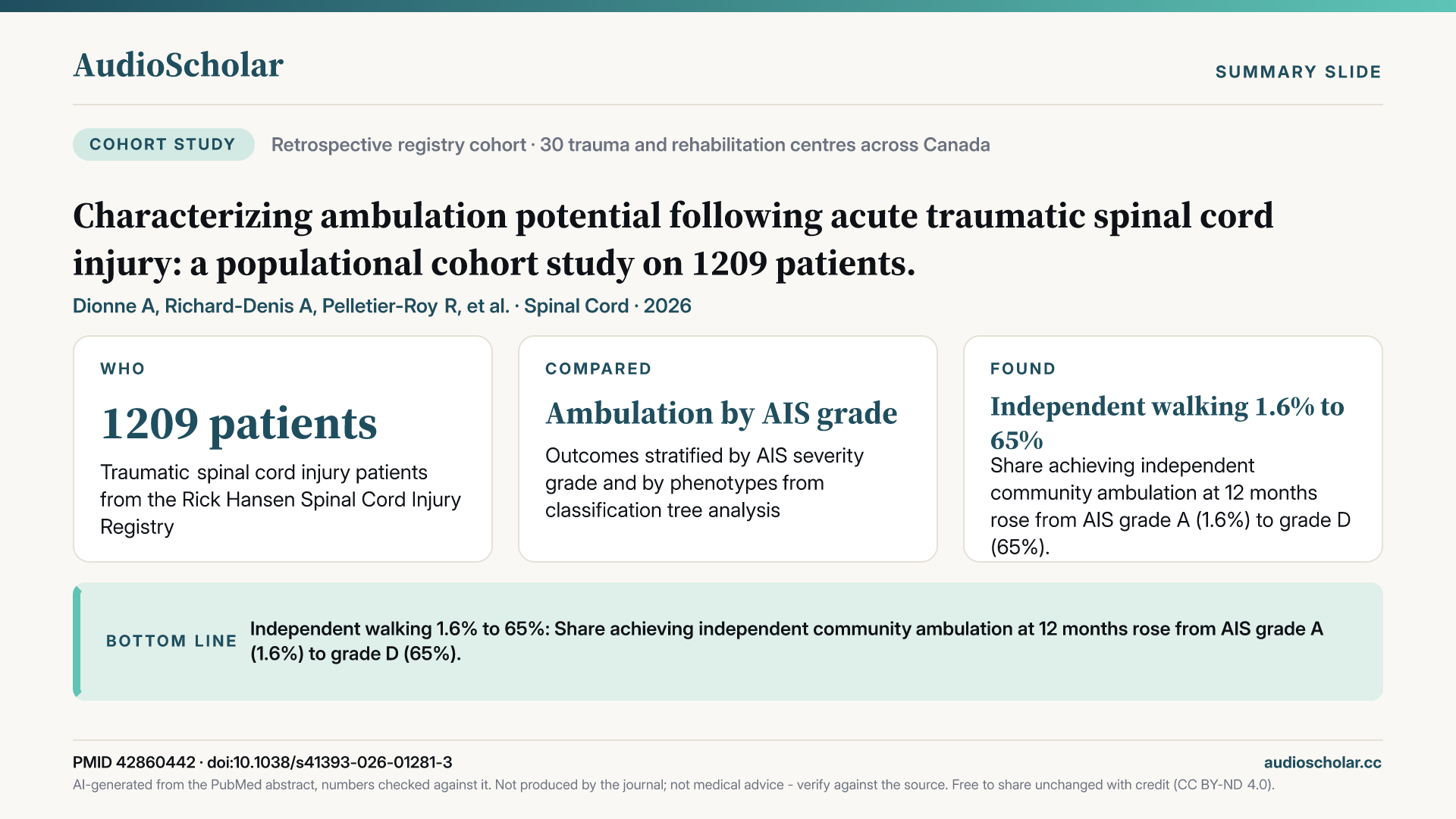
From the briefingIn Spinal Cord, Dionne and colleagues analysed 1,209 patients from the Rick Hansen Spinal Cord Injury Registry across 30 Canadian centres and argue for describing rather than predicting ambulation outcomes [1]. Instead of a risk score, they offer a chart of what actually happened at twelve months, stratified by injury grade. Among patients with motor and sensory complete injuries, ninety-four percent remained dependent for outdoor mobility, and only about one or two in a hundred became independent community walkers. With an incomplete grade C injury, roughly a quarter of patients reached independent community ambulation, and with a grade D injury, about two thirds of patients did. Beyond grade, lower extremity motor score, mechanism of injury, and age further separated the outcomes. The data are retrospective registry data, but they give rehabilitation teams real-world numbers to anchor early goal-setting conversations with patients and families.
If you only have time for one paper this week, make it the ambulation chart from Dionne and colleagues in Spinal Cord [1]. It reframes one of the most common and difficult early conversations after spinal cord injury, replacing probabilistic prediction with observed outcomes from more than a thousand Canadian patients.
Written by AI from the published abstract, for healthcare professionals. Not medical advice; check the paper before acting on it.
- 02
Timing of sacral pressure injury development during acute care after traumatic spinal cord injury: a prospective study of 142 patients.
Nearly a third of acute traumatic spinal cord injury patients developed sacral pressure injuries, half within two weeks, with motor-complete injuries roughly doubling risk later in the stay.
Thomassin P et al. · Spinal Cord · 2026
From the briefingFrom the same Montreal research group, also in Spinal Cord, Thomassin and colleagues prospectively followed 142 patients with traumatic injuries at L2 or above during acute care and found that close to a third of patients developed a sacral pressure injury [2]. Half of those injuries appeared within the first two weeks. Motor-complete injury roughly doubled the hazard, and that gap widened after day fourteen, suggesting vulnerability persists later into the hospital stay for that group. Lower admission Braden scores showed only a borderline association. This is a single-centre cohort with modest numbers, so it supports intensified early surveillance rather than defining a protocol.
Written by AI from the published abstract, for healthcare professionals. Not medical advice; check the paper before acting on it.
- 03
Time-Varying Social Integration and Long-Term All-Cause and Cause-Specific Mortality After Traumatic Spinal Cord Injury: A Longitudinal SCIMS Study.
In nearly 17,000 people with spinal cord injury, lower and declining social integration scores were associated with higher long-term mortality, though causality was not established.
Calderone A et al. · Archives of Physical Medicine and Rehabilitation · 2026
From the briefingTaking the long view, Calderone and colleagues, in Archives of Physical Medicine and Rehabilitation, used the Spinal Cord Injury Model Systems database covering nearly 17,000 people and close to 3,000 deaths [3]. Crude mortality was nearly three times higher among people with the lowest social integration scores compared with those at the top of the scale, and each ten-point drop in score, including a decline within the same person over time, was linked to roughly an eight to nine percent higher risk of death. The association held for both natural and external causes, though the suicide estimate was too imprecise to interpret. The authors are explicit that this is observational, affected by survivor selection and missing causes of death, and does not show that improving social integration extends survival. Repeated social integration assessment may carry prognostic value, but that is as far as the evidence goes.
Written by AI from the published abstract, for healthcare professionals. Not medical advice; check the paper before acting on it.
- 04
Association between hospital-level factors and early rehabilitation initiation in patients with acute ischemic stroke: a multilevel analysis using a Japanese administrative database from a rural prefecture.
Across 19 Japanese hospitals, weekend rehabilitation services were linked to about 65 percent higher early therapy initiation after ischemic stroke, while staffing and stroke volume were not.
Homma D et al. · Topics in Stroke Rehabilitation · 2026
From the briefingIn Topics in Stroke Rehabilitation, Homma and colleagues used a Japanese administrative database covering more than 17,000 acute ischemic stroke patients across 19 hospitals in a rural prefecture [4]. Just over half of patients started therapy within two days of admission. The one hospital-level factor that mattered was weekend rehabilitation services, which were associated with about a sixty-five percent higher rate of early initiation. Therapist staffing, stroke volume, and thrombolysis availability showed no association. The authors conclude that variation is driven largely by organisational systems rather than patient characteristics, a cross-sectional finding from one region that nonetheless speaks directly to service design.
Written by AI from the published abstract, for healthcare professionals. Not medical advice; check the paper before acting on it.
- 05
A Behaviour Change Intervention Delivered Using Telehealth with a Physical Activity Monitor to Increase Physical Activity Post-Stroke: A Feasibility Randomised Controlled Trial.
A telehealth behaviour change programme for stroke survivors was feasible and raised physical activity in both arms, with a larger but unconfirmed effect when a smartwatch was added.
Peniche PDC et al. · Clinical Rehabilitation · 2026
From the briefingMoving past the acute phase, Peniche and colleagues, in Clinical Rehabilitation, ran a feasibility trial in 24 stroke survivors comparing a telehealth behaviour change intervention with and without a consumer smartwatch [5]. Recruitment and delivery were feasible, though attrition was a challenge. Physical activity rose in both groups beyond the minimal detectable change, with a larger within-group effect in the smartwatch arm, but this was a pilot not powered for comparison, so the added value of the monitor remains an open question for a larger trial.
Written by AI from the published abstract, for healthcare professionals. Not medical advice; check the paper before acting on it.
- 06
Comparisons of immediate efficacy of cryoneurolysis and phenol neurolysis in spasticity reduction using Modified Ashworth Scale after brain injury: A retrospective cohort study.
Cryoneurolysis and phenol neurolysis produced similar large immediate reductions in brain injury spasticity on the Modified Ashworth Scale, though durability and tolerability were not assessed.
Mejia S et al. · PM&R · 2026
From the briefingFor focal spasticity after brain injury, Mejia and colleagues, in PM&R, retrospectively compared cryoneurolysis and phenol neurolysis in 35 patients at a rehabilitation hospital [6]. Both procedures dropped Modified Ashworth scores by more than two and a half points immediately, with no difference between them overall or within specific muscle groups. The groups differed in age, follow-up was immediate only, and durability, tolerability, and cost were not assessed, so this establishes comparable acute effect rather than equivalence.
Written by AI from the published abstract, for healthcare professionals. Not medical advice; check the paper before acting on it.
- 07
Effect of Integrated Respiratory and Functional Training on Weaning from Mechanical Ventilation, Respiratory and Peripheral Muscle Strength, Functional Ability, and Pain After Emergency Abdominal Surgery: A Randomized Controlled Trial.
Adding functional training to inspiratory muscle training after emergency abdominal surgery raised weaning success to about 96 percent and shortened intensive care stays by nearly eight days.
Mehani SHM et al. · Archives of Physical Medicine and Rehabilitation · 2026
From the briefingIn Archives of Physical Medicine and Rehabilitation, Mehani and colleagues randomised 90 patients with difficult weaning after emergency abdominal surgery across two intensive care units [7]. Both arms received high-intensity inspiratory muscle training plus chest physiotherapy, and one arm added integrated functional training. Weaning success was about 96 percent with the added functional training versus 82 percent without it. Inspiratory pressure improved equally in both arms, but the functional training group showed greater gains in peripheral strength and functional independence, less pain, roughly six fewer days of weaning, and close to eight fewer days in intensive care. Those are large effects from a moderately sized trial, and replication would firm them up, but they support the idea that early mobility adds something beyond respiratory muscle training alone.
Written by AI from the published abstract, for healthcare professionals. Not medical advice; check the paper before acting on it.
- 08
Six-month supervised telerehabilitation combining pilates-based therapeutic exercise and self-myofascial release in adults with fibromyalgia: a randomized controlled trial.
Six months of supervised online Pilates and self-myofascial release improved fibromyalgia impact, sleep, depression and stress versus usual care, but not anxiety, with high adherence.
Marantidou T et al. · Journal of Rehabilitation Medicine · 2026
From the briefingIn fibromyalgia, Marantidou and colleagues, in the Journal of Rehabilitation Medicine, randomised 68 adults to six months of live, supervised online sessions three times weekly combining Pilates-based exercise and self-myofascial release, or usual care [8]. The programme improved fibromyalgia impact, sleep quality, depressive symptoms, and perceived stress, but not anxiety. Adherence was high at close to ninety percent, with no adverse events. Outcomes were self-reported and the comparator was usual care, so the trial supports feasibility and benefit of sustained supervised telerehabilitation without isolating which component matters.
Written by AI from the published abstract, for healthcare professionals. Not medical advice; check the paper before acting on it.
- 09
Comparative Effects of Schroth and Core Stabilization Exercises in Adolescent Idiopathic Scoliosis: A Randomized Controlled Trial.
In 38 adolescents with idiopathic scoliosis, Schroth exercise outperformed core stabilisation for Cobb angle, trunk rotation, respiratory strength and cosmetic perception over twelve weeks.
Yildirim S et al. · American Journal of Physical Medicine & Rehabilitation · 2026
From the briefingIn adolescent idiopathic scoliosis, Yildirim and colleagues, in the American Journal of Physical Medicine & Rehabilitation, randomised 38 adolescents to twelve weeks of Schroth or core stabilisation exercise [9]. Both improved trunk and hip strength similarly, but the Schroth group showed greater improvements in Cobb angle, trunk rotation, respiratory muscle strength, and perceived cosmetic deformity. The sample is small and follow-up short, so whether these gains translate into fewer curves progressing remains unknown.
Written by AI from the published abstract, for healthcare professionals. Not medical advice; check the paper before acting on it.
- 10
Strengthening health systems to prioritise, provide care, and prevent osteoarthritis: a roadmap for global health policy.
A global policy roadmap calls for osteoarthritis surveillance, integration into primary and chronic disease care, and prevention targeting body weight and joint injury as cases near one billion.
Briggs AM et al. · The Lancet · 2026
From the briefingFraming all of this, Briggs and colleagues, writing in The Lancet, present a co-created global policy roadmap for osteoarthritis, projected to affect almost a billion people by 2050 [10]. They describe an identity problem in which osteoarthritis is seen as inevitable with ageing, and set out three priorities: national surveillance and embedding musculoskeletal health in policy, scaling up person-centred care integrated into primary and chronic disease services for the roughly 600 million people already living with the disease, and prevention targeting excess body weight and joint injury. It is a policy document rather than new data, but it gives physiatrists a framework for advocacy.
Written by AI from the published abstract, for healthcare professionals. Not medical advice; check the paper before acting on it.
The full briefing
This AudioScholar briefing is generated by artificial intelligence for healthcare professionals and trainees. It is not medical advice.
Welcome to This Week in Physical Medicine & Rehabilitation. This week we're covering 10 notable papers spanning prognosis and complications after spinal cord injury, how stroke and brain injury rehabilitation is delivered, and exercise-based therapy across the lifespan, from scoliosis to the intensive care unit. Let's dive in.
Spinal cord injury dominates the week, with three papers covering early walking prognosis, acute skin risk, and long-term survival. In Spinal Cord, Dionne and colleagues analysed 1,209 patients from the Rick Hansen Spinal Cord Injury Registry across 30 Canadian centres and argue for describing rather than predicting ambulation outcomes [1]. Instead of a risk score, they offer a chart of what actually happened at twelve months, stratified by injury grade. Among patients with motor and sensory complete injuries, ninety-four percent remained dependent for outdoor mobility, and only about one or two in a hundred became independent community walkers. With an incomplete grade C injury, roughly a quarter of patients reached independent community ambulation, and with a grade D injury, about two thirds of patients did. Beyond grade, lower extremity motor score, mechanism of injury, and age further separated the outcomes. The data are retrospective registry data, but they give rehabilitation teams real-world numbers to anchor early goal-setting conversations with patients and families. From the same Montreal research group, also in Spinal Cord, Thomassin and colleagues prospectively followed 142 patients with traumatic injuries at L2 or above during acute care and found that close to a third of patients developed a sacral pressure injury [2]. Half of those injuries appeared within the first two weeks. Motor-complete injury roughly doubled the hazard, and that gap widened after day fourteen, suggesting vulnerability persists later into the hospital stay for that group. Lower admission Braden scores showed only a borderline association. This is a single-centre cohort with modest numbers, so it supports intensified early surveillance rather than defining a protocol. Taking the long view, Calderone and colleagues, in Archives of Physical Medicine and Rehabilitation, used the Spinal Cord Injury Model Systems database covering nearly 17,000 people and close to 3,000 deaths [3]. Crude mortality was nearly three times higher among people with the lowest social integration scores compared with those at the top of the scale, and each ten-point drop in score, including a decline within the same person over time, was linked to roughly an eight to nine percent higher risk of death. The association held for both natural and external causes, though the suicide estimate was too imprecise to interpret. The authors are explicit that this is observational, affected by survivor selection and missing causes of death, and does not show that improving social integration extends survival. Repeated social integration assessment may carry prognostic value, but that is as far as the evidence goes.
Our second theme concerns how neurologic rehabilitation gets delivered, and the organisational factors that shape it. In Topics in Stroke Rehabilitation, Homma and colleagues used a Japanese administrative database covering more than 17,000 acute ischemic stroke patients across 19 hospitals in a rural prefecture [4]. Just over half of patients started therapy within two days of admission. The one hospital-level factor that mattered was weekend rehabilitation services, which were associated with about a sixty-five percent higher rate of early initiation. Therapist staffing, stroke volume, and thrombolysis availability showed no association. The authors conclude that variation is driven largely by organisational systems rather than patient characteristics, a cross-sectional finding from one region that nonetheless speaks directly to service design. Moving past the acute phase, Peniche and colleagues, in Clinical Rehabilitation, ran a feasibility trial in 24 stroke survivors comparing a telehealth behaviour change intervention with and without a consumer smartwatch [5]. Recruitment and delivery were feasible, though attrition was a challenge. Physical activity rose in both groups beyond the minimal detectable change, with a larger within-group effect in the smartwatch arm, but this was a pilot not powered for comparison, so the added value of the monitor remains an open question for a larger trial. For focal spasticity after brain injury, Mejia and colleagues, in PM&R, retrospectively compared cryoneurolysis and phenol neurolysis in 35 patients at a rehabilitation hospital [6]. Both procedures dropped Modified Ashworth scores by more than two and a half points immediately, with no difference between them overall or within specific muscle groups. The groups differed in age, follow-up was immediate only, and durability, tolerability, and cost were not assessed, so this establishes comparable acute effect rather than equivalence.
Our third theme is structured exercise as treatment, spanning critical care, chronic pain, adolescent spine deformity, and global policy. In Archives of Physical Medicine and Rehabilitation, Mehani and colleagues randomised 90 patients with difficult weaning after emergency abdominal surgery across two intensive care units [7]. Both arms received high-intensity inspiratory muscle training plus chest physiotherapy, and one arm added integrated functional training. Weaning success was about 96 percent with the added functional training versus 82 percent without it. Inspiratory pressure improved equally in both arms, but the functional training group showed greater gains in peripheral strength and functional independence, less pain, roughly six fewer days of weaning, and close to eight fewer days in intensive care. Those are large effects from a moderately sized trial, and replication would firm them up, but they support the idea that early mobility adds something beyond respiratory muscle training alone. In fibromyalgia, Marantidou and colleagues, in the Journal of Rehabilitation Medicine, randomised 68 adults to six months of live, supervised online sessions three times weekly combining Pilates-based exercise and self-myofascial release, or usual care [8]. The programme improved fibromyalgia impact, sleep quality, depressive symptoms, and perceived stress, but not anxiety. Adherence was high at close to ninety percent, with no adverse events. Outcomes were self-reported and the comparator was usual care, so the trial supports feasibility and benefit of sustained supervised telerehabilitation without isolating which component matters. In adolescent idiopathic scoliosis, Yildirim and colleagues, in the American Journal of Physical Medicine & Rehabilitation, randomised 38 adolescents to twelve weeks of Schroth or core stabilisation exercise [9]. Both improved trunk and hip strength similarly, but the Schroth group showed greater improvements in Cobb angle, trunk rotation, respiratory muscle strength, and perceived cosmetic deformity. The sample is small and follow-up short, so whether these gains translate into fewer curves progressing remains unknown. Framing all of this, Briggs and colleagues, writing in The Lancet, present a co-created global policy roadmap for osteoarthritis, projected to affect almost a billion people by 2050 [10]. They describe an identity problem in which osteoarthritis is seen as inevitable with ageing, and set out three priorities: national surveillance and embedding musculoskeletal health in policy, scaling up person-centred care integrated into primary and chronic disease services for the roughly 600 million people already living with the disease, and prevention targeting excess body weight and joint injury. It is a policy document rather than new data, but it gives physiatrists a framework for advocacy.
If you only have time for one paper this week, make it the ambulation chart from Dionne and colleagues in Spinal Cord [1]. It reframes one of the most common and difficult early conversations after spinal cord injury, replacing probabilistic prediction with observed outcomes from more than a thousand Canadian patients.
Here is what this week's evidence adds up to in Physical Medicine & Rehabilitation. First, after traumatic spinal cord injury, injury grade combined with motor score and age gives a concrete, registry-based picture of walking potential at one year, though the data are retrospective and Canadian. Second, sacral pressure injury risk peaks early in acute care yet persists longer in motor-complete injury, based on a single-centre prospective cohort. Third, social integration tracks with long-term survival after spinal cord injury, but the association is observational and does not show that intervening changes mortality. Fourth, early stroke rehabilitation appears to depend more on whether hospitals offer weekend services than on staffing or volume, a cross-sectional signal from one Japanese region. Fifth, a series of small to moderate trials supports structured exercise, whether functional training in the intensive care unit, supervised telerehabilitation in fibromyalgia, or Schroth exercise in scoliosis, with replication and longer follow-up still needed.
That's your roundup for This Week in Physical Medicine & Rehabilitation. The full transcript and references are available on the episode page. This is an AI-curated summary — for clinical decisions, always consult primary sources and current guidelines. See you next week.
If this weekly briefing is useful, follow the show in your podcast app so new episodes arrive automatically. And a quick rating on Apple Podcasts or Spotify helps other physicians discover the show.
This is an automated summary generated by artificial intelligence, which can make mistakes. Always review the original source materials.
Spot something worth flagging?
Get this every week in your podcast app — free.
New physical_medicine_rehabilitation episodes land in your feed automatically — listen on your commute.