This Week in Pathology — Oct 24, 2026
Generated Oct 24, 2026 · 11:05
The week's practice-changing Pathology research, summarized for clinicians.
If the audio fails to play, refresh the page to renew the link.
Get next week’s Pathology briefing — free.
In your podcast app, or readable in your inbox with the audio one tap away.
Grading colorectal adenocarcinoma: interobserver agreement between American Joint Committee on Cancer and World Health Organization criteria and revisiting diagnostic challenges.
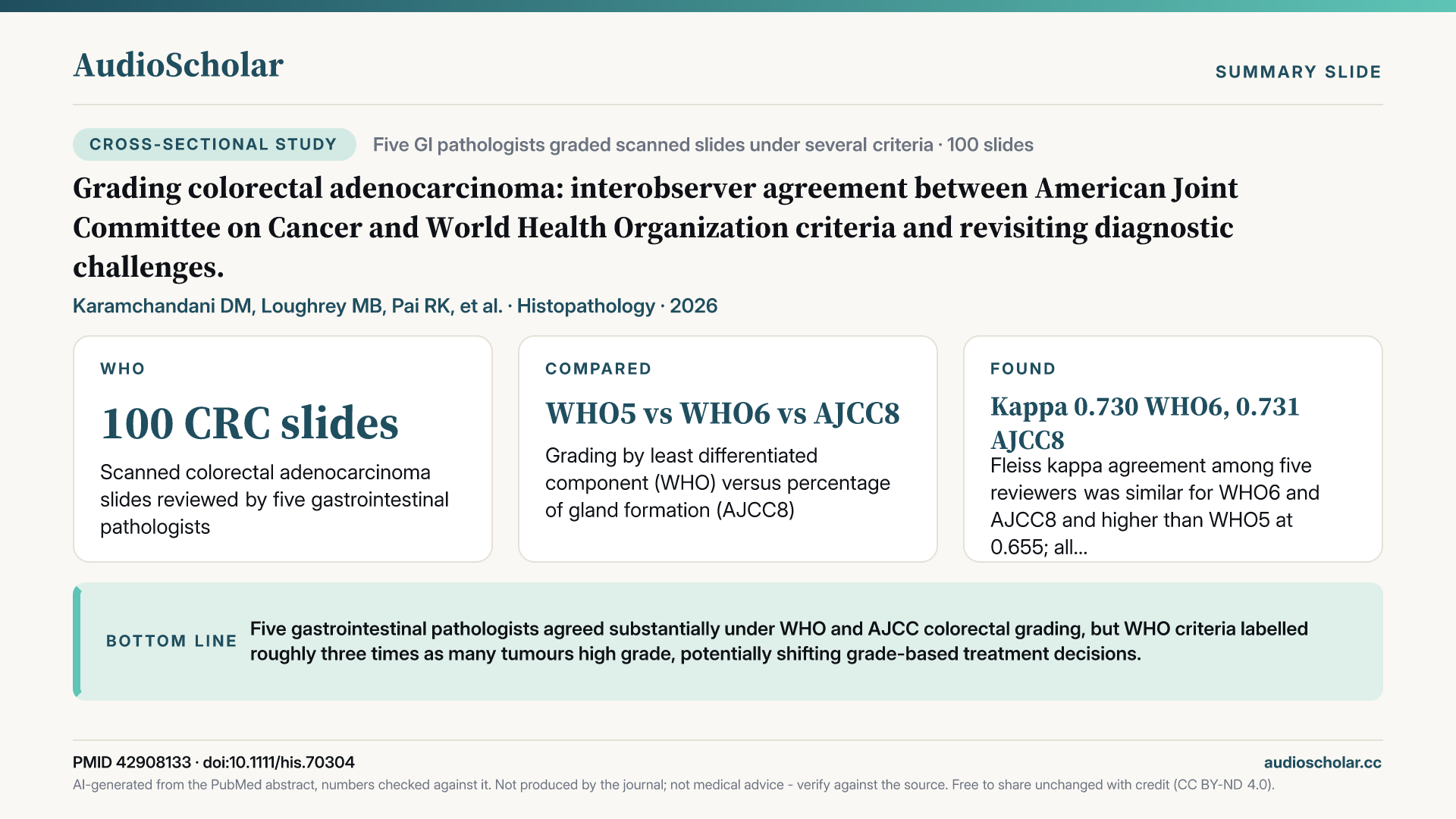
Five gastrointestinal pathologists agreed substantially under WHO and AJCC colorectal grading, but WHO criteria labelled roughly three times as many tumours high grade, potentially shifting grade-based treatment decisions.
Histopathology · 2026 · PubMed

This week’s papers
- 01
Grading colorectal adenocarcinoma: interobserver agreement between American Joint Committee on Cancer and World Health Organization criteria and revisiting diagnostic challenges.
Five gastrointestinal pathologists agreed substantially under WHO and AJCC colorectal grading, but WHO criteria labelled roughly three times as many tumours high grade, potentially shifting grade-based treatment decisions.
Karamchandani DM, Loughrey MB, Pai RK, et al. · Histopathology · 2026
From the briefingIn Histopathology, Karamchandani, Loughrey, Pai and colleagues had five gastrointestinal pathologists grade the same 100 scanned colorectal adenocarcinoma slides four ways: by the WHO fifth edition, the WHO sixth edition, the gland-formation-based AJCC eighth edition, and their own usual practice [1]. Agreement was substantial under every system, and it was slightly better under the WHO sixth edition and the two-tiered AJCC scheme than under the WHO fifth edition. The striking finding was not agreement, though, but the label itself. Both WHO schemes, which grade on the least differentiated component, called roughly three times as many tumours high grade as AJCC did, about 34 cases versus about 12 out of 100. Reviewers were unanimous about discounting tumour buds at the invasive front under WHO rules, but disagreed on how to handle stroma-rich areas. The authors point out that this persistent upgrading could shift treatment algorithms that rely on grade, and they call for the two systems to be synchronised and validated against clinical outcomes in prospective studies. It is a small reader study without outcome data, so it shows which system labels more tumours as high grade, not which system predicts behaviour better.
If you only have time for one paper this week, make it the colorectal grading study by Karamchandani and colleagues in Histopathology [1]. It shows that the choice of grading system, not just the observer, can roughly triple how many colorectal cancers are called high grade, and it reopens the question of which definition should feed treatment decisions.
Written by AI from the published abstract, for healthcare professionals. Not medical advice; check the paper before acting on it.
- 02
Interobserver variability in the interpretation of Papanicolaou tests using the Hologic Genius Digital Diagnostics System: detailed analysis of cytology verification in a large academic laboratory.
Sixteen trained reviewers using an AI-assisted digital Pap platform exceeded 95 percent accuracy for LSIL or worse, though borderline cellularity and non-Trichomonas microorganisms were frequently missed or misread.
Corbin H, Matsko J, Charity T, et al. · American Journal of Clinical Pathology · 2026
From the briefingMoving to cytology, the American Journal of Clinical Pathology carries an evaluation by Corbin, Matsko, Charity and colleagues of the Hologic Genius Digital Diagnostics System for ThinPrep Pap tests [2]. Sixteen trained cytologists and cytopathologists reviewed 110 cases, and for low-grade squamous intraepithelial lesion or worse, sensitivity, specificity, predictive values and accuracy all exceeded 95 percent, with an overall misinterpretation rate of about five and a half percent. The weak spots were specific. Three cases drew widespread disagreement, including a high-grade lesion that some reviewers read as adenocarcinoma, low grade or unsatisfactory, and two negative cases with borderline cellularity that most reviewers called unsatisfactory. Microorganism detection lagged. Trichomonas was picked up well, but sensitivity for other organisms ran only around 60 to 70 percent, partly because in four of the cases with organisms the organisms never appeared in the 60-image gallery. The authors suggest monitoring discordance and temporary dual review during early implementation. As a single-laboratory study on an enriched case set, it supports the platform's performance for epithelial abnormalities, while leaving open how it behaves at real-world prevalence.
Written by AI from the published abstract, for healthcare professionals. Not medical advice; check the paper before acting on it.
- 03
Integrated molecular and histopathological analysis reveals genotype-phenotype correlations and diagnostic challenges in endometrial stromal sarcoma.
RNA sequencing reclassified about one in five morphologically suspected endometrial stromal sarcomas, linked specific fusions to distinct morphology, and identified a novel GATA6::SRF fusion uterine sarcoma.
Cai Y, Chen L, Li K, et al. · The Journal of Pathology · 2026
From the briefingIn The Journal of Pathology, Cai, Chen, Li and colleagues performed targeted RNA sequencing on 51 tumours that had been diagnosed or suspected as endometrial stromal sarcoma, then went back to the slides [3]. Molecular reassessment reclassified 10 tumours, about one in five, as something other than conventional endometrial stromal sarcoma, including a uterine sarcoma with a novel GATA6::SRF fusion that looked like low-grade stromal sarcoma but lacked its defining alterations. The genotype-phenotype links were informative. PHF1-rearranged low-grade tumours were significantly less cellular, with collagenised stroma, than JAZF1::SUZ12 tumours, and high-grade tumours with YWHAE::NUTM2 or BCOR::ZC3H7B fusions showed tongue-like infiltration, a pattern traditionally taught as a low-grade feature. This is a modest single series in a rare tumour, but it adds weight to the view that morphology alone can misclassify a meaningful share of these lesions. Haematopathology contributes two papers with a similar spirit.
Written by AI from the published abstract, for healthcare professionals. Not medical advice; check the paper before acting on it.
- 04
Acute Erythroid Leukemia Associated With Myeloid Neoplasms: Clinicopathologic Features and Evidence of Clonal Continuity.
In 116 cases, acute erythroid leukaemia arising from MDS or MPN followed different genetic routes but converged on TP53-mutant complex karyotypes, shared clones with precursors, and median survival near six weeks.
Fitzpatrick MJ, Yuan J, Akuma DC, et al. · Modern Pathology · 2026
From the briefingIn Modern Pathology, Fitzpatrick, Yuan, Akuma and colleagues pooled 116 multi-institutional cases of acute erythroid leukaemia arising from a prior myeloid neoplasm, mostly myelodysplastic neoplasms and BCR::ABL1-negative myeloproliferative neoplasms [4]. The two routes started very differently. At initial diagnosis, nearly all of the myelodysplastic cases already carried TP53 mutations and roughly three quarters had complex karyotypes, and they transformed in a median of under eight months. The myeloproliferative cases began largely without these lesions and took close to seven years, acquiring TP53 and complex karyotypes along the way. By transformation the two routes had converged on the same adverse genetic landscape and the same dismal median survival of about six weeks. In all 58 cases with serial data, the leukaemia shared at least one genetic aberration with the earlier neoplasm, which the authors read as evidence of direct clonal evolution.
Written by AI from the published abstract, for healthcare professionals. Not medical advice; check the paper before acting on it.
- 05
Characterization of the morphological, immunophenotypical and cytogenetic features of high-grade B-cell lymphoma with 11q aberration.
In 27 single-centre cases, high-grade B-cell lymphoma with 11q aberration was mostly Burkitt-like, MYC-positive and BCL2-negative, and 24 patients achieved complete remission, suggesting a favourable prognosis.
Wang Z, Liu Y, Wang J, et al. · Histopathology · 2026
From the briefingThen in Histopathology, Wang, Liu, Wang and colleagues describe 27 cases of high-grade B-cell lymphoma with 11q aberration, drawn from 92 high-grade or diffuse large B-cell lymphomas tested by FISH at a single centre [5]. Nearly all patients were men, the median age was 61 though cases ranged from childhood to old age, and the gastrointestinal tract was the most common extranodal site. About three quarters of the tumours had Burkitt-like or blastoid morphology, almost all had a germinal centre phenotype, every tested case was MYC protein positive, and most were BCL2 negative. Twenty-four patients achieved complete remission, and outcome did not track with morphology, stage, MYC co-alteration or regimen. The authors describe a favourable prognosis, but with 27 retrospective cases and limited follow-up detail, that conclusion is provisional.
Written by AI from the published abstract, for healthcare professionals. Not medical advice; check the paper before acting on it.
- 06
High-Grade Follicular Cell-Derived Non-Anaplastic Thyroid Carcinoma and Anaplastic Thyroid Carcinoma.
A question-and-answer review clarifies poorly differentiated and high-grade differentiated thyroid carcinoma versus anaplastic carcinoma, emphasising broad differentials, limited sampling, and biomarker testing for targeted and immune therapy.
Barletta JA, Seethala RR · Modern Pathology · 2026
From the briefingIn Modern Pathology, Barletta and Seethala use a question-and-answer format to address high-grade follicular cell-derived non-anaplastic thyroid carcinoma, now split into poorly differentiated carcinoma and high-grade differentiated carcinoma, alongside anaplastic carcinoma [6]. They emphasise the broad differential before calling a tumour anaplastic, the difficulty of limited sampling, and the now critical role of biomarker testing given targeted and checkpoint inhibitor therapy.
Written by AI from the published abstract, for healthcare professionals. Not medical advice; check the paper before acting on it.
- 07
Intrahepatic cholangiocarcinoma: contemporary classification, molecular pathology, and emerging concepts.
A review of the 2026 WHO classification of intrahepatic cholangiocarcinoma highlights the small-duct versus large-duct distinction and immunohistochemical and molecular biomarkers that guide diagnosis and targeted therapy.
Wen KW, Kakar S · Virchows Archiv · 2026
From the briefingIn Virchows Archiv, Wen and Kakar review intrahepatic cholangiocarcinoma under the 2026 WHO classification, centring on the small-duct versus large-duct distinction, which carries different morphology, immunoprofiles, molecular alterations and outcomes, and on the biomarkers that guide targeted therapy [7]. Lung pathology gets two reviews.
Written by AI from the published abstract, for healthcare professionals. Not medical advice; check the paper before acting on it.
- 08
Non-small cell lung carcinoma and its mimics on cytology and small biopsy samples: a practical approach aligned with the WHO Reporting System.
A practical review of lung tumour subtyping on aspirates and small biopsies favours limited immunohistochemical panels that preserve material for molecular testing and catalogues pitfalls like crush artifact and reactive mimics.
Silva RSD, Schmitt F · Cancer Cytopathology · 2026
From the briefingIn Cancer Cytopathology, Silva and Schmitt offer a WHO Reporting System-aligned approach to non-small cell carcinoma and its mimics on aspirates and small biopsies, stressing lean immunohistochemical panels that preserve tissue for molecular testing and flagging pitfalls such as crush artifact, necrosis and reactive mimics [8].
Written by AI from the published abstract, for healthcare professionals. Not medical advice; check the paper before acting on it.
- 09
Primary and secondary vasculitis of the lung - critical evaluation of the update classification.
A single-author critique argues current vasculitis nomenclature fits pulmonary pathology poorly and proposes a pattern-based lung classification, neutrophilic, eosinophilic and other, including autoimmune-associated variants.
Popper H · Virchows Archiv · 2026
From the briefingAlso in Virchows Archiv, Popper offers a more contrarian piece, arguing that the 2011 vasculitis nomenclature serves pulmonary pathology poorly and proposing a pattern-based scheme, neutrophilic, eosinophilic and other forms, that adds variants such as autoimmune-associated vasculitis [9]. He notes that in the lung, unlike some other organs, clinical and laboratory findings often fail to secure the diagnosis, and that biopsies frequently arrive labelled as interstitial lung disease. This is a single-author proposal born of working-group discussion, not a consensus classification.
Written by AI from the published abstract, for healthcare professionals. Not medical advice; check the paper before acting on it.
- 10
Pathological assessment of neoadjuvant-treated melanoma specimens: a historical overview, lessons learned along the way and the road ahead.
With neoadjuvant therapy now standard for resectable stage III melanoma, both the extent and the composition of pathological response correlate with recurrence-free survival, making rigorous response assessment essential.
Rawson R, Burton EM, Tetzlaff MT · Histopathology · 2026
From the briefingFinally, in Histopathology, Rawson, Burton and Tetzlaff trace pathological response assessment in neoadjuvant-treated melanoma, now standard of care for resectable stage three disease, and highlight that both the extent and the composition of response correlate with recurrence-free survival [10]. These reviews are expert syntheses rather than new data, but they mark where routine reporting is heading.
Written by AI from the published abstract, for healthcare professionals. Not medical advice; check the paper before acting on it.
The full briefing
This AudioScholar briefing is generated by artificial intelligence for healthcare professionals and trainees. It is not medical advice.
Welcome to This Week in Pathology. This week we're covering 10 notable papers spanning reproducibility in grading and digital screening, molecular reclassification of rare tumours and haematologic malignancies, and practical classification updates across thyroid, liver, lung and skin. Let's dive in.
We start with reproducibility, because two papers this week ask how consistently pathologists reach the same answer when the criteria or the platform change. In Histopathology, Karamchandani, Loughrey, Pai and colleagues had five gastrointestinal pathologists grade the same 100 scanned colorectal adenocarcinoma slides four ways: by the WHO fifth edition, the WHO sixth edition, the gland-formation-based AJCC eighth edition, and their own usual practice [1]. Agreement was substantial under every system, and it was slightly better under the WHO sixth edition and the two-tiered AJCC scheme than under the WHO fifth edition. The striking finding was not agreement, though, but the label itself. Both WHO schemes, which grade on the least differentiated component, called roughly three times as many tumours high grade as AJCC did, about 34 cases versus about 12 out of 100. Reviewers were unanimous about discounting tumour buds at the invasive front under WHO rules, but disagreed on how to handle stroma-rich areas. The authors point out that this persistent upgrading could shift treatment algorithms that rely on grade, and they call for the two systems to be synchronised and validated against clinical outcomes in prospective studies. It is a small reader study without outcome data, so it shows which system labels more tumours as high grade, not which system predicts behaviour better. Moving to cytology, the American Journal of Clinical Pathology carries an evaluation by Corbin, Matsko, Charity and colleagues of the Hologic Genius Digital Diagnostics System for ThinPrep Pap tests [2]. Sixteen trained cytologists and cytopathologists reviewed 110 cases, and for low-grade squamous intraepithelial lesion or worse, sensitivity, specificity, predictive values and accuracy all exceeded 95 percent, with an overall misinterpretation rate of about five and a half percent. The weak spots were specific. Three cases drew widespread disagreement, including a high-grade lesion that some reviewers read as adenocarcinoma, low grade or unsatisfactory, and two negative cases with borderline cellularity that most reviewers called unsatisfactory. Microorganism detection lagged. Trichomonas was picked up well, but sensitivity for other organisms ran only around 60 to 70 percent, partly because in four of the cases with organisms the organisms never appeared in the 60-image gallery. The authors suggest monitoring discordance and temporary dual review during early implementation. As a single-laboratory study on an enriched case set, it supports the platform's performance for epithelial abnormalities, while leaving open how it behaves at real-world prevalence.
Our second theme is molecular reclassification, where sequencing is redrawing boundaries that morphology alone had set. In The Journal of Pathology, Cai, Chen, Li and colleagues performed targeted RNA sequencing on 51 tumours that had been diagnosed or suspected as endometrial stromal sarcoma, then went back to the slides [3]. Molecular reassessment reclassified 10 tumours, about one in five, as something other than conventional endometrial stromal sarcoma, including a uterine sarcoma with a novel GATA6::SRF fusion that looked like low-grade stromal sarcoma but lacked its defining alterations. The genotype-phenotype links were informative. PHF1-rearranged low-grade tumours were significantly less cellular, with collagenised stroma, than JAZF1::SUZ12 tumours, and high-grade tumours with YWHAE::NUTM2 or BCOR::ZC3H7B fusions showed tongue-like infiltration, a pattern traditionally taught as a low-grade feature. This is a modest single series in a rare tumour, but it adds weight to the view that morphology alone can misclassify a meaningful share of these lesions. Haematopathology contributes two papers with a similar spirit. In Modern Pathology, Fitzpatrick, Yuan, Akuma and colleagues pooled 116 multi-institutional cases of acute erythroid leukaemia arising from a prior myeloid neoplasm, mostly myelodysplastic neoplasms and BCR::ABL1-negative myeloproliferative neoplasms [4]. The two routes started very differently. At initial diagnosis, nearly all of the myelodysplastic cases already carried TP53 mutations and roughly three quarters had complex karyotypes, and they transformed in a median of under eight months. The myeloproliferative cases began largely without these lesions and took close to seven years, acquiring TP53 and complex karyotypes along the way. By transformation the two routes had converged on the same adverse genetic landscape and the same dismal median survival of about six weeks. In all 58 cases with serial data, the leukaemia shared at least one genetic aberration with the earlier neoplasm, which the authors read as evidence of direct clonal evolution. Then in Histopathology, Wang, Liu, Wang and colleagues describe 27 cases of high-grade B-cell lymphoma with 11q aberration, drawn from 92 high-grade or diffuse large B-cell lymphomas tested by FISH at a single centre [5]. Nearly all patients were men, the median age was 61 though cases ranged from childhood to old age, and the gastrointestinal tract was the most common extranodal site. About three quarters of the tumours had Burkitt-like or blastoid morphology, almost all had a germinal centre phenotype, every tested case was MYC protein positive, and most were BCL2 negative. Twenty-four patients achieved complete remission, and outcome did not track with morphology, stage, MYC co-alteration or regimen. The authors describe a favourable prognosis, but with 27 retrospective cases and limited follow-up detail, that conclusion is provisional.
Our final theme is a cluster of practical reviews that update how specific tumour families and lesions are classified and reported. In Modern Pathology, Barletta and Seethala use a question-and-answer format to address high-grade follicular cell-derived non-anaplastic thyroid carcinoma, now split into poorly differentiated carcinoma and high-grade differentiated carcinoma, alongside anaplastic carcinoma [6]. They emphasise the broad differential before calling a tumour anaplastic, the difficulty of limited sampling, and the now critical role of biomarker testing given targeted and checkpoint inhibitor therapy. In Virchows Archiv, Wen and Kakar review intrahepatic cholangiocarcinoma under the 2026 WHO classification, centring on the small-duct versus large-duct distinction, which carries different morphology, immunoprofiles, molecular alterations and outcomes, and on the biomarkers that guide targeted therapy [7]. Lung pathology gets two reviews. In Cancer Cytopathology, Silva and Schmitt offer a WHO Reporting System-aligned approach to non-small cell carcinoma and its mimics on aspirates and small biopsies, stressing lean immunohistochemical panels that preserve tissue for molecular testing and flagging pitfalls such as crush artifact, necrosis and reactive mimics [8]. Also in Virchows Archiv, Popper offers a more contrarian piece, arguing that the 2011 vasculitis nomenclature serves pulmonary pathology poorly and proposing a pattern-based scheme, neutrophilic, eosinophilic and other forms, that adds variants such as autoimmune-associated vasculitis [9]. He notes that in the lung, unlike some other organs, clinical and laboratory findings often fail to secure the diagnosis, and that biopsies frequently arrive labelled as interstitial lung disease. This is a single-author proposal born of working-group discussion, not a consensus classification. Finally, in Histopathology, Rawson, Burton and Tetzlaff trace pathological response assessment in neoadjuvant-treated melanoma, now standard of care for resectable stage three disease, and highlight that both the extent and the composition of response correlate with recurrence-free survival [10]. These reviews are expert syntheses rather than new data, but they mark where routine reporting is heading.
If you only have time for one paper this week, make it the colorectal grading study by Karamchandani and colleagues in Histopathology [1]. It shows that the choice of grading system, not just the observer, can roughly triple how many colorectal cancers are called high grade, and it reopens the question of which definition should feed treatment decisions.
Here is what this week's evidence adds up to in Pathology. First, WHO and AJCC colorectal grading are similarly reproducible but not interchangeable, since the WHO schemes upgrade far more tumours, and no outcome data yet say which is right. Second, AI-assisted digital Pap review performs very well for epithelial abnormalities among trained users in one academic laboratory, while microorganism detection and borderline cellularity remain weak points. Third, molecular testing reclassified about one in five suspected endometrial stromal sarcomas in a single series, strengthening the case for integrated molecular diagnosis in this rare group. Fourth, acute erythroid leukaemia arising from myeloid neoplasms appears clonally continuous with its precursor, converging on a TP53-driven landscape with very poor survival regardless of route. Fifth, high-grade B-cell lymphoma with 11q aberration looked Burkitt-like and fared well in a small retrospective cohort, a signal that needs larger series to confirm.
That's your roundup for This Week in Pathology. The full transcript and references are available on the episode page. This is an AI-curated summary — for clinical decisions, always consult primary sources and current guidelines. See you next week.
If this weekly briefing is useful, follow the show in your podcast app so new episodes arrive automatically. And think of one colleague — in any specialty — who never has time to keep up with the literature. Tell them about AudioScholar: a free ten-minute weekly for every specialty, to listen to in any podcast app, or to read at audioscholar dot C C.
This is an automated summary generated by artificial intelligence, which can make mistakes. Always review the original source materials.
Spot something worth flagging?
Get this every week in your podcast app — free.
New pathology episodes land in your feed automatically — listen on your commute.