This Week in Physical Medicine & Rehabilitation — Oct 8, 2026
Generated Oct 8, 2026 · 10:38
The week's practice-changing Physical Medicine & Rehabilitation research, summarized for clinicians.
If the audio fails to play, refresh the page to renew the link.
Get next week’s Physical Medicine & Rehabilitation briefing — free.
In your podcast app, or readable in your inbox with the audio one tap away.
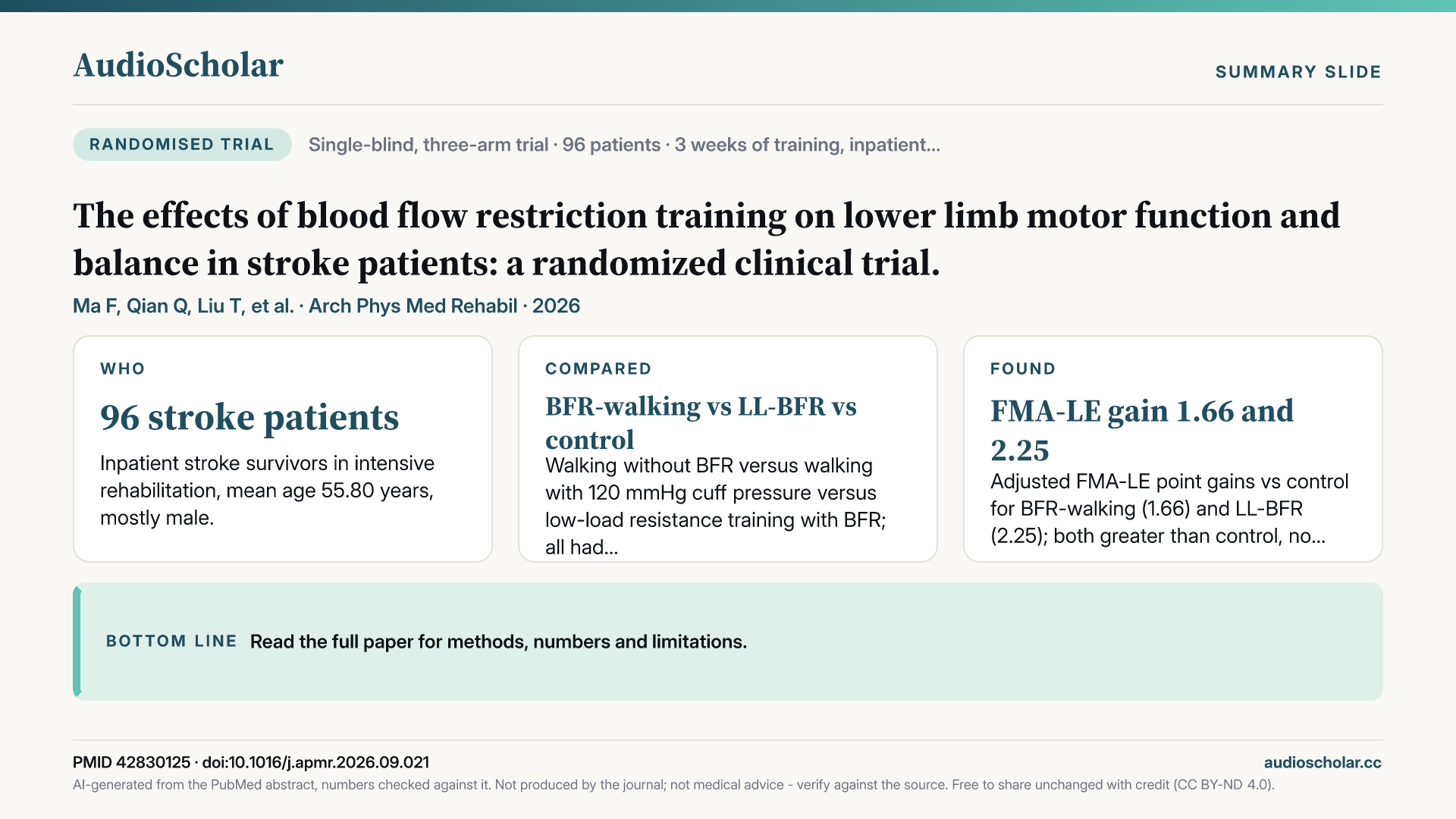
The effects of blood flow restriction training on lower limb motor function and balance in stroke patients: a randomized clinical trial.
Three weeks of blood flow restriction walking or low-load resistance training improved stroke survivors' leg function and balance beyond standard training, with roughly double the clinically meaningful responders.
Archives of Physical Medicine and Rehabilitation · 2026 · PubMed

This week’s papers
- 01
The effects of blood flow restriction training on lower limb motor function and balance in stroke patients: a randomized clinical trial.
Three weeks of blood flow restriction walking or low-load resistance training improved stroke survivors' leg function and balance beyond standard training, with roughly double the clinically meaningful responders.
Ma F, Qian Q, Liu T, et al. · Archives of Physical Medicine and Rehabilitation · 2026
- 02
Mirror therapy versus functional electrical stimulation cycling in post-stroke lower limb rehabilitation: a randomized controlled trial.
In subacute stroke, mirror therapy and electrical stimulation cycling both improved leg motor scores over conventional care without differing from each other, though only cycling improved quality of life.
Çınar MS, Koyuncu E, Atan T, et al. · Topics in Stroke Rehabilitation · 2026
- 03
Effect of iTBS and rTMS Combined with Robotic Rehabilitation on Ambulation and Lower Extremity Motor Function in Chronic SCI Patients.
In 30 people with chronic incomplete spinal cord injury, theta-burst and high-frequency magnetic stimulation plus robotic gait training outperformed sham on several leg outcomes, without differing from each other.
Kalem Ozgen AN, Yardimci G, Yilmaz B · American Journal of Physical Medicine & Rehabilitation · 2026
- 04
Methodological quality of systematic reviews on treatments in stroke rehabilitation: A cross-sectional study.
Of 140 recent systematic reviews on stroke rehabilitation treatments, only two rated high quality and about 93 percent rated critically low, undermining confidence in much pooled evidence.
Chan YT, Siu SY, Mak CH, et al. · PM&R · 2026
- 05
Dextrose prolotherapy for chronic symptomatic rotator cuff tendinopathy and subacromial bursitis: A systematic review and meta-analysis.
Across 14 mostly small, high-bias studies, dextrose prolotherapy for chronic rotator cuff tendinopathy or bursitis showed little to no benefit over saline and probably worse physical performance than corticosteroid.
Zerzan N, Ewart D, Sowerby C, et al. · PM&R · 2026
- 06
Single Ultrasound-Guided Dextrose Prolotherapy Plus Therapeutic Exercise for Subacromial-Subdeltoid Bursitis: A Pilot Double-Blind Randomized Controlled Trial.
Adding one ultrasound-guided dextrose injection to exercise for recent-onset bursitis improved shoulder pain and disability trajectories versus saline, but the 13-week difference fell short of clinical importance.
Hsieh RL, Lee WC, Chiu WM · Archives of Physical Medicine and Rehabilitation · 2026
- 07
Comparison of Early Postoperative Mobilization and Electrical Stimulation-Supported Rehabilitation on Functional Recovery After Lumbar Disc Herniation Surgery: A Prospective Randomized Controlled Trial.
After single-level lumbar discectomy, adding electrical stimulation to early mobilization produced greater gains in pain, disability, mobility and strength in 60 patients, though no sham control was used.
Yıldırım K, Balkış O, Tan MS · American Journal of Physical Medicine & Rehabilitation · 2026
- 08
Comparative Efficacy of Electrical Stimulation Therapies for Bone Healing: A Network Meta-analysis of Randomized Controlled Trials.
Pooling 37 randomized trials, electrical stimulation raised bone healing rates by just under a fifth versus controls, with pulsed electromagnetic fields appearing the most effective modality.
Liu G, Sun J, Xie W, et al. · American Journal of Physical Medicine & Rehabilitation · 2026
- 09
Effect of Short-Rest Interval versus Traditional Multiple-Set Resistance Training Combined with Endurance Training in Patients with Cardiovascular Disease: A Randomized Clinical Trial.
In cardiac rehabilitation, short-rest and traditional resistance training produced similar gains in aerobic capacity and lean mass, with no consistent strength advantage, supporting either approach by preference.
Gillet A, Lamotte M, Forton K, et al. · American Journal of Physical Medicine & Rehabilitation · 2026
- 10
Adolescent Mental Health Risk post-mild Traumatic Brain Injury: Examination of Diagnostic codes in Electronic Health Records.
Adolescents with mild traumatic brain injury had steadily rising odds of new mental health diagnoses, roughly doubling by twelve months versus typically developing peers, especially with prior risk factors.
Bhatnagar S, Zhang N, Guzman T, et al. · Archives of Physical Medicine and Rehabilitation · 2026
The full briefing
This AudioScholar briefing is generated by artificial intelligence for healthcare professionals and trainees. It is not medical advice.
Welcome to This Week in Physical Medicine & Rehabilitation. This week we're covering 10 notable papers spanning lower limb recovery after stroke and spinal cord injury, the evidence behind injections and electrical stimulation in musculoskeletal care, and a set of papers on research quality, cardiac rehabilitation, and mental health after adolescent concussion. Let's dive in.
We start with neurorehabilitation, where several trials tested adjuncts layered on top of conventional lower limb training. In Archives of Physical Medicine and Rehabilitation, Ma and colleagues randomized 96 inpatient stroke survivors to three weeks of ordinary walking, walking with a blood flow restriction cuff at 120 millimetres of mercury, or low-load resistance training at 20 percent of one-repetition maximum under the same cuff pressure [1]. Both cuff groups improved more than controls on the lower extremity Fugl-Meyer, balance, Timed Up and Go, and sit-to-stand, with no meaningful difference between the two cuff approaches. The honest caveat is size: the average extra gain was only about two points on the Fugl-Meyer, below the four-point threshold for a clinically important change. What shifts the picture is the responder analysis, where about a third of patients in the resistance arm crossed that threshold, roughly double the rate in the control group, with no serious adverse events. The authors themselves conclude that larger and longer trials are needed before routine use. In Topics in Stroke Rehabilitation, Çınar and colleagues compared mirror therapy and functional electrical stimulation cycling in subacute stroke, each replacing 30 minutes of conventional therapy five days a week for six weeks [2]. Both adjuncts produced greater lower extremity Fugl-Meyer gains than conventional care, by about three points, and only the cycling group showed better Brunnstrom stage and stroke-specific quality of life. Yet the two active approaches did not differ from each other, which the authors read as support for mirror therapy as a simple, low-cost option. With only 15 patients per arm, that equivalence is far from established. Moving to spinal cord injury, Kalem Ozgen and colleagues, in the American Journal of Physical Medicine and Rehabilitation, randomized 30 people with chronic incomplete injury to high-frequency repetitive transcranial magnetic stimulation, intermittent theta-burst stimulation, or sham, all paired with robotic gait training [3]. At four weeks, both active protocols showed larger gains than sham in lower extremity motor score, the Spinal Cord Independence Measure, and walking speed, with no difference between them, though the advantage over sham varied by outcome. This is a small single-centre signal, not a basis for practice change.
Those small trials make a paper in PM&R especially timely. Chan and colleagues appraised 140 systematic reviews of stroke rehabilitation treatments published between 2021 and 2023 using the AMSTAR 2 tool [4]. Only two reviews were rated high quality, and more than nine in ten reviews were rated critically low. Fewer than one in twenty reviews conducted a comprehensive literature search, and only about one in eight reviews listed excluded studies with reasons. Cochrane reviews, reviews reporting harms, and those in higher-impact journals fared better. The practical implication is that a meta-analysis in stroke rehabilitation is not automatically stronger evidence than the trials it pools, and the quality of the review deserves the same scrutiny as the trials themselves.
Our second theme is musculoskeletal intervention, starting with dextrose prolotherapy for the shoulder, where two papers point in somewhat different directions. In PM&R, Zerzan and colleagues systematically reviewed 14 studies of dextrose prolotherapy for chronic rotator cuff tendinopathy and subacromial bursitis, ten of them at high risk of bias [5]. For mixed tendinopathy and bursitis, prolotherapy may offer little to no benefit over saline, and compared with corticosteroid injection it probably results in worse physical performance. Evidence against physical therapy or blood products was sparse, and cost and treatment burden went unreported. In Archives of Physical Medicine and Rehabilitation, Hsieh and colleagues ran a pilot double-blind trial in 46 adults with ultrasound-confirmed subacromial-subdeltoid bursitis, adding one ultrasound-guided injection of 20 percent dextrose or saline before a 12-week exercise program [6]. The dextrose group followed a more favourable trajectory on the Shoulder Pain and Disability Index, pain, and several range of motion measures, but the difference at 13 weeks was about six points, short of the prespecified eight-point minimal clinically important difference. Two details reconcile these papers: the pilot enrolled patients with pain of three months or less, whereas the review addressed chronic disease, and the pilot's effect did not reach clinical importance. Taken together, the evidence does not establish prolotherapy as superior for chronic shoulder pain, and the early-bursitis question remains open pending larger trials.
Electrical stimulation features in two further papers in the American Journal of Physical Medicine and Rehabilitation. Yıldırım and colleagues randomized 60 adults after single-level lumbar discectomy to early mobilization alone or early mobilization plus neuromuscular and transcutaneous electrical stimulation, three times weekly for five weeks [7]. The combined group improved more on disability, walking tests, strength, and especially pain. The authors describe it as a low-cost adjunct ready for routine use, but the comparison was against no stimulation rather than a sham, so expectation effects on pain cannot be excluded, and this is a single modest trial. On a larger scale, Liu and colleagues performed a network meta-analysis of 37 randomized trials with more than three thousand participants on electrical stimulation for bone healing [8]. Stimulation overall raised healing rates by just under a fifth compared with controls, with pulsed electromagnetic fields appearing the most effective modality, and combined magnetic fields also showing benefit. The authors call for more high-quality trials, and given the findings from Chan and colleagues on review quality, ranking modalities from heterogeneous trials remains provisional.
Our final theme pairs cardiac rehabilitation with a large pediatric concussion cohort. In the American Journal of Physical Medicine and Rehabilitation, Gillet and colleagues randomized 71 patients with cardiovascular disease in a 12-week supervised program to endurance training plus either short-rest interval resistance training or traditional multiple-set training [9]. Peak oxygen uptake, sit-to-stand performance, and lean mass improved similarly in both groups. Isokinetic quadriceps strength gained roughly twice as much with the short-rest protocol, but this was not consistent across other strength measures, so the authors conclude that neither approach is clearly superior and that patient preference can reasonably guide the choice. This supports flexibility in programming, particularly where session time is limited. In Archives of Physical Medicine and Rehabilitation, Bhatnagar and colleagues used electronic health records from a tertiary children's centre to follow 18,755 adolescents with mild traumatic brain injury, matched to peers with orthopaedic injuries and typically developing peers [10]. Compared with typically developing adolescents, the concussion group had modestly higher odds of a new mental health diagnosis at three months, rising to roughly double the odds by twelve months. ADHD was the most common diagnosis, while anxiety and trauma-related disorders continued to climb over time. Female sex, socioeconomic disadvantage, and prior mental health history raised risk in every group, whereas rural residence raised risk only after concussion. Because this is retrospective, code-based data from a single centre, it cannot separate new illness from increased detection, but the steadily rising curve over a full year argues against viewing concussion recovery as complete once acute symptoms settle, and the authors frame it as support for targeted screening.
If you only have time for one paper this week, make it the blood flow restriction trial from Ma and colleagues in Archives of Physical Medicine and Rehabilitation [1]. It moves cuff-based training from the sports clinic into the inpatient stroke unit with a randomized design, and its responder data reopen the question of whether modest average effects can conceal a meaningful benefit for a substantial subset of patients.
Here is what this week's evidence adds up to in Physical Medicine & Rehabilitation. First, adjuncts for lower limb recovery after stroke and spinal cord injury, including blood flow restriction, mirror therapy, stimulation cycling, and transcranial stimulation, all show early positive signals, but from small, mostly single-centre trials with average effects near or below clinically important thresholds. Second, the stroke rehabilitation review literature is overwhelmingly of critically low methodological quality, which tempers confidence in pooled conclusions across the field. Third, for chronic rotator cuff and bursal pain, the best available synthesis does not show dextrose prolotherapy beating saline and suggests it trails corticosteroid on physical performance, while early bursitis remains an open question. Fourth, electrical stimulation appears to aid bone healing and post-discectomy recovery, though the discectomy evidence lacks a sham comparison and the bone healing ranking needs confirmation. Finally, mental health diagnoses in adolescents rise steadily over the year after concussion, an observational finding that strengthens the case for longer follow-up in higher-risk groups.
That's your roundup for This Week in Physical Medicine & Rehabilitation. The full transcript and references are available on the episode page. This is an AI-curated summary — for clinical decisions, always consult primary sources and current guidelines. See you next week.
If this weekly briefing is useful, follow the show in your podcast app so new episodes arrive automatically. And if you have a paper you have been meaning to read, upload the PDF, or paste any link, at audioscholar dot C C. We will turn it into audio like this one, in any of thirty-one languages.
This is an automated summary generated by artificial intelligence, which can make mistakes. Always review the original source materials.
Spot something worth flagging?
Get this every week in your podcast app — free.
New physical_medicine_rehabilitation episodes land in your feed automatically — listen on your commute.