This Week in Hematology — Oct 21, 2026
Generated Oct 21, 2026 · 12:09
The week's practice-changing Hematology research, summarized for clinicians.
If the audio fails to play, refresh the page to renew the link.
Get next week’s Hematology briefing — free.
In your podcast app, or readable in your inbox with the audio one tap away.
Ponatinib-Blinatumomab or Imatinib-Chemotherapy for Adult Ph-Positive ALL.
In a phase 3 trial of 236 adults with Philadelphia-positive ALL, frontline ponatinib plus blinatumomab raised two-year event-free survival to 86 percent versus 67 percent with imatinib-chemotherapy.
New England Journal of Medicine · 2026 · PubMed

This week’s papers
- 01
Ponatinib-Blinatumomab or Imatinib-Chemotherapy for Adult Ph-Positive ALL.
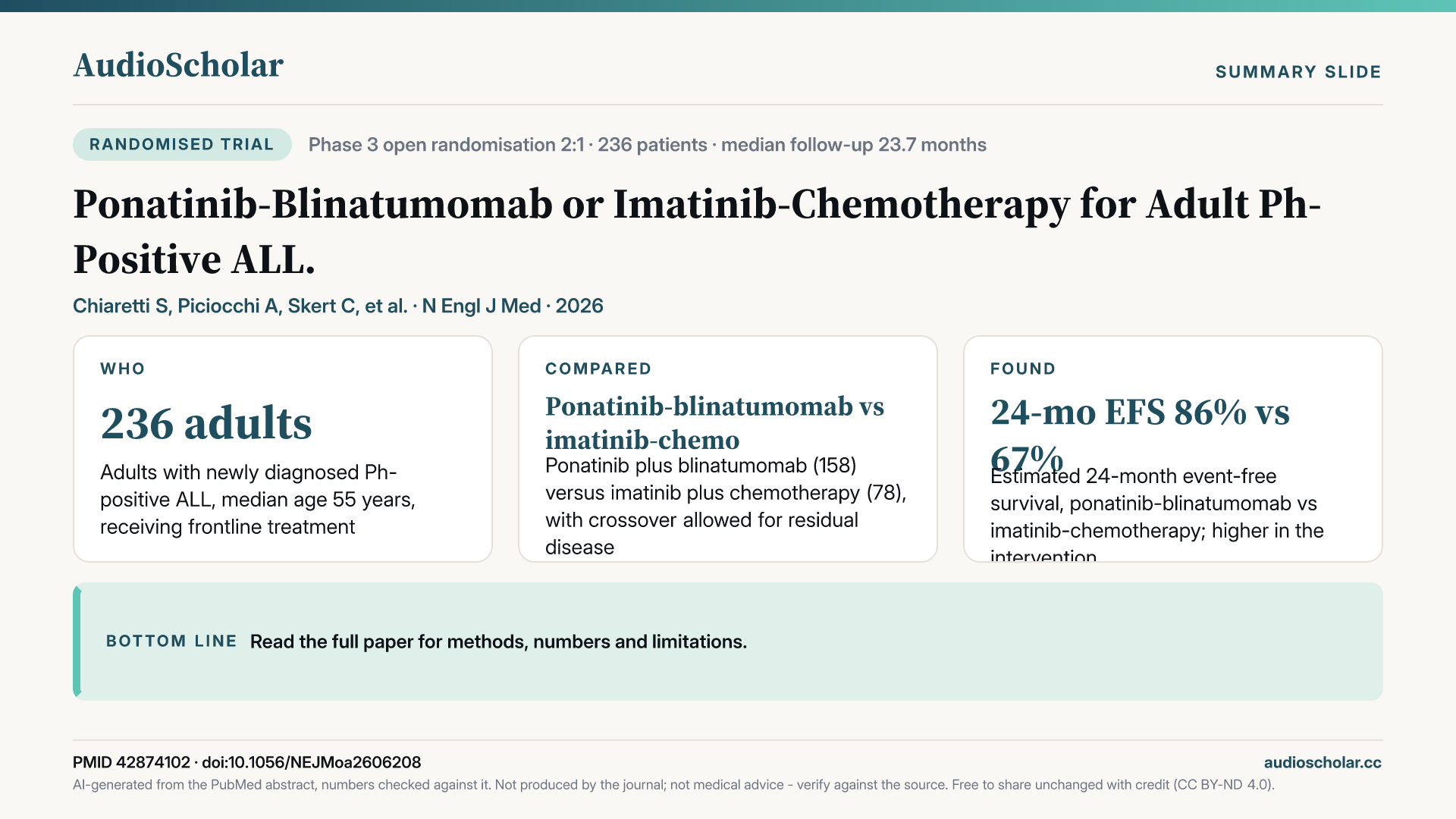
In a phase 3 trial of 236 adults with Philadelphia-positive ALL, frontline ponatinib plus blinatumomab raised two-year event-free survival to 86 percent versus 67 percent with imatinib-chemotherapy.
Chiaretti S et al. · New England Journal of Medicine · 2026
From the briefingIn the New England Journal of Medicine, Chiaretti and colleagues report the GIMEMA ALL2820 phase 3 trial, which randomly assigned 236 adults, with a median age of 55 and some as old as 82, two to one to ponatinib plus blinatumomab or to imatinib plus chemotherapy [1]. At two years, event-free survival was 86 percent with the targeted immunotherapy combination versus 67 percent with the control approach. Molecular responses after blinatumomab consolidation were notably deeper, relapse was less than half as frequent, and only about a fifth of patients in the intervention group had gone on to transplant in first remission. Overall survival was numerically higher, 90 versus 85 percent, though follow-up is still under two years and crossover was permitted for control patients with persistent residual disease, so the survival comparison remains immature. Still, this is a randomized phase 3 result supporting a chemotherapy-free frontline strategy across a broad age range, and it raises the question of how often transplant is needed in first remission.
If you only have time for one paper this week, make it the GIMEMA ALL2820 trial in the New England Journal of Medicine [1]. It is a randomized phase 3 demonstration that a chemotherapy-free ponatinib and blinatumomab backbone outperforms imatinib with chemotherapy in adult Philadelphia-positive leukemia, and it reopens the question of who still needs transplant in first remission.
Written by AI from the published abstract, for healthcare professionals. Not medical advice; check the paper before acting on it.
- 02
Flow MRD pre-blinatumomab consolidation, despite subsequent clearance, is associated with inferior survival in Ph+ B-ALL.
Among 81 adults with Philadelphia-positive B-ALL, flow-detectable residual disease before blinatumomab predicted worse survival despite later clearance, an effect not seen in patients who underwent transplant.
Frost BF et al. · Blood Advances · 2026
From the briefingA retrospective multicenter study in Blood Advances from Frost and colleagues speaks directly to that question [2]. Among 81 adults who were residual-disease negative after blinatumomab consolidation, patients who had been flow cytometry positive before blinatumomab did worse, with roughly four-fold higher risk of relapse or death on multivariable analysis despite later clearance. The IKZF1-plus genotype and extramedullary disease at diagnosis also marked worse disease-free survival. In exploratory analyses, the adverse signal from pre-blinatumomab positivity was seen in patients who did not undergo transplant but not in those who did. This is a small retrospective cohort, so it cannot settle transplant decisions, but read alongside the trial it suggests that residual-disease kinetics may help identify the minority of patients for whom a transplant-sparing approach carries more risk.
Written by AI from the published abstract, for healthcare professionals. Not medical advice; check the paper before acting on it.
- 03
A randomized phase 2 study combining midostaurin, low-dose cytarabine and venetoclax in newly diagnosed AML ≥60 years.
Adding midostaurin to low-dose cytarabine and venetoclax did not improve overall remission in older AML patients, though a small FLT3-ITD subgroup showed better clearance and longer survival.
Chua CC et al. · Blood · 2026
From the briefingIn acute myeloid leukemia, Blood published the randomized phase 2 INTERVENE study from Chua and colleagues, testing whether sequential midostaurin added to low-dose cytarabine and venetoclax helps adults aged 60 and over with non-adverse karyotype who are unfit for intensive therapy [3]. In 120 randomized patients, the primary endpoint was negative: composite complete remission was 72 percent with the triplet versus 68 percent without midostaurin, not a meaningful difference. The interest lies in a subgroup of just 29 patients with FLT3-ITD, where remission rates were higher with midostaurin, ultrasensitive sequencing showed FLT3-ITD clearance in about two thirds of triplet-treated patients versus none in the doublet group, and median overall survival was roughly 24 months versus about 9. The regimen was reported as well tolerated, which matters given the marrow toxicity seen with other FLT3 inhibitor triplets. These subgroup findings are hypothesis-generating rather than definitive, and the authors frame midostaurin as possibly having a role in FLT3-ITD disease pending larger studies.
Written by AI from the published abstract, for healthcare professionals. Not medical advice; check the paper before acting on it.
- 04
American Society of Hematology 2026 Guidelines for the Management of Myelofibrosis in Adults.
New ASH guidelines issue ten GRADE-based recommendations for myelofibrosis, covering extended molecular testing, JAK inhibition in symptomatic lower-risk disease, anemia management, and transplant referral timing.
Stein BL et al. · Blood Advances · 2026
From the briefingIn Blood Advances, Stein and colleagues present the American Society of Hematology 2026 guidelines for myelofibrosis in adults, ten GRADE-based recommendations developed with patient representatives and the Mayo Clinic Evidence-based Practice Center [4]. Key suggestions include extended molecular genetic testing for prognosis, JAK inhibition in symptomatic lower-risk patients, strategies for disease-related and JAK-inhibitor-induced anemia, and guidance on the timing of transplant referral and optimization beforehand. The panel also addressed antiplatelet therapy and iron chelation, and identified research gaps for every recommendation, a reminder that much of this guidance rests on limited evidence.
Written by AI from the published abstract, for healthcare professionals. Not medical advice; check the paper before acting on it.
- 05
Incidence of thrombosis and bleeding in patients with JAK2- positive myeloproliferative neoplasms receiving low-dose aspirin: a systematic review and meta-analysis.
In JAK2 V617F-positive myeloproliferative neoplasms, low-dose aspirin was associated with about 40 percent fewer thromboses but roughly 2.5-fold more bleeding, based on low-certainty evidence.
Vrotniakaite-Bajerciene K et al. · Journal of Thrombosis and Haemostasis · 2026
From the briefingThat theme of uncertain aspirin benefit is quantified in a systematic review and meta-analysis in the Journal of Thrombosis and Haemostasis by Vrotniakaite-Bajerciene and colleagues [5]. Pooling three randomized trials and seven observational studies of JAK2 V617F-positive patients, the authors found that low-dose aspirin was associated with about a 40 percent reduction in thrombosis but roughly a two-and-a-half-fold increase in bleeding. Thrombotic events on aspirin occurred at under three per hundred person-years, and bleeding at about two. The certainty of evidence was rated low and heterogeneity was substantial, so this does not overturn routine use, but it puts the bleeding trade-off on firmer numerical footing and argues for better trials.
Written by AI from the published abstract, for healthcare professionals. Not medical advice; check the paper before acting on it.
- 06
National Alliance of Sickle Cell Disease Consensus Recommendations for Gene Therapy Implementation.
A Delphi consensus of 64 sickle cell centers across the United States defined 24 essential elements for delivering gene therapy, spanning infrastructure, multidisciplinary care, treatment delivery, and long-term follow-up.
Leonard A et al. · Blood Advances · 2026
From the briefingIn Blood Advances, Leonard and colleagues report consensus recommendations from the National Alliance of Sickle Cell Centers, built through a modified Delphi process involving 64 centers across the United States [6]. They identified 24 essential and four recommended elements spanning clinical infrastructure, multidisciplinary care, treatment delivery and long-term follow-up, offering a practical template as gene therapy access expands, although expert consensus is not outcome data.
Written by AI from the published abstract, for healthcare professionals. Not medical advice; check the paper before acting on it.
- 07
Sustained improvement in sickle cell cardiomyopathy after haematopoietic stem cell transplantation is superior to that with disease-modifying therapy.
In 20 young patients with sickle cell disease, stem cell transplant reversed cardiac remodeling and normalized myocardial fibrosis markers by three years, outperforming disease-modifying therapy on echocardiography.
Rai P et al. · British Journal of Haematology · 2026
From the briefingOn the transplant side, the British Journal of Haematology published a prospective study by Rai and colleagues following 20 children and young adults with sickle cell disease through matched-sibling or haploidentical transplant with serial cardiac magnetic resonance imaging for up to three years [7]. Biventricular and left atrial volumes progressively decreased with preserved ejection fraction, and extracellular volume, a surrogate for myocardial fibrosis, normalized in nearly all participants assessed at 36 months. Compared with age-matched patients on disease-modifying therapy, transplant recipients had lower tricuspid regurgitant jet velocity and better diastolic function at one year. The sample is small and the comparison non-randomized, but the data suggest that cure may reverse cardiac remodeling beyond what current disease-modifying drugs achieve.
Written by AI from the published abstract, for healthcare professionals. Not medical advice; check the paper before acting on it.
- 08
Cases of High-Titer Inhibitor Formation After AAV Gene Therapy for Hemophilia A.
Two heavily pretreated hemophilia A patients developed persistent high-titer factor VIII inhibitors after ASC618, a hybrid human-porcine transgene gene therapy, highlighting immunogenicity risks of engineered transgenes.
Crary SE et al. · Blood · 2026
From the briefingA cautionary note comes from hemophilia A, in a Blood report by Crary and colleagues [8]. Two previously treated patients, each with more than a thousand exposure days to factor VIII, received ASC618, a second-generation gene therapy using a bioengineered human-porcine hybrid factor VIII transgene. Both developed high-titer inhibitors after initial expression, and both remain high-titer nearly two years later, now on emicizumab prophylaxis. The authors attribute this to novel epitopes to which these patients had never become tolerant, and the trial has been halted. Two cases cannot define incidence, but they show that extensive prior factor exposure does not guarantee tolerance to an engineered transgene.
Written by AI from the published abstract, for healthcare professionals. Not medical advice; check the paper before acting on it.
- 09
Clinical characteristics and outcome of a cohort of CLL patients with BTK T474 gatekeeper mutation.
In 17 relapsed CLL patients, emergence of the BTK T474 gatekeeper mutation preceded progression in all cases within a median of four months, with venetoclax-based therapy giving longest subsequent control.
Omer Z et al. · Blood Advances · 2026
From the briefingIn Blood Advances, Omer and colleagues describe 17 patients with relapsed chronic lymphocytic leukemia who acquired the BTK T474 gatekeeper mutation, which confers resistance to both covalent and non-covalent BTK inhibitors [9]. Most of these patients also carried C481 mutations, and five of the 17 were on pirtobrutinib at detection. Every patient progressed after T474 emerged, with a median of about four months to progression, and venetoclax-based therapy gave the longest subsequent disease control, at around 18 months. This is a small retrospective series, but it identifies T474 as a marker of a high-risk population and adds to concern about sequencing BTK inhibitors.
Written by AI from the published abstract, for healthcare professionals. Not medical advice; check the paper before acting on it.
- 10
Molecular predictors of minimal residual disease in newly diagnosed multiple myeloma treated with quadruplet therapy.
Multiomic profiling of 423 newly diagnosed myelomas linked transcriptomic subtypes and genomic features to residual-disease status after Isa-KRd induction, with an integrated model achieving moderate predictive accuracy.
Magrangeas F et al. · Nature Medicine · 2026
From the briefingIn Nature Medicine, Magrangeas and colleagues profiled 423 newly diagnosed myeloma samples from the MIDAS cohort treated with isatuximab, carfilzomib, lenalidomide and dexamethasone [10]. Rates of residual-disease negativity after induction varied across gene expression subtypes, with proliferation and MYC programs linked to negativity and B-cell differentiation linked to persistence, findings validated in external cohorts. A multiomic model predicted residual-disease status with moderate discrimination, an area under the curve of 0.77. This is a research classification rather than a clinical tool, but it begins to explain why quadruplet responses are so heterogeneous.
Written by AI from the published abstract, for healthcare professionals. Not medical advice; check the paper before acting on it.
The full briefing
This AudioScholar briefing is generated by artificial intelligence for healthcare professionals and trainees. It is not medical advice.
Welcome to This Week in Hematology. This week we're covering 10 notable papers spanning chemotherapy-free and residual-disease-guided approaches in acute leukemia, a fresh look at myeloproliferative neoplasms, and the promise and pitfalls of curative therapies for inherited blood disorders. Let's dive in.
We start with Philadelphia-positive acute lymphoblastic leukemia, where two papers frame both the promise of a chemotherapy-free backbone and the question of who still relapses. In the New England Journal of Medicine, Chiaretti and colleagues report the GIMEMA ALL2820 phase 3 trial, which randomly assigned 236 adults, with a median age of 55 and some as old as 82, two to one to ponatinib plus blinatumomab or to imatinib plus chemotherapy [1]. At two years, event-free survival was 86 percent with the targeted immunotherapy combination versus 67 percent with the control approach. Molecular responses after blinatumomab consolidation were notably deeper, relapse was less than half as frequent, and only about a fifth of patients in the intervention group had gone on to transplant in first remission. Overall survival was numerically higher, 90 versus 85 percent, though follow-up is still under two years and crossover was permitted for control patients with persistent residual disease, so the survival comparison remains immature. Still, this is a randomized phase 3 result supporting a chemotherapy-free frontline strategy across a broad age range, and it raises the question of how often transplant is needed in first remission. A retrospective multicenter study in Blood Advances from Frost and colleagues speaks directly to that question [2]. Among 81 adults who were residual-disease negative after blinatumomab consolidation, patients who had been flow cytometry positive before blinatumomab did worse, with roughly four-fold higher risk of relapse or death on multivariable analysis despite later clearance. The IKZF1-plus genotype and extramedullary disease at diagnosis also marked worse disease-free survival. In exploratory analyses, the adverse signal from pre-blinatumomab positivity was seen in patients who did not undergo transplant but not in those who did. This is a small retrospective cohort, so it cannot settle transplant decisions, but read alongside the trial it suggests that residual-disease kinetics may help identify the minority of patients for whom a transplant-sparing approach carries more risk.
In acute myeloid leukemia, Blood published the randomized phase 2 INTERVENE study from Chua and colleagues, testing whether sequential midostaurin added to low-dose cytarabine and venetoclax helps adults aged 60 and over with non-adverse karyotype who are unfit for intensive therapy [3]. In 120 randomized patients, the primary endpoint was negative: composite complete remission was 72 percent with the triplet versus 68 percent without midostaurin, not a meaningful difference. The interest lies in a subgroup of just 29 patients with FLT3-ITD, where remission rates were higher with midostaurin, ultrasensitive sequencing showed FLT3-ITD clearance in about two thirds of triplet-treated patients versus none in the doublet group, and median overall survival was roughly 24 months versus about 9. The regimen was reported as well tolerated, which matters given the marrow toxicity seen with other FLT3 inhibitor triplets. These subgroup findings are hypothesis-generating rather than definitive, and the authors frame midostaurin as possibly having a role in FLT3-ITD disease pending larger studies.
Turning to myeloproliferative neoplasms, two papers address long-standing areas of uncertainty. In Blood Advances, Stein and colleagues present the American Society of Hematology 2026 guidelines for myelofibrosis in adults, ten GRADE-based recommendations developed with patient representatives and the Mayo Clinic Evidence-based Practice Center [4]. Key suggestions include extended molecular genetic testing for prognosis, JAK inhibition in symptomatic lower-risk patients, strategies for disease-related and JAK-inhibitor-induced anemia, and guidance on the timing of transplant referral and optimization beforehand. The panel also addressed antiplatelet therapy and iron chelation, and identified research gaps for every recommendation, a reminder that much of this guidance rests on limited evidence. That theme of uncertain aspirin benefit is quantified in a systematic review and meta-analysis in the Journal of Thrombosis and Haemostasis by Vrotniakaite-Bajerciene and colleagues [5]. Pooling three randomized trials and seven observational studies of JAK2 V617F-positive patients, the authors found that low-dose aspirin was associated with about a 40 percent reduction in thrombosis but roughly a two-and-a-half-fold increase in bleeding. Thrombotic events on aspirin occurred at under three per hundred person-years, and bleeding at about two. The certainty of evidence was rated low and heterogeneity was substantial, so this does not overturn routine use, but it puts the bleeding trade-off on firmer numerical footing and argues for better trials.
Our next theme is curative and transformative therapy for inherited blood disorders, where this week's papers balance enthusiasm with caution. In Blood Advances, Leonard and colleagues report consensus recommendations from the National Alliance of Sickle Cell Centers, built through a modified Delphi process involving 64 centers across the United States [6]. They identified 24 essential and four recommended elements spanning clinical infrastructure, multidisciplinary care, treatment delivery and long-term follow-up, offering a practical template as gene therapy access expands, although expert consensus is not outcome data. On the transplant side, the British Journal of Haematology published a prospective study by Rai and colleagues following 20 children and young adults with sickle cell disease through matched-sibling or haploidentical transplant with serial cardiac magnetic resonance imaging for up to three years [7]. Biventricular and left atrial volumes progressively decreased with preserved ejection fraction, and extracellular volume, a surrogate for myocardial fibrosis, normalized in nearly all participants assessed at 36 months. Compared with age-matched patients on disease-modifying therapy, transplant recipients had lower tricuspid regurgitant jet velocity and better diastolic function at one year. The sample is small and the comparison non-randomized, but the data suggest that cure may reverse cardiac remodeling beyond what current disease-modifying drugs achieve. A cautionary note comes from hemophilia A, in a Blood report by Crary and colleagues [8]. Two previously treated patients, each with more than a thousand exposure days to factor VIII, received ASC618, a second-generation gene therapy using a bioengineered human-porcine hybrid factor VIII transgene. Both developed high-titer inhibitors after initial expression, and both remain high-titer nearly two years later, now on emicizumab prophylaxis. The authors attribute this to novel epitopes to which these patients had never become tolerant, and the trial has been halted. Two cases cannot define incidence, but they show that extensive prior factor exposure does not guarantee tolerance to an engineered transgene.
Our final theme is predicting resistance and response in lymphoid and plasma cell malignancies. In Blood Advances, Omer and colleagues describe 17 patients with relapsed chronic lymphocytic leukemia who acquired the BTK T474 gatekeeper mutation, which confers resistance to both covalent and non-covalent BTK inhibitors [9]. Most of these patients also carried C481 mutations, and five of the 17 were on pirtobrutinib at detection. Every patient progressed after T474 emerged, with a median of about four months to progression, and venetoclax-based therapy gave the longest subsequent disease control, at around 18 months. This is a small retrospective series, but it identifies T474 as a marker of a high-risk population and adds to concern about sequencing BTK inhibitors. In Nature Medicine, Magrangeas and colleagues profiled 423 newly diagnosed myeloma samples from the MIDAS cohort treated with isatuximab, carfilzomib, lenalidomide and dexamethasone [10]. Rates of residual-disease negativity after induction varied across gene expression subtypes, with proliferation and MYC programs linked to negativity and B-cell differentiation linked to persistence, findings validated in external cohorts. A multiomic model predicted residual-disease status with moderate discrimination, an area under the curve of 0.77. This is a research classification rather than a clinical tool, but it begins to explain why quadruplet responses are so heterogeneous.
If you only have time for one paper this week, make it the GIMEMA ALL2820 trial in the New England Journal of Medicine [1]. It is a randomized phase 3 demonstration that a chemotherapy-free ponatinib and blinatumomab backbone outperforms imatinib with chemotherapy in adult Philadelphia-positive leukemia, and it reopens the question of who still needs transplant in first remission.
Here is what this week's evidence adds up to in Hematology. First, chemotherapy-free frontline therapy for adult Philadelphia-positive leukemia now has randomized phase 3 support for event-free survival, while overall survival data remain immature and residual-disease kinetics may help define who still benefits from transplant, though that comes from retrospective data. Second, adding midostaurin to low-dose cytarabine and venetoclax did not improve remission overall in older patients with AML, and the apparent benefit in FLT3-ITD disease rests on a very small subgroup. Third, aspirin in JAK2-positive neoplasms appears to trade a reduction in clots for more bleeding, on low-certainty evidence, and new national myelofibrosis guidelines formalize extended molecular testing and transplant timing while flagging many evidence gaps. Fourth, curative approaches for sickle cell disease may reverse cardiac remodeling, and centers now have a consensus framework for gene therapy, yet the hemophilia inhibitor cases are a reminder that engineered transgenes can carry unexpected immunogenicity. Finally, molecular markers, from BTK T474 in chronic lymphocytic leukemia to multiomic subtypes in myeloma, are sharpening risk prediction, though none is yet validated to guide individual treatment.
That's your roundup for This Week in Hematology. The full transcript and references are available on the episode page. This is an AI-curated summary — for clinical decisions, always consult primary sources and current guidelines. See you next week.
If this weekly briefing is useful, follow the show in your podcast app so new episodes arrive automatically. And think of one colleague — in any specialty — who never has time to keep up with the literature. Tell them about AudioScholar: a free ten-minute weekly for every specialty, to listen to in any podcast app, or to read at audioscholar dot C C.
This is an automated summary generated by artificial intelligence, which can make mistakes. Always review the original source materials.
Spot something worth flagging?
Get this every week in your podcast app — free.
New hematology episodes land in your feed automatically — listen on your commute.