This Week in Ophthalmology — Oct 18, 2026
Generated Oct 18, 2026 · 10:25
The week's practice-changing Ophthalmology research, summarized for clinicians.
If the audio fails to play, refresh the page to renew the link.
Get next week’s Ophthalmology briefing — free.
In your podcast app, or readable in your inbox with the audio one tap away.
Artificial intelligence-supported diabetic retinopathy screening in Tanzania: a randomised controlled trial.
In a Tanzanian randomised trial, point-of-screening AI results with face-to-face counselling roughly doubled clinic attendance among people with referable diabetic retinopathy, from about 18 to 36 percent.
The Lancet Global Health · 2026 · PubMed

This week’s papers
- 01
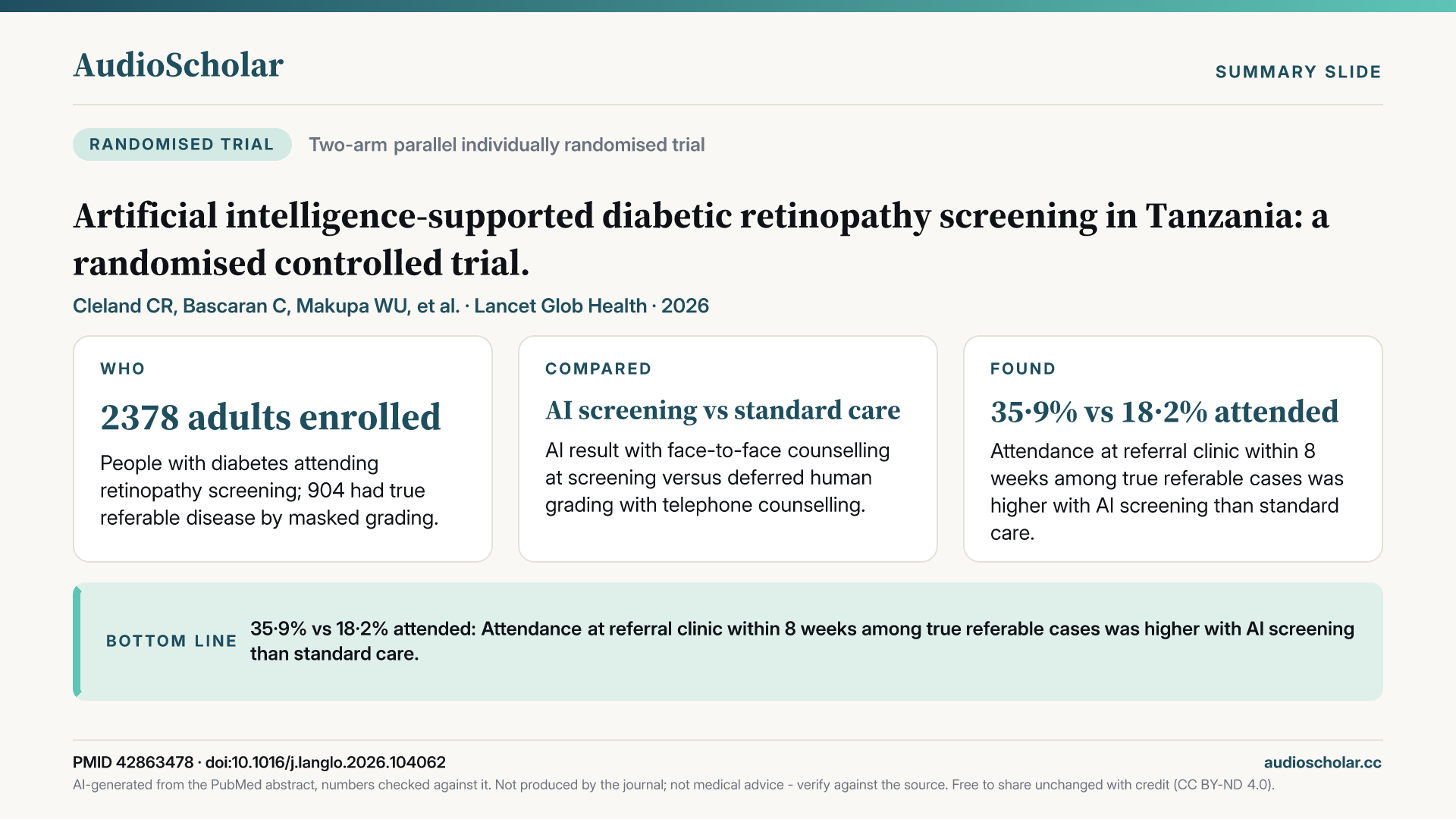
Artificial intelligence-supported diabetic retinopathy screening in Tanzania: a randomised controlled trial.
In a Tanzanian randomised trial, point-of-screening AI results with face-to-face counselling roughly doubled clinic attendance among people with referable diabetic retinopathy, from about 18 to 36 percent.
Cleland CR et al. · The Lancet Global Health · 2026
From the briefingIn The Lancet Global Health, Cleland and colleagues ran an individually randomised trial across 24 hospitals in the Kilimanjaro and Arusha regions of Tanzania, enrolling close to 2,400 adults with diabetes [1]. Patients in one arm received artificial intelligence grading of their retinal photographs with the result and face-to-face counselling before leaving the photography room, while patients in the other arm got standard deferred human grading with a telephone call a few weeks later. Among roughly 900 people whom masked graders confirmed had true referable retinopathy, attendance at the central eye clinic within eight weeks roughly doubled, from about 18 percent to about 36 percent. That is a large, statistically robust effect from a well-designed trial, though it is worth noting that even in the intervention arm, nearly two thirds of referable patients still did not attend, and the intervention bundles the algorithm with in-person counselling, so the trial cannot separate the two. The authors conclude that such pathways have the potential to strengthen screening programmes in Africa.
If you only have time for one paper this week, make it the Tanzanian artificial intelligence screening trial in The Lancet Global Health [1]. It is randomised evidence that the value of point-of-care artificial intelligence lies not only in grading accuracy but in closing the referral gap, a question most screening programmes have not been able to answer.
Written by AI from the published abstract, for healthcare professionals. Not medical advice; check the paper before acting on it.
- 02
Serum Ang-1, sFLT-1, and sST2 Profiles Distinguish Anti-VEGF Responders in Diabetic Macular Edema.
In 44 patients with diabetic macular edema, higher serum angiopoietin-1, soluble FLT-1 and soluble ST2 levels were associated with anti-VEGF response, a small hypothesis-generating biomarker signal.
Ranga D et al. · Retina · 2026
From the briefingAt the other end of the diabetic pathway, Ranga and colleagues, writing in Retina, measured serum cytokines in 44 patients with diabetic macular edema treated with at least three anti-VEGF injections [2]. Responders, whose vision and central retinal thickness improved, had higher levels of angiopoietin-1, soluble FLT-1, and soluble ST2, and ratios of these markers discriminated responders from non-responders with high accuracy in this sample. This is a small, single-centre association study, so it is hypothesis-generating rather than a test ready for clinical use.
Written by AI from the published abstract, for healthcare professionals. Not medical advice; check the paper before acting on it.
- 03
Outcomes of Complex Retinal Detachment Repair with Proliferative Vitreoretinopathy Grade C using the Cincinnati Methotrexate Protocol.
In a retrospective 300-eye cohort with grade C PVR, perioperative methotrexate was associated with higher single surgery success, less recurrent PVR and better vision, without excess serious adverse events.
Huang D et al. · Ophthalmology Retina · 2026
From the briefingIn Ophthalmology Retina, Huang and colleagues report on the Cincinnati methotrexate protocol, an intraoperative infusion of 40 milligrams per 500 millilitres in the balanced salt solution followed by intravitreal injections of 200 to 400 micrograms at weeks 1, 3, 6 and 10 [3]. Comparing 150 treated eyes with 150 contemporaneous eyes with grade C disease that did not receive methotrexate, treated eyes had roughly five times the odds of single surgery success and substantially lower odds of recurrent proliferative vitreoretinopathy, with better vision at every time point through one year and no excess in serious ocular adverse events. The difference in final anatomic failure did not hold up after adjustment. This is retrospective, non-randomised, single-centre data, so selection effects cannot be excluded, but it is a sizable cohort.
Written by AI from the published abstract, for healthcare professionals. Not medical advice; check the paper before acting on it.
- 04
Pharmacological strategies for the prevention and treatment of proliferative vitreoretinopathy: A comprehensive review.
Anti-inflammatory and anti-VEGF agents have failed to improve reattachment in PVR trials, whereas antiproliferative agents, led by methotrexate, appear more promising for prevention and treatment.
Giannuzzi F et al. · Survey of Ophthalmology · 2026
From the briefingA comprehensive review in Survey of Ophthalmology by Giannuzzi and colleagues places this in context [4]: anti-inflammatory and anti-VEGF agents have not improved reattachment rates in human trials, while antiproliferative agents look more promising, with methotrexate described as the leading candidate alongside combined 5-fluorouracil and heparin, daunorubicin, and emerging Rho kinase and mTOR inhibitors. Together they strengthen the case for methotrexate as an adjunct in high-risk detachments, while underscoring that randomised evidence is still what the field needs.
Written by AI from the published abstract, for healthcare professionals. Not medical advice; check the paper before acting on it.
- 05
Clinical outcomes of epiretinal membrane surgery in patients with good baseline visual acuity.
Among 163 eyes with symptomatic epiretinal membrane and vision of 20/40 or better, 80 percent kept or improved acuity, 92 percent reported symptom improvement, and 1.2 percent suffered major loss.
Jones RL et al. · Retina · 2026
From the briefingAlso in Retina, Jones and colleagues addressed a common counselling question: whether epiretinal membrane surgery is worthwhile when vision is still 20/40 or better [5]. Across four United Kingdom centres and 163 eyes, mean visual acuity was essentially unchanged after surgery, but 80 percent of eyes maintained or improved their vision, 92 percent of patients reported symptomatic improvement, and two eyes, just over one percent, ended worse than 20/200. Those figures give clinicians concrete risk numbers for shared decision-making, though they come from a retrospective review without a comparison group.
Written by AI from the published abstract, for healthcare professionals. Not medical advice; check the paper before acting on it.
- 06
Aspergillus Endophthalmitis: Clinical Features, Treatment Modalities, and Visual Outcomes.
In 14 eyes with Aspergillus endophthalmitis treated with intravitreal and systemic antifungals and usually vitrectomy, only one reached 20/200 and half ended with light perception or worse.
Kang S et al. · Investigative Ophthalmology and Visual Science · 2026
From the briefingFinally in this theme, Kang and colleagues at Bascom Palmer, publishing in Investigative Ophthalmology and Visual Science, describe 14 eyes with Aspergillus endophthalmitis over about eleven years [6]. Despite intravitreal voriconazole in most eyes, systemic antifungals, and vitrectomy in nearly all, only one eye reached 20/200 or better, and half of the eyes ended with light perception or worse. It is a small case series, but it documents how poor the prognosis remains, with distinct patterns between exogenous and endogenous disease.
Written by AI from the published abstract, for healthcare professionals. Not medical advice; check the paper before acting on it.
- 07
Cytopathology and Prognostic Accuracy of 15-GEP/PRAME: The Collaborative Ocular Oncology Group Study 2.
In about 1,500 uveal melanoma patients, metastasis rates within each 15-GEP/PRAME class did not differ by cytopathology confirmation, supporting the assay's prognostic validity when cytopathology is unavailable.
Lane AM et al. · JAMA Ophthalmology · 2026
From the briefingIn JAMA Ophthalmology, Lane and colleagues report from the Collaborative Ocular Oncology Group Study 2, a prospective multicentre cohort of about 1,500 patients tested with the 15-gene expression profile plus PRAME assay [7]. Roughly half of these patients had confirmatory cytopathology. Metastasis was more common in the group with confirmed cytopathology, but that group also had more high-risk class 2, PRAME-positive tumours, and once gene expression class was accounted for, metastasis rates did not differ by cytopathology status. The authors conclude that the gene expression classification retains prognostic validity even when cytopathology is unavailable or nondiagnostic, which supports its use for guiding surveillance in that setting. One caveat is that melanoma-associated mutations were found less often in the group without cytopathology, raising the possibility that some of those samples or diagnoses differ.
Written by AI from the published abstract, for healthcare professionals. Not medical advice; check the paper before acting on it.
- 08
The Second and Third Decade After 103Pd Plaque Brachytherapy for Choroidal Melanoma.
Among 170 choroidal melanoma patients followed at least ten years after palladium-103 plaque brachytherapy, local control was 100 percent, and about 64 percent retained 20/200 or better at 20 years.
Labkovich M, Finger PT · Ophthalmology · 2026
From the briefingComplementing this, Labkovich and Finger, in Ophthalmology, report 170 patients followed at least ten years after palladium-103 plaque brachytherapy [8]. Local tumour control was 100 percent, only one eye was enucleated, and the proportion retaining 20/200 or better vision was about 93 percent at 12 years, 87 percent at 15 years, and just under two thirds at 20 years. Tumours near the fovea or optic disc fared worst visually. As a single-centre retrospective series, it lacks a comparison arm, but it offers rare two-decade data useful for counselling.
Written by AI from the published abstract, for healthcare professionals. Not medical advice; check the paper before acting on it.
- 09
Topical Insulin in the Treatment of Ocular Surface Disease: A Retrospective Cohort Study.
In a retrospective 57-eye cohort, topical insulin succeeded in about 84 percent of neurotrophic keratopathy eyes and closed most persistent epithelial defects, though prospective trials are still needed.
Lammens M et al. · Cornea · 2026
From the briefingLammens and colleagues reviewed 57 eyes treated with topical insulin at one unit per millilitre four times daily across two Belgian university hospitals [9]. Treatment success was highest in neurotrophic keratopathy, at about 84 percent, considerably lower in dry eye and graft-versus-host disease, and about seven in ten persistent epithelial defects closed completely in around five weeks, with one transient pressure rise as the only adverse event. The authors describe topical insulin as safe and affordable but explicitly call for prospective trials before it can be placed in standard protocols.
Written by AI from the published abstract, for healthcare professionals. Not medical advice; check the paper before acting on it.
- 10
Severe Dupilumab-Associated Ocular Surface Disease: Multicenter Experience and Management Considerations.
In 13 patients with severe dupilumab-associated ocular surface disease, mild nonspecific early symptoms delayed referral, allowing limbal stem cell deficiency and scarring, while pre-existing atopic eye disease marked higher risk.
Kufta A et al. · Cornea · 2026
From the briefingKufta and colleagues describe 13 patients with severe dupilumab-associated ocular surface disease [10]. Every patient initially had nonspecific redness and itching, symptom onset ranged up to three years after starting the drug, and by referral some had limbitis, corneal neovascularisation, limbal stem cell deficiency, or cicatricial conjunctivitis. Just under half of the patients had pre-existing atopic eye disease, and dupilumab was stopped in about half. Most patients stabilised, but as a small case series it can describe the spectrum of disease, not its frequency.
Written by AI from the published abstract, for healthcare professionals. Not medical advice; check the paper before acting on it.
The full briefing
This AudioScholar briefing is generated by artificial intelligence for healthcare professionals and trainees. It is not medical advice.
Welcome to This Week in Ophthalmology. This week we're covering 10 notable papers spanning diabetic eye disease and screening, vitreoretinal surgery and its complications, ocular oncology, and the ocular surface. Let's dive in.
We start with diabetic eye disease, where the bottleneck is often not detection but getting patients to the people who can treat them. In The Lancet Global Health, Cleland and colleagues ran an individually randomised trial across 24 hospitals in the Kilimanjaro and Arusha regions of Tanzania, enrolling close to 2,400 adults with diabetes [1]. Patients in one arm received artificial intelligence grading of their retinal photographs with the result and face-to-face counselling before leaving the photography room, while patients in the other arm got standard deferred human grading with a telephone call a few weeks later. Among roughly 900 people whom masked graders confirmed had true referable retinopathy, attendance at the central eye clinic within eight weeks roughly doubled, from about 18 percent to about 36 percent. That is a large, statistically robust effect from a well-designed trial, though it is worth noting that even in the intervention arm, nearly two thirds of referable patients still did not attend, and the intervention bundles the algorithm with in-person counselling, so the trial cannot separate the two. The authors conclude that such pathways have the potential to strengthen screening programmes in Africa. At the other end of the diabetic pathway, Ranga and colleagues, writing in Retina, measured serum cytokines in 44 patients with diabetic macular edema treated with at least three anti-VEGF injections [2]. Responders, whose vision and central retinal thickness improved, had higher levels of angiopoietin-1, soluble FLT-1, and soluble ST2, and ratios of these markers discriminated responders from non-responders with high accuracy in this sample. This is a small, single-centre association study, so it is hypothesis-generating rather than a test ready for clinical use.
Turning to vitreoretinal surgery, proliferative vitreoretinopathy remains the main reason retinal detachment repair fails, and two papers this week converge on methotrexate. In Ophthalmology Retina, Huang and colleagues report on the Cincinnati methotrexate protocol, an intraoperative infusion of 40 milligrams per 500 millilitres in the balanced salt solution followed by intravitreal injections of 200 to 400 micrograms at weeks 1, 3, 6 and 10 [3]. Comparing 150 treated eyes with 150 contemporaneous eyes with grade C disease that did not receive methotrexate, treated eyes had roughly five times the odds of single surgery success and substantially lower odds of recurrent proliferative vitreoretinopathy, with better vision at every time point through one year and no excess in serious ocular adverse events. The difference in final anatomic failure did not hold up after adjustment. This is retrospective, non-randomised, single-centre data, so selection effects cannot be excluded, but it is a sizable cohort. A comprehensive review in Survey of Ophthalmology by Giannuzzi and colleagues places this in context [4]: anti-inflammatory and anti-VEGF agents have not improved reattachment rates in human trials, while antiproliferative agents look more promising, with methotrexate described as the leading candidate alongside combined 5-fluorouracil and heparin, daunorubicin, and emerging Rho kinase and mTOR inhibitors. Together they strengthen the case for methotrexate as an adjunct in high-risk detachments, while underscoring that randomised evidence is still what the field needs.
Also in Retina, Jones and colleagues addressed a common counselling question: whether epiretinal membrane surgery is worthwhile when vision is still 20/40 or better [5]. Across four United Kingdom centres and 163 eyes, mean visual acuity was essentially unchanged after surgery, but 80 percent of eyes maintained or improved their vision, 92 percent of patients reported symptomatic improvement, and two eyes, just over one percent, ended worse than 20/200. Those figures give clinicians concrete risk numbers for shared decision-making, though they come from a retrospective review without a comparison group. Finally in this theme, Kang and colleagues at Bascom Palmer, publishing in Investigative Ophthalmology and Visual Science, describe 14 eyes with Aspergillus endophthalmitis over about eleven years [6]. Despite intravitreal voriconazole in most eyes, systemic antifungals, and vitrectomy in nearly all, only one eye reached 20/200 or better, and half of the eyes ended with light perception or worse. It is a small case series, but it documents how poor the prognosis remains, with distinct patterns between exogenous and endogenous disease.
In ocular oncology, two papers speak to prognostication and long-term treatment outcomes in uveal melanoma. In JAMA Ophthalmology, Lane and colleagues report from the Collaborative Ocular Oncology Group Study 2, a prospective multicentre cohort of about 1,500 patients tested with the 15-gene expression profile plus PRAME assay [7]. Roughly half of these patients had confirmatory cytopathology. Metastasis was more common in the group with confirmed cytopathology, but that group also had more high-risk class 2, PRAME-positive tumours, and once gene expression class was accounted for, metastasis rates did not differ by cytopathology status. The authors conclude that the gene expression classification retains prognostic validity even when cytopathology is unavailable or nondiagnostic, which supports its use for guiding surveillance in that setting. One caveat is that melanoma-associated mutations were found less often in the group without cytopathology, raising the possibility that some of those samples or diagnoses differ. Complementing this, Labkovich and Finger, in Ophthalmology, report 170 patients followed at least ten years after palladium-103 plaque brachytherapy [8]. Local tumour control was 100 percent, only one eye was enucleated, and the proportion retaining 20/200 or better vision was about 93 percent at 12 years, 87 percent at 15 years, and just under two thirds at 20 years. Tumours near the fovea or optic disc fared worst visually. As a single-centre retrospective series, it lacks a comparison arm, but it offers rare two-decade data useful for counselling.
Our final theme is the ocular surface, with two papers in Cornea. Lammens and colleagues reviewed 57 eyes treated with topical insulin at one unit per millilitre four times daily across two Belgian university hospitals [9]. Treatment success was highest in neurotrophic keratopathy, at about 84 percent, considerably lower in dry eye and graft-versus-host disease, and about seven in ten persistent epithelial defects closed completely in around five weeks, with one transient pressure rise as the only adverse event. The authors describe topical insulin as safe and affordable but explicitly call for prospective trials before it can be placed in standard protocols. Kufta and colleagues describe 13 patients with severe dupilumab-associated ocular surface disease [10]. Every patient initially had nonspecific redness and itching, symptom onset ranged up to three years after starting the drug, and by referral some had limbitis, corneal neovascularisation, limbal stem cell deficiency, or cicatricial conjunctivitis. Just under half of the patients had pre-existing atopic eye disease, and dupilumab was stopped in about half. Most patients stabilised, but as a small case series it can describe the spectrum of disease, not its frequency.
If you only have time for one paper this week, make it the Tanzanian artificial intelligence screening trial in The Lancet Global Health [1]. It is randomised evidence that the value of point-of-care artificial intelligence lies not only in grading accuracy but in closing the referral gap, a question most screening programmes have not been able to answer.
Here is what this week's evidence adds up to in Ophthalmology. First, a randomised trial shows that point-of-screening artificial intelligence results with in-person counselling roughly doubled referral attendance in Tanzania, though most referable patients still did not attend. Second, retrospective data and a broad review both point to methotrexate as the most promising pharmacologic adjunct against proliferative vitreoretinopathy, but randomised confirmation is still lacking. Third, for uveal melanoma, prospective cohort data support gene expression prognostication even without cytopathology, and long-term palladium plaque data show durable tumour control with vision declining over the second decade. Fourth, retrospective series give useful counselling figures for epiretinal membrane surgery in eyes with good vision and early, uncontrolled signals for topical insulin in neurotrophic keratopathy. And finally, case series on dupilumab-related surface disease and Aspergillus endophthalmitis highlight underrecognised and still poorly treated conditions, without yet defining how common they are.
That's your roundup for This Week in Ophthalmology. The full transcript and references are available on the episode page. This is an AI-curated summary — for clinical decisions, always consult primary sources and current guidelines. See you next week.
If this weekly briefing is useful, follow the show in your podcast app so new episodes arrive automatically. And a quick rating on Apple Podcasts or Spotify helps other physicians discover the show.
This is an automated summary generated by artificial intelligence, which can make mistakes. Always review the original source materials.
Spot something worth flagging?
Get this every week in your podcast app — free.
New ophthalmology episodes land in your feed automatically — listen on your commute.