AI in Medicine Update — Oct 24, 2026
Generated Oct 25, 2026 · 10:04
The latest research on this topic, summarized for clinicians.
If the audio fails to play, refresh the page to renew the link.
Get this every week in your podcast app — free.
New research episodes land in your feed automatically — listen on your commute.
Overuse and False Restraint in Large Language Model Recommendations for Choosing Wisely Scenarios.
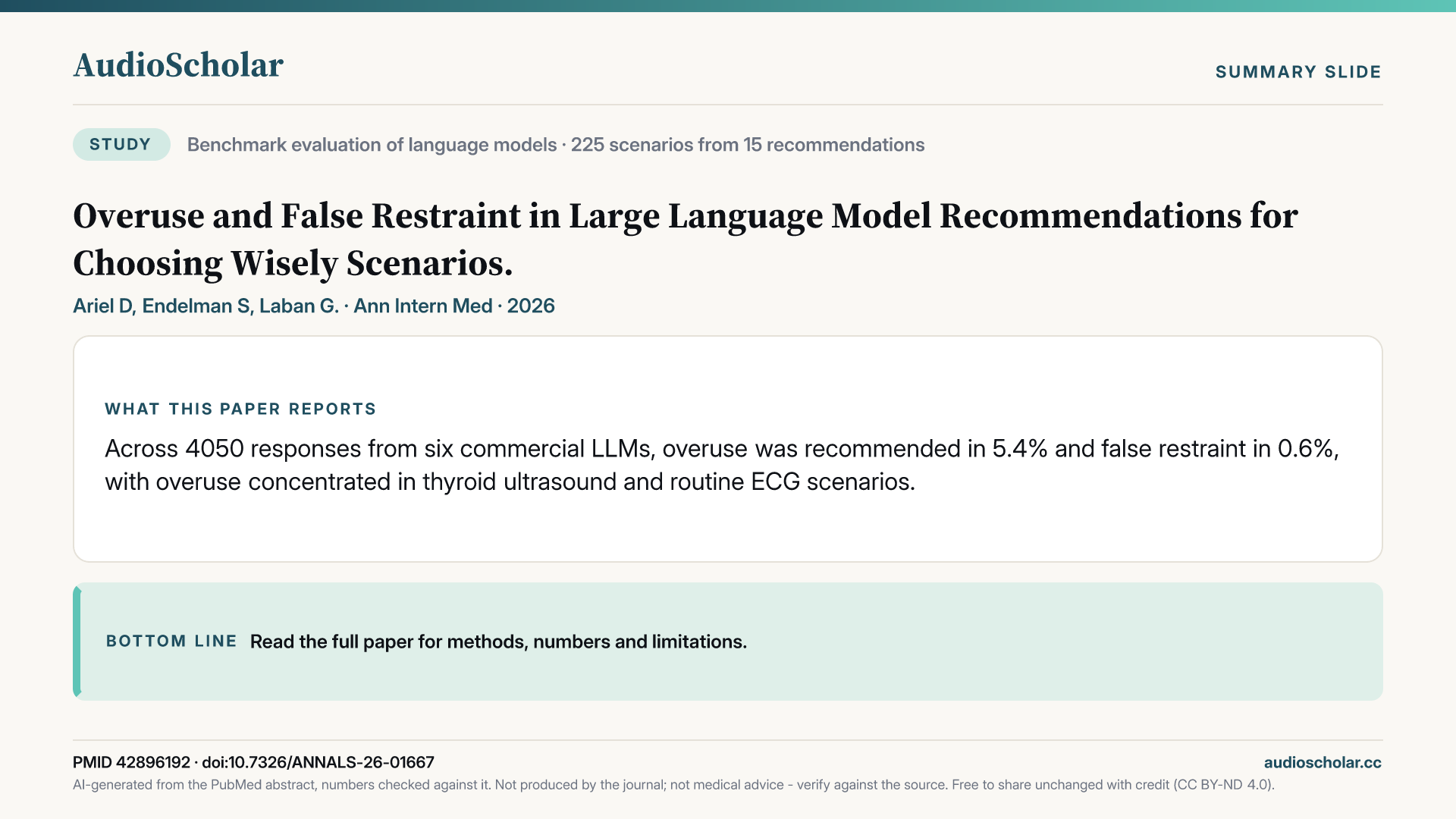
Across 4050 responses from six commercial LLMs, overuse was recommended in 5.4% and false restraint in 0.6%, with overuse concentrated in thyroid ultrasound and routine ECG scenarios.
Annals of Internal Medicine · 2026 · PubMed

Papers in this briefing
- 01
Sequential diagnosis with language models.
An AI panel system reached 83.2% accuracy on NEJM clinicopathological cases and 80.3% on MIMIC-IV-ED admissions versus 36.1% and 46.8% for generalist physicians, though only in a controlled benchmark setting.
Science · 2026
From the briefingThe biggest question in clinical AI right now is whether language models can reason through a case the way a clinician does, and two papers give answers that are hard to reconcile. Writing in Science, Nori and colleagues built a benchmark that releases case information only when it is asked for, so a model has to choose which history, exam findings or tests to pursue, and every choice carries a cost [1]. Their system simulates a panel of physicians that keeps revising the differential. On New England Journal clinicopathological conference cases it reached the right diagnosis about four times in five. Generalist physicians managed only about a third of those cases, and the system also kept spending on tests down. The authors are candid that this is a controlled benchmark. The physicians worked without colleagues or references, and the conference cases are deliberately hard puzzles rather than everyday medicine. The finding supports language models as diagnostic support, but there is no prospective patient evidence yet.
Written by AI from the published abstract, for healthcare professionals. Not medical advice; check the paper before acting on it.
- 02
Overuse and False Restraint in Large Language Model Recommendations for Choosing Wisely Scenarios.
Across 4050 responses from six commercial LLMs, overuse was recommended in 5.4% and false restraint in 0.6%, with overuse concentrated in thyroid ultrasound and routine ECG scenarios.
Annals of Internal Medicine · 2026
From the briefingThe Annals of Internal Medicine paper from Ariel and colleagues tests something closer to daily use [2]. The team built 225 scenarios from fifteen Choosing Wisely recommendations and put them to six commercial models, phrased as a clinician would ask. The models rarely failed to recommend care when care was appropriate. Overuse was also uncommon overall, but it was concentrated in two places. In more than four in ten responses, the models endorsed thyroid ultrasound for an incidental subcentimetre nodule. In more than a quarter of responses, they endorsed routine electrocardiograms for low-risk adults. These were single prompts, graded by a model judge with physician adjudication, and the results may not carry over to consumer use.
If you read only one paper from this period, make it the Annals of Internal Medicine study of language models in Choosing Wisely scenarios [2]. It tests the tools clinicians are already using, and it reopens the question of whether those tools quietly push toward low-value testing in a few specific, common situations.
Written by AI from the published abstract, for healthcare professionals. Not medical advice; check the paper before acting on it.
- 03
The anatomy of a personal health agent.
A multi-agent personal health system integrating wearable and medical-record data was evaluated across 11 benchmark tasks with over 7,000 expert and user annotations, providing the most comprehensive such evaluation to date.
Nature · 2026
From the briefingThe third language model paper moves from the clinician to the patient. In Nature, Heydari and colleagues describe a personal health agent that reasons over wearable data and medical records [3]. It splits the work among a data-science agent, a domain-expert agent and a coaching agent. The evaluation is unusually large, with more than seven thousand annotations from experts and end users across eleven tasks. It is still an evaluation of outputs, not outcomes. No one has yet shown that patients using such an agent end up healthier or better triaged, and the overuse pattern in the Annals data is a reasonable caution for any tool that interprets symptoms.
Written by AI from the published abstract, for healthcare professionals. Not medical advice; check the paper before acting on it.
- 04
Rapid patient-specific neural networks for X-ray to volume registration.
A self-supervised patient-specific network achieved 2D/3D registration in seconds across anatomies and hospitals, improving accuracy by an order of magnitude over existing methods after only 5 minutes of fine-tuning.
Nature · 2026
From the briefingLast, also in Nature, Gopalakrishnan and colleagues address a problem familiar to interventionalists: aligning a preoperative CT or MRI with live fluoroscopy [4]. Their open-source tool trains on the patient's own scan through physics-based simulation and adapts in about five minutes. In what the authors describe as the largest real-fluoroscopy evaluation to date, it improved accuracy by roughly an order of magnitude across anatomies and hospitals. Accuracy of alignment is not the same as better procedural outcomes, and that clinical evidence has not yet arrived.
Written by AI from the published abstract, for healthcare professionals. Not medical advice; check the paper before acting on it.
- 05
Artificial intelligence-enabled clinical phenotyping of human brown fat.
Machine-learning quantification of brown fat activity in about 8,700 patients linked higher activity to lower odds of cardiometabolic disease, and losartan increased brown adipocyte activity in a proof-of-concept experiment.
Nature · 2026
From the briefingIn Nature, Gómez-Banoy and colleagues mined more than a hundred thousand patients from a cancer centre who had PET scans, and used machine learning to quantify brown fat in roughly 8,700 of those patients [5]. People with active brown fat had less cardiovascular and psychiatric disease, along with better glucose, lipid and inflammatory profiles. Angiotensin receptor blocker use was associated with having brown fat, and a proof-of-concept experiment showed that losartan increased brown fat activity and energy expenditure. This is observational work in an oncology population, so confounding is a real concern, and the losartan signal is a hypothesis for repurposing, not a reason to prescribe.
Written by AI from the published abstract, for healthcare professionals. Not medical advice; check the paper before acting on it.
- 06
Sex-specific biological aging clocks across organs and omics.
Thirty-eight sex-specific AI aging clocks across 15 organ systems diverged between females and males and predicted systemic disease and mortality in sex- and organ-dependent ways.
Nature Medicine · 2026
From the briefingThen, in Nature Medicine, Song and colleagues argue that most existing clocks share a flaw: they were trained on men and women pooled together [6]. Their 38 sex-specific clocks across fifteen organ systems diverged markedly by sex, in their genetics, their protein networks and the outcomes they predicted. The brain clock tracked cognitive decline differently in women and men during a preclinical Alzheimer's trial. The authors themselves say pooled models remain useful.
Written by AI from the published abstract, for healthcare professionals. Not medical advice; check the paper before acting on it.
- 07
A machine learning-derived aging index for risk stratification and mortality prediction in cardiovascular-kidney-metabolic syndrome: A retrospective cohort study.
A machine-learning aging index outperformed PhenoAge and KDM, with 5-year AUC of 0.907 for all-cause mortality, though validation in geographically independent cohorts remains limited.
PLOS Medicine · 2026
From the briefingIn PLOS Medicine, Zhu and colleagues took the opposite approach and built a clock tailored to one syndrome, cardiovascular-kidney-metabolic disease [7]. Using national survey data on just under seven thousand United States adults, they screened more than a hundred candidate models. Interestingly, the winner was a simple Cox model. It discriminated mortality very well and outperformed general-purpose measures such as PhenoAge. The study is retrospective, though, and the only external check was a hospital cohort of 261 patients in China with no mortality follow-up. The authors call the index implementable, but that claim runs ahead of independent validation.
Written by AI from the published abstract, for healthcare professionals. Not medical advice; check the paper before acting on it.
- 08
Metabolomic aging and mortality clocks based on ensemble learning identify systemic aging risk across the human life span in 18,476 individuals.
Metabolomic age acceleration derived by ensemble learning in 18,476 participants was associated with incident fatty liver, hypertension, diabetes and all-cause mortality over follow-up from 2019 to 2025.
Science Translational Medicine · 2026
From the briefingIn Science Translational Medicine, Cao and colleagues profiled plasma metabolites in more than eighteen thousand people aged one to ninety-six across six Chinese centres [8]. They built an ensemble model of metabolomic age. People whose metabolomic age ran ahead of their real age went on to develop more fatty liver disease, hypertension and diabetes, and they had higher mortality. A separate metric tracked multimorbidity burden in a disease cohort. Follow-up was relatively short, the cohort came from a single country, and the mass spectrometry platform is not routine in clinical laboratories.
Written by AI from the published abstract, for healthcare professionals. Not medical advice; check the paper before acting on it.
- 09
Trastuzumab plus nivolumab with gemcitabine and cisplatin as first-line therapy for HER2-positive unresectable biliary tract cancer: a phase 1b/2 trial.
The quadruplet regimen achieved a 55% response rate in 40 patients, and AI-powered slide analysis suggested tumors with more HER2 3+ cells derived greater clinical benefit.
Nature Medicine · 2026
From the briefingThe pathology example comes from Nature Medicine, in a phase 1b/2 trial by Lee and colleagues [9]. They added trastuzumab and nivolumab to gemcitabine and cisplatin as first-line treatment for HER2-positive biliary tract cancer. Just over half of the forty participants responded, and median progression-free survival was about ten and a half months. The cost was substantial grade three or higher neutropenia, which affected more than half of the participants. The AI angle is a preplanned whole-slide analysis suggesting that tumours with a higher share of HER2 3+ cells benefited more. The trial was small, single-arm and open-label, so the slide-based biomarker is hypothesis-generating until the ongoing phase 3 studies test it.
Written by AI from the published abstract, for healthcare professionals. Not medical advice; check the paper before acting on it.
The full briefing
This AudioScholar briefing is generated by artificial intelligence for healthcare professionals and trainees. It is not medical advice.
Welcome to your weekly update in AI in Medicine. This period has three threads. Language models are being tested as diagnosticians, as advisers on low-value care, and as personal health coaches, and the results look strong on benchmarks but uneven where cost and restraint matter. Machine-learning aging clocks keep multiplying, and they now disagree about whether one clock can serve everyone. And AI is pulling clinical signal out of images we already acquire, from PET scans to pathology slides to the fluoroscopy suite. If you use chatbots at the point of care or order biomarker panels, this period is relevant to you.
The biggest question in clinical AI right now is whether language models can reason through a case the way a clinician does, and two papers give answers that are hard to reconcile. Writing in Science, Nori and colleagues built a benchmark that releases case information only when it is asked for, so a model has to choose which history, exam findings or tests to pursue, and every choice carries a cost [1]. Their system simulates a panel of physicians that keeps revising the differential. On New England Journal clinicopathological conference cases it reached the right diagnosis about four times in five. Generalist physicians managed only about a third of those cases, and the system also kept spending on tests down. The authors are candid that this is a controlled benchmark. The physicians worked without colleagues or references, and the conference cases are deliberately hard puzzles rather than everyday medicine. The finding supports language models as diagnostic support, but there is no prospective patient evidence yet.
The Annals of Internal Medicine paper from Ariel and colleagues tests something closer to daily use [2]. The team built 225 scenarios from fifteen Choosing Wisely recommendations and put them to six commercial models, phrased as a clinician would ask. The models rarely failed to recommend care when care was appropriate. Overuse was also uncommon overall, but it was concentrated in two places. In more than four in ten responses, the models endorsed thyroid ultrasound for an incidental subcentimetre nodule. In more than a quarter of responses, they endorsed routine electrocardiograms for low-risk adults. These were single prompts, graded by a model judge with physician adjudication, and the results may not carry over to consumer use.
Here the two papers pull apart. Nori's system is presented as a cost-conscious tester, yet the off-the-shelf models in Ariel's study default to testing in exactly the places where restraint is the point. Part of the gap is design. One system is purpose-built and orchestrated, while the others are general models answering a single prompt. Settling the question would take a head-to-head comparison in real encounters, measuring both diagnostic accuracy and the low-value tests actually ordered.
The third language model paper moves from the clinician to the patient. In Nature, Heydari and colleagues describe a personal health agent that reasons over wearable data and medical records [3]. It splits the work among a data-science agent, a domain-expert agent and a coaching agent. The evaluation is unusually large, with more than seven thousand annotations from experts and end users across eleven tasks. It is still an evaluation of outputs, not outcomes. No one has yet shown that patients using such an agent end up healthier or better triaged, and the overuse pattern in the Annals data is a reasonable caution for any tool that interprets symptoms.
Biological age is the second area where AI is moving quickly. Three papers agree that a deviation from chronological age predicts disease and death, but they disagree about how a clock should be built.
In Science Translational Medicine, Cao and colleagues profiled plasma metabolites in more than eighteen thousand people aged one to ninety-six across six Chinese centres [8]. They built an ensemble model of metabolomic age. People whose metabolomic age ran ahead of their real age went on to develop more fatty liver disease, hypertension and diabetes, and they had higher mortality. A separate metric tracked multimorbidity burden in a disease cohort. Follow-up was relatively short, the cohort came from a single country, and the mass spectrometry platform is not routine in clinical laboratories.
In PLOS Medicine, Zhu and colleagues took the opposite approach and built a clock tailored to one syndrome, cardiovascular-kidney-metabolic disease [7]. Using national survey data on just under seven thousand United States adults, they screened more than a hundred candidate models. Interestingly, the winner was a simple Cox model. It discriminated mortality very well and outperformed general-purpose measures such as PhenoAge. The study is retrospective, though, and the only external check was a hospital cohort of 261 patients in China with no mortality follow-up. The authors call the index implementable, but that claim runs ahead of independent validation.
Then, in Nature Medicine, Song and colleagues argue that most existing clocks share a flaw: they were trained on men and women pooled together [6]. Their 38 sex-specific clocks across fifteen organ systems diverged markedly by sex, in their genetics, their protein networks and the outcomes they predicted. The brain clock tracked cognitive decline differently in women and men during a preclinical Alzheimer's trial. The authors themselves say pooled models remain useful.
Put side by side, these papers do not agree on how a clock should be built. One favours a universal metabolomic clock, one a disease-specific clock, and one a sex-specific clock, and each beats some comparator chosen by its own authors. None of them shows that knowing a patient's biological age changes management or outcomes. What would settle it is running all three approaches in the same independent cohort and testing whether any of them improves decisions beyond standard risk scores.
Finally, three papers show AI extracting value from images that are already sitting in hospital systems.
In Nature, Gómez-Banoy and colleagues mined more than a hundred thousand patients from a cancer centre who had PET scans, and used machine learning to quantify brown fat in roughly 8,700 of those patients [5]. People with active brown fat had less cardiovascular and psychiatric disease, along with better glucose, lipid and inflammatory profiles. Angiotensin receptor blocker use was associated with having brown fat, and a proof-of-concept experiment showed that losartan increased brown fat activity and energy expenditure. This is observational work in an oncology population, so confounding is a real concern, and the losartan signal is a hypothesis for repurposing, not a reason to prescribe.
The pathology example comes from Nature Medicine, in a phase 1b/2 trial by Lee and colleagues [9]. They added trastuzumab and nivolumab to gemcitabine and cisplatin as first-line treatment for HER2-positive biliary tract cancer. Just over half of the forty participants responded, and median progression-free survival was about ten and a half months. The cost was substantial grade three or higher neutropenia, which affected more than half of the participants. The AI angle is a preplanned whole-slide analysis suggesting that tumours with a higher share of HER2 3+ cells benefited more. The trial was small, single-arm and open-label, so the slide-based biomarker is hypothesis-generating until the ongoing phase 3 studies test it.
Last, also in Nature, Gopalakrishnan and colleagues address a problem familiar to interventionalists: aligning a preoperative CT or MRI with live fluoroscopy [4]. Their open-source tool trains on the patient's own scan through physics-based simulation and adapts in about five minutes. In what the authors describe as the largest real-fluoroscopy evaluation to date, it improved accuracy by roughly an order of magnitude across anatomies and hospitals. Accuracy of alignment is not the same as better procedural outcomes, and that clinical evidence has not yet arrived.
If you read only one paper from this period, make it the Annals of Internal Medicine study of language models in Choosing Wisely scenarios [2]. It tests the tools clinicians are already using, and it reopens the question of whether those tools quietly push toward low-value testing in a few specific, common situations.
Here is what this period adds up to. First, language models now look like strong diagnosticians on benchmarks, but all of that evidence is simulated, and no prospective study with patients exists yet. Second, the same class of tools shows a small but concentrated tendency toward overuse, which sits in tension with claims of cost-conscious reasoning. Third, aging clocks consistently predict disease and death, but the field has not agreed on whether clocks should be universal, disease-specific or sex-specific, and none has yet been shown to change care. Fourth, imaging-derived AI keeps producing intriguing leads, from brown fat to HER2 heterogeneity, that remain observational or early-phase. The things to watch for are real-world trials of diagnostic agents and the phase 3 HER2 biliary results.
That's your AI in Medicine update for this period. Until next time.
This is an automated summary generated by artificial intelligence, which can make mistakes. Always review the original source materials.
Spot something worth flagging?
Get this every week in your podcast app — free.
New research episodes land in your feed automatically — listen on your commute.