Peritoneal Dialysis Update — Sep 3, 2026
Generated Oct 8, 2026 · 11:41
The latest research on this topic, summarized for clinicians.
If the audio fails to play, refresh the page to renew the link.
Get this every week in your podcast app — free.
New research episodes land in your feed automatically — listen on your commute.
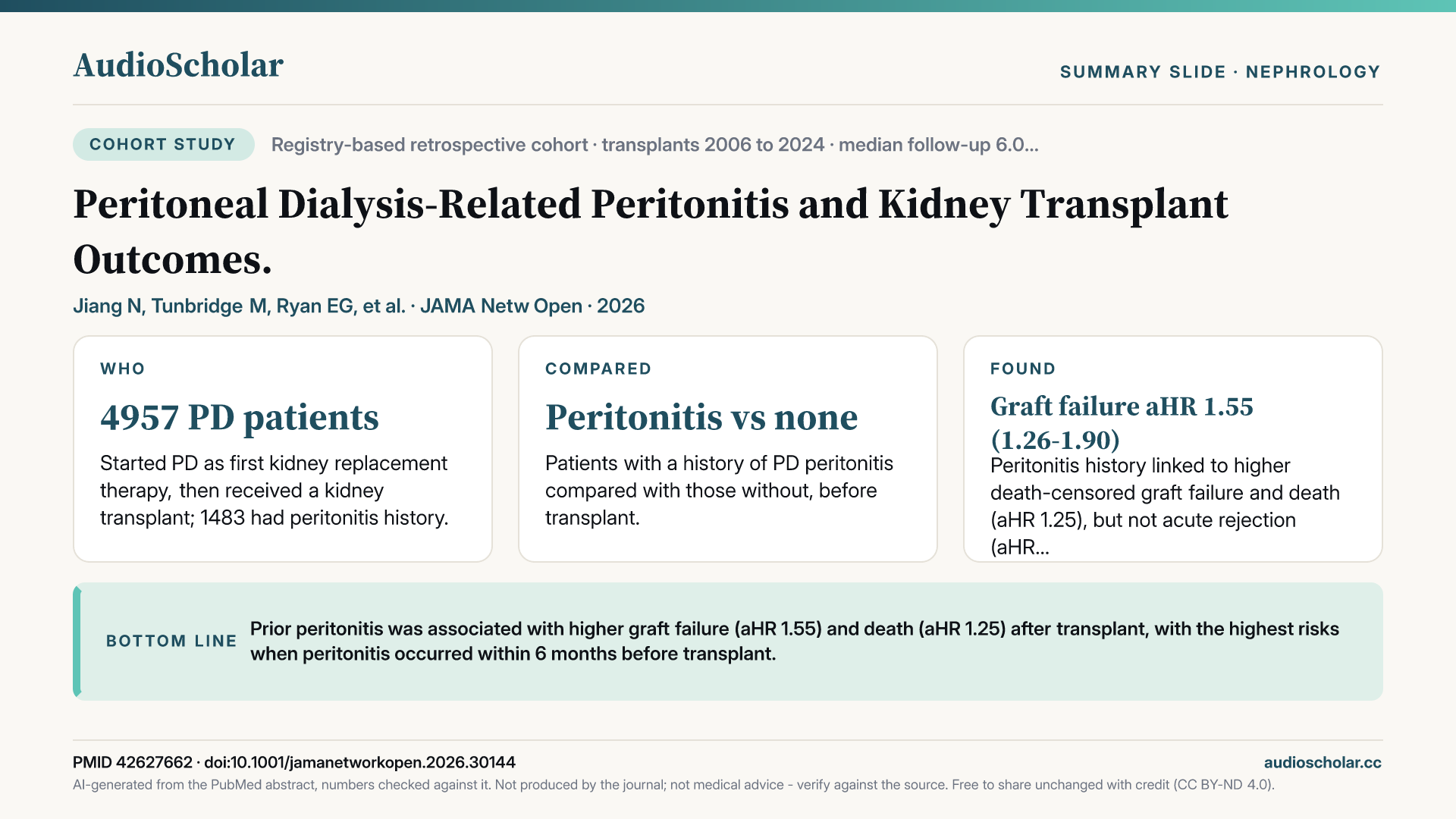
Peritoneal Dialysis-Related Peritonitis and Kidney Transplant Outcomes.
Prior peritonitis was associated with higher graft failure (aHR 1.55) and death (aHR 1.25) after transplant, with the highest risks when peritonitis occurred within 6 months before transplant.
JAMA network open · 2026 · PubMed

Papers in this briefing
- 01
Peritoneal Dialysis-Related Peritonitis and Kidney Transplant Outcomes.
Prior peritonitis was associated with higher graft failure (aHR 1.55) and death (aHR 1.25) after transplant, with the highest risks when peritonitis occurred within 6 months before transplant.
JAMA network open · 2026
- 02
Peritonitis and Mortality Risks of Gastric Acid Suppressants in Patients Undergoing Peritoneal Dialysis.
PPI initiation raised peritonitis risk (HR 1.53) and all-cause mortality (HR 1.55); H2RAs carried smaller increases, and PPIs showed higher mortality than H2RAs, supporting cautious acid-suppressant use in PD.
Kidney International Reports · 2026
- 03
Exit-site infection and subsequent incident risk of peritoneal dialysis-associated peritonitis: a retrospective cohort study with meta-analysis.
Exit-site infection was associated with a five-fold higher subsequent peritonitis risk (HR 5.30), peaking around 18-fold within one month, and a pooled meta-analysis confirmed the association (HR 3.37).
Frontiers in public health · 2026
- 04
Evaluating Patterns and Outcomes in the Prescription of Incremental Peritoneal Dialysis in Support of Shared Decision Making.
About 64% remained on their starting regimen at one year, with low hemodialysis transfer and mortality (0.11 events per person-year), supporting the safety of incremental PD prescribing.
Clinical Journal of the American Society of Nephrology · 2026
- 05
Changing prognostic significance of peritoneal transport status in contemporary incident peritoneal dialysis patients.
High transport status was not independently associated with technique failure in adjusted models, and its adverse impact attenuated across treatment eras (interaction P=.044), suggesting PET should guide prescription rather than predict outcome.
Clinical kidney journal · 2026
- 06
Metabolic Phenotype-Stratified Associations Between Obesity/Overweight and Mortality in Peritoneal Dialysis Patients.
Metabolically unhealthy overweight/obese (HR 1.206) and non-obese (HR 1.169) patients had higher mortality than metabolically healthy non-obese patients, while metabolically healthy obesity carried no excess risk.
Journal of renal nutrition · 2026
- 07
PNI, CONUT, and GNRI for predicting treatment failure in peritoneal dialysis-associated peritonitis: a two-center retrospective study.
Treatment failure occurred in 30.8% of peritonitis episodes; the Prognostic Nutritional Index predicted it best (AUC 0.712) and added the most incremental value over CONUT and GNRI.
Frontiers in nutrition · 2026
- 08
Social Risk Factors and Peritoneal Dialysis Use Among Maintenance Dialysis Patients: A National Cross-Sectional Study.
One social risk factor (aOR 1.46) or more than one (aOR 2.27) was associated with nonreceipt of PD, with housing instability and transportation insecurity independently associated.
Kidney medicine · 2026
- 09
Fragility fractures and risk factors in a peritoneal dialysis setting.
Fragility fractures affected 9.8% of PD patients, mostly asymptomatic vertebral fractures; prior fracture and vascular calcification predicted risk, while FRAX discriminated poorly (AUC 0.69).
Archives of osteoporosis · 2026
- 10
Effects and Safety of Henagliflozin on Cardiac Structure in Dialysis Patients with Heart Failure with Preserved Ejection Fraction.
Henagliflozin reduced left ventricular mass index versus placebo by 5.27 g/m2 over 24 weeks (P=0.03) with similar adverse events, though secondary outcomes did not differ.
Clinical Journal of the American Society of Nephrology · 2026
The full briefing
This AudioScholar briefing is generated by artificial intelligence for healthcare professionals and trainees. It is not medical advice.
Welcome to your bi-weekly update in Peritoneal Dialysis. This period is dominated by peritonitis: what predicts it, how a commonly prescribed drug class tracks with it, and how long its shadow lasts, right through to kidney transplant. Alongside that, several cohorts question old prognostic assumptions about transport status, obesity and the safety of starting dialysis at a lower dose. A new randomized trial puts an SGLT2 inhibitor into dialysis patients with preserved ejection fraction heart failure. And a fracture study suggests the standard risk tool misses many of the patients who are actually breaking bones.
Peritonitis remains the complication that ends more peritoneal dialysis careers than any other, and this period's papers trace it from the earliest warning sign to its consequences years later.
The warning sign comes from a multicentre Thai cohort by Nochaiwong and colleagues in Frontiers in Public Health [3]. They matched about three hundred patients with a first exit-site infection to similar patients without one. After adjustment, an exit-site infection was followed by roughly a fivefold higher risk of peritonitis. The timing is the striking part: the excess risk peaked at around eighteenfold within the first month and faded to about double by the end of the first year. The signal held across causative organisms and infection severity. A small meta-analysis of three earlier cohorts pointed the same way, though with a smaller effect. The study is retrospective, and almost nine in ten patients were on continuous ambulatory dialysis, so its relevance to automated cycler programmes is less certain. Even so, it gives the first month after an exit-site infection a concrete risk figure, which earlier evidence lacked.
A more modifiable factor appears in Kidney International Reports, where Fan and colleagues used Hong Kong health records from nearly twelve thousand patients to emulate a target trial of gastric acid suppressants [2]. Starting a proton pump inhibitor was associated with about a fifty percent higher risk of peritonitis and a similar rise in all-cause mortality. Starting an H2 receptor antagonist carried a smaller but still real increase. The finding that complicates the story comes from the head-to-head comparison. Proton pump inhibitors and H2 blockers did not differ in peritonitis risk, yet proton pump inhibitors were tied to higher overall and peritonitis-related mortality. If the gut-barrier mechanism explained everything, the peritonitis gap should have tracked the mortality gap. The fact that it did not raises the possibility of residual confounding. Sicker patients may simply be more likely to receive a proton pump inhibitor, and the authors found the excess risk concentrated in patients with higher baseline risk. The design is careful, with sequential trials and weighting to limit immortal time bias, but it remains observational. Only a pragmatic deprescribing trial would separate drug effect from patient selection. For now, the study strengthens the case for scrutinising whether acid suppression is truly indicated in this population.
Once peritonitis has taken hold, the question becomes who will fail treatment. Zhang and colleagues, in Frontiers in Nutrition, compared three nutritional scores across almost four hundred episodes at two centres [7]. Close to a third of episodes ended in treatment failure. The prognostic nutritional index, which combines albumin and lymphocyte count, discriminated best and added meaningfully to a baseline model. The geriatric nutritional risk index did not. The discrimination is moderate rather than strong, the study is retrospective, and there was no external validation. The score is a plausible triage aid, not yet a validated one.
The consequences of peritonitis extend well beyond the dialysis years. In JAMA Network Open, Jiang and colleagues drew on the Australia and New Zealand registry to follow nearly five thousand patients who went from peritoneal dialysis to transplant [1]. Patients with any peritonitis history had a higher risk of graft failure and death over a median of six years, though not of rejection overall. Timing again proved decisive. Peritonitis within six months of transplant was associated with roughly double the risk of graft failure, and with higher rejection and mortality. More remote episodes showed no consistent excess risk. Episodes severe enough to force a move to haemodialysis carried the greatest graft risk. Patients with peritonitis were also more obese, more comorbid and had been on dialysis longer, so confounding is a real concern despite consistent sensitivity analyses. Taken together with the exit-site data, the picture is of infection risk that clusters in time, which argues for viewing recent infection history as a dynamic element of pretransplant assessment.
Moving from infection to prescription, several studies challenge risk markers that have long shaped how peritoneal dialysis is started and adjusted.
Selwood and colleagues, in the Clinical Journal of the American Society of Nephrology, followed 527 patients who began on incremental regimens at a single centre [4]. Nearly two thirds of patients were still on their starting prescription at one year, and over a third had not needed an increase by two years. Transfers to haemodialysis were uncommon and mortality was low. Younger age, male sex and lower albumin predicted an earlier need to increase the dose. This is a single experienced centre with no full-dose comparison group, so the safety conclusion reflects that programme rather than proven equivalence. The simple score the authors built to support shared decision-making still needs external validation.
In the Clinical Kidney Journal, Yoon and colleagues tracked 473 Korean patients across three treatment eras spanning nearly twenty-five years [5]. In the earliest era, high transporters had roughly double the crude rate of technique failure. That gap narrowed steadily and was minimal in the most recent era. After full adjustment, high transport status no longer predicted technique failure, while treatment era and serum albumin did. This runs directly against the traditional teaching that high transport is a poor prognostic sign. The authors argue that modern individualised prescribing, including icodextrin and automated regimens, has neutralised much of that disadvantage. It is a modest single-centre cohort, and the interaction between transport status and era was only borderline. A larger multicentre contemporary cohort would settle whether the reassurance generalises.
Obesity gets a similar reframing in the Journal of Renal Nutrition, where Shang and colleagues studied over four thousand patients, more than a thousand of whom died [6]. Metabolic status, rather than body mass index alone, tracked with mortality. Metabolically unhealthy patients carried higher risk whether or not they were overweight, while metabolically healthy overweight patients did not. The excess risks were modest, the study is observational, and metabolic status was measured once at baseline. Still, it supports metabolic profile as a more informative stratifier than weight alone.
Albumin connects these three cohorts, along with the nutritional scores in the peritonitis work. Across very different questions, it keeps emerging as the variable that matters.
Who reaches peritoneal dialysis in the first place is the question behind a national cross-sectional study in Kidney Medicine by Babroudi and colleagues [8]. They screened over seven thousand recent-start patients at a mid-sized dialysis provider in the United States. Patients with one social risk factor had moderately higher odds of not being on peritoneal dialysis, and patients with more than one had roughly double the odds. Housing instability and transportation insecurity stood out independently. Social risk factors were uncommon overall, the design cannot establish direction, and residual confounding is acknowledged. Even so, the findings point to housing and transport as concrete barriers to wider home dialysis uptake in the United States.
Finally, two papers look beyond the peritoneum at the heart and the skeleton.
In the Clinical Journal of the American Society of Nephrology, Yan and colleagues randomized 112 dialysis patients with heart failure with preserved ejection fraction to henagliflozin or placebo for twenty-four weeks [10]. Just under half of participants were on peritoneal dialysis. Henagliflozin reduced left ventricular mass index by about five grams per square metre relative to placebo, and adverse events were similar between groups. Echocardiographic filling measures and NT-proBNP did not move. The peritoneal dialysis subgroup showed a numerically larger effect, but it did not reach significance on its own. This is a small, short trial with a surrogate primary endpoint, and the authors call for larger studies. It is early, tolerable-looking evidence for SGLT2 inhibition in a population excluded from the landmark trials, and no guideline yet reflects it.
In Archives of Osteoporosis, Diz-Lopes and colleagues reviewed 325 Portuguese patients at a single centre [9]. Roughly one in ten patients had fragility fractures, most of them silent vertebral fractures found only on spine radiographs. Prior fracture and vascular calcification predicted fracture independently. The fracture risk tool FRAX discriminated only modestly and had very low sensitivity at standard thresholds, even when kidney disease was coded as secondary osteoporosis. The cohort is small and retrospective, with few fracture events, but the signal is clear that the standard tool underestimates risk in this group.
If you read only one paper from this period, make it the Australia and New Zealand registry study linking peritonitis to transplant outcomes. It reframes peritonitis from a dialysis-era event into a time-sensitive transplant risk factor, and it reopens the question of how recent infection should weigh on transplant timing.
Here is what this period adds up to. First, peritonitis risk appears strongly time-dependent, peaking soon after an exit-site infection and carrying the most transplant risk when recent; that pattern is consistent across two large observational datasets but untested prospectively. Second, the acid suppressant signal is now backed by a rigorous emulation, yet the mismatch between peritonitis and mortality in the head-to-head comparison leaves confounding by indication unresolved. Third, several traditional risk markers look weaker in contemporary practice, including high transport status, obesity without metabolic disease and reduced-dose starts, while albumin keeps resurfacing as the more durable signal; all of this rests on single-centre or observational data. Fourth, SGLT2 inhibition in dialysis-dependent heart failure now has a first randomized signal, small and surrogate-based. Worth watching are larger outcome trials of that approach and fracture risk tools built specifically for dialysis patients.
That's your Peritoneal Dialysis update for this period. Until next time.
This is an automated summary generated by artificial intelligence, which can make mistakes. Always review the original source materials.
Spot something worth flagging?
Get this every week in your podcast app — free.
New research episodes land in your feed automatically — listen on your commute.