This Week in Rheumatology — Oct 8, 2026
Generated Oct 8, 2026 · 11:12
The week's practice-changing Rheumatology research, summarized for clinicians.
If the audio fails to play, refresh the page to renew the link.
Get next week’s Rheumatology briefing — free.
In your podcast app, or readable in your inbox with the audio one tap away.
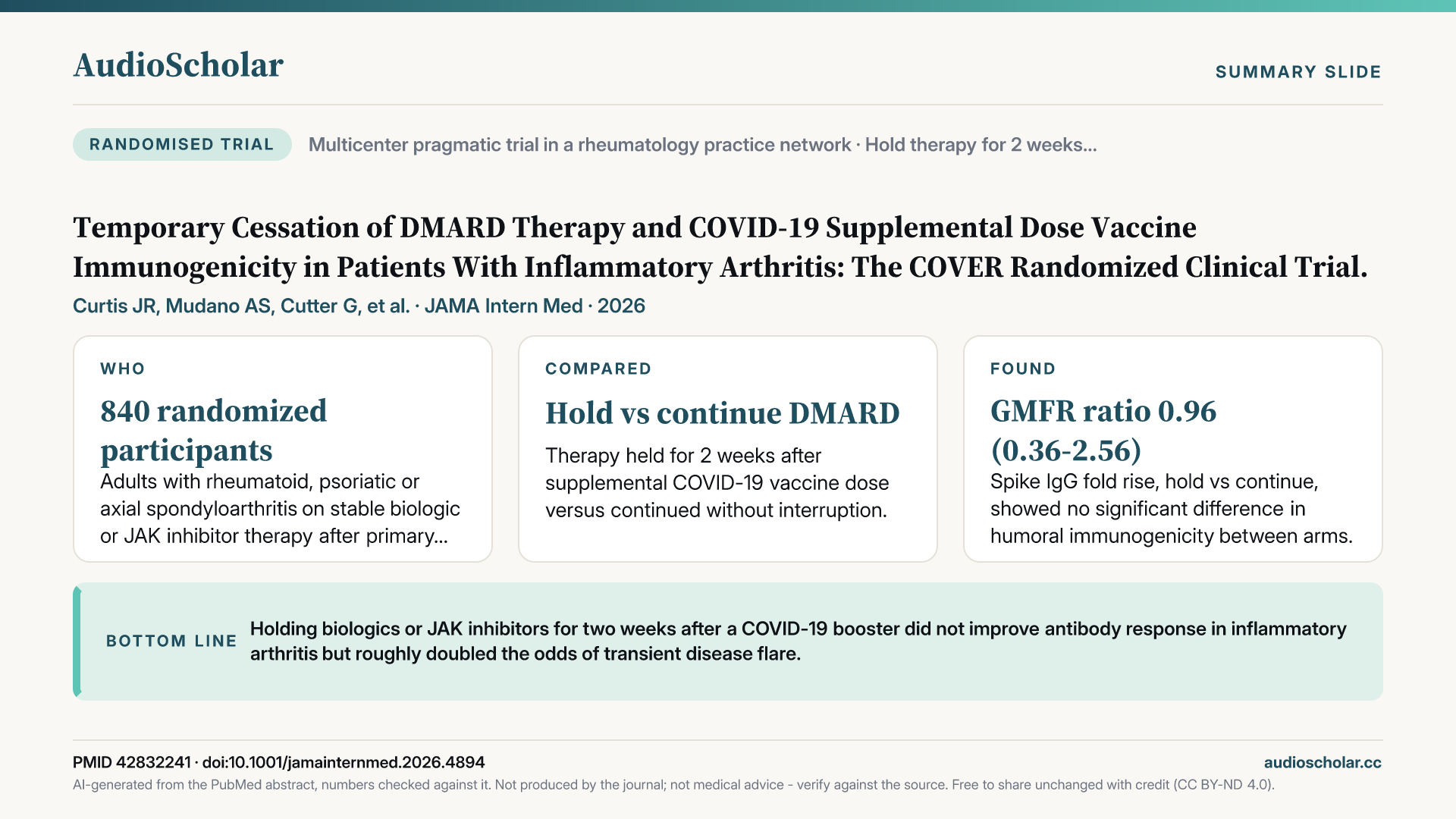
Temporary Cessation of DMARD Therapy and COVID-19 Supplemental Dose Vaccine Immunogenicity in Patients With Inflammatory Arthritis: The COVER Randomized Clinical Trial.
Holding biologics or JAK inhibitors for two weeks after a COVID-19 booster did not improve antibody response in inflammatory arthritis but roughly doubled the odds of transient disease flare.
JAMA Internal Medicine · 2026 · PubMed

This week’s papers
- 01
Outcomes of Tapering Biologic and Targeted Synthetic DMARDs in Rheumatoid Arthritis: A Multicenter Randomized Non-Inferiority Trial.
In rheumatoid arthritis with sustained low disease activity, stepwise biologic or targeted synthetic tapering was non-inferior to continuation at 24 weeks, though some secondary measures favoured continuation.
Park DJ et al. · Arthritis & Rheumatology · 2026
- 02
Comparative efficacy and safety of disease-modifying antirheumatic drugs tapering strategies in sustained-remission rheumatoid arthritis: Systematic review and network meta-analysis.
Across nineteen studies, tapering roughly doubled flare risk overall, but gradual biologic dose reduction with conventional DMARD backbone came closest to maintenance, whereas biologic discontinuation roughly tripled flares.
Tandi YYP et al. · Seminars in Arthritis and Rheumatism · 2026
- 03
Temporary Cessation of DMARD Therapy and COVID-19 Supplemental Dose Vaccine Immunogenicity in Patients With Inflammatory Arthritis: The COVER Randomized Clinical Trial.
Holding biologics or JAK inhibitors for two weeks after a COVID-19 booster did not improve antibody response in inflammatory arthritis but roughly doubled the odds of transient disease flare.
Curtis JR et al. · JAMA Internal Medicine · 2026
- 04
Preclinical and clinical outcomes in patients with high rheumatoid factor levels treated with TNF inhibitors:a systematic review.
Across 21 mostly observational studies, high rheumatoid factor patients on Fc-free TNF inhibitors had similar or slightly better outcomes than low rheumatoid factor patients, suggesting a possible advantage.
Smolen J et al. · Annals of the Rheumatic Diseases · 2026
- 05
Impact of bimekizumab on CANDEN spinal MRI inflammation & structural lesions in radiographic axial spondyloarthritis: 2-year phase 3 results.
Bimekizumab reduced spinal MRI inflammation in radiographic axial spondyloarthritis by week 16, sustained to two years, with early fat lesion increases and minimal change in erosions or new bone.
Maksymowych WP et al. · Rheumatology · 2026
- 06
Oral glucocorticoid dose patterns and organ damage in systemic lupus erythematosus - a nationwide cohort study.
In a Swedish nationwide lupus cohort, glucocorticoid dosing over the prior two years best captured organ damage risk, while cardiovascular damage reflected exposure over the preceding three years.
Dominicus A et al. · Arthritis & Rheumatology · 2026
- 07
Belimumab prevention against organ damage over 8 years and safety up to 13 years: three pooled open-label, long-term extension SLE studies.
In uncontrolled extension studies of 1,299 lupus patients, belimumab use accompanied progressive glucocorticoid reduction, minimal organ damage accrual over eight years, and no new safety signals over thirteen years.
Touma Z et al. · Lupus Science & Medicine · 2026
- 08
Study on the implementation of the 2015 EULAR/ACR recommendations for polymyalgia rheumatica in clinical practice.
An international survey found self-reported adherence to 2015 polymyalgia rheumatica recommendations of 83 percent among rheumatologists versus 35 percent among general practitioners, with far less methotrexate use in primary care.
di Lernia M et al. · RMD Open · 2026
- 09
CAR T cells for autoimmune diseases: 2026 update of the EBMT-ISCT-JACIE practice harmonisation and consensus recommendations.
Updated international consensus provides expert-based recommendations on patient selection, investigation, management, follow-up and immune monitoring for CAR T cell therapy across rheumatic and other autoimmune diseases.
Greco R et al. · Lancet Rheumatology · 2026
- 10
Immune reset in rheumatic autoimmune disease: from a tantalising metaphor to a measurable therapeutic state.
Experts argue immune reset should require sustained off-therapy control, organ stabilisation, rewired immune circuits and restored immune competence, and remains unproven across current autoimmune therapies.
Dörner T et al. · Annals of the Rheumatic Diseases · 2026
The full briefing
This AudioScholar briefing is generated by artificial intelligence for healthcare professionals and trainees. It is not medical advice.
Welcome to This Week in Rheumatology. This week we're covering 10 notable papers spanning when and how to step back from targeted therapy in inflammatory arthritis, the long shadow of glucocorticoids in lupus and polymyalgia, and the emerging framework around CAR T cells and the idea of immune reset. Let's dive in.
Our first theme is de-escalation, and three papers this week ask the same underlying question from different angles: what happens to disease control when we pull back on biologics or targeted synthetics? In Arthritis and Rheumatology, Park and colleagues report a multicentre, open-label, randomized non-inferiority trial of 348 patients with rheumatoid arthritis who had held low disease activity by DAS28-ESR for at least six months on a stable biologic or targeted synthetic drug. Patients were assigned to stepwise dose tapering or to continuation. At 24 weeks, low disease activity was maintained in close to ninety percent of patients in both arms, with a difference of under two points, which met the prespecified non-inferiority margin of ten percent. Most patients who worsened regained control after protocol-guided re-escalation. There is a note of caution, though: several secondary disease activity measures, including the SDAI at week 24, favoured continuation, and 24 weeks is a short horizon [1]. A network meta-analysis in Seminars in Arthritis and Rheumatism by Tandi and colleagues helps put that trial in context. Pooling nineteen studies and about 3,100 patients in sustained remission, the authors found that tapering overall roughly doubled the risk of flare compared with continuing therapy. But the strategies were not equal. Gradually reducing the biologic dose while keeping conventional synthetic therapy as a backbone came closest to maintenance, with no clear increase in flare, whereas stopping the biologic outright roughly tripled flare risk, with high confidence in that particular comparison [2]. Read together, the two papers support structured dose reduction rather than discontinuation as the gentler path, while reminding us that some loss of control is the price of any de-escalation.
The third paper in this theme looks at a short, deliberate interruption. In JAMA Internal Medicine, Curtis and colleagues report the COVER pragmatic trial, which randomized 840 patients with rheumatoid arthritis, psoriatic arthritis or axial spondyloarthritis on a TNF inhibitor, an interleukin-17 inhibitor, abatacept or a JAK inhibitor to either continue or hold therapy for two weeks after a supplemental COVID-19 mRNA vaccine dose. Antibody responses rose substantially in everyone, and holding therapy made no meaningful difference to the size of that rise, consistent across drug classes and half-lives. Holding therapy did, however, roughly double the odds of a flare, most markedly among patients on JAK inhibitors; on a validated flare questionnaire, about one in five patients who held therapy worsened meaningfully, compared with about one in eleven who continued. Flares resolved by six weeks [3]. The authors conclude that routine interruption at the time of a COVID booster is likely not warranted. The trial is large and randomized, though it addresses COVID boosters specifically, and whether the same logic extends to other vaccines is not tested here.
Staying with biologic selection, a systematic review in the Annals of the Rheumatic Diseases by Smolen and colleagues examines whether high rheumatoid factor levels blunt response to TNF inhibitors. The proposed mechanism is that rheumatoid factor binds the Fc portion of a biologic, forming immune complexes that are cleared and reduce drug levels. Across 21 studies, including clinical data on almost 9,000 patients, outcomes in high rheumatoid factor patients given Fc-free TNF inhibitors were similar to, or slightly better than, those in low rheumatoid factor patients [4]. The authors frame this cautiously, saying Fc-free agents may offer some advantage; this is a synthesis of mostly observational data rather than head-to-head trials. And in axial disease, Maksymowych and colleagues, writing in Rheumatology, report two-year spinal MRI findings from the BE MOBILE 2 trial of bimekizumab, the dual interleukin-17A and 17F inhibitor, in radiographic axial spondyloarthritis. Among 102 patients with scorable scans at every timepoint, spinal inflammation fell by week 16 across all anatomical locations and stayed down at two years; fat lesions increased early, largely in patients with baseline inflammation, and then plateaued, while erosions and new bone formation barely changed [5]. These are observed-case data from a subset with an open-label extension, so they describe durability of imaging response rather than proving structural protection.
Our second theme is glucocorticoid burden, and two lupus papers this week approach it from opposite directions. In Arthritis and Rheumatology, Dominicus and colleagues used linked Swedish national registers to follow 3,749 patients with newly diagnosed lupus, modelling how oral glucocorticoid dose over time relates to first organ damage. The risk was best captured by dosing over the preceding two years, where each 5 milligrams a day was associated with roughly a forty percent higher risk of new damage. For cardiovascular damage specifically, exposure over the past three years mattered [6]. This is observational, but it argues that a single current dose understates cumulative harm, and that cardiovascular risk tracks with longer exposure windows. Against that backdrop, Touma and colleagues in Lupus Science and Medicine pooled three open-label extension studies of belimumab covering 1,299 patients. About half of patients had reduced prednisone to 7.5 milligrams a day or less within three years, rising to about three quarters by year eight, and damage index scores changed minimally over eight years. Safety over up to thirteen years showed no new signals, with about one in ten patients stopping for adverse events [7]. The important caveat is design: this is a post hoc, uncontrolled extension of patients who completed the parent trials, so it is consistent with steroid sparing and damage prevention but cannot prove belimumab caused them. Polymyalgia rheumatica rounds out this theme. In RMD Open, di Lernia and colleagues surveyed 308 clinicians from 37 countries about the 2015 EULAR and ACR management recommendations. Self-reported adherence was 83 percent among rheumatologists but only 35 percent among general practitioners. Nearly all rheumatologists used methotrexate as a steroid-sparing agent, compared with about a quarter of general practitioners, and experience with interleukin-6 receptor inhibitors was largely confined to rheumatologists [8]. A snowball survey has obvious selection bias, but the gap is wide enough to suggest that many patients with polymyalgia, most of whom are managed in primary care, may carry avoidable steroid exposure.
Our final theme looks ahead to cell therapy. In Lancet Rheumatology, Greco and colleagues publish the 2026 update of the EBMT, ISCT and JACIE consensus recommendations on CAR T cells for autoimmune disease. Built as living guidance, it covers rheumatic, neurological, haematological and paediatric indications, with expert-based recommendations on patient selection, work-up, management, follow-up and immune monitoring, and highlights research gaps [9]. It is consensus rather than trial evidence, but it is the most structured framework available for centres starting such programmes. A perspective in the Annals of the Rheumatic Diseases by Dörner and colleagues offers a timely counterweight on language. They argue that immune reset should mean a persistently normalised state, requiring sustained off-therapy control beyond the expected drug effect, stable or improving organs, demonstrable rewiring of disease-relevant immune circuits, and restored immune competence including vaccine responses and infection defence. Naive B-cell repopulation or transient remission alone does not qualify, and until validated prospectively, they suggest immune reset remains an aspiration rather than an established therapeutic reality [10].
If you only have time for one paper this week, make it the COVER trial from Curtis and colleagues in JAMA Internal Medicine [3]. It settles a long-debated perivaccination question with a large randomized trial, showing that the immunogenicity gain hoped for from holding therapy did not materialise while the flare cost was real.
Here is what this week's evidence adds up to in Rheumatology. First, in rheumatoid arthritis with sustained low disease activity or remission, randomized and pooled data now support gradual biologic dose reduction on a conventional backbone as broadly non-inferior over the short term, while outright discontinuation carries a clearly higher flare risk; longer-term durability remains unsettled. Second, a large pragmatic trial shows that holding biologics or JAK inhibitors around a COVID booster does not improve antibody response and roughly doubles short-term flare odds, although other vaccines were not studied. Third, Swedish registry data link lupus organ damage to glucocorticoid exposure over the past one to two years, and three years for cardiovascular damage, while uncontrolled belimumab extension data are consistent with sustained steroid sparing and little damage accrual. Fourth, the evidence that Fc-free TNF inhibitors may perform better in high rheumatoid factor patients is suggestive but observational. And finally, CAR T guidance is maturing, yet experts caution that claims of immune reset have not yet been proven.
That's your roundup for This Week in Rheumatology. The full transcript and references are available on the episode page. This is an AI-curated summary — for clinical decisions, always consult primary sources and current guidelines. See you next week.
If this weekly briefing is useful, follow the show in your podcast app so new episodes arrive automatically. And if you have a paper you have been meaning to read, upload the PDF, or paste any link, at audioscholar dot C C. We will turn it into audio like this one, in any of thirty-one languages.
This is an automated summary generated by artificial intelligence, which can make mistakes. Always review the original source materials.
Spot something worth flagging?
Get this every week in your podcast app — free.
New rheumatology episodes land in your feed automatically — listen on your commute.