This Week in Orthopedics — Oct 22, 2026
Generated Oct 22, 2026 · 10:22
The week's practice-changing Orthopedics research, summarized for clinicians.
If the audio fails to play, refresh the page to renew the link.
Get next week’s Orthopedics briefing — free.
In your podcast app, or readable in your inbox with the audio one tap away.
Comparison of Shoulder Field Anesthesia (SFA) with Interscalene Block (ISB) for Analgesia After Arthroscopic Shoulder Surgery: A Randomized Noninferiority Trial.
Surgeon-performed shoulder field anesthesia was noninferior to interscalene block for 48-hour pain after shoulder arthroscopy, with shorter stays and no observed Horner syndrome or respiratory events.
Journal of Bone and Joint Surgery · 2026 · PubMed

This week’s papers
- 01
Sex-related differences after ACL reconstruction differ between early functional recovery and 5-year outcomes.
Five years after ACL reconstruction, men and women returned to sport at similar rates, but men were roughly twice as likely to regain their pre-injury activity level.
Marty-Diloy T, Graveleau N, Bouguennec N · Knee Surgery Sports Traumatology Arthroscopy · 2026
From the briefingWriting in Knee Surgery Sports Traumatology Arthroscopy, Marty-Diloy and colleagues followed close to five hundred patients for five years after primary reconstruction [1]. At six months, men showed better quadriceps symmetry and smaller hop-test deficits, while psychological readiness scores were similar between sexes. By five years, the headline return-to-sport rate was nearly identical, around sixty percent in both groups, yet men were far more likely to get back to their pre-injury activity level, roughly 45 percent of men versus 28 percent of women, and after adjustment male sex roughly doubled the odds of that outcome. Men also reported better subjective knee function and psychological readiness at five years. The authors' point is that return to sport is not a proxy for quality of recovery, though this is a retrospective single-cohort analysis.
Written by AI from the published abstract, for healthcare professionals. Not medical advice; check the paper before acting on it.
- 02
The use of patellar tendon autograft and lateral meniscus repair are associated with loss of motion of the knee among female patients undergoing anterior cruciate ligament reconstruction.
Women needed surgery for stiffness after ACL reconstruction about twice as often as men, with patellar tendon grafts and lateral meniscus repair predicting this risk only in women.
Dadoo S, Nash AE, Yang Z, et al. · Knee Surgery Sports Traumatology Arthroscopy · 2026
From the briefingA second paper in the same journal, from Dadoo and colleagues, adds a complementary angle [2]. In just over twelve hundred primary reconstructions, women needed a second operation for loss of motion at about twice the rate of men, roughly 12 versus 6 percent. In the female subgroup, patellar tendon autograft and lateral meniscus repair each independently predicted stiffness surgery, and when both were combined, close to a third of women went back to theatre for motion loss. No such predictors emerged among men. This is retrospective and hypothesis-generating, but together these two papers strengthen the case that sex-stratified counselling and outcome reporting after ACL surgery deserve more attention than they currently get.
Written by AI from the published abstract, for healthcare professionals. Not medical advice; check the paper before acting on it.
- 03
Low graft failure after primary anterior cruciate ligament reconstruction in professional soccer players: A retrospective cohort study of 232 knees from the SANTI Study Group.
Professional soccer players had under six percent graft failure after primary ACL reconstruction; lateral extra-articular augmentation showed no independently confirmed protection, while contralateral ACL injury affected over a quarter.
Santamaria F, Santos PM, Ayata M, et al. · Knee Surgery Sports Traumatology Arthroscopy · 2026
From the briefingSantamaria and colleagues followed 232 primary reconstructions in professional soccer players for a mean of just over eight years [3]. Graft failure was low at under six percent overall. Failures were less frequent when a lateral extra-articular procedure was added, but time-to-event analysis did not confirm a statistically significant protective effect, and the isolated reconstruction group numbered only 31 knees, so the comparison is underpowered. Higher preoperative laxity and patellar tendon graft use each roughly tripled the risk of reoperation, and strikingly, contralateral ACL injury occurred in just over a quarter of knees, and in close to half of female athletes.
Written by AI from the published abstract, for healthcare professionals. Not medical advice; check the paper before acting on it.
- 04
Long-term survivorship of medial meniscus posterior horn repair during revision anterior cruciate ligament reconstruction: 10-year results from the SANTI Group.
About 17.5 percent of medial meniscus posterior horn repairs done during revision ACL reconstruction failed by ten years, and repair technique was not an independent predictor after adjustment.
Santamaria F, Wehbe H, Ayata M, et al. · Knee Surgery Sports Traumatology Arthroscopy · 2026
From the briefingThe second SANTI paper, also led by Santamaria, examined 402 medial meniscus posterior horn repairs performed during revision reconstruction [4]. At ten years, about one in six repaired menisci had gone on to secondary meniscectomy. Contemporary posteromedial suture-hook repair looked better on unadjusted analysis, but after multivariable adjustment repair technique was no longer an independent predictor. The honest reading of both studies is that augmentation and technique comparisons remain unproven in these cohorts, while the absolute survivorship figures give useful, realistic benchmarks for counselling, coming from a single high-volume centre.
Written by AI from the published abstract, for healthcare professionals. Not medical advice; check the paper before acting on it.
- 05
Changes in Coronal and Sagittal Plane Alignment After Transphyseal ACL Reconstruction Performed Within Two Years of Skeletal Maturity: Results From the PLUTO Study Group.
Transphyseal ACL reconstruction near skeletal maturity caused minimal average alignment change, but 16 to 28 percent of adolescents developed clinically relevant deformity, mostly valgus, supporting surveillance.
Bram JT, Saville GH, Whalen MM, et al. · American Journal of Sports Medicine · 2026
From the briefingIn the American Journal of Sports Medicine, Bram and colleagues from the PLUTO Study Group prospectively assessed alignment one year after transphyseal soft tissue reconstruction in 91 adolescents with two years or less of growth remaining [5]. Cohort-wide changes in mechanical axis, joint angles, and leg length were small. But a meaningful subset of patients, between about one in six and just over a quarter depending on the measure, showed clinically relevant alignment change, mostly toward valgus, and one patient was recommended for intervention for growth disturbance. The authors conclude this supports routine preoperative radiographs and surveillance to skeletal maturity, though thresholds for guided growth remain undefined.
Written by AI from the published abstract, for healthcare professionals. Not medical advice; check the paper before acting on it.
- 06
Neuromuscular Electric Stimulation Improves Early Isometric Knee Strength After Anterior Cruciate Ligament Reconstruction and Repair: A Meta-analysis of Randomized Controlled Trials.
Across 21 randomized trials, neuromuscular electrical stimulation modestly improved isometric quadriceps strength six to twelve weeks after ACL surgery, with no demonstrated benefit beyond three months.
Daud A, Lameire DL, Schemitsch GW, et al. · Arthroscopy · 2026
From the briefingMeanwhile in Arthroscopy, Daud and colleagues pooled 21 randomized trials of neuromuscular electrical stimulation after ACL surgery [6]. Stimulation added to standard rehabilitation modestly improved isometric quadriceps strength in the first six to twelve weeks, but not beyond three months, and showed no difference in isokinetic strength or IKDC scores. Heterogeneity was high for some outcomes. This is reasonably firm evidence for faster early strength gains, and no evidence yet for better long-term function.
Written by AI from the published abstract, for healthcare professionals. Not medical advice; check the paper before acting on it.
- 07
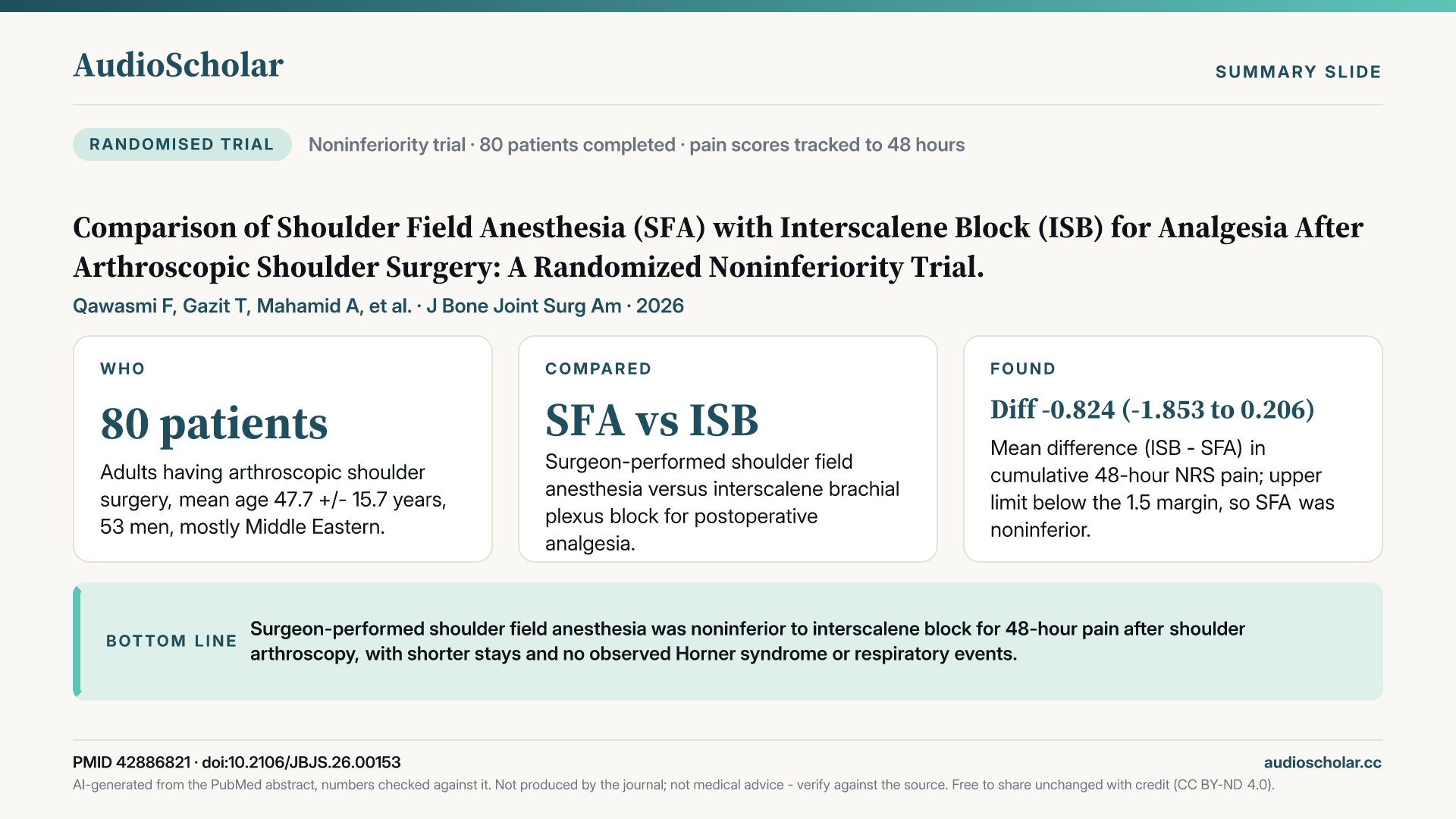
Comparison of Shoulder Field Anesthesia (SFA) with Interscalene Block (ISB) for Analgesia After Arthroscopic Shoulder Surgery: A Randomized Noninferiority Trial.
Surgeon-performed shoulder field anesthesia was noninferior to interscalene block for 48-hour pain after shoulder arthroscopy, with shorter stays and no observed Horner syndrome or respiratory events.
Qawasmi F, Gazit T, Mahamid A, et al. · Journal of Bone and Joint Surgery · 2026
From the briefingThe shoulder papers this week span the entire episode of care, beginning with regional analgesia. In the Journal of Bone and Joint Surgery, Qawasmi and colleagues randomized 80 patients undergoing arthroscopic shoulder surgery to surgeon-performed shoulder field anesthesia, a landmark-guided, phrenic nerve-sparing technique, or an interscalene block [7]. Field anesthesia met the prespecified noninferiority margin for cumulative 48-hour pain. The interscalene block gave better relief in the first four to eight hours, after which pain scores converged. Opioid use, satisfaction, and desaturation rates were similar, hospital stay was shorter with field anesthesia, and the only clinically apparent complications, two cases of Horner syndrome and one respiratory event needing intensive care, occurred in the interscalene group. The trial is modest in size and drawn from a largely Middle Eastern population, so it supports field anesthesia as a reasonable lung-sparing option, particularly for patients with respiratory vulnerability, rather than settling the question for everyone.
If you only have time for one paper this week, make it the Journal of Bone and Joint Surgery trial comparing shoulder field anesthesia with interscalene block [7]. It is the only randomized trial in this week's set, and it reopens a default many shoulder surgeons take for granted by putting a phrenic-sparing, surgeon-delivered alternative on a level evidentiary footing for cumulative pain.
Written by AI from the published abstract, for healthcare professionals. Not medical advice; check the paper before acting on it.
- 08
Myocardial Infarction Within 6 Months before Total Shoulder Arthroplasty is Strongly Associated with Postoperative Complications.
A heart attack within six months before total shoulder arthroplasty was associated with roughly ten times the odds of postoperative myocardial infarction in a large insurance database.
Parmar RP, Sahni VS, Holle AM, et al. · Journal of Shoulder and Elbow Surgery · 2026
From the briefingPerioperative risk is the focus of Parmar and colleagues in the Journal of Shoulder and Elbow Surgery, who used the PearlDiver insurance database to study total shoulder arthroplasty after recent myocardial infarction [8]. Compared with matched controls, an infarct within two years was associated with more than five times the odds of a postoperative heart attack, and an infarct within six months with roughly ten times the odds. Subtype and location mattered too, with recent type 2 infarcts also linked to thrombosis and periprosthetic infection, and inferior infarcts linked to higher ninety-day mortality. This is claims-based and observational, so residual confounding is likely, but the signal for elective timing is strong.
Written by AI from the published abstract, for healthcare professionals. Not medical advice; check the paper before acting on it.
- 09
Arthroscopic-Assisted Lower Trapezius Transfer Improves Outcomes in Patients With Irreparable Posterosuperior Rotator Cuff Tears Irrespective of the Presence of External Rotation Lag Sign.
Lower trapezius transfer improved function in irreparable posterosuperior cuff tears regardless of preoperative external rotation lag sign, though patients without a lag sign regained more rotation.
Hachem AI, Marcet P, Ezzeddine H, et al. · Arthroscopy · 2026
From the briefingOn outcomes, Hachem and colleagues in Arthroscopy reviewed 53 patients with irreparable posterosuperior cuff tears treated with arthroscopic-assisted lower trapezius transfer [9]. Both patients with and without a preoperative external rotation lag sign improved, lag signs resolved in about four fifths of patients, mostly within three months, and rates of clinically meaningful improvement were similar, although patients without a lag sign regained more external rotation. It is a small retrospective series.
Written by AI from the published abstract, for healthcare professionals. Not medical advice; check the paper before acting on it.
- 10
Variation of the definition of "survival" in reverse total shoulder arthroplasty: a systematic review.
With standardized definitions, ten-year reverse shoulder arthroplasty survival was about 83 percent in clinical series versus 94 to 95 percent in registries, exposing inconsistent survival definitions.
Fox HM, Glenn ER, Padley JH, et al. · Journal of Shoulder and Elbow Surgery · 2026
From the briefingFinally, back in the Journal of Shoulder and Elbow Surgery, Fox and colleagues systematically reviewed ten-year survival after reverse shoulder arthroplasty and found definitions all over the map [10]. Using standardized definitions, clinical series showed about 83 percent survival of the entire construct and about 90 percent when isolated liner exchanges were excluded, while registries reported a consistently higher figure of around 94 to 95 percent. The gap is a reminder that a survival number means little without knowing what counted as failure.
Written by AI from the published abstract, for healthcare professionals. Not medical advice; check the paper before acting on it.
The full briefing
This AudioScholar briefing is generated by artificial intelligence for healthcare professionals and trainees. It is not medical advice.
Welcome to This Week in Orthopedics. This week we're covering 10 notable papers spanning anterior cruciate ligament reconstruction and its long-term outcomes, sex differences in knee recovery, and shoulder surgery from analgesia to arthroplasty risk and survivorship. Let's dive in.
We start with a question that keeps resurfacing in sports medicine: do men and women actually recover the same way after ACL reconstruction? Writing in Knee Surgery Sports Traumatology Arthroscopy, Marty-Diloy and colleagues followed close to five hundred patients for five years after primary reconstruction [1]. At six months, men showed better quadriceps symmetry and smaller hop-test deficits, while psychological readiness scores were similar between sexes. By five years, the headline return-to-sport rate was nearly identical, around sixty percent in both groups, yet men were far more likely to get back to their pre-injury activity level, roughly 45 percent of men versus 28 percent of women, and after adjustment male sex roughly doubled the odds of that outcome. Men also reported better subjective knee function and psychological readiness at five years. The authors' point is that return to sport is not a proxy for quality of recovery, though this is a retrospective single-cohort analysis. A second paper in the same journal, from Dadoo and colleagues, adds a complementary angle [2]. In just over twelve hundred primary reconstructions, women needed a second operation for loss of motion at about twice the rate of men, roughly 12 versus 6 percent. In the female subgroup, patellar tendon autograft and lateral meniscus repair each independently predicted stiffness surgery, and when both were combined, close to a third of women went back to theatre for motion loss. No such predictors emerged among men. This is retrospective and hypothesis-generating, but together these two papers strengthen the case that sex-stratified counselling and outcome reporting after ACL surgery deserve more attention than they currently get.
Turning to durability, two long-term series from the SANTI group, both in Knee Surgery Sports Traumatology Arthroscopy, report what happens years after reconstruction. Santamaria and colleagues followed 232 primary reconstructions in professional soccer players for a mean of just over eight years [3]. Graft failure was low at under six percent overall. Failures were less frequent when a lateral extra-articular procedure was added, but time-to-event analysis did not confirm a statistically significant protective effect, and the isolated reconstruction group numbered only 31 knees, so the comparison is underpowered. Higher preoperative laxity and patellar tendon graft use each roughly tripled the risk of reoperation, and strikingly, contralateral ACL injury occurred in just over a quarter of knees, and in close to half of female athletes. The second SANTI paper, also led by Santamaria, examined 402 medial meniscus posterior horn repairs performed during revision reconstruction [4]. At ten years, about one in six repaired menisci had gone on to secondary meniscectomy. Contemporary posteromedial suture-hook repair looked better on unadjusted analysis, but after multivariable adjustment repair technique was no longer an independent predictor. The honest reading of both studies is that augmentation and technique comparisons remain unproven in these cohorts, while the absolute survivorship figures give useful, realistic benchmarks for counselling, coming from a single high-volume centre.
Two further knee papers address the edges of the ACL population: the growing adolescent and the early rehabilitation window. In the American Journal of Sports Medicine, Bram and colleagues from the PLUTO Study Group prospectively assessed alignment one year after transphyseal soft tissue reconstruction in 91 adolescents with two years or less of growth remaining [5]. Cohort-wide changes in mechanical axis, joint angles, and leg length were small. But a meaningful subset of patients, between about one in six and just over a quarter depending on the measure, showed clinically relevant alignment change, mostly toward valgus, and one patient was recommended for intervention for growth disturbance. The authors conclude this supports routine preoperative radiographs and surveillance to skeletal maturity, though thresholds for guided growth remain undefined. Meanwhile in Arthroscopy, Daud and colleagues pooled 21 randomized trials of neuromuscular electrical stimulation after ACL surgery [6]. Stimulation added to standard rehabilitation modestly improved isometric quadriceps strength in the first six to twelve weeks, but not beyond three months, and showed no difference in isokinetic strength or IKDC scores. Heterogeneity was high for some outcomes. This is reasonably firm evidence for faster early strength gains, and no evidence yet for better long-term function.
The shoulder papers this week span the entire episode of care, beginning with regional analgesia. In the Journal of Bone and Joint Surgery, Qawasmi and colleagues randomized 80 patients undergoing arthroscopic shoulder surgery to surgeon-performed shoulder field anesthesia, a landmark-guided, phrenic nerve-sparing technique, or an interscalene block [7]. Field anesthesia met the prespecified noninferiority margin for cumulative 48-hour pain. The interscalene block gave better relief in the first four to eight hours, after which pain scores converged. Opioid use, satisfaction, and desaturation rates were similar, hospital stay was shorter with field anesthesia, and the only clinically apparent complications, two cases of Horner syndrome and one respiratory event needing intensive care, occurred in the interscalene group. The trial is modest in size and drawn from a largely Middle Eastern population, so it supports field anesthesia as a reasonable lung-sparing option, particularly for patients with respiratory vulnerability, rather than settling the question for everyone.
Perioperative risk is the focus of Parmar and colleagues in the Journal of Shoulder and Elbow Surgery, who used the PearlDiver insurance database to study total shoulder arthroplasty after recent myocardial infarction [8]. Compared with matched controls, an infarct within two years was associated with more than five times the odds of a postoperative heart attack, and an infarct within six months with roughly ten times the odds. Subtype and location mattered too, with recent type 2 infarcts also linked to thrombosis and periprosthetic infection, and inferior infarcts linked to higher ninety-day mortality. This is claims-based and observational, so residual confounding is likely, but the signal for elective timing is strong.
On outcomes, Hachem and colleagues in Arthroscopy reviewed 53 patients with irreparable posterosuperior cuff tears treated with arthroscopic-assisted lower trapezius transfer [9]. Both patients with and without a preoperative external rotation lag sign improved, lag signs resolved in about four fifths of patients, mostly within three months, and rates of clinically meaningful improvement were similar, although patients without a lag sign regained more external rotation. It is a small retrospective series. Finally, back in the Journal of Shoulder and Elbow Surgery, Fox and colleagues systematically reviewed ten-year survival after reverse shoulder arthroplasty and found definitions all over the map [10]. Using standardized definitions, clinical series showed about 83 percent survival of the entire construct and about 90 percent when isolated liner exchanges were excluded, while registries reported a consistently higher figure of around 94 to 95 percent. The gap is a reminder that a survival number means little without knowing what counted as failure.
If you only have time for one paper this week, make it the Journal of Bone and Joint Surgery trial comparing shoulder field anesthesia with interscalene block [7]. It is the only randomized trial in this week's set, and it reopens a default many shoulder surgeons take for granted by putting a phrenic-sparing, surgeon-delivered alternative on a level evidentiary footing for cumulative pain.
Here is what this week's evidence adds up to in Orthopedics. First, sex differences after ACL reconstruction look real and multidimensional: similar return-to-sport rates conceal lower recovery of pre-injury activity in women, and women appear more prone to stiffness surgery, especially with patellar tendon grafts and lateral meniscus repair, though all of this comes from retrospective cohorts. Second, long-term ACL and meniscal repair survivorship benchmarks are encouraging, but claimed benefits of lateral extra-articular augmentation and specific repair techniques were not confirmed after adjustment. Third, transphyseal reconstruction near skeletal maturity is safe at the cohort level, yet a meaningful minority of adolescents develop alignment change, supporting surveillance while thresholds for intervention remain unknown. Fourth, in the shoulder, a single modest trial supports field anesthesia as noninferior to interscalene block with fewer apparent complications, and large observational data link a recent heart attack to sharply higher arthroplasty risk, especially within six months. And finally, inconsistent definitions of survival continue to make reverse arthroplasty outcomes hard to compare.
That's your roundup for This Week in Orthopedics. The full transcript and references are available on the episode page. This is an AI-curated summary — for clinical decisions, always consult primary sources and current guidelines. See you next week.
If this weekly briefing is useful, follow the show in your podcast app so new episodes arrive automatically. And think of one colleague — in any specialty — who never has time to keep up with the literature. Tell them about AudioScholar: a free ten-minute weekly for every specialty, to listen to in any podcast app, or to read at audioscholar dot C C.
This is an automated summary generated by artificial intelligence, which can make mistakes. Always review the original source materials.
Spot something worth flagging?
Get this every week in your podcast app — free.
New orthopedics episodes land in your feed automatically — listen on your commute.