This Week in Otolaryngology — Oct 22, 2026
Generated Oct 23, 2026 · 10:26
The week's practice-changing Otolaryngology (ENT) research, summarized for clinicians.
If the audio fails to play, refresh the page to renew the link.
Get next week’s Otolaryngology (ENT) briefing — free.
In your podcast app, or readable in your inbox with the audio one tap away.
Protocolized tranexamic acid use lowers surgical intervention rates after active post-tonsillectomy hemorrhage: A retrospective cohort study.
A tranexamic acid protocol for active post-tonsillectomy bleeding was associated with fewer returns to the operating room, with nebulized delivery most consistently linked to avoiding surgery.
International Journal of Pediatric Otorhinolaryngology · 2026 · PubMed

This week’s papers
- 01
Oncologic Outcomes in p16-Positive Oropharyngeal Squamous Cell Carcinoma With Extranodal Extension.
In surgically treated p16-positive oropharyngeal cancer, extranodal extension presence did not significantly affect survival, though macroscopic and clinical extension suggested a possible, unconfirmed risk gradient.
Taylor V et al. · The Laryngoscope · 2026
From the briefingWriting in The Laryngoscope, Taylor and colleagues looked at 232 patients with p16-positive oropharyngeal cancer treated with primary surgery, a group where extranodal extension remains the main sticking point for de-escalation [1]. Just over half of the patients with reported nodal pathology had extranodal extension, and most of those cases were macroscopic. Five-year survival was excellent across the cohort, close to ninety percent overall, and extranodal extension as a simple yes or no was not significantly associated with disease-specific, disease-free, or overall survival. Macroscopic extension showed a trend toward roughly a fourfold higher hazard of death, but that did not reach significance, and only an exploratory risk-gradient analysis suggested worse survival moving from microscopic to macroscopic to clinically evident extension. The honest reading is that extent of extension may matter more than its presence, but the numbers are small and the authors themselves call for larger studies before this informs de-escalation decisions.
Written by AI from the published abstract, for healthcare professionals. Not medical advice; check the paper before acting on it.
- 02
Intraoperative Bone Marrow Frozen Sections Reduce Positive Final Margins in Mandibulectomy.
Intraoperative bone marrow frozen sections during mandibulectomy were associated with far fewer positive final bone margins and high concordance with histology, but showed no survival benefit in squamous cancer.
Klage AW et al. · The Laryngoscope · 2026
From the briefingAlso in The Laryngoscope, Klage and colleagues reviewed 235 mandibulectomies and found that intraoperative bone marrow frozen sections, used in about four in five cases, were associated with far fewer positive final bone margins, roughly one percent versus nearly nine percent [2]. The frozen sections agreed with final histology about 99 percent of the time, and they appeared especially useful in non-squamous tumours. There was, however, no survival benefit among squamous cell carcinoma patients, so this supports the technique as a margin-control adjunct rather than as a proven outcome changer.
Written by AI from the published abstract, for healthcare professionals. Not medical advice; check the paper before acting on it.
- 03
Obesity and Pathologic Response to Neoadjuvant Immunotherapy in Head and Neck Cancer: Preliminary Results From a Pilot Study.
In a 42-patient pilot, obesity was associated with markedly lower pathologic response to neoadjuvant checkpoint inhibitors in head and neck cancer, contrasting with the obesity paradox in metastatic disease.
Truong AA et al. · Head & Neck · 2026
From the briefingRounding out the theme, Truong and colleagues in Head and Neck report a 42-patient pilot on neoadjuvant immune checkpoint inhibitors [3]. Obese patients had a pathologic response rate of about 29 percent against about 69 percent in non-obese patients, and each additional unit of body mass index cut the odds of response by about 15 percent. That runs opposite to the so-called obesity paradox seen in recurrent and metastatic disease. With only seven obese patients, this is hypothesis-generating, but it flags metabolic state as a variable worth tracking in neoadjuvant trials.
Written by AI from the published abstract, for healthcare professionals. Not medical advice; check the paper before acting on it.
- 04
Swallowing Outcomes Following Early Treatment of Head and Neck Cancer-Related Lymphedema.
Early treatment of internal lymphedema after head and neck radiation was associated with better instrumental and patient-reported swallowing outcomes at fifteen months, without differences in mouth opening or recurrence.
Gregor JW et al. · The Laryngoscope · 2026
From the briefingGregor and colleagues followed 110 patients in a standardized care pathway, all of whom had internal lymphedema three months after radiation or chemoradiation [4]. The 72 patients who completed treatment with an advanced pneumatic compression device or manual lymphatic drainage had better instrumental swallowing outcomes on DIGEST, covering safety and efficiency, at fifteen months, and their patient-reported swallowing and reflux scores improved while the untreated group's worsened. Mouth opening did not differ, and there was no signal of increased recurrence. These associations held after adjustment, but treatment was not randomized, and patients who complete therapy may differ in motivation or health, so this strengthens the case for surveillance pathways without proving causation.
Written by AI from the published abstract, for healthcare professionals. Not medical advice; check the paper before acting on it.
- 05
Cannabis Use and Prolonged Opioid Utilization After Head and Neck Free Flap Reconstructive Surgery.
Head and neck free flap patients with cannabis use had higher risk of prolonged opioid use up to a year and more early gastrostomy dependence, even after adjusting for behavioral comorbidities.
Jackert EP et al. · The Laryngoscope · 2026
From the briefingMeanwhile, Jackert and colleagues used the TriNetX database to compare 532 cannabis users with 532 matched non-users undergoing free flap reconstruction [5]. Cannabis users had roughly a fifth to a third higher risk of still using opioids three to twelve months after surgery, and that association persisted after adjusting for behavioral health conditions. They were also about one and a half times as likely to be gastrostomy dependent at three months, with no difference in tracheostomy dependence. This is administrative data, with the usual limits on how cannabis exposure is captured, but it identifies a group in whom the authors argue for closer postoperative pain monitoring.
Written by AI from the published abstract, for healthcare professionals. Not medical advice; check the paper before acting on it.
- 06
Cochlear Implantation and Cognitive Function in Adults: A Systematic Review and Meta-analysis.
Pooling twenty studies of 798 adults, cochlear implantation was associated with small but significant cognitive test improvements, while any effect on dementia risk remains unestablished.
Joyce CA et al. · Otology & Neurotology · 2026
From the briefingIn Otology and Neurotology, Joyce and colleagues pooled twenty studies including 798 adult cochlear implant recipients with postlingual hearing loss [6]. Across all cognitive tests there was a small but statistically significant improvement in scores about a year after implantation. The Montreal Cognitive Assessment improved by just over one point, while the Mini-Mental State Exam showed no significant change. The underlying studies are mostly observational and used fifteen different tests, and practice effects are hard to exclude, so this supports a modest cognitive association but says nothing yet about dementia risk, a gap the authors explicitly acknowledge.
Written by AI from the published abstract, for healthcare professionals. Not medical advice; check the paper before acting on it.
- 07
Mastoid Obliteration in Acquired Cholesteatoma, Importance and Evolution of Surgical Technique Used in Epitympanic Separation of the Middle Ear.
Cholesteatoma recurrence after canal wall up obliteration varied sharply by epitympanic separation technique, lowest with vascularized or avital flaps, though the newest technique has short follow-up.
Sutter A et al. · Otology & Neurotology · 2026
From the briefingAlso in Otology and Neurotology, Sutter and colleagues reviewed about 400 canal wall up procedures with mastoid obliteration over thirteen years [7]. Overall recurrence was about twelve percent, but it varied dramatically by how the epitympanum was separated from the middle ear: every case obliterated with bone pâté recurred, cartilage and hybrid techniques recurred in roughly a fifth, the middle temporal artery flap in about a tenth, and the newest avital flap technique had no recurrences so far. That last figure rests on a median follow-up of only about seven months, which the authors flag as a key limitation, so the main message is the principle of a complete, smooth separation rather than a verdict on any single flap.
Written by AI from the published abstract, for healthcare professionals. Not medical advice; check the paper before acting on it.
- 08
For Patients With Sequelae From Bell's Palsy, Electrical Stimulation May Cause Increased Synkinesis When Aggressively Applied in the Acute Phase of Recovery.
In severe Bell's palsy with synkinesis, acute-phase electrical stimulation was linked to worse synkinesis and shorter botulinum toxin effect, whereas chronic-phase stimulation was associated with better recovery.
Jung S et al. · The Laryngoscope · 2026
From the briefingFinally, in The Laryngoscope, Jung and colleagues studied 317 patients with severe Bell's palsy who went on to develop synkinesis [8]. Electrical stimulation overall was associated with worse synkinesis and botulinum toxin effects that wore off sooner, about three months versus four and a half. The effect depended sharply on timing: stimulation started in the first month was linked to the worst synkinesis, while stimulation started after six months was associated with less synkinesis and better recovery. The authors propose a cumulative threshold of about 4.6 hours of stimulation, beyond which outcomes deteriorated. Because everyone in the cohort already had synkinesis, and the threshold came from a decision-tree model, this is a retrospective signal that warrants caution about aggressive early stimulation rather than a validated cut-off.
Written by AI from the published abstract, for healthcare professionals. Not medical advice; check the paper before acting on it.
- 09
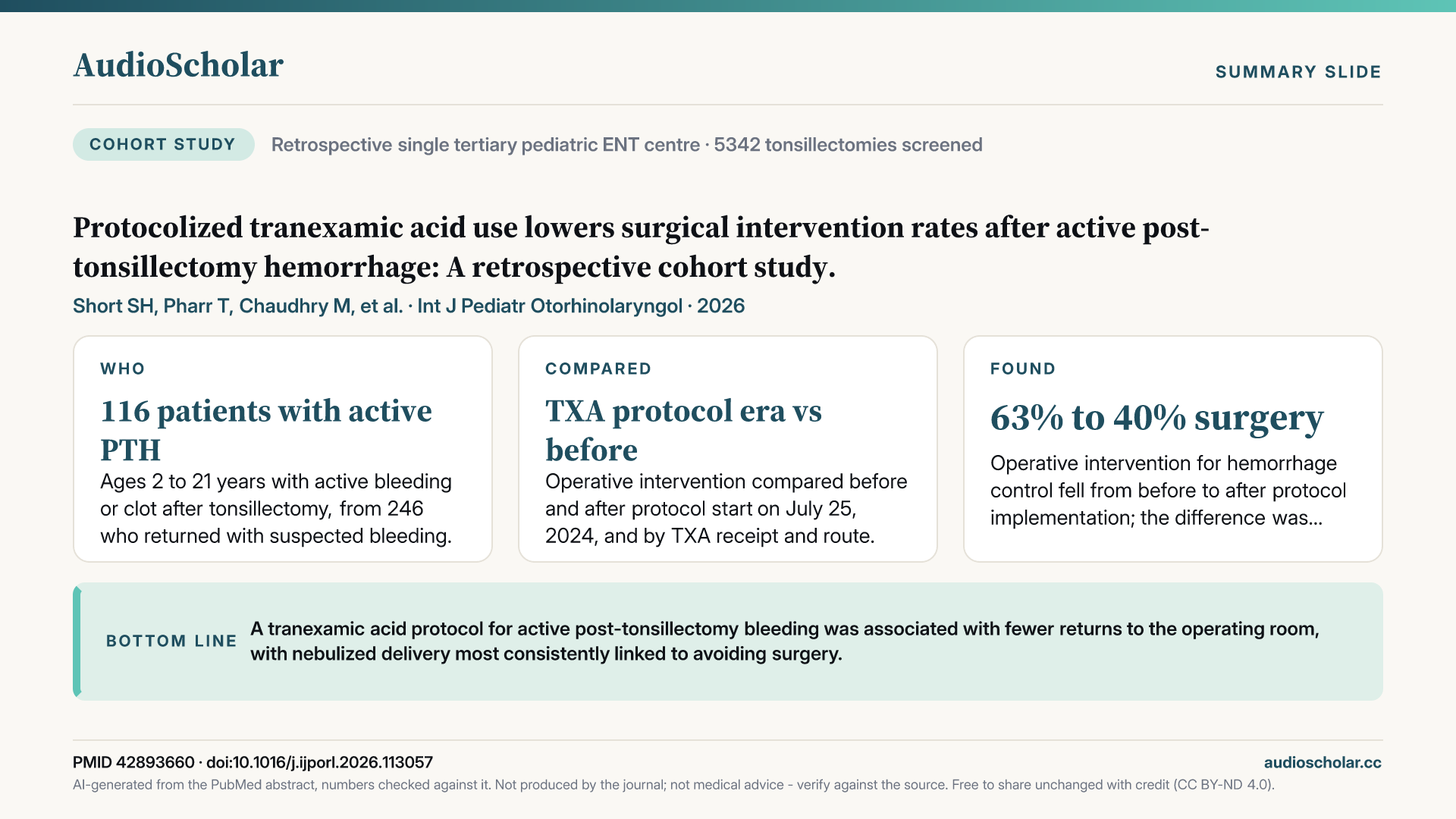
Protocolized tranexamic acid use lowers surgical intervention rates after active post-tonsillectomy hemorrhage: A retrospective cohort study.
A tranexamic acid protocol for active post-tonsillectomy bleeding was associated with fewer returns to the operating room, with nebulized delivery most consistently linked to avoiding surgery.
Short SH et al. · International Journal of Pediatric Otorhinolaryngology · 2026
From the briefingIn the International Journal of Pediatric Otorhinolaryngology, Short and colleagues examined 116 children and young adults with active post-tonsillectomy hemorrhage at a tertiary centre, before and after a tranexamic acid protocol was introduced [9]. Return to the operating room fell from roughly two thirds of patients to about forty percent after the protocol. Among patients who never received tranexamic acid, nine in ten went to theatre, compared with fewer than four in ten of those who did. Nebulized, intravenous, and combined routes were all associated with lower odds of surgery, with nebulized delivery the most consistent driver. This is retrospective, single-centre, before-and-after data, so selection and secular change could contribute, but it is a strong practical signal for a common emergency.
If you only have time for one paper this week, make it the tranexamic acid protocol study from Short and colleagues [9]. It addresses a frequent, high-stakes pediatric emergency and reopens the question of whether a nebulized-first protocol can routinely spare children a return to the operating room, a question now ripe for a prospective trial.
Written by AI from the published abstract, for healthcare professionals. Not medical advice; check the paper before acting on it.
- 10
Real-world dupilumab treatment reduced healthcare resource utilization and medication use in patients with CRSwNP.
Among over a thousand real-world patients with nasal polyps, starting dupilumab was associated with large drops in oral steroid, antibiotic, CT, and outpatient visit use over one year.
Han JK et al. · Rhinology · 2026
From the briefingIn Rhinology, Han and colleagues analysed 1,016 adults with chronic rhinosinusitis with nasal polyps who started dupilumab in real-world United States practice [10]. In the year after starting, the share of patients prescribed oral corticosteroids for any reason fell from about two thirds to under a third, antibiotic prescriptions roughly halved, and CT scans dropped from about a fifth of patients to under five percent, with fewer outpatient visits as well. Without a comparison group, regression to the mean and changing care patterns cannot be excluded, but these data complement the trial evidence with real-world utilization outcomes.
Written by AI from the published abstract, for healthcare professionals. Not medical advice; check the paper before acting on it.
The full briefing
This AudioScholar briefing is generated by artificial intelligence for healthcare professionals and trainees. It is not medical advice.
Welcome to This Week in Otolaryngology. This week we're covering 10 notable papers spanning head and neck oncology and survivorship, otology and facial nerve recovery, and two practical questions in bleeding control and chronic rhinosinusitis. Let's dive in.
We start in head and neck oncology, where three single-centre studies refine how we read pathology and how we predict response. Writing in The Laryngoscope, Taylor and colleagues looked at 232 patients with p16-positive oropharyngeal cancer treated with primary surgery, a group where extranodal extension remains the main sticking point for de-escalation [1]. Just over half of the patients with reported nodal pathology had extranodal extension, and most of those cases were macroscopic. Five-year survival was excellent across the cohort, close to ninety percent overall, and extranodal extension as a simple yes or no was not significantly associated with disease-specific, disease-free, or overall survival. Macroscopic extension showed a trend toward roughly a fourfold higher hazard of death, but that did not reach significance, and only an exploratory risk-gradient analysis suggested worse survival moving from microscopic to macroscopic to clinically evident extension. The honest reading is that extent of extension may matter more than its presence, but the numbers are small and the authors themselves call for larger studies before this informs de-escalation decisions. Also in The Laryngoscope, Klage and colleagues reviewed 235 mandibulectomies and found that intraoperative bone marrow frozen sections, used in about four in five cases, were associated with far fewer positive final bone margins, roughly one percent versus nearly nine percent [2]. The frozen sections agreed with final histology about 99 percent of the time, and they appeared especially useful in non-squamous tumours. There was, however, no survival benefit among squamous cell carcinoma patients, so this supports the technique as a margin-control adjunct rather than as a proven outcome changer. Rounding out the theme, Truong and colleagues in Head and Neck report a 42-patient pilot on neoadjuvant immune checkpoint inhibitors [3]. Obese patients had a pathologic response rate of about 29 percent against about 69 percent in non-obese patients, and each additional unit of body mass index cut the odds of response by about 15 percent. That runs opposite to the so-called obesity paradox seen in recurrent and metastatic disease. With only seven obese patients, this is hypothesis-generating, but it flags metabolic state as a variable worth tracking in neoadjuvant trials.
Our second theme is what happens to head and neck patients after the main treatment, where two Laryngoscope papers look at function and pain. Gregor and colleagues followed 110 patients in a standardized care pathway, all of whom had internal lymphedema three months after radiation or chemoradiation [4]. The 72 patients who completed treatment with an advanced pneumatic compression device or manual lymphatic drainage had better instrumental swallowing outcomes on DIGEST, covering safety and efficiency, at fifteen months, and their patient-reported swallowing and reflux scores improved while the untreated group's worsened. Mouth opening did not differ, and there was no signal of increased recurrence. These associations held after adjustment, but treatment was not randomized, and patients who complete therapy may differ in motivation or health, so this strengthens the case for surveillance pathways without proving causation. Meanwhile, Jackert and colleagues used the TriNetX database to compare 532 cannabis users with 532 matched non-users undergoing free flap reconstruction [5]. Cannabis users had roughly a fifth to a third higher risk of still using opioids three to twelve months after surgery, and that association persisted after adjusting for behavioral health conditions. They were also about one and a half times as likely to be gastrostomy dependent at three months, with no difference in tracheostomy dependence. This is administrative data, with the usual limits on how cannabis exposure is captured, but it identifies a group in whom the authors argue for closer postoperative pain monitoring.
Turning to otology and the facial nerve, three papers address long-standing questions about cognition, cholesteatoma recurrence, and rehabilitation timing. In Otology and Neurotology, Joyce and colleagues pooled twenty studies including 798 adult cochlear implant recipients with postlingual hearing loss [6]. Across all cognitive tests there was a small but statistically significant improvement in scores about a year after implantation. The Montreal Cognitive Assessment improved by just over one point, while the Mini-Mental State Exam showed no significant change. The underlying studies are mostly observational and used fifteen different tests, and practice effects are hard to exclude, so this supports a modest cognitive association but says nothing yet about dementia risk, a gap the authors explicitly acknowledge. Also in Otology and Neurotology, Sutter and colleagues reviewed about 400 canal wall up procedures with mastoid obliteration over thirteen years [7]. Overall recurrence was about twelve percent, but it varied dramatically by how the epitympanum was separated from the middle ear: every case obliterated with bone pâté recurred, cartilage and hybrid techniques recurred in roughly a fifth, the middle temporal artery flap in about a tenth, and the newest avital flap technique had no recurrences so far. That last figure rests on a median follow-up of only about seven months, which the authors flag as a key limitation, so the main message is the principle of a complete, smooth separation rather than a verdict on any single flap. Finally, in The Laryngoscope, Jung and colleagues studied 317 patients with severe Bell's palsy who went on to develop synkinesis [8]. Electrical stimulation overall was associated with worse synkinesis and botulinum toxin effects that wore off sooner, about three months versus four and a half. The effect depended sharply on timing: stimulation started in the first month was linked to the worst synkinesis, while stimulation started after six months was associated with less synkinesis and better recovery. The authors propose a cumulative threshold of about 4.6 hours of stimulation, beyond which outcomes deteriorated. Because everyone in the cohort already had synkinesis, and the threshold came from a decision-tree model, this is a retrospective signal that warrants caution about aggressive early stimulation rather than a validated cut-off.
Our last theme pairs two treatment-effect studies from very different corners of the specialty. In the International Journal of Pediatric Otorhinolaryngology, Short and colleagues examined 116 children and young adults with active post-tonsillectomy hemorrhage at a tertiary centre, before and after a tranexamic acid protocol was introduced [9]. Return to the operating room fell from roughly two thirds of patients to about forty percent after the protocol. Among patients who never received tranexamic acid, nine in ten went to theatre, compared with fewer than four in ten of those who did. Nebulized, intravenous, and combined routes were all associated with lower odds of surgery, with nebulized delivery the most consistent driver. This is retrospective, single-centre, before-and-after data, so selection and secular change could contribute, but it is a strong practical signal for a common emergency. In Rhinology, Han and colleagues analysed 1,016 adults with chronic rhinosinusitis with nasal polyps who started dupilumab in real-world United States practice [10]. In the year after starting, the share of patients prescribed oral corticosteroids for any reason fell from about two thirds to under a third, antibiotic prescriptions roughly halved, and CT scans dropped from about a fifth of patients to under five percent, with fewer outpatient visits as well. Without a comparison group, regression to the mean and changing care patterns cannot be excluded, but these data complement the trial evidence with real-world utilization outcomes.
If you only have time for one paper this week, make it the tranexamic acid protocol study from Short and colleagues [9]. It addresses a frequent, high-stakes pediatric emergency and reopens the question of whether a nebulized-first protocol can routinely spare children a return to the operating room, a question now ripe for a prospective trial.
Here is what this week's evidence adds up to in Otolaryngology. First, protocolized tranexamic acid, particularly nebulized, is associated with substantially fewer operative interventions for active post-tonsillectomy bleeding, though the evidence is single-centre and retrospective. Second, in HPV-associated oropharyngeal cancer, the presence of extranodal extension alone did not predict survival, while macroscopic or clinical extension showed a possible but unconfirmed risk gradient, leaving de-escalation questions open. Third, early lymphedema treatment after radiation is associated with better swallowing at fifteen months, supporting routine surveillance pathways, but without randomized confirmation. Fourth, cochlear implantation is associated with small cognitive test improvements, and whether that translates into lower dementia risk remains unknown. And fifth, timing appears to matter in facial nerve rehabilitation, with acute-phase electrical stimulation linked to worse synkinesis in severe Bell's palsy, a retrospective finding that still needs prospective testing.
That's your roundup for This Week in Otolaryngology. The full transcript and references are available on the episode page. This is an AI-curated summary — for clinical decisions, always consult primary sources and current guidelines. See you next week.
If this weekly briefing is useful, follow the show in your podcast app so new episodes arrive automatically. And think of one colleague — in any specialty — who never has time to keep up with the literature. Tell them about AudioScholar: a free ten-minute weekly for every specialty, to listen to in any podcast app, or to read at audioscholar dot C C.
This is an automated summary generated by artificial intelligence, which can make mistakes. Always review the original source materials.
Spot something worth flagging?
Get this every week in your podcast app — free.
New otolaryngology episodes land in your feed automatically — listen on your commute.