This Week in Pathology — Oct 10, 2026
Generated Oct 10, 2026 · 10:34
The week's practice-changing Pathology research, summarized for clinicians.
If the audio fails to play, refresh the page to renew the link.
Get next week’s Pathology briefing — free.
In your podcast app, or readable in your inbox with the audio one tap away.
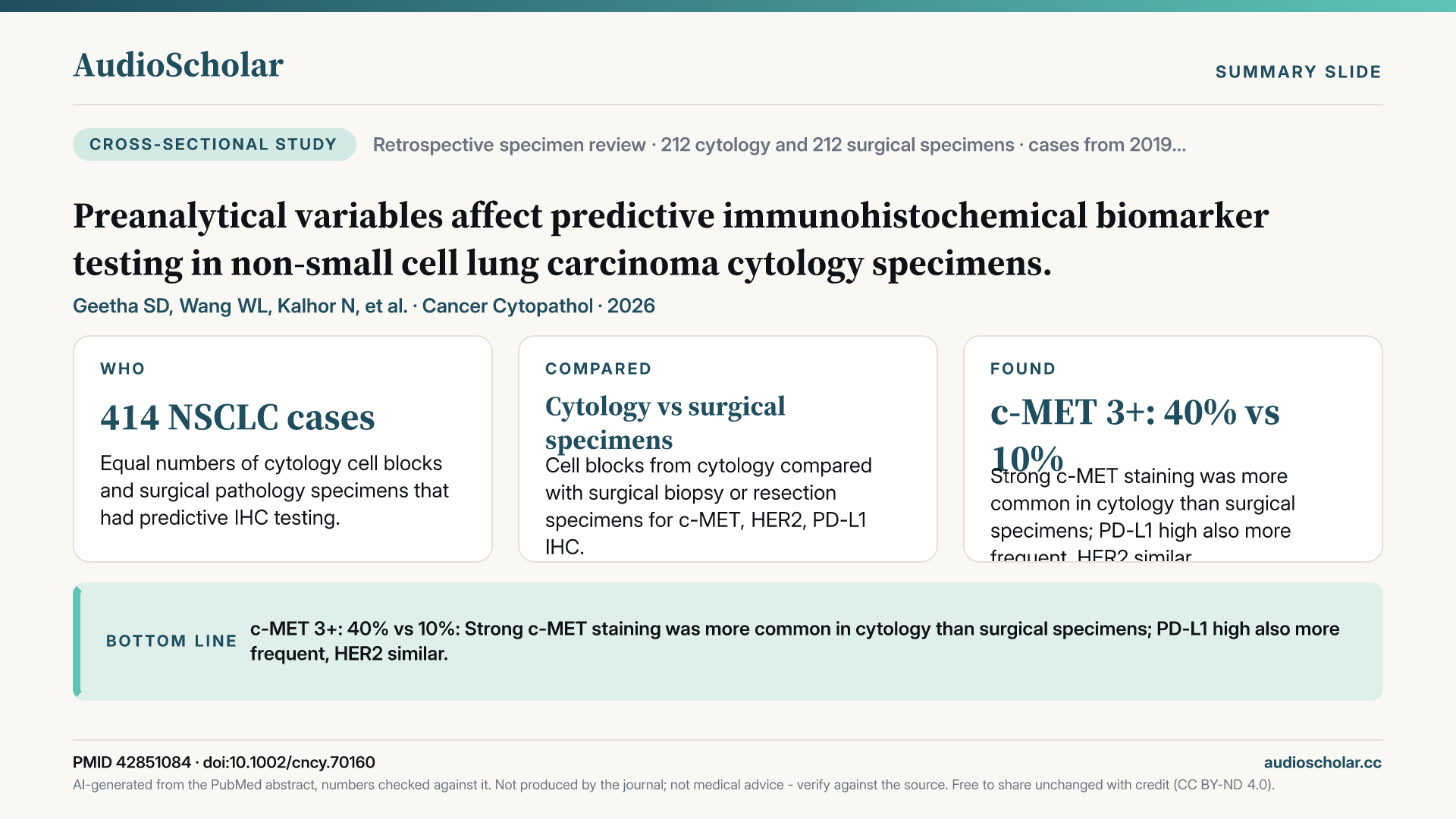
Preanalytical variables affect predictive immunohistochemical biomarker testing in non-small cell lung carcinoma cytology specimens.
Ethanol-formalin processed lung cancer cell blocks showed strong c-MET staining four times as often as surgical specimens and more frequent high PD-L1, while HER2 rates were similar.
Cancer Cytopathology · 2026 · PubMed

This week’s papers
- 01
The 2026 World Health Organization Classification of Tumors of Soft Tissue and Bone: 6th Edition.
The sixth edition WHO soft tissue and bone classification adds 19 new entities, refines essential and desirable criteria, and replaces variants with morphological patterns lacking distinct clinical behaviour.
Hornick JL et al. · The American Journal of Surgical Pathology · 2026
- 02
Diagnostic Utility of USP6 RNA Chromogenic In Situ Hybridization in the Differential Diagnosis of Nodular Fasciitis and Aneurysmal Bone Cyst.
Across 1,210 tumors, USP6 RNA in situ hybridization detected 92 percent of nodular fasciitis and 85 percent of primary aneurysmal bone cysts, with rare positives in unrelated sarcomas.
de Toro MM et al. · The American Journal of Surgical Pathology · 2026
- 03
A Complementary Role for Immunohistochemistry and NGS for Detection of MTAP Loss in Patients with Non-Small Cell Lung Cancer.
MTAP deletion occurred in about 6 percent of lung cancers, enriched in EGFR and ALK-driven tumors, and immunohistochemistry agreed with sequencing in 97 percent while performing better at low tumor content.
Laaksonen S et al. · Modern Pathology · 2026
- 04
Preanalytical variables affect predictive immunohistochemical biomarker testing in non-small cell lung carcinoma cytology specimens.
Ethanol-formalin processed lung cancer cell blocks showed strong c-MET staining four times as often as surgical specimens and more frequent high PD-L1, while HER2 rates were similar.
Geetha SD et al. · Cancer Cytopathology · 2026
- 05
Alternative lengthening of telomeres in small well-differentiated pancreatic neuroendocrine tumors: independent validation and cross-platform concordance.
In a multi-institutional cohort of small pancreatic neuroendocrine tumors, ALT positivity was linked to substantially worse progression-free survival, and bright-field CISH agreed closely with FISH, pending further validation.
Patil A et al. · Virchows Archiv · 2026
- 06
Ex vivo fluorescence confocal microscopy for real-time margin assessment of nonmelanoma skin cancer in Mohs surgery: A prospective interventional study.
In 261 Mohs margins from 42 nonmelanoma skin cancers, ex vivo confocal microscopy reached about 96 percent accuracy versus histology with near-perfect dermatologist-pathologist agreement.
Spadafora M et al. · Modern Pathology · 2026
- 07
Do alternative classification systems improve prognostication in phyllodes tumours of the breast? A comparative clinicopathological study.
In 58 borderline and malignant phyllodes tumours, the Refined Criteria upgraded over half of borderline cases without better metastasis prediction, while high mitoses and malignant heterologous elements predicted metastasis.
Gomes YM et al. · Histopathology · 2026
- 08
Mitoses counting in phyllodes tumours: rationale for a standardized hotspot-based approach.
Expert authors recommend counting stromal mitoses in phyllodes tumours in the most active hotspot, adjusted for microscope field diameter, to improve reproducibility and grading accuracy.
Hadi E et al. · Histopathology · 2026
- 09
Gastric dysplasia: an integrated classification of surface epithelium-derived precursor lesions.
Gastric dysplasia subtypes range from indolent foveolar and small intestinal-type lesions to high-risk serrated dysplasia, with size, depression, high-grade histology and abnormal p53 signalling progression risk.
Ushiku T · Virchows Archiv · 2026
- 10
Parathyroid Pathology Uncovered: Tiny Glands, Big Questions.
A practical framework for parathyroid tumors emphasizes separating overinterpreted atypia from true carcinoma, integrating immunohistochemical and molecular data, and recognizing clues to hereditary syndromes.
Juhlin CC, Gill AJ · Modern Pathology · 2026
The full briefing
This AudioScholar briefing is generated by artificial intelligence for healthcare professionals and trainees. It is not medical advice.
Welcome to This Week in Pathology. This week we're covering 10 notable papers spanning a new soft tissue and bone classification with the ancillary tools that support it, the reliability of predictive biomarker testing across specimen types and platforms, and the persistent challenge of separating indolent lesions from dangerous ones. Let's dive in.
Soft tissue and bone pathology has a new reference standard, and one ancillary test is maturing alongside it. In The American Journal of Surgical Pathology, Hornick, Bovee, Antonescu and colleagues summarize the sixth edition of the World Health Organization Classification of Soft Tissue and Bone Tumors [1]. Drafted by 203 editors and authors from 27 countries, the volume adds 19 new entities, refines essential and desirable diagnostic criteria with different resource settings in mind, and drops the term variant in favour of morphological pattern, reserved for features that aid recognition but carry no different clinical behaviour. Subtypes, by contrast, must differ in at least one clinical, histological or genetic dimension, ideally with treatment or outcome consequences. The classification now spans 62 sarcomas among roughly two hundred tumor types. As a consensus document, it defines the common diagnostic language rather than presenting new outcome data, but it is the framework reports will be measured against. In the same journal, de Toro and colleagues tested USP6 RNA chromogenic in situ hybridization across 1,210 bone and soft tissue tumors [2]. Overexpression was seen in 92 percent of nodular fasciitis and 85 percent of primary aneurysmal bone cysts, and in every case with a molecularly confirmed USP6 fusion. Cellular fibroma of tendon sheath and myositis ossificans were also positive, consistent with their place in the USP6 family. Among more than eleven hundred negative controls, specificity was high, but isolated positives appeared in an angiosarcoma, a malignant peripheral nerve sheath tumor and a carcinosarcoma. The data support this bright-field assay as a practical surrogate for fusion testing, with the authors stressing that interpretation in morphological context remains essential.
The second theme concerns how well a biomarker result reflects biology once specimen type, tumor content and platform come into play. In Modern Pathology, Laaksonen and colleagues examined MTAP loss, a metabolic vulnerability with emerging therapeutic relevance, in 5,233 non-small cell lung cancers sequenced on a 447-gene panel [3]. Homozygous MTAP deletion occurred in about 6 percent of tumors and was enriched in adenocarcinomas from never or light smokers and in tumors with EGFR mutations or ALK fusions. In a subset of 105 cases, sequencing and immunohistochemistry agreed in about 97 percent of cases, but only after careful quality control and exclusion of samples with tumor content at or below 30 percent. Roughly one in eight loss cases showed heterogeneous staining, and the authors conclude that immunohistochemistry is more sensitive when tumor content is low or the event is subclonal, making the two methods complementary rather than interchangeable. A cytology study adds a sharper caution. In Cancer Cytopathology, Geetha and colleagues compared 212 lung cancer cell blocks, processed with an ethanol and formalin mixture before paraffin embedding, against 212 surgical specimens [4]. Strong 3-plus c-MET staining appeared in 40 percent of cytology cases versus 10 percent of surgical specimens, a fourfold difference, and high PD-L1 expression was also more frequent in cytology, about a third versus a fifth. HER2 rates did not differ. Because these cut-offs determine therapy eligibility, the findings suggest that alcohol exposure before formalin fixation may inflate some predictive scores, though this is a single-institution retrospective comparison of unmatched patients, so the true cause of the gap is not proven. Platform translation is also the story in Virchows Archiv, where Patil and colleagues validated alternative lengthening of telomeres in small pancreatic neuroendocrine tumors of 2 centimeters or less across four institutions [5]. Among 133 tumors tested by FISH, about 16 percent were ALT-positive, and positivity was associated with roughly a fourfold to fivefold higher risk of progression, with five-year progression-free survival around 70 percent versus 89 percent. Chromogenic in situ hybridization agreed closely with FISH, offering a bright-field option. The event count was small, with only 19 progressions, and the authors are explicit that analytic validation and confirmation in unselected cohorts must come before routine use in deciding between surgery and surveillance. Finally, in Modern Pathology, Spadafora and colleagues prospectively studied ex vivo fluorescence confocal microscopy for Mohs margins in 42 nonmelanoma skin cancers [6]. Across 261 margins, a dermatologist and a pathologist agreed almost perfectly, and overall accuracy against conventional histology was about 96 percent, with one false-negative margin. This is a small single-centre study, and claimed time savings remain unmeasured.
The third theme is grading: how pathologists decide which lesions are truly dangerous, and how reproducible that decision is. Two papers in Histopathology address phyllodes tumours. Gomes and colleagues reclassified 58 borderline and malignant tumours under the 2019 World Health Organization criteria, the system proposed by Tan and colleagues in 2025, and the 2023 Refined Criteria [7]. The Tan system agreed with the World Health Organization scheme in 97 percent of cases, whereas the Refined Criteria upgraded just over half of borderline tumours to malignant, and none of those upgraded tumours metastasized during roughly two and a half years of median follow-up. High stromal mitotic activity, at least 30 per 10 high-power fields, and malignant heterologous elements were independently linked to metastasis. With seven metastatic events, the cohort is small, but it argues against the Refined Criteria improving discrimination. That puts weight on how mitoses are counted, which is precisely the subject of a methods review by Hadi and colleagues [8]. They argue for a standardized hotspot approach, recording the highest stromal count while correcting for microscope field diameter, rather than averaging across regions, and discuss digital counting aids. This is expert recommendation rather than outcome data, but read together the two papers point to mitotic counting as both the strongest predictor and the least standardized step. In Virchows Archiv, Ushiku offers an integrated classification of surface-derived gastric dysplasia [9]. Small, pale, flat lesions with orderly intestinal differentiation tend to be indolent, as do flat-elevated foveolar adenoma, raspberry-type adenoma and dysplasia in fundic gland polyps, whereas large size, redness, depression, high-grade histology and abnormal p53 raise progression risk. Other foveolar lesions can be the surface of microsatellite-unstable, Epstein-Barr virus-associated or deceptively well-differentiated carcinoma, and serrated dysplasia is frequently associated with invasive cancer. The review emphasizes integrating endoscopic appearance and background mucosa. Similarly, in Modern Pathology, Juhlin and Gill review parathyroid pathology [10], focusing on separating overinterpreted atypia from true parathyroid carcinoma, integrating immunohistochemical and molecular findings, and recognizing clues that may first raise suspicion of a hereditary syndrome. Both are narrative expert reviews rather than new datasets.
If you only have time for one paper this week, make it the cytology biomarker study from Geetha and colleagues in Cancer Cytopathology [4]. It reopens a question many laboratories considered settled, whether a formalin-fixed cell block behaves like tissue for predictive immunohistochemistry, at precisely the cut-offs that determine targeted therapy eligibility.
Here is what this week's evidence adds up to in Pathology. First, the sixth edition soft tissue and bone classification sets new definitions and 19 new entities, and USP6 RNA in situ hybridization now has a large series supporting it as a sensitive, highly specific surrogate, with rare false positives still documented. Second, predictive biomarker results depend on preanalytical and analytical context: single-centre retrospective data suggest alcohol-exposed cell blocks may overcall c-MET and PD-L1, and MTAP testing by sequencing and immunohistochemistry agrees well but each method has blind spots. Third, ALT status shows prognostic promise in small pancreatic neuroendocrine tumors, but the event count is small and the authors themselves say it is not ready for routine management decisions. Fourth, in phyllodes tumours, stromal mitoses and malignant heterologous elements carry the most prognostic weight, the Refined Criteria upgraded many tumours without better prediction in one small cohort, and a standardized hotspot count is so far an expert proposal. Fifth, confocal margin assessment in Mohs surgery showed high accuracy in an early, small prospective study, with workflow benefit still unquantified.
That's your roundup for This Week in Pathology. The full transcript and references are available on the episode page. This is an AI-curated summary — for clinical decisions, always consult primary sources and current guidelines. See you next week.
If this weekly briefing is useful, follow the show in your podcast app so new episodes arrive automatically. And if you have a paper you have been meaning to read, upload the PDF, or paste any link, at audioscholar dot C C. We will turn it into audio like this one, in any of thirty-one languages.
This is an automated summary generated by artificial intelligence, which can make mistakes. Always review the original source materials.
Spot something worth flagging?
Get this every week in your podcast app — free.
New pathology episodes land in your feed automatically — listen on your commute.