This Week in Neurology — Oct 7, 2026
Generated Oct 8, 2026 · 12:27
The week's practice-changing Neurology research, summarized for clinicians.
If the audio fails to play, refresh the page to renew the link.
Get next week’s Neurology briefing — free.
In your podcast app, or readable in your inbox with the audio one tap away.
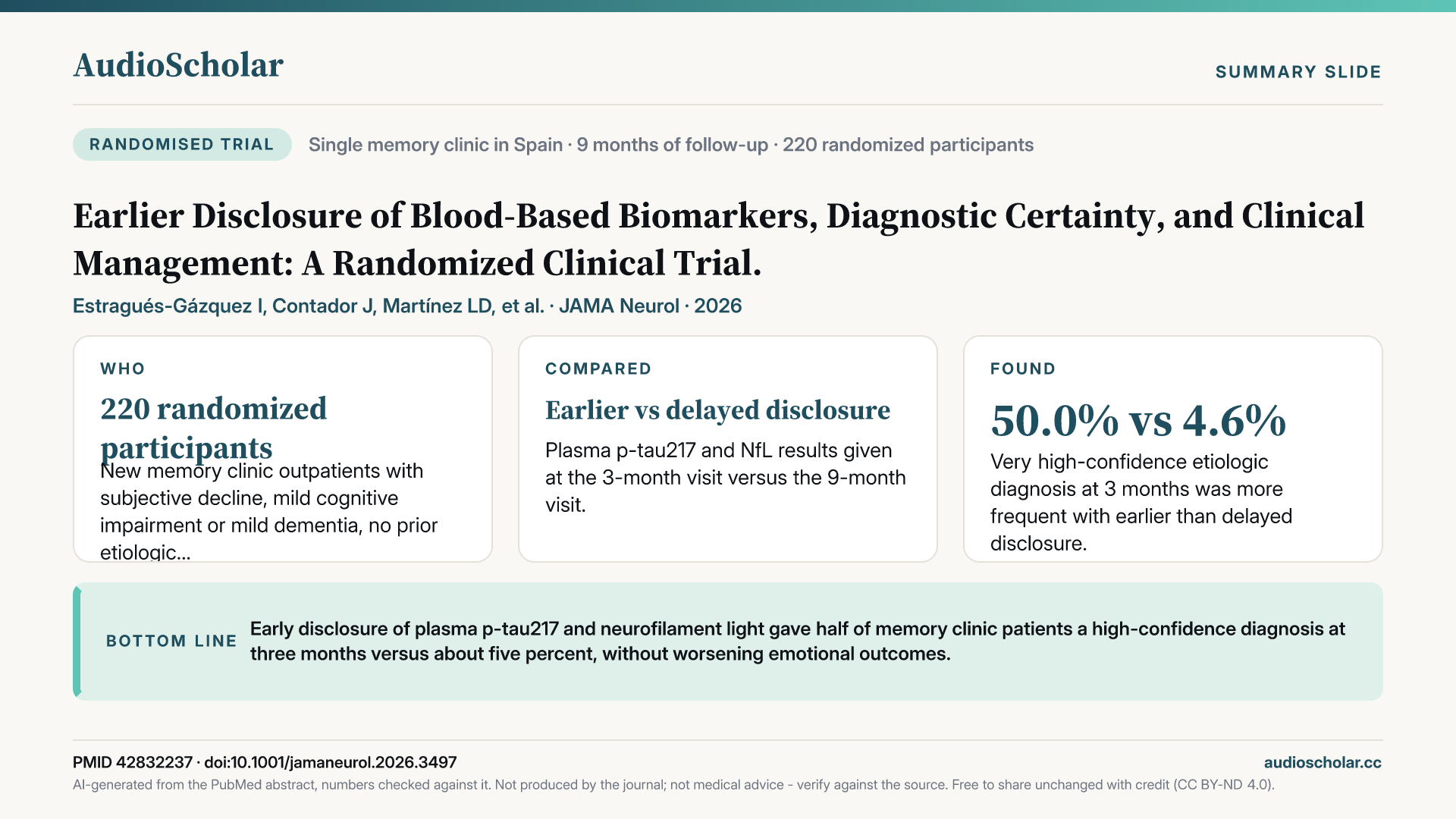
Earlier Disclosure of Blood-Based Biomarkers, Diagnostic Certainty, and Clinical Management: A Randomized Clinical Trial.
Early disclosure of plasma p-tau217 and neurofilament light gave half of memory clinic patients a high-confidence diagnosis at three months versus about five percent, without worsening emotional outcomes.
JAMA Neurology · 2026 · PubMed

This week’s papers
- 01
Ten Years of Ocrelizumab in Relapsing Multiple Sclerosis: The OPERA I and II Randomized Clinical Trials.
Over ten years, continuous ocrelizumab cut confirmed disability progression by about a quarter versus a two-year delayed start, with no rise in serious infections during extension.
Hauser SL et al. · JAMA Neurology · 2026
- 02
Ofatumumab vs Ocrelizumab in Relapsing-Remitting Multiple Sclerosis: A Nationwide Cohort Study.
In a Danish registry of 1,870 patients, ofatumumab had a slightly higher but very low relapse rate than ocrelizumab, with no differences in disability or MRI activity.
El Mahdaoui S et al. · Neurology · 2026
- 03
Comparative Effectiveness of Treatments for Relapse Prevention in Myelin Oligodendrocyte Glycoprotein Antibody-Associated Disease.
In 312 children with MOGAD, intravenous immunoglobulin was the only maintenance therapy associated with roughly halved relapse risk, though matched early-course analyses were underpowered and non-significant.
Virupakshaiah A et al. · Neurology · 2026
- 04
Earlier Disclosure of Blood-Based Biomarkers, Diagnostic Certainty, and Clinical Management: A Randomized Clinical Trial.
Early disclosure of plasma p-tau217 and neurofilament light gave half of memory clinic patients a high-confidence diagnosis at three months versus about five percent, without worsening emotional outcomes.
Estragués-Gázquez I et al. · JAMA Neurology · 2026
- 05
Clinical Factors Associated With Discordant Plasma P-Tau217 and Established Alzheimer Disease Biomarkers.
Plasma p-tau217 disagreed with amyloid PET or spinal fluid in 8.5 percent of participants, with false negatives linked to mild stage, higher body mass index and better kidney function.
Shir D et al. · Neurology · 2026
- 06
Timing of Deep Brain Stimulation and Cognitive Trajectories in GBA1-Associated Parkinson's Disease.
In GBA1 variant carriers with Parkinson disease, subthalamic stimulation performed later in the disease course was associated with faster cognitive decline, an effect absent in non-carriers.
Asimakidou E et al. · Movement Disorders · 2026
- 07
Directional Adaptive Deep Brain Stimulation: An Initial Report of Safety, Tolerability, and Effectiveness.
In a small open-label Parkinson cohort, directional adaptive stimulation was safe and added a median 1.2 hours daily of good on-time, and all fifteen completers chose to continue it.
Beudel M et al. · Movement Disorders · 2026
- 08
Dual Antiglutamate Therapy in Super-Refractory Status Epilepticus After Cardiac Arrest (SUPER-CAT Study).
In selected post-cardiac arrest super-refractory status epilepticus, ketamine plus perampanel resolved seizures more often and was linked to lower six-month mortality, but frequently caused reversible cholestatic liver injury.
Beretta S et al. · Neurology · 2026
- 09
Rapid Whole-Genome Sequencing in Pediatric Neurology Inpatients.
Rapid whole-genome sequencing diagnosed about 45 percent of pediatric neurology inpatients with unexplained presentations and changed management in roughly two thirds of diagnosed children.
Amanat M et al. · JAMA Neurology · 2026
- 10
Updated Meta-Analysis of Left Atrial Appendage Closure Versus Oral Anticoagulation to Prevent Stroke in Atrial Fibrillation.
Across six randomized trials, appendage closure matched anticoagulation for overall stroke and reduced non-procedural bleeding, but ischemic stroke was more frequent, positioning it as a bleeding-reduction option.
Pekyi-Boateng PK et al. · Stroke · 2026
The full briefing
This AudioScholar briefing is generated by artificial intelligence for healthcare professionals and trainees. It is not medical advice.
Welcome to This Week in Neurology. This week we're covering 10 notable papers spanning long-term and comparative immunotherapy in demyelinating disease, blood biomarkers for Alzheimer disease, and the timing and technology of deep brain stimulation, with stops in neurocritical care, pediatric genomics and stroke prevention. Let's dive in.
We start with B-cell therapy in multiple sclerosis, where this week brings a ten-year randomized dataset and a large real-world head-to-head comparison. In JAMA Neurology, Hauser and colleagues report ten-year follow-up of the OPERA one and two trials [1]. In these trials, 1,656 patients with relapsing multiple sclerosis were randomized to ocrelizumab or interferon beta for two years, then nearly all patients entering the extension received ocrelizumab for up to eight more years. Patients on continuous ocrelizumab had about a quarter lower risk of 48-week confirmed disability progression than patients whose ocrelizumab started two years later. Just over eighty percent of patients in the continuous arm remained free of confirmed progression. The risk of reaching an EDSS of 6, meaning a need for walking aid, was cut by a little over forty percent. The difference at EDSS 4 did not reach statistical significance. Relapse rates in the continuous arm fell to very low levels by year ten, and adverse events, including serious infections, did not rise over the extension. One caveat applies here: the extension was open label, and only about two thirds of patients entering it completed the studies, so attrition may flatter long-term figures. Even so, the data add durable randomized support to the argument that a two-year delay in high-efficacy therapy leaves a lasting deficit. In Neurology, El Mahdaoui and colleagues used the Danish Multiple Sclerosis Registry to compare ofatumumab and ocrelizumab in 1,870 patients with relapsing-remitting disease [2]. After propensity weighting, the annualized relapse rate was roughly sixty-five percent higher on ofatumumab in relative terms. In absolute terms, however, the relapse rate was about one relapse per twenty patient-years on ofatumumab versus about one per thirty on ocrelizumab. There were no significant differences in time to first relapse, disability worsening, progression independent of relapse, or MRI activity. The authors themselves judge the difference to be of limited clinical relevance. Given the observational design and the risk of channeling bias, this is Class two evidence that both anti-CD20 agents perform very well, rather than evidence that one is clearly superior. Staying with neuroimmunology, Virupakshaiah and colleagues, also in Neurology, analyzed 312 children with MOG antibody-associated disease across 13 pediatric centers in the United States [3]. Close to half of the children relapsed over a median of about two and a half years. In the main time-varying analysis, intravenous immunoglobulin was the only maintenance therapy associated with lower relapse risk, roughly halving it. Anti-CD20 therapy and oral steroids showed no significant association. In a stricter early-course propensity-matched analysis, the trends still favored immunoglobulin but did not reach significance, with very small matched groups. Older age at onset and prior relapses predicted further relapse. The data support immunoglobulin as a leading maintenance candidate in pediatric MOGAD, but residual confounding is acknowledged and the authors call for randomized trials.
Our second theme is plasma p-tau217, a test that is moving from research into routine memory clinic use, with this week's papers looking at both its benefits and its blind spots. In JAMA Neurology, Estragués-Gázquez and colleagues ran a randomized trial at a single Spanish memory clinic [4]. The trial enrolled 220 new patients with subjective decline, mild cognitive impairment or mild dementia. Plasma p-tau217 and neurofilament light results were disclosed either at three months or at nine months. At three months, half of the patients in the early-disclosure arm had a very high-confidence etiologic diagnosis, compared with about one in twenty in the delayed arm. Certainty later converged once both arms had results, except in mild cognitive impairment, where the early advantage persisted. Earlier disclosure led to roughly three times as many starts of symptomatic Alzheimer treatment and to fewer repeat neuropsychological assessments. It also led to more discharges back to primary care. Anxiety, depression, stress and quality of life were not worse with earlier disclosure. Because it is a single-centre trial in one health system, generalizability is the open question, but it is among the first randomized evidence that these tests change management. A complementary paper in Neurology from Shir and colleagues at Mayo Clinic examined when p-tau217 gets it wrong [5]. Among 706 participants with confirmatory amyloid PET or spinal fluid biomarkers, about one in twelve had a discordant plasma result. False negatives were about twice as common as false positives. False negatives clustered in people at milder clinical stages, with higher body mass index and better kidney function. False positives were linked to reduced kidney function, more advanced dementia, older age and thyroid disease. Obstructive sleep apnea was associated with discordance overall. The work is retrospective and drawn from research cohorts, but read alongside the Spanish trial it suggests that the gains in certainty are real while particular patient profiles may still warrant confirmatory testing.
The third theme is deep brain stimulation in Parkinson disease, where the questions are about when to operate and how to stimulate. In Movement Disorders, Asimakidou and colleagues studied 343 patients across ten sites in Europe and the United States, 91 of whom carried GBA1 variants, all treated with bilateral subthalamic stimulation [6]. Among GBA1 carriers, patients implanted later in their disease declined cognitively faster than patients implanted earlier, independent of age. The clearest separation fell at seven to eight years from onset. No such timing effect was seen in non-carriers, and the pattern held across variant classes. The authors suggest earlier surgery may extend the window of motor benefit before cognitive decline, and argue for earlier genetic testing. This is observational, though, and earlier versus later surgery was not randomized. Also in Movement Disorders, Beudel and colleagues report the first experience with directional adaptive stimulation, which adjusts stimulation in response to sensed brain signals [7]. Seventeen patients were enrolled and fifteen completed the open-label evaluation. Both adaptive modes met the prespecified endpoint, and the dual-threshold mode added a median of about 1.2 hours a day of good on-time without troublesome dyskinesia. Stimulation-related events were similar to conventional directional stimulation, and every one of the fifteen completers chose to stay on adaptive stimulation. This is early feasibility data from a small unblinded cohort, not yet efficacy evidence.
Our final group covers acute and diagnostic care across the age range. In Neurology, Beretta and colleagues report the SUPER-CAT cohort on super-refractory status epilepticus after cardiac arrest [8]. They restricted the cohort to patients without poor prognostic markers, meaning preserved cortical evoked responses, intact pupillary reflexes and no generalized periodic discharges. Only 95 of more than 1,300 post-arrest patients qualified. Dual antiglutamate therapy combined ketamine with perampanel. Status epilepticus resolved in 84 percent of patients on the dual regimen versus about half of patients on other combinations. Six-month mortality was also lower, at about half versus roughly three quarters. Awakening and good six-month neurologic outcome trended better but were not statistically significant. Reversible cholestatic liver injury occurred in about three quarters of patients on the dual regimen. This is a non-randomized comparison in a highly selected group, so it supports a trial rather than settling the question. In JAMA Neurology, Amanat and colleagues describe rapid whole-genome sequencing in 175 pediatric neurology inpatients, from the neonatal unit to the general ward [9]. The test gave a phenotype-matched diagnosis in about 45 percent of children, higher in children past the newborn period than in neonates. Preliminary results came back in about four days. Reanalysis nudged cumulative yield to just under half. Management changed in about two thirds of diagnosed children. A family history raised the odds of a diagnosis about six-fold, and multisystem involvement and dysmorphism also predicted yield. This is a single-centre retrospective series, but it extends the case for rapid sequencing beyond intensive care. Finally, in Stroke, Pekyi-Boateng and colleagues pooled six randomized trials with about seven thousand patients comparing left atrial appendage closure with oral anticoagulation, including two new 2026 trials [10]. Overall stroke was similar. Ischemic stroke was about forty percent more frequent with closure, though that signal has not yet reached adequate information size. Non-procedural bleeding was roughly forty percent lower with closure, the only robust finding, and seen in standard-risk and post-ablation patients but not in high-bleeding-risk patients. The authors position closure as a bleeding-reduction strategy rather than an equivalent substitute for anticoagulation.
If you only have time for one paper this week, make it the randomized trial of earlier blood biomarker disclosure from Estragués-Gázquez and colleagues in JAMA Neurology [4]. It moves plasma p-tau217 from a question of test accuracy to randomized evidence of what disclosure actually changes in diagnostic confidence and care, without emotional harm.
Here is what this week's evidence adds up to in Neurology. First, ten-year randomized follow-up shows that a two-year delay in ocrelizumab leaves a lasting disability gap, while real-world data suggest only a small, probably unimportant relapse difference between anti-CD20 agents. Second, plasma p-tau217 disclosure raises diagnostic certainty and shifts management in a single-centre trial, but discordance with reference biomarkers, tied to stage, kidney function and body size, remains a known limitation. Third, observational data link later subthalamic stimulation to faster cognitive decline in GBA1 carriers, a timing question that has not been tested prospectively. Fourth, signals for dual antiglutamate therapy in selected post-anoxic status epilepticus and for intravenous immunoglobulin in pediatric MOGAD are promising but non-randomized. Fifth, pooled trials suggest appendage closure trades possibly more ischemic strokes for less bleeding, a balance that is not yet settled.
That's your roundup for This Week in Neurology. The full transcript and references are available on the episode page. This is an AI-curated summary — for clinical decisions, always consult primary sources and current guidelines. See you next week.
If this weekly briefing is useful, follow the show in your podcast app so new episodes arrive automatically. And if you have a paper you have been meaning to read, upload the PDF, or paste any link, at audioscholar dot C C. We will turn it into audio like this one, in any of thirty-one languages.
This is an automated summary generated by artificial intelligence, which can make mistakes. Always review the original source materials.
Spot something worth flagging?
Get this every week in your podcast app — free.
New neurology episodes land in your feed automatically — listen on your commute.