This Week in Hematology — Oct 14, 2026
Generated Oct 14, 2026 · 12:12
The week's practice-changing Hematology research, summarized for clinicians.
If the audio fails to play, refresh the page to renew the link.
Get next week’s Hematology briefing — free.
In your podcast app, or readable in your inbox with the audio one tap away.
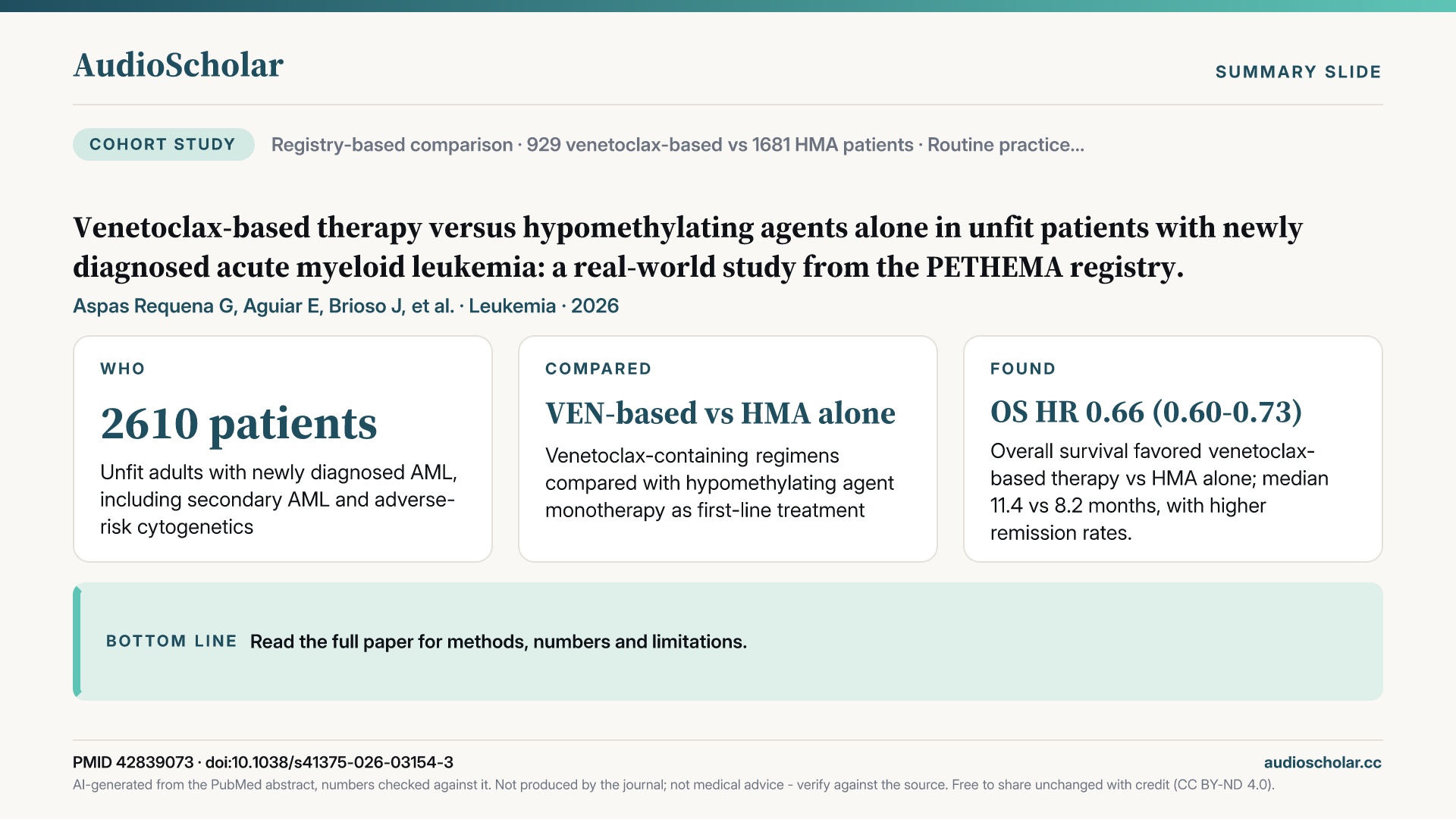
Venetoclax-based therapy versus hypomethylating agents alone in unfit patients with newly diagnosed acute myeloid leukemia: a real-world study from the PETHEMA registry.
In 2,610 unfit AML patients, venetoclax-based therapy cut mortality risk by about a third versus hypomethylating agents alone, mirroring VIALE-A, but showed no benefit in AML arising from prior MDS or MPN.
Leukemia · 2026 · PubMed

This week’s papers
- 01
Venetoclax-based therapy versus hypomethylating agents alone in unfit patients with newly diagnosed acute myeloid leukemia: a real-world study from the PETHEMA registry.
In 2,610 unfit AML patients, venetoclax-based therapy cut mortality risk by about a third versus hypomethylating agents alone, mirroring VIALE-A, but showed no benefit in AML arising from prior MDS or MPN.
Aspas Requena G et al. · Leukemia · 2026
- 02
Measurable residual disease assessment as an early end point of treatment efficacy in acute myeloid leukemia: a multinational PETHEMA study of 2623 patients treated with intensive therapy.
Among 2,623 intensively treated AML patients in first remission, flow MRD negativity at 0.01 percent correlated with survival, though not in all genetic and post-consolidation subgroups, warranting formal surrogate-endpoint studies.
Paiva B et al. · Leukemia · 2026
- 03
Validation of the International Working Group 2023 response criteria for higher risk myelodysplastic syndromes/neoplasms using the International Consortium for Myelodysplastic Syndromes VALIDATE database and a randomized phase III trial.
In two independent cohorts of nearly 1,300 higher-risk MDS patients on hypomethylating agents, composite complete remission under IWG 2023 criteria was associated with improved overall survival, supporting the updated criteria.
Bewersdorf JP et al. · Haematologica · 2026
- 04
Clinical Features and Outcomes of Therapy-Related Myeloid Neoplasms After CAR T-Cell Therapy.
Therapy-related myeloid neoplasms after CAR T-cell therapy arose earlier and carried roughly double the mortality risk of those after standard therapy, a disadvantage not explained by TP53 clone burden.
Jain MD et al. · Blood Advances · 2026
- 05
Germline DDX41 defines a distinct subgroup in MDS undergoing transplantation with reduced relapse and improved survival.
Among 1,514 transplanted MDS patients, germline DDX41 variants were linked to about half the two-year relapse incidence and better disease-free survival, without excess non-relapse mortality or graft-versus-host disease.
Gagelmann N et al. · Blood · 2026
- 06
Choice of a different donor reduces relapse risk after second allogeneic SCT for MDS.
In 313 MDS patients receiving a second allogeneic transplant, survival improved in recent years and a different donor lowered relapse risk, though higher non-relapse mortality prevented a significant survival benefit.
Velazquez GF et al. · Blood · 2026
- 07
Allogeneic stem cell transplantation in aggressive Adult T cell leukemia/lymphoma: a prospective multicenter study.
In a prospective French study of aggressive adult T-cell leukemia-lymphoma, allogeneic transplant was associated with markedly better survival, with 52 percent three-year survival after transplant and evidence of graft-versus-ATL activity.
Marçais A et al. · Blood Advances · 2026
- 08
MAIA frailty subgroup analysis: long-term follow-up with daratumumab plus lenalidomide/dexamethasone in transplant-ineligible newly diagnosed myeloma.
With over five years of follow-up, daratumumab plus lenalidomide-dexamethasone significantly improved survival in non-frail myeloma patients, while in frail patients survival gains were non-significant despite better progression-free survival and responses.
Facon T et al. · Leukemia · 2026
- 09
Plasma Exchange and Daratumumab for Myeloma Cast Nephropathy.
In target trial emulations across 25 United States academic centers, neither early plasma exchange nor early daratumumab was significantly associated with kidney recovery at 90 days in myeloma cast nephropathy.
Shincovich CI et al. · American Journal of Hematology · 2026
- 10
Molecular surveillance of aggressive large B-cell lymphoma using circulating tumor DNA duplexes.
Duplex-sequenced circulating tumor DNA in high-risk large B-cell lymphoma strongly predicted progression, corrected most false radiological assessments, and detected relapse a median of six months before clinical recurrence.
Meriranta L et al. · Haematologica · 2026
The full briefing
This AudioScholar briefing is generated by artificial intelligence for healthcare professionals and trainees. It is not medical advice.
Welcome to This Week in Hematology. This week we're covering 10 notable papers spanning frontline therapy and response endpoints in myeloid disease, the shifting landscape of allogeneic transplantation, and new evidence in myeloma and lymphoma care. Let's dive in.
We start with acute myeloid leukemia and myelodysplastic neoplasms, where three large datasets test how well trial results and response definitions hold up outside tightly controlled settings. In Leukemia, Aspas Requena and colleagues report the largest real-world comparison to date of venetoclax-based therapy against hypomethylating agents alone in unfit patients with newly diagnosed AML, drawing on more than 2,600 patients from the Spanish PETHEMA registry [1]. Composite complete remission was roughly three times as common with venetoclax, at about 64 percent versus 20 percent, early mortality at 30 and 60 days was lower, and median survival rose from about 8 to about 11 months, a reduction in the risk of death of roughly a third. That effect size matched the VIALE-A trial almost exactly, even though this cohort was considerably sicker, with more than 40 percent of patients carrying secondary AML. The benefit held up across propensity matching and era-restricted analyses, and it followed a molecular gradient: the largest gains were seen with IDH2, NPM1, FLT3-ITD and IDH1 mutations. In TP53-mutated disease, survival improved statistically but remained dismal, at about seven months, and patients whose AML arose from prior MDS or myeloproliferative neoplasm showed no benefit at all. This is observational evidence, but its size and consistency strengthen the case that VIALE-A generalizes, while flagging subgroups where the combination adds little. A second PETHEMA analysis in Leukemia, led by Paiva, turns to fit patients treated intensively, asking whether flow-cytometric measurable residual disease could serve as an early efficacy endpoint [2]. Among more than 2,600 patients in morphologic remission after one cycle, roughly two thirds of patients still had detectable MRD, and even low levels between 0.01 and 0.1 percent were linked to worse survival. MRD-negative remission at the 0.01 percent cutoff correlated with survival at the individual patient level, but that correlation was lost within certain genetic risk and post-consolidation subgroups. The authors frame this as support for formal surrogate-endpoint studies rather than as proof that MRD is ready to replace survival in AML trials. In Haematologica, Bewersdorf and colleagues validated the 2023 International Working Group response criteria for higher-risk MDS in two independent cohorts totaling nearly 1,300 patients treated with hypomethylating-agent-based therapy, one a retrospective international database and the other the randomized phase three PANTHER trial [3]. In both datasets, achieving composite complete remission was associated with better survival, with roughly a third lower risk of death in the larger cohort after adjustment, lending external support to the updated criteria as a meaningful trial endpoint.
Our second theme is allogeneic transplantation, where this week's papers help define who benefits, who struggles, and how donor choice matters. In Blood Advances, Jain and colleagues assembled a multicenter cohort of 399 adults with therapy-related myeloid neoplasms, comparing cases arising after CAR T-cell therapy with those after autologous transplant or conventional chemotherapy and radiation [4]. Neoplasms after CAR T appeared far sooner, at a median of about 15 months versus 30 to 38 months for the other groups, and in a latency-matched comparison median survival was about 9 months versus 17 to 19 months. After adjustment, patients with post-CAR T disease had roughly double the risk of death, and this persisted after accounting for TP53 status, so clone burden alone does not explain it. Allogeneic transplant showed a favorable but statistically non-significant association with survival, and the authors still regard it as the only potentially curative option. Two papers in Blood address transplant in MDS from different angles. Gagelmann and colleagues tested 1,514 transplanted MDS patients for germline DDX41 variants, finding pathogenic variants in about 3 percent [5]. These patients had no TP53 mutations, and their two-year relapse incidence was about half that of wild-type patients, at 17 versus 34 percent, translating to significantly better disease-free survival without excess non-relapse mortality or graft-versus-host disease. The relapse advantage was concentrated in reduced-intensity and nonmyeloablative conditioning, and the authors argue germline DDX41 status belongs in transplant planning, though the variant group numbered only 49 patients. Velazquez and colleagues looked at the harder problem of relapse after a first transplant, analyzing 313 adults who underwent a second allogeneic transplant for MDS [6]. Two-year overall survival was 45 percent overall and about half of patients in the most recent era, a clear improvement over historical figures below 20 percent. Choosing a different donor was associated with roughly a 45 percent lower relapse risk, a finding the authors note has not been seen in acute leukemia, but a trend toward higher non-relapse mortality meant this did not translate into a survival benefit. Remission lasting at least a year after the first transplant and good performance status predicted better survival. Rounding out the theme, Marçais and colleagues in Blood Advances report a prospective French study of allogeneic transplant in aggressive adult T-cell leukemia-lymphoma, a disease with median survival under a year [7]. Of 74 patients treated with frontline chemotherapy, 39 proceeded to transplant, more than half with haploidentical donors. In time-dependent analysis, transplant was associated with roughly a two-thirds reduction in the risk of death, and three-year survival after transplant was 52 percent. Uncontrolled disease was the main barrier to reaching transplant, and lack of response at transplant the main predictor of failure. Molecular monitoring showed tumor clones becoming undetectable afterward, consistent with a graft-versus-leukemia effect. This is a single-arm cohort, but it is prospective data from outside Japan in a population that includes ethnic minorities.
Our final theme covers plasma cell and lymphoma care, where the question is how well established treatments and new monitoring tools deliver for specific patients. In Leukemia, Facon and colleagues report a long-term frailty subgroup analysis of the MAIA trial of daratumumab plus lenalidomide and dexamethasone in transplant-ineligible newly diagnosed myeloma [8]. After more than five years of median follow-up, the overall survival benefit was clear in non-frail patients, with roughly half the risk of death. In frail patients the estimate favored daratumumab but did not reach statistical significance, so the survival question in this group remains open. Progression-free survival, complete response rates and MRD negativity improved across all frailty groups, and treatment duration was longer with daratumumab, suggesting tolerability in frail patients. Frailty was assigned retrospectively from baseline data, a limitation the authors acknowledge. Myeloma cast nephropathy was the focus of Shincovich and colleagues in the American Journal of Hematology, who used data from 25 United States academic cancer centers to emulate two target trials [9]. Neither early plasma exchange nor early daratumumab was significantly associated with kidney recovery at 90 days. Plasma exchange showed signals in subgroups, specifically newly diagnosed rather than relapsed disease and stage three acute kidney injury, but these are hypothesis-generating. For two widely used interventions, the evidence supporting a kidney-specific benefit remains thin. Finally, in Haematologica, Meriranta and colleagues studied circulating tumor DNA duplex sequencing in high-risk large B-cell lymphoma patients from a Nordic phase two trial [10]. Clearance of circulating tumor DNA after two cycles had a negative predictive value of about 91 percent for progression. At end of therapy, MRD status sharply separated outcomes, with two-year progression-free survival of about 94 percent in MRD-negative patients versus about 18 percent in MRD-positive patients. The assay resolved most false radiological response assessments and detected relapse a median of six months before clinical recurrence, although isolated central nervous system relapses had the shortest lead times. This is promising but derives from a single trial cohort and has not yet been tested as a strategy that changes treatment.
If you only have time for one paper this week, make it the PETHEMA venetoclax registry study in Leukemia [1]. It largely settles whether VIALE-A's survival benefit carries into a broad, sicker real-world population, while reopening the question of how much venetoclax adds in TP53-mutated AML and disease arising from prior MDS or myeloproliferative neoplasm.
Here is what this week's evidence adds up to in Hematology. First, real-world data now closely mirror the trial benefit of venetoclax-based therapy in unfit AML, with a molecular gradient of benefit, though secondary AML from prior myeloid neoplasms and TP53-mutated disease remain areas of little or no gain. Second, response measures are maturing: flow MRD in intensively treated AML and the 2023 IWG criteria in higher-risk MDS both track with survival, but MRD's value as a surrogate endpoint is not uniform across subgroups and still needs formal validation. Third, transplant decisions are becoming more biologically informed, with germline DDX41 marking a lower-relapse MDS subgroup, donor change lowering relapse at second transplant without a proven survival gain, and myeloid neoplasms after CAR T emerging as a distinctly poor-risk entity, all based on retrospective data. Fourth, in myeloma, daratumumab's survival advantage is firm in non-frail transplant-ineligible patients but unproven in frail ones, and observational data do not show kidney recovery benefit from early plasma exchange or daratumumab in cast nephropathy. And fifth, ultrasensitive circulating tumor DNA monitoring in large B-cell lymphoma shows strong prognostic power and early relapse detection, though whether acting on it improves outcomes is still untested.
That's your roundup for This Week in Hematology. The full transcript and references are available on the episode page. This is an AI-curated summary — for clinical decisions, always consult primary sources and current guidelines. See you next week.
If this weekly briefing is useful, follow the show in your podcast app so new episodes arrive automatically. And a quick rating on Apple Podcasts or Spotify helps other physicians discover the show.
This is an automated summary generated by artificial intelligence, which can make mistakes. Always review the original source materials.
Spot something worth flagging?
Get this every week in your podcast app — free.
New hematology episodes land in your feed automatically — listen on your commute.