This Week in Endocrinology — Oct 14, 2026
Generated Oct 15, 2026 · 10:46
The week's practice-changing Endocrinology research, summarized for clinicians.
If the audio fails to play, refresh the page to renew the link.
Get next week’s Endocrinology briefing — free.
In your podcast app, or readable in your inbox with the audio one tap away.
Risk-Stratified Outcomes Using the 2025 ATA Thyroglobulin Cutoff After Total Thyroidectomy in Differentiated Thyroid Cancer.
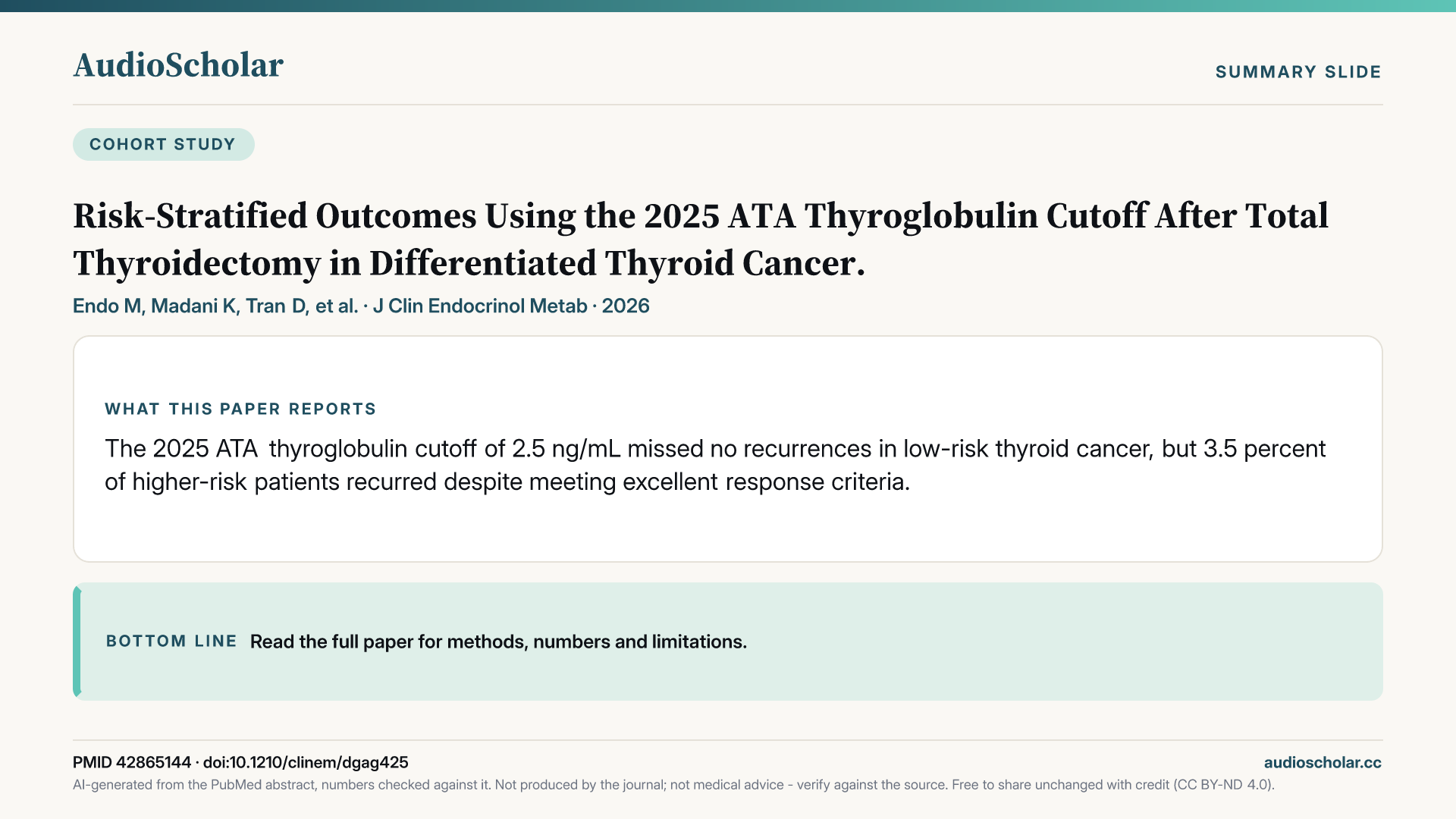
The 2025 ATA thyroglobulin cutoff of 2.5 ng/mL missed no recurrences in low-risk thyroid cancer, but 3.5 percent of higher-risk patients recurred despite meeting excellent response criteria.
Journal of Clinical Endocrinology & Metabolism · 2026 · PubMed

This week’s papers
- 01
Comparative Performance of the 2015 and 2025 American Thyroid Association Initial Recurrence Risk Stratification Systems in Differentiated Thyroid Cancer.
In 1,508 Chinese patients with thyroid cancer, the 2025 ATA risk system discriminated recurrence better than 2015 but upgraded nearly four in ten patients who never recurred.
Ke W et al. · Thyroid · 2026
From the briefingIn Thyroid, Ke and colleagues compared the 2015 and 2025 initial recurrence risk systems in 1,508 patients treated at a tertiary centre in China and followed for a median of almost nine years, during which 8 percent of patients developed structural recurrence [1]. The 2025 system discriminated modestly but significantly better and showed greater net clinical benefit on decision curve analysis. The catch is specificity: it moved about four in ten patients who later recurred into higher-risk categories, which is the intent, but it also moved nearly four in ten patients who never recurred upward. The authors trace much of this risk inflation to the revised multifocality criteria and to counting two or more low-to-intermediate features, while the new compartment-based lymph node stratification genuinely improved accuracy.
Written by AI from the published abstract, for healthcare professionals. Not medical advice; check the paper before acting on it.
- 02
Risk-Stratified Outcomes Using the 2025 ATA Thyroglobulin Cutoff After Total Thyroidectomy in Differentiated Thyroid Cancer.
The 2025 ATA thyroglobulin cutoff of 2.5 ng/mL missed no recurrences in low-risk thyroid cancer, but 3.5 percent of higher-risk patients recurred despite meeting excellent response criteria.
Endo M et al. · Journal of Clinical Endocrinology & Metabolism · 2026
From the briefingWriting in the Journal of Clinical Endocrinology and Metabolism, Endo and colleagues looked at the other end of the pathway, the new unstimulated thyroglobulin threshold of 2.5 nanograms per millilitre after total thyroidectomy without radioactive iodine [2]. Among 205 carefully selected patients followed for about seven years on average, the revised cutoff expanded the excellent response group from roughly three quarters of patients to nearly all of them. In low-risk disease, no structural recurrence was missed. But among patients with low-intermediate or higher-risk disease, about 3.5 percent recurred despite meeting excellent response criteria, at a median of about two years, and a postoperative thyroglobulin cutoff of 0.3 caught every one of those recurrences. Both studies are retrospective and single-system, and the second is small, but read together they suggest the new framework may over-call risk at diagnosis while under-calling it at follow-up in intermediate-risk patients, and the authors argue for risk-adapted interpretation of thyroglobulin and continued imaging surveillance in that group.
If you only have time for one paper this week, make it the thyroglobulin cutoff study by Endo and colleagues in the Journal of Clinical Endocrinology and Metabolism [2]. It directly tests a newly adopted guideline threshold that will shape follow-up for a large population of thyroid cancer survivors, and it reopens the question of whether a single cutoff fits every risk category.
Written by AI from the published abstract, for healthcare professionals. Not medical advice; check the paper before acting on it.
- 03
Iopanoic Acid in Severe Thyrotoxicosis: Rediscovering an Effective Therapy.
Short-course iopanoic acid lowered free T3 by about 55 percent within roughly two days in refractory thyrotoxicosis, supporting its revival as rescue therapy, though evidence remains case-series level.
Taylor P et al. · Journal of Clinical Endocrinology & Metabolism · 2026
From the briefingStaying with the thyroid, Taylor, Schoenmakers, Duntas and colleagues make the case in the Journal of Clinical Endocrinology and Metabolism for bringing back iopanoic acid, a potent deiodinase inhibitor that rapidly blocks conversion of thyroxine to triiodothyronine [3]. Across early studies and a recent tertiary-centre series of 12 patients with treatment-resistant thyrotoxicosis, free T3 fell by roughly 55 percent and normalised within a median of two days, allowing most patients to proceed to definitive surgery. The authors position it as short-course rescue or bridging therapy in thyroid storm and refractory, iodine-unresponsive amiodarone-induced thyrotoxicosis, not for straightforward disease, and they note that its disappearance reflected the end of oral cholecystography rather than safety concerns. The evidence is case-series level, and the authors identify reliable, governed sourcing as the main barrier.
Written by AI from the published abstract, for healthcare professionals. Not medical advice; check the paper before acting on it.
- 04
Cortisol Cutoffs for Adrenal Insufficiency Using Elecsys II: A Systematic Review.
Pooling six small studies, a peak ACTH-stimulated cortisol cutoff of 405 nmol/L on the Elecsys II assay is proposed for adrenal insufficiency, replacing the older 500 nmol/L threshold.
Haunton S et al. · Clinical Endocrinology · 2026
From the briefingIn Clinical Endocrinology, Haunton and colleagues systematically reviewed cortisol thresholds for the standard-dose ACTH stimulation test on the Roche Elecsys II monoclonal assay [4]. Pooling six studies covering 430 adult and paediatric patients, they propose a peak cortisol cutoff of 405 nanomoles per litre, or 14.7 micrograms per decilitre, deliberately conservative to limit false negatives. This reinforces the move away from the historical 500 nanomole threshold derived from older polyclonal assays, though the authors are candid that the included studies are few and of limited quality.
Written by AI from the published abstract, for healthcare professionals. Not medical advice; check the paper before acting on it.
- 05
Mild Autonomous Cortisol Secretion and Psychiatric Morbidity in Patients With Adrenal Tumors: A Cohort Study.
Among 3,195 Swedish patients with adrenal tumours, mild autonomous cortisol secretion was associated with roughly 80 percent higher incidence of psychiatric disorders compared with non-functional tumours.
Mirzaei H et al. · Journal of Clinical Endocrinology & Metabolism · 2026
From the briefingAlso in the Journal of Clinical Endocrinology and Metabolism, Mirzaei and colleagues used Swedish registers to follow 3,195 patients with benign adrenal tumours, of whom 1,216 had mild autonomous cortisol secretion [5]. Psychiatric disorders were about a third more common at baseline in the cortisol-secreting group, and over nearly five years new psychiatric diagnoses were roughly 80 percent more frequent, with the highest estimate, roughly a tripling, in men younger than 65. After correction for multiple comparisons, only overall psychiatric disorders and substance use disorders remained significant. This is observational and cannot establish that cortisol causes the excess, but it adds a psychiatric dimension to a condition usually framed around cardiometabolic risk.
Written by AI from the published abstract, for healthcare professionals. Not medical advice; check the paper before acting on it.
- 06
Comparative Effectiveness of Denosumab Versus Bisphosphonates for Hypercalcemia of Malignancy: A Real-World Cohort Study.
Denosumab and intravenous bisphosphonates normalised calcium equally fast in hypercalcaemia of malignancy; lower 90-day mortality with denosumab came from only 55 patients and needs prospective confirmation.
Milosavljevic J et al. · Journal of Clinical Endocrinology & Metabolism · 2026
From the briefingFor hypercalcaemia of malignancy, Milosavljevic and colleagues, again in the Journal of Clinical Endocrinology and Metabolism, compared denosumab with intravenous bisphosphonates in 836 hospitalised patients at a safety-net system in the Bronx [6]. Calcium normalised in about a day and a half with either drug, and rates of hypocalcaemia and recurrence did not differ. Ninety-day mortality was roughly halved with denosumab, but only 55 patients received it, and the authors explicitly call this a signal for prospective study rather than proof. The 2023 Endocrine Society guideline conditionally favours denosumab; this cohort supports equivalent calcium control but cannot settle the survival question.
Written by AI from the published abstract, for healthcare professionals. Not medical advice; check the paper before acting on it.
- 07
Approach to a patient with MEN1 syndrome.
Four clinical vignettes illustrate lifelong surveillance and carefully timed intervention for hyperparathyroidism, pancreatic neuroendocrine tumours and pituitary adenomas in multiple endocrine neoplasia type 1.
Mitchell AL, Korbonits M · Journal of Clinical Endocrinology & Metabolism · 2026
From the briefingRounding out this theme, Mitchell and Korbonits offer an Approach to the Patient piece on multiple endocrine neoplasia type 1, using four case vignettes to explore lifelong surveillance and the timing of interventions for hyperparathyroidism, pancreatic neuroendocrine tumours and pituitary adenomas [7].
Written by AI from the published abstract, for healthcare professionals. Not medical advice; check the paper before acting on it.
- 08
Preconception incretin therapy reduces pregnancy and cardiometabolic outcomes in polycystic ovary syndrome.
In a large target trial emulation, preconception GLP-1 or GIP/GLP-1 agonists versus metformin in PCOS were associated with roughly 60 percent fewer adverse pregnancy outcomes, though not supporting gestational use.
Henney AE et al. · Journal of Clinical Endocrinology & Metabolism · 2026
From the briefingIn the Journal of Clinical Endocrinology and Metabolism, Henney and colleagues emulated a target trial using the TriNetX network, matching about 48,000 women with polycystic ovary syndrome on preconception liraglutide, semaglutide or tirzepatide against the same number on metformin [8]. The composite of adverse pregnancy outcomes over two years was roughly 60 percent lower with incretin therapy, type 2 diabetes was about two thirds lower, and major cardiovascular events were modestly lower. The effect sizes are large enough to raise concerns about residual confounding, associations varied across sensitivity analyses, and the authors stress that the data say nothing about safety during pregnancy and do not support use in gestation.
Written by AI from the published abstract, for healthcare professionals. Not medical advice; check the paper before acting on it.
- 09
Effects of tirzepatide (GIP/GLP-1 dual receptor agonist) on cardiorenal biomarkers and functional capacity in heart failure: a systematic review and meta-analysis.
Across seven heart failure studies, tirzepatide cut hsCRP by about a third and NT-proBNP by under a fifth, while functional and renal benefits rest only on single trials.
Eisa N, Khoury M · Journal of Clinical Endocrinology & Metabolism · 2026
From the briefingIn the same journal, Eisa and Khoury meta-analysed seven studies of tirzepatide in heart failure covering about 5,400 participants [9]. Tirzepatide lowered high-sensitivity C-reactive protein by about a third and NT-proBNP by just under a fifth, with moderate certainty. Functional gains from the SUMMIT trial, about five points on the Kansas City questionnaire and roughly 16 metres on the six-minute walk, and the renal signals all come from single trials, which the authors call hypothesis-generating.
Written by AI from the published abstract, for healthcare professionals. Not medical advice; check the paper before acting on it.
- 10
Contemporary Sex-Specific Mortality Risk in Type 1 Diabetes During the Era of Advanced Therapeutic Care.
People diagnosed with type 1 diabetes since 2000 had roughly three and a half times higher mortality than matched controls, with greater relative excess in women and attenuation in recent cohorts.
Vinograd A et al. · Diabetes Care · 2026
From the briefingFinally, in Diabetes Care, Vinograd and colleagues followed 4,299 people diagnosed with type 1 diabetes before age 35 between 2000 and 2022 in Israel's Maccabi network, against about 17,000 matched controls [10]. Even in this era of pumps and sensors, mortality was roughly three and a half times higher. The relative excess was striking in women, around eightfold, compared with about threefold in men, although absolute death rates were higher in men. Encouragingly, the excess was smaller among those diagnosed after 2010. With only 112 deaths, the estimates are imprecise, but the sex difference deserves attention.
Written by AI from the published abstract, for healthcare professionals. Not medical advice; check the paper before acting on it.
The full briefing
This AudioScholar briefing is generated by artificial intelligence for healthcare professionals and trainees. It is not medical advice.
Welcome to This Week in Endocrinology. This week we're covering 10 notable papers spanning the real-world test of the 2025 American Thyroid Association guidance, adrenal and calcium problems from diagnosis to emergency care, and the widening metabolic reach of incretin therapy alongside a sobering look at type 1 diabetes mortality. Let's dive in.
The 2025 American Thyroid Association guideline is now being stress-tested in real patients, and two cohorts this week point to a trade-off between catching more disease and labelling more people as higher risk. In Thyroid, Ke and colleagues compared the 2015 and 2025 initial recurrence risk systems in 1,508 patients treated at a tertiary centre in China and followed for a median of almost nine years, during which 8 percent of patients developed structural recurrence [1]. The 2025 system discriminated modestly but significantly better and showed greater net clinical benefit on decision curve analysis. The catch is specificity: it moved about four in ten patients who later recurred into higher-risk categories, which is the intent, but it also moved nearly four in ten patients who never recurred upward. The authors trace much of this risk inflation to the revised multifocality criteria and to counting two or more low-to-intermediate features, while the new compartment-based lymph node stratification genuinely improved accuracy. Writing in the Journal of Clinical Endocrinology and Metabolism, Endo and colleagues looked at the other end of the pathway, the new unstimulated thyroglobulin threshold of 2.5 nanograms per millilitre after total thyroidectomy without radioactive iodine [2]. Among 205 carefully selected patients followed for about seven years on average, the revised cutoff expanded the excellent response group from roughly three quarters of patients to nearly all of them. In low-risk disease, no structural recurrence was missed. But among patients with low-intermediate or higher-risk disease, about 3.5 percent recurred despite meeting excellent response criteria, at a median of about two years, and a postoperative thyroglobulin cutoff of 0.3 caught every one of those recurrences. Both studies are retrospective and single-system, and the second is small, but read together they suggest the new framework may over-call risk at diagnosis while under-calling it at follow-up in intermediate-risk patients, and the authors argue for risk-adapted interpretation of thyroglobulin and continued imaging surveillance in that group.
Staying with the thyroid, Taylor, Schoenmakers, Duntas and colleagues make the case in the Journal of Clinical Endocrinology and Metabolism for bringing back iopanoic acid, a potent deiodinase inhibitor that rapidly blocks conversion of thyroxine to triiodothyronine [3]. Across early studies and a recent tertiary-centre series of 12 patients with treatment-resistant thyrotoxicosis, free T3 fell by roughly 55 percent and normalised within a median of two days, allowing most patients to proceed to definitive surgery. The authors position it as short-course rescue or bridging therapy in thyroid storm and refractory, iodine-unresponsive amiodarone-induced thyrotoxicosis, not for straightforward disease, and they note that its disappearance reflected the end of oral cholecystography rather than safety concerns. The evidence is case-series level, and the authors identify reliable, governed sourcing as the main barrier.
Our second theme moves to the adrenal gland and calcium, where several papers refine how we diagnose and treat common but high-stakes problems. In Clinical Endocrinology, Haunton and colleagues systematically reviewed cortisol thresholds for the standard-dose ACTH stimulation test on the Roche Elecsys II monoclonal assay [4]. Pooling six studies covering 430 adult and paediatric patients, they propose a peak cortisol cutoff of 405 nanomoles per litre, or 14.7 micrograms per decilitre, deliberately conservative to limit false negatives. This reinforces the move away from the historical 500 nanomole threshold derived from older polyclonal assays, though the authors are candid that the included studies are few and of limited quality. Also in the Journal of Clinical Endocrinology and Metabolism, Mirzaei and colleagues used Swedish registers to follow 3,195 patients with benign adrenal tumours, of whom 1,216 had mild autonomous cortisol secretion [5]. Psychiatric disorders were about a third more common at baseline in the cortisol-secreting group, and over nearly five years new psychiatric diagnoses were roughly 80 percent more frequent, with the highest estimate, roughly a tripling, in men younger than 65. After correction for multiple comparisons, only overall psychiatric disorders and substance use disorders remained significant. This is observational and cannot establish that cortisol causes the excess, but it adds a psychiatric dimension to a condition usually framed around cardiometabolic risk.
For hypercalcaemia of malignancy, Milosavljevic and colleagues, again in the Journal of Clinical Endocrinology and Metabolism, compared denosumab with intravenous bisphosphonates in 836 hospitalised patients at a safety-net system in the Bronx [6]. Calcium normalised in about a day and a half with either drug, and rates of hypocalcaemia and recurrence did not differ. Ninety-day mortality was roughly halved with denosumab, but only 55 patients received it, and the authors explicitly call this a signal for prospective study rather than proof. The 2023 Endocrine Society guideline conditionally favours denosumab; this cohort supports equivalent calcium control but cannot settle the survival question. Rounding out this theme, Mitchell and Korbonits offer an Approach to the Patient piece on multiple endocrine neoplasia type 1, using four case vignettes to explore lifelong surveillance and the timing of interventions for hyperparathyroidism, pancreatic neuroendocrine tumours and pituitary adenomas [7].
Our final theme is metabolic risk, where incretin therapy keeps extending its reach while type 1 diabetes still carries a heavy mortality cost. In the Journal of Clinical Endocrinology and Metabolism, Henney and colleagues emulated a target trial using the TriNetX network, matching about 48,000 women with polycystic ovary syndrome on preconception liraglutide, semaglutide or tirzepatide against the same number on metformin [8]. The composite of adverse pregnancy outcomes over two years was roughly 60 percent lower with incretin therapy, type 2 diabetes was about two thirds lower, and major cardiovascular events were modestly lower. The effect sizes are large enough to raise concerns about residual confounding, associations varied across sensitivity analyses, and the authors stress that the data say nothing about safety during pregnancy and do not support use in gestation. In the same journal, Eisa and Khoury meta-analysed seven studies of tirzepatide in heart failure covering about 5,400 participants [9]. Tirzepatide lowered high-sensitivity C-reactive protein by about a third and NT-proBNP by just under a fifth, with moderate certainty. Functional gains from the SUMMIT trial, about five points on the Kansas City questionnaire and roughly 16 metres on the six-minute walk, and the renal signals all come from single trials, which the authors call hypothesis-generating.
Finally, in Diabetes Care, Vinograd and colleagues followed 4,299 people diagnosed with type 1 diabetes before age 35 between 2000 and 2022 in Israel's Maccabi network, against about 17,000 matched controls [10]. Even in this era of pumps and sensors, mortality was roughly three and a half times higher. The relative excess was striking in women, around eightfold, compared with about threefold in men, although absolute death rates were higher in men. Encouragingly, the excess was smaller among those diagnosed after 2010. With only 112 deaths, the estimates are imprecise, but the sex difference deserves attention.
If you only have time for one paper this week, make it the thyroglobulin cutoff study by Endo and colleagues in the Journal of Clinical Endocrinology and Metabolism [2]. It directly tests a newly adopted guideline threshold that will shape follow-up for a large population of thyroid cancer survivors, and it reopens the question of whether a single cutoff fits every risk category.
Here is what this week's evidence adds up to in Endocrinology. First, early real-world data on the 2025 thyroid cancer guidance suggest better discrimination at diagnosis but meaningful upward reclassification, and a relaxed thyroglobulin threshold that appears safe in low-risk disease but may miss some recurrences in intermediate-risk patients; both findings are retrospective and await replication. Second, monoclonal cortisol assays support a lower stimulated threshold, around 405 nanomoles per litre on Elecsys II, though the underlying evidence is thin. Third, mild autonomous cortisol secretion is associated with more psychiatric illness, and denosumab matched bisphosphonates for calcium control in malignancy with a mortality signal that remains unconfirmed. Fourth, incretin therapy is linked to better preconception and cardiorenal markers, but the pregnancy data are observational and the heart failure functional data rest on single trials. And type 1 diabetes still carries a large mortality excess, especially in relative terms for women, even as it narrows in recent cohorts.
That's your roundup for This Week in Endocrinology. The full transcript and references are available on the episode page. This is an AI-curated summary — for clinical decisions, always consult primary sources and current guidelines. See you next week.
If this weekly briefing is useful, follow the show in your podcast app so new episodes arrive automatically. And a quick rating on Apple Podcasts or Spotify helps other physicians discover the show.
This is an automated summary generated by artificial intelligence, which can make mistakes. Always review the original source materials.
Spot something worth flagging?
Get this every week in your podcast app — free.
New endocrine episodes land in your feed automatically — listen on your commute.