This Week in Gastroenterology — Oct 20, 2026
Generated Oct 21, 2026 · 12:13
The week's practice-changing Gastroenterology research, summarized for clinicians.
If the audio fails to play, refresh the page to renew the link.
Get next week’s Gastroenterology briefing — free.
In your podcast app, or readable in your inbox with the audio one tap away.
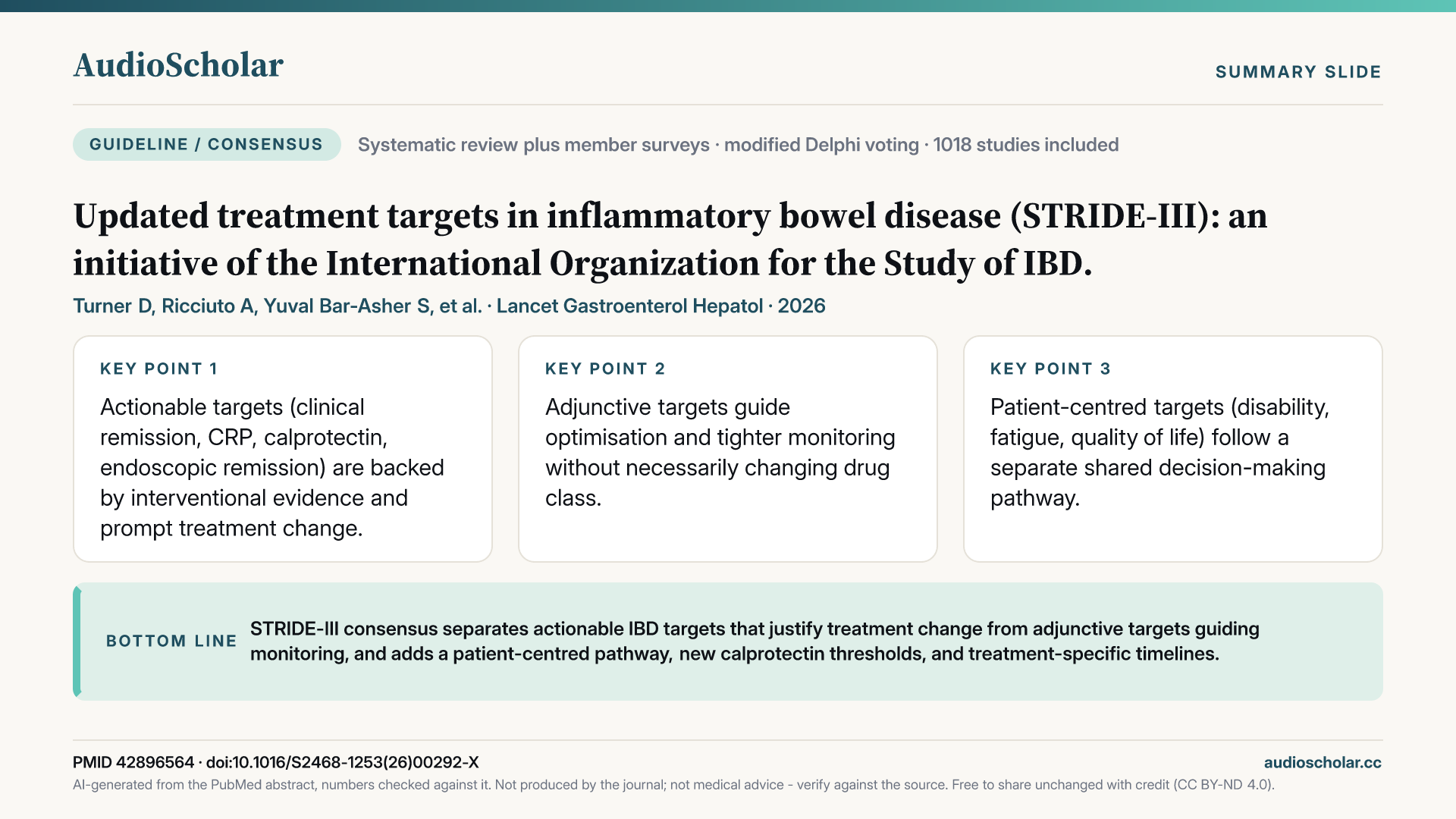
Updated treatment targets in inflammatory bowel disease (STRIDE-III): an initiative of the International Organization for the Study of IBD.
STRIDE-III consensus separates actionable IBD targets that justify treatment change from adjunctive targets guiding monitoring, and adds a patient-centred pathway, new calprotectin thresholds, and treatment-specific timelines.
The Lancet Gastroenterology & Hepatology · 2026 · PubMed

This week’s papers
- 01
Updated treatment targets in inflammatory bowel disease (STRIDE-III): an initiative of the International Organization for the Study of IBD.
STRIDE-III consensus separates actionable IBD targets that justify treatment change from adjunctive targets guiding monitoring, and adds a patient-centred pathway, new calprotectin thresholds, and treatment-specific timelines.
Turner D et al. · The Lancet Gastroenterology & Hepatology · 2026
From the briefingIn The Lancet Gastroenterology and Hepatology, Turner and colleagues present STRIDE-III, the International Organization for the Study of IBD update to the treat-to-target framework [1]. Built on a systematic review that included more than a thousand studies, surveys of adult and paediatric specialists, and a modified Delphi vote, it sorts targets into three tiers. Actionable targets, meaning clinical response and remission plus C-reactive protein normalisation, faecal calprotectin in range, and endoscopic remission, are those with interventional evidence that adjusting treatment to reach them helps. Adjunctive targets, including urgency, histological remission in ulcerative colitis, transmural remission in Crohn's disease, and growth in children, are associated with better outcomes and are framed as reasons for optimisation and closer monitoring rather than a change of drug class. A separate patient-centred tier covers disability, fatigue, and quality of life, where impairment is meant to trigger a search for inflammation or other causes and shared decision-making. The document also adds treatment-specific times to target, new calprotectin thresholds, and adaptations for resource-limited settings. This is consensus guidance rather than new trial data, but it sharpens the line between targets that justify switching therapy and those that do not.
If you only have time for one paper this week, make it STRIDE-III in The Lancet Gastroenterology and Hepatology [1]. It reframes treat-to-target care by separating targets that justify a change of therapy from those that only justify closer monitoring, which is the question that shapes most routine decisions in inflammatory bowel disease clinics.
Written by AI from the published abstract, for healthcare professionals. Not medical advice; check the paper before acting on it.
- 02
Phase 2 Trial of Icotrokinra for Patients with Ulcerative Colitis.
Oral icotrokinra, an interleukin-23 receptor blocking peptide, more than doubled week 12 clinical response versus placebo in moderate to severe ulcerative colitis, with similar adverse event rates in phase 2b.
Abreu MT et al. · New England Journal of Medicine · 2026
From the briefingOn the therapy side, the New England Journal of Medicine published a phase 2b trial led by Abreu of oral icotrokinra, a peptide that blocks the interleukin-23 receptor, in 252 adults with moderately to severely active ulcerative colitis [2]. At twelve weeks, clinical response occurred in just under two thirds of patients on the 400 milligram dose versus about a quarter of those on placebo, and all three doses beat placebo on that primary endpoint. At the top dose, clinical remission nearly tripled, to about three in ten patients, with similar gains in symptomatic remission and endoscopic improvement. Remission at 200 milligrams fell just short of statistical significance, which halted formal testing of the remaining secondary endpoints. Adverse event rates looked similar to placebo, and serious events were not more frequent. This is a short, industry-funded phase 2 study, so it establishes proof of concept for oral interleukin-23 pathway blockade rather than a place in the treatment sequence.
Written by AI from the published abstract, for healthcare professionals. Not medical advice; check the paper before acting on it.
- 03
Incidence and Risk Factors for C. difficile Reinfection After Faecal Microbiota Transplantation or Antibiotic Therapy.
Late C. difficile reinfection after faecal microbiota transplantation was low, about one in ten at three years, similar to antibiotics alone, while proton pump inhibitor use was associated with higher reinfection risk.
Kelly CR et al. · Alimentary Pharmacology and Therapeutics · 2026
From the briefingStaying in the gut, Kelly and colleagues in Alimentary Pharmacology and Therapeutics used a large claims database to examine late reinfection with C. difficile among more than eight thousand patients with multiply recurrent infection [3]. Reinfection beyond six months was uncommon, reaching about one in ten at three years after faecal microbiota transplantation, and was not statistically different from antibiotics alone. Proton pump inhibitor use was associated with roughly a fifty percent higher risk of reinfection after transplant in the claims data, with a similar but non-significant signal in the AGA registry. These are observational associations, but they add weight to the authors' case for revisiting whether ongoing acid suppression is still indicated in this group.
Written by AI from the published abstract, for healthcare professionals. Not medical advice; check the paper before acting on it.
- 04
Thyroid hormone receptor-β agonist simedeutirom (HSK31679) for Chinese patients with metabolic dysfunction-associated steatohepatitis: a 52-week, multicentre, randomised, double-blind, placebo-controlled, phase 2b trial.
In Chinese adults with F2 to F3 steatohepatitis, simedeutirom achieved steatohepatitis improvement without fibrosis worsening in 30 to 37 percent versus 10 percent on placebo, with comparable safety, supporting phase 3.
Xue F et al. · The Lancet Gastroenterology & Hepatology · 2026
From the briefingAlso in The Lancet Gastroenterology and Hepatology, Xue and colleagues report a 52-week phase 2b trial of simedeutirom, a selective thyroid hormone receptor beta agonist, in 186 Chinese adults with biopsy-confirmed steatohepatitis and stage F2 or F3 fibrosis [4]. Steatohepatitis improvement without fibrosis worsening occurred in about 37 percent of patients on 80 milligrams and 30 percent on 160 milligrams, against 10 percent on placebo, an absolute gain of roughly 27 points at the lower dose. The higher dose did not add benefit, and severe and serious adverse events were similar to placebo, with no discontinuations for adverse events. The abstract does not report fibrosis regression as a primary result, and the population is exclusively Chinese, so phase 3 data will be needed before this agent joins the conversation alongside existing options.
Written by AI from the published abstract, for healthcare professionals. Not medical advice; check the paper before acting on it.
- 05
Corticosteroid Exposure in Autoimmune Hepatitis: Early Toxicity, Cumulative Burden and Associations With Long-Term Patient-Reported Outcomes.
Patients with autoimmune hepatitis reported near-universal early steroid side effects and dose-dependent long-term harms, with over five years of extensive exposure linked to roughly fourfold odds of metabolic complications.
Gentry E et al. · Alimentary Pharmacology and Therapeutics · 2026
From the briefingA more sobering paper in Alimentary Pharmacology and Therapeutics, from Gentry and colleagues, surveyed 563 members of an autoimmune hepatitis patient network [5]. Nearly every patient reported side effects within six months of starting corticosteroids, with more symptoms after prednisone or prednisolone than after budesonide, and about half of patients started on prednisone or prednisolone reported a new metabolic condition within six months. Among those with longer disease, about three quarters reported long-term complications such as weight gain, osteoporosis, and hypertension. Each additional year of extensive steroid exposure raised the odds of the composite harm outcome by roughly a tenth, and more than five years roughly quadrupled the odds. Self-report and recruitment through a patient network limit how far these figures generalise, and the authors frame lower induction doses and budesonide as strategies needing prospective testing rather than proven alternatives.
Written by AI from the published abstract, for healthcare professionals. Not medical advice; check the paper before acting on it.
- 06
Bicentric comparison of 3-year clinical outcomes between endoscopic ultrasound-guided embolization with coil and hemostatic adjunct versus balloon-occluded retrograde transvenous obliteration for treatment of bleeding gastric varices: A propensity-score matched study.
In a retrospective matched cirrhosis cohort, endoscopic ultrasound-guided coil therapy for bleeding gastric varices had far fewer adverse events and less hepatic decompensation than BRTO, without mortality difference.
Siranart N et al. · Gastrointestinal Endoscopy · 2026
From the briefingFinally, in Gastrointestinal Endoscopy, Siranart and colleagues compared endoscopic ultrasound-guided coil embolization with balloon-occluded retrograde transvenous obliteration for bleeding gastric varices across two tertiary centres [6]. In 60 propensity-matched patients with cirrhosis, adverse events occurred in about 3 percent after the endoscopic approach versus 37 percent after the radiological one, and the risk of further hepatic decompensation was cut by roughly seventy percent. Transfusion needs, reintervention rates, length of stay, and mortality did not differ. This is a small retrospective series from expert centres, and the authors themselves call for prospective trials before the endoscopic route is regarded as the preferred first step.
Written by AI from the published abstract, for healthcare professionals. Not medical advice; check the paper before acting on it.
- 07
Optimal Incidence Threshold for Cost-Effective Hepatocellular Carcinoma Surveillance in Alcohol-Associated Cirrhosis.
Modelling suggests twice-yearly liver cancer surveillance in alcohol-associated cirrhosis is cost-effective once annual incidence exceeds about 0.45 per 100 person-years, well below the traditional 1 per 100 threshold.
Hajjar A et al. · Clinical Gastroenterology and Hepatology · 2026
From the briefingIn Clinical Gastroenterology and Hepatology, Hajjar and colleagues built a microsimulation model of alcohol-associated cirrhosis in the United States and found that twice-yearly ultrasound plus alpha-fetoprotein surveillance became cost-effective once annual liver cancer incidence reached about 0.45 per 100 person-years [7]. That is less than half the traditional threshold of 1 per 100, and surveillance looked good value in both active drinkers and abstinent patients, at roughly nineteen thousand and fifty-six thousand dollars per quality-adjusted life year respectively. It is a model, not outcome data, and guidelines have not adopted the lower threshold, but it challenges the argument that low contemporary incidence makes surveillance in this group poor value.
Written by AI from the published abstract, for healthcare professionals. Not medical advice; check the paper before acting on it.
- 08
Cost-Effectiveness of HCV Screening in Emergency Departments Using DETECT Hep C Trial Results.
Simulation using DETECT Hep C trial data found nontargeted emergency department hepatitis C screening cured the most infections and was cost-effective at about 12,800 dollars per quality-adjusted life year.
Czoty LMW et al. · JAMA Internal Medicine · 2026
From the briefingJAMA Internal Medicine carried a related economic analysis from Czoty and colleagues, using data from the DETECT Hep C trial in three emergency departments in the United States [8]. Nontargeted hepatitis C screening produced the most cures and was cost-effective at about thirteen thousand dollars per quality-adjusted life year. The per-person gains are small because more than nine in ten people screened did not have the infection, but the benefit to those with hepatitis C was clear, and the analysis supports universal rather than risk-based testing in that setting. Two papers in the American Journal of Gastroenterology look at screening delivery.
Written by AI from the published abstract, for healthcare professionals. Not medical advice; check the paper before acting on it.
- 09
Implementation of Programmatic Mailed Fecal Immunochemical Testing for Colorectal Cancer Screening in the Veterans Health Administration.
The Veterans Health Administration mailed stool test programme achieved about 40 percent kit return and improved screening uptake, but only about half of patients with abnormal results completed colonoscopy.
Dominitz JA et al. · American Journal of Gastroenterology · 2026
From the briefingDominitz and colleagues describe the Veterans Health Administration's national mailed faecal immunochemical test programme, now in nearly nine in ten eligible facilities [9]. Of roughly 644 thousand kits ordered, about 40 percent were returned, and about one in ten returned kits could not be tested, mostly because of a missing collection date. Among patients with an abnormal result, only about half completed colonoscopy, although adenomas were found in about two thirds of those procedures and cancer in about 2 percent. Wider adoption tracked closely with higher rates of being up to date with screening, while the follow-up colonoscopy gap stands out as the weak link.
Written by AI from the published abstract, for healthcare professionals. Not medical advice; check the paper before acting on it.
- 10
Integrating Non-Invasive Liver Assessment into Screening Colonoscopy: A Prospective Cross-Sectional Study.
Adding liver ultrasound and elastography to screening colonoscopy visits was well accepted and found steatosis in over half of adults and stiffness suggesting significant fibrosis in about nine percent.
Qasem M et al. · American Journal of Gastroenterology · 2026
From the briefingQasem and colleagues, meanwhile, tested adding liver ultrasound and shear wave elastography to screening colonoscopy visits in adults aged 50 and over without known liver disease [10]. Close to nine in ten people offered the assessment accepted it, just over half of participants had steatosis, about one in eleven had stiffness consistent with significant fibrosis, and about one in twenty met the threshold for compensated advanced chronic liver disease. The Fibrosis-4 score discriminated only modestly, and age-adjusted cut-offs missed more cases. Without biopsy confirmation or outcome follow-up, this establishes feasibility and yield rather than benefit, but it identifies the colonoscopy visit as an underused point of contact for liver case-finding.
Written by AI from the published abstract, for healthcare professionals. Not medical advice; check the paper before acting on it.
The full briefing
This AudioScholar briefing is generated by artificial intelligence for healthcare professionals and trainees. It is not medical advice.
Welcome to This Week in Gastroenterology. This week we're covering 10 notable papers spanning updated targets and new oral therapy in inflammatory bowel disease, treatment and its harms across liver disease and portal hypertension, and the value and yield of population screening for liver and colorectal disease. Let's dive in.
Inflammatory bowel disease and recurrent infection gave us both a new map of what to aim for and a possible new way to get there. In The Lancet Gastroenterology and Hepatology, Turner and colleagues present STRIDE-III, the International Organization for the Study of IBD update to the treat-to-target framework [1]. Built on a systematic review that included more than a thousand studies, surveys of adult and paediatric specialists, and a modified Delphi vote, it sorts targets into three tiers. Actionable targets, meaning clinical response and remission plus C-reactive protein normalisation, faecal calprotectin in range, and endoscopic remission, are those with interventional evidence that adjusting treatment to reach them helps. Adjunctive targets, including urgency, histological remission in ulcerative colitis, transmural remission in Crohn's disease, and growth in children, are associated with better outcomes and are framed as reasons for optimisation and closer monitoring rather than a change of drug class. A separate patient-centred tier covers disability, fatigue, and quality of life, where impairment is meant to trigger a search for inflammation or other causes and shared decision-making. The document also adds treatment-specific times to target, new calprotectin thresholds, and adaptations for resource-limited settings. This is consensus guidance rather than new trial data, but it sharpens the line between targets that justify switching therapy and those that do not. On the therapy side, the New England Journal of Medicine published a phase 2b trial led by Abreu of oral icotrokinra, a peptide that blocks the interleukin-23 receptor, in 252 adults with moderately to severely active ulcerative colitis [2]. At twelve weeks, clinical response occurred in just under two thirds of patients on the 400 milligram dose versus about a quarter of those on placebo, and all three doses beat placebo on that primary endpoint. At the top dose, clinical remission nearly tripled, to about three in ten patients, with similar gains in symptomatic remission and endoscopic improvement. Remission at 200 milligrams fell just short of statistical significance, which halted formal testing of the remaining secondary endpoints. Adverse event rates looked similar to placebo, and serious events were not more frequent. This is a short, industry-funded phase 2 study, so it establishes proof of concept for oral interleukin-23 pathway blockade rather than a place in the treatment sequence. Staying in the gut, Kelly and colleagues in Alimentary Pharmacology and Therapeutics used a large claims database to examine late reinfection with C. difficile among more than eight thousand patients with multiply recurrent infection [3]. Reinfection beyond six months was uncommon, reaching about one in ten at three years after faecal microbiota transplantation, and was not statistically different from antibiotics alone. Proton pump inhibitor use was associated with roughly a fifty percent higher risk of reinfection after transplant in the claims data, with a similar but non-significant signal in the AGA registry. These are observational associations, but they add weight to the authors' case for revisiting whether ongoing acid suppression is still indicated in this group.
Liver disease and portal hypertension produced three papers that speak to both new drugs and the cost of old ones. Also in The Lancet Gastroenterology and Hepatology, Xue and colleagues report a 52-week phase 2b trial of simedeutirom, a selective thyroid hormone receptor beta agonist, in 186 Chinese adults with biopsy-confirmed steatohepatitis and stage F2 or F3 fibrosis [4]. Steatohepatitis improvement without fibrosis worsening occurred in about 37 percent of patients on 80 milligrams and 30 percent on 160 milligrams, against 10 percent on placebo, an absolute gain of roughly 27 points at the lower dose. The higher dose did not add benefit, and severe and serious adverse events were similar to placebo, with no discontinuations for adverse events. The abstract does not report fibrosis regression as a primary result, and the population is exclusively Chinese, so phase 3 data will be needed before this agent joins the conversation alongside existing options. A more sobering paper in Alimentary Pharmacology and Therapeutics, from Gentry and colleagues, surveyed 563 members of an autoimmune hepatitis patient network [5]. Nearly every patient reported side effects within six months of starting corticosteroids, with more symptoms after prednisone or prednisolone than after budesonide, and about half of patients started on prednisone or prednisolone reported a new metabolic condition within six months. Among those with longer disease, about three quarters reported long-term complications such as weight gain, osteoporosis, and hypertension. Each additional year of extensive steroid exposure raised the odds of the composite harm outcome by roughly a tenth, and more than five years roughly quadrupled the odds. Self-report and recruitment through a patient network limit how far these figures generalise, and the authors frame lower induction doses and budesonide as strategies needing prospective testing rather than proven alternatives. Finally, in Gastrointestinal Endoscopy, Siranart and colleagues compared endoscopic ultrasound-guided coil embolization with balloon-occluded retrograde transvenous obliteration for bleeding gastric varices across two tertiary centres [6]. In 60 propensity-matched patients with cirrhosis, adverse events occurred in about 3 percent after the endoscopic approach versus 37 percent after the radiological one, and the risk of further hepatic decompensation was cut by roughly seventy percent. Transfusion needs, reintervention rates, length of stay, and mortality did not differ. This is a small retrospective series from expert centres, and the authors themselves call for prospective trials before the endoscopic route is regarded as the preferred first step.
Our last theme is screening, and specifically whether long-standing thresholds and workflows still fit. In Clinical Gastroenterology and Hepatology, Hajjar and colleagues built a microsimulation model of alcohol-associated cirrhosis in the United States and found that twice-yearly ultrasound plus alpha-fetoprotein surveillance became cost-effective once annual liver cancer incidence reached about 0.45 per 100 person-years [7]. That is less than half the traditional threshold of 1 per 100, and surveillance looked good value in both active drinkers and abstinent patients, at roughly nineteen thousand and fifty-six thousand dollars per quality-adjusted life year respectively. It is a model, not outcome data, and guidelines have not adopted the lower threshold, but it challenges the argument that low contemporary incidence makes surveillance in this group poor value. JAMA Internal Medicine carried a related economic analysis from Czoty and colleagues, using data from the DETECT Hep C trial in three emergency departments in the United States [8]. Nontargeted hepatitis C screening produced the most cures and was cost-effective at about thirteen thousand dollars per quality-adjusted life year. The per-person gains are small because more than nine in ten people screened did not have the infection, but the benefit to those with hepatitis C was clear, and the analysis supports universal rather than risk-based testing in that setting. Two papers in the American Journal of Gastroenterology look at screening delivery. Dominitz and colleagues describe the Veterans Health Administration's national mailed faecal immunochemical test programme, now in nearly nine in ten eligible facilities [9]. Of roughly 644 thousand kits ordered, about 40 percent were returned, and about one in ten returned kits could not be tested, mostly because of a missing collection date. Among patients with an abnormal result, only about half completed colonoscopy, although adenomas were found in about two thirds of those procedures and cancer in about 2 percent. Wider adoption tracked closely with higher rates of being up to date with screening, while the follow-up colonoscopy gap stands out as the weak link. Qasem and colleagues, meanwhile, tested adding liver ultrasound and shear wave elastography to screening colonoscopy visits in adults aged 50 and over without known liver disease [10]. Close to nine in ten people offered the assessment accepted it, just over half of participants had steatosis, about one in eleven had stiffness consistent with significant fibrosis, and about one in twenty met the threshold for compensated advanced chronic liver disease. The Fibrosis-4 score discriminated only modestly, and age-adjusted cut-offs missed more cases. Without biopsy confirmation or outcome follow-up, this establishes feasibility and yield rather than benefit, but it identifies the colonoscopy visit as an underused point of contact for liver case-finding.
If you only have time for one paper this week, make it STRIDE-III in The Lancet Gastroenterology and Hepatology [1]. It reframes treat-to-target care by separating targets that justify a change of therapy from those that only justify closer monitoring, which is the question that shapes most routine decisions in inflammatory bowel disease clinics.
Here is what this week's evidence adds up to in Gastroenterology. First, inflammatory bowel disease targets are now tiered, with interventional evidence behind inflammatory and clinical targets and associative evidence behind urgency, histology, and transmural healing, while oral interleukin-23 receptor blockade has promising but early phase 2 data [1, 2]. Second, two phase 2 and observational signals point in useful directions, simedeutirom for steatohepatitis and a possible link between acid suppression and late C. difficile reinfection, but neither is practice-defining yet [3, 4]. Third, corticosteroid harm in autoimmune hepatitis appears early and cumulative in patient-reported data, and retrospective data favour endoscopic coil therapy for gastric varices, with prospective confirmation lacking for both [5, 6]. Fourth, modelling suggests liver cancer surveillance in alcohol-associated cirrhosis and nontargeted hepatitis C testing in emergency departments are good value, though guidelines have not caught up [7, 8]. Finally, screening programmes can reach large populations, but follow-up colonoscopy after a positive stool test remains incomplete, and screening visits may offer an opportunity for liver case-finding whose outcome benefit is still unproven [9, 10].
That's your roundup for This Week in Gastroenterology. The full transcript and references are available on the episode page. This is an AI-curated summary — for clinical decisions, always consult primary sources and current guidelines. See you next week.
If this weekly briefing is useful, follow the show in your podcast app so new episodes arrive automatically. And think of one colleague — in any specialty — who never has time to keep up with the literature. Tell them about AudioScholar: a free ten-minute weekly for every specialty, to listen to in any podcast app, or to read at audioscholar dot C C.
This is an automated summary generated by artificial intelligence, which can make mistakes. Always review the original source materials.
Spot something worth flagging?
Get this every week in your podcast app — free.
New gastroenterology episodes land in your feed automatically — listen on your commute.