This Week in Urology — Oct 16, 2026
Generated Oct 16, 2026 · 11:13
The week's practice-changing Urology research, summarized for clinicians.
If the audio fails to play, refresh the page to renew the link.
Get next week’s Urology briefing — free.
In your podcast app, or readable in your inbox with the audio one tap away.
177Lu-Prostate-specific Membrane Antigen Prior to Stereotactic Ablative Radiotherapy in Oligorecurrent Prostate Cancer: Secondary and Exploratory End Point Results from the Randomized Phase 2 LUNAR Trial.
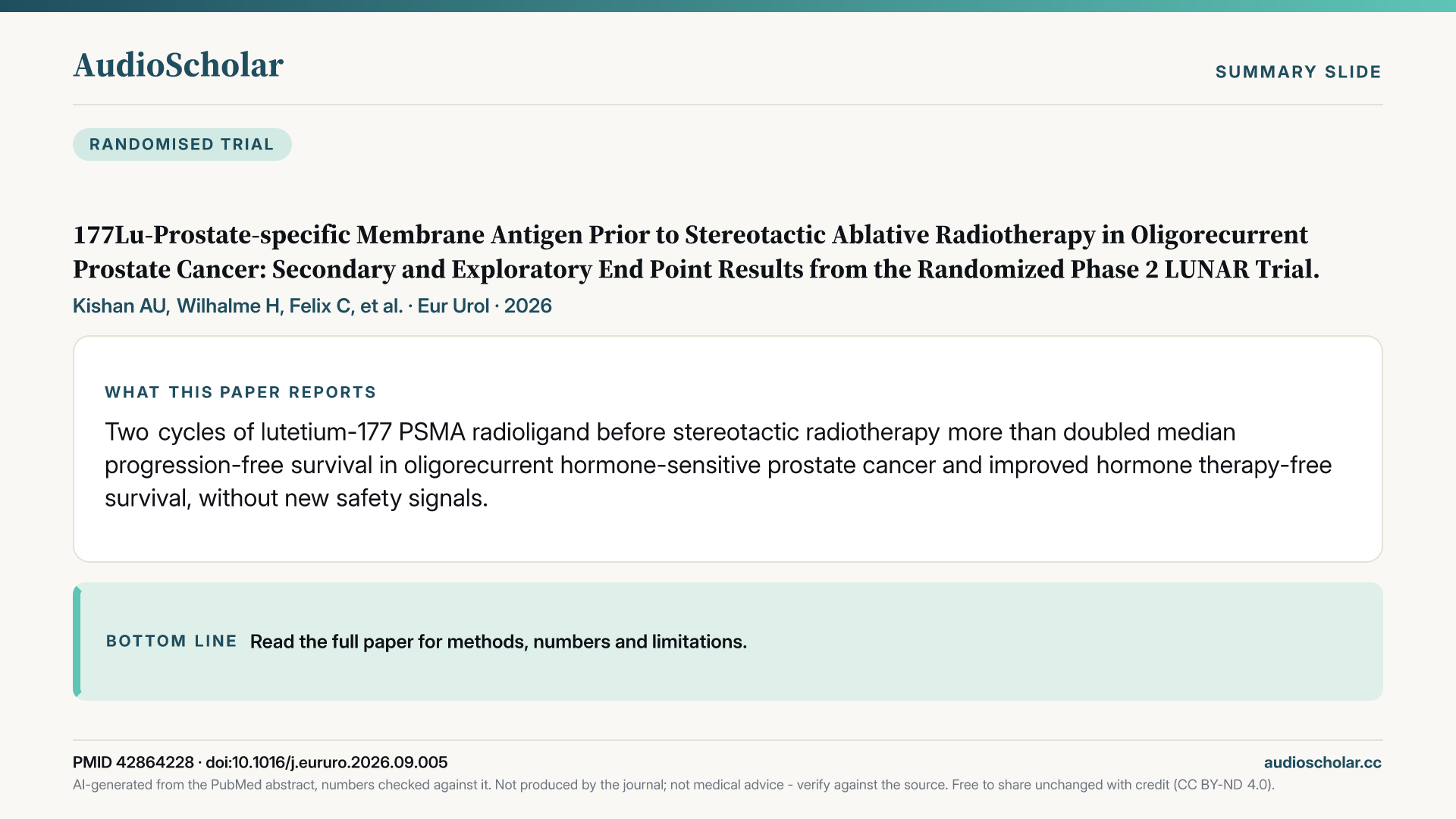
Two cycles of lutetium-177 PSMA radioligand before stereotactic radiotherapy more than doubled median progression-free survival in oligorecurrent hormone-sensitive prostate cancer and improved hormone therapy-free survival, without new safety signals.
European Urology · 2026 · PubMed

This week’s papers
- 01
177Lu-Prostate-specific Membrane Antigen Prior to Stereotactic Ablative Radiotherapy in Oligorecurrent Prostate Cancer: Secondary and Exploratory End Point Results from the Randomized Phase 2 LUNAR Trial.
Two cycles of lutetium-177 PSMA radioligand before stereotactic radiotherapy more than doubled median progression-free survival in oligorecurrent hormone-sensitive prostate cancer and improved hormone therapy-free survival, without new safety signals.
Kishan AU et al. · European Urology · 2026
From the briefingIn European Urology, Kishan and colleagues report extended follow-up from the randomized phase 2 LUNAR trial, in which 92 men with oligorecurrent hormone-sensitive prostate cancer, one to five lesions on PSMA PET, received stereotactic body radiotherapy alone or two cycles of lutetium-177 PNT2002 first [1]. At nearly three years of median follow-up, median progression-free survival was 17.6 months with the radioligand versus 7.4 months without it, roughly a sixty percent reduction in the risk of progression, and hormonal therapy-free survival also improved significantly. Exploratory endpoints, including time to polymetastatic disease and castration-resistant disease-free survival, pointed in the same direction, though conventional imaging progression-free survival did not reach significance, and no new safety signals emerged. The authors frame these exploratory signals as hypothesis-generating; this remains a modest phase 2 trial whose primary endpoint is driven by PSMA PET, so it strengthens the case for radioligand-plus-radiotherapy in this group without yet establishing a survival benefit.
If you only have time for one paper this week, make it the LUNAR update in European Urology [1]. It reinforces, with longer follow-up, that radioligand therapy before stereotactic radiotherapy can meaningfully delay progression in oligorecurrent disease, and it reopens the question of whether metastasis-directed therapy alone is enough for these men.
Written by AI from the published abstract, for healthcare professionals. Not medical advice; check the paper before acting on it.
- 02
Metabolic and oncological effects of metformin added to ADT in prostate cancer: systematic review and meta-analysis including STAMPEDE.
Adding metformin to androgen deprivation modestly reduced waist circumference and HbA1c but did not improve overall survival in unselected men; a high-volume subgroup signal remains hypothesis-generating only.
Fakhri F et al. · Prostate Cancer and Prostatic Diseases · 2026
From the briefingA contrasting message comes from Prostate Cancer and Prostatic Diseases, where Fakhri and colleagues pooled six randomized trials of metformin added to androgen deprivation, about 2,400 men, with STAMPEDE contributing close to four in five participants [2]. Metformin produced small but statistically significant reductions in waist circumference, HbA1c and fasting glucose, while changes in body weight and LDL cholesterol were not significant. Oncologically, metformin did not improve overall survival in STAMPEDE; a survival signal in high-volume disease came from a subgroup whose interaction test was not significant, and a castration-resistance benefit came from one small open-label trial. The authors conclude that oncological benefit in unselected patients was not demonstrated and that a volume-stratified trial is needed.
Written by AI from the published abstract, for healthcare professionals. Not medical advice; check the paper before acting on it.
- 03
Perilesional biopsy in - systematic out? Comparative analysis of targeted, perilesional and systematic core yield by needle tracking with robotic-assisted transperineal MRI/US fusion prostate biopsy.
Robotic needle-tracked fusion biopsy showed perilesional cores added unique significant cancer detection, while systematic cores added little significant cancer but increased Grade Group 1 overdetection by about a quarter.
Alargkof V et al. · Urology · 2026
From the briefingIn Urology, Alargkof and colleagues used robotic transperineal fusion biopsy with needle tracking to map every core in 566 cases [3]. Among 131 men with clinically significant cancer in the trizonal cohort, perilesional cores within ten millimetres of the MRI lesion were solely responsible for the diagnosis in about six percent, while systematic cores added unique significant cancer in just under four percent, and only two men had it arise from an MRI-negative lobe. Omitting systematic cores when targeted and perilesional cores were negative would have cut Grade Group 1 overdetection by about a quarter. The authors argue for targeted plus perilesional sampling with deintensified systematic cores; this is single-system observational data, and the small number of missed cancers will matter to some readers.
Written by AI from the published abstract, for healthcare professionals. Not medical advice; check the paper before acting on it.
- 04
EQUIPOISE: EQUivalence In Prostate cancer treatment: surgery Or radiotherapy? An Intention-to-treat Survival analysis from real-world Evidence.
In a large propensity-matched Brazilian registry, surgery and radiotherapy with androgen deprivation gave similar cancer-specific and overall survival in intermediate- and high-risk localized prostate cancer.
Viani GA et al. · World Journal of Urology · 2026
From the briefingOn treatment choice, the EQUIPOISE analysis in the World Journal of Urology, from Viani and colleagues, drew on a state-wide registry in São Paulo, Brazil, matching more than 4,200 pairs of men with intermediate- or high-risk disease [4]. Cancer-specific survival did not differ between surgery and radiotherapy with androgen deprivation in either risk group, and an apparent crude overall survival advantage for surgery disappeared after matching. Notably, about one in five operated men needed additional therapy, rising to just under half of men with node-positive disease. Despite its size, this is registry data subject to residual confounding, but it supports presenting both options as equivalent in shared decision-making.
Written by AI from the published abstract, for healthcare professionals. Not medical advice; check the paper before acting on it.
- 05
Transurethral ultrasound ablation (TULSA) for prostate cancer: a systematic review and meta-analysis.
Across twelve studies, primary MRI-guided transurethral ultrasound ablation achieved about seventy percent one-year freedom from significant cancer with high continence and erectile preservation, but long-term oncological data are lacking.
Wang E et al. · BJU International · 2026
From the briefingFor men weighing focal or minimally invasive options, a BJU International meta-analysis by Wang and colleagues pooled twelve studies and 630 patients treated with MRI-guided transurethral ultrasound ablation [5]. Twelve-month biopsy-proven freedom from significant cancer was about seventy percent after primary treatment, pad-free continence about ninety percent, and preserved erectile function about eighty percent, with severe adverse events in roughly six percent of patients. The authors stress substantial heterogeneity, absent long-term oncological data, and higher incontinence in the sparse salvage literature, so this remains an investigational technique.
Written by AI from the published abstract, for healthcare professionals. Not medical advice; check the paper before acting on it.
- 06
Anatomical Mapping of Lymphatic Leakage Leading to Symptomatic Lymphoceles Formation After Pelvic Lymph Node Dissection for Prostate Cancer.
Lymphangiography traced nearly all symptomatic lymphocele leaks after prostate cancer node dissection to the Cloquet node region, suggesting Cloquet-sparing dissection could reduce lymphoceles, pending comparative studies.
Ridouani F et al. · The Journal of Urology · 2026
From the briefingFinally, in The Journal of Urology, Ridouani and colleagues performed lymphangiography in forty men with symptomatic lymphoceles after extended or salvage pelvic node dissection [6]. Active leaks were found in nearly every lymphocele, and almost all of them, ninety-eight percent, arose in the region of Cloquet's node, a node rarely involved by prostate cancer; embolization succeeded in about five of six cases. The authors propose Cloquet-sparing dissection with careful lymphostasis, but without a comparison group this is a mechanistic hypothesis awaiting prospective testing.
Written by AI from the published abstract, for healthcare professionals. Not medical advice; check the paper before acting on it.
- 07
Contemporary Oncological and Patient-reported Outcomes of Intravesical Gemcitabine/Docetaxel in BCG-unresponsive Non-muscle-invasive Bladder Cancer: A Multi-institutional Prospective Cohort Study.
Sequential intravesical gemcitabine and docetaxel gave about two-thirds twelve-month high-grade recurrence-free survival in BCG-unresponsive bladder cancer, with no grade 3 or 4 toxicity and stable quality of life.
Tan YG et al. · European Urology Focus · 2026
From the briefingIn European Urology Focus, Tan and colleagues report a prospective two-institution cohort of 63 patients with BCG-unresponsive non-muscle-invasive bladder cancer treated with sequential intravesical gemcitabine and docetaxel [7]. High-grade recurrence-free survival was close to ninety percent at three months and about two thirds at twelve months, roughly one in eight patients went on to cystectomy, and no grade 3 or 4 adverse events were recorded, with quality-of-life scores stable through treatment. BCG-refractory patients had more than double the recurrence risk of early relapsers, while carcinoma in situ did not separate outcomes. Follow-up is short at a median of fourteen months and there is no comparator, but the data add prospective, patient-reported support for this widely used regimen.
Written by AI from the published abstract, for healthcare professionals. Not medical advice; check the paper before acting on it.
- 08
[18F]fluorodeoxyglucose PET/CT refines staging and treatment selection in high-risk upper tract urothelial carcinoma.
FDG PET/CT added to contrast CT changed metastatic staging and treatment recommendations in about one in five patients with high-risk upper tract urothelial carcinoma, with markedly better nodal sensitivity.
Lijnen RAG et al. · BJU International · 2026
From the briefingFor upper tract disease, Lijnen and colleagues in BJU International studied 203 patients with suspected high-risk upper tract urothelial carcinoma who had both contrast CT and FDG PET/CT [8]. PET changed the stage between non-metastatic and metastatic disease in about a fifth of patients, mostly through upstaging, and treatment recommendations changed in a similar proportion, rising to about half of those with suspicious nodes on CT. Where pathology was available, nodal sensitivity was roughly seventy-five percent for PET versus a third for CT, with similar specificity. This is a retrospective single-centre series with incomplete pathological confirmation, so it supports selective rather than universal use pending confirmation.
Written by AI from the published abstract, for healthcare professionals. Not medical advice; check the paper before acting on it.
- 09
Comparative accuracy of imaging modalities for differentiating malignant small testicular masses.
Contrast-enhanced ultrasound best distinguished malignant from benign small testicular masses, with significantly higher specificity than greyscale ultrasound or MRI, potentially supporting testis-sparing approaches.
Dua Y et al. · BJU International · 2026
From the briefingDua and colleagues meta-analysed eleven studies and 707 patients with small, mostly sub-two-centimetre testicular masses [9]. Contrast-enhanced ultrasound offered the best balance, with sensitivity around ninety percent and specificity around eighty percent, and significantly higher specificity than either standard greyscale ultrasound or MRI, both of which were highly sensitive but misclassified most benign lesions. The authors see contrast-enhanced ultrasound as a tool supporting testis-sparing strategies, though the evidence base is small and reference standards were mixed.
Written by AI from the published abstract, for healthcare professionals. Not medical advice; check the paper before acting on it.
- 10
A novel ureteric stent coating reduces encrustation and improves tolerability in a randomised trial.
A sulfonic acid-coated ureteric stent roughly halved encrustation and reduced urinary symptoms, fatigue and antimicrobial use compared with an identical uncoated stent in a randomized stone trial.
Vistunov N et al. · BJU International · 2026
From the briefingAnd in stone disease, Vistunov and colleagues randomized 100 patients in two German centres to a standard ureteric stent or an identical stent with a novel sulfonic acid coating, removed at thirty days [10]. The coated stent roughly halved encrustation weight, blunted the rise in lower urinary tract symptoms by about half, improved light physical activity and fatigue, and was linked to a much lower need for antimicrobial therapy, about seven percent versus about a third. This is a modest single-device trial with short dwell times, so durability and longer indwelling performance remain open questions.
Written by AI from the published abstract, for healthcare professionals. Not medical advice; check the paper before acting on it.
The full briefing
This AudioScholar briefing is generated by artificial intelligence for healthcare professionals and trainees. It is not medical advice.
Welcome to This Week in Urology. This week we're covering 10 notable papers spanning advanced and localized prostate cancer, urothelial cancer staging and bladder-sparing therapy, and diagnostic and device innovations in testis and stone care. Let's dive in.
We start with systemic and radioligand strategies in advanced prostate cancer, where two papers test what adding a second therapy actually buys. In European Urology, Kishan and colleagues report extended follow-up from the randomized phase 2 LUNAR trial, in which 92 men with oligorecurrent hormone-sensitive prostate cancer, one to five lesions on PSMA PET, received stereotactic body radiotherapy alone or two cycles of lutetium-177 PNT2002 first [1]. At nearly three years of median follow-up, median progression-free survival was 17.6 months with the radioligand versus 7.4 months without it, roughly a sixty percent reduction in the risk of progression, and hormonal therapy-free survival also improved significantly. Exploratory endpoints, including time to polymetastatic disease and castration-resistant disease-free survival, pointed in the same direction, though conventional imaging progression-free survival did not reach significance, and no new safety signals emerged. The authors frame these exploratory signals as hypothesis-generating; this remains a modest phase 2 trial whose primary endpoint is driven by PSMA PET, so it strengthens the case for radioligand-plus-radiotherapy in this group without yet establishing a survival benefit. A contrasting message comes from Prostate Cancer and Prostatic Diseases, where Fakhri and colleagues pooled six randomized trials of metformin added to androgen deprivation, about 2,400 men, with STAMPEDE contributing close to four in five participants [2]. Metformin produced small but statistically significant reductions in waist circumference, HbA1c and fasting glucose, while changes in body weight and LDL cholesterol were not significant. Oncologically, metformin did not improve overall survival in STAMPEDE; a survival signal in high-volume disease came from a subgroup whose interaction test was not significant, and a castration-resistance benefit came from one small open-label trial. The authors conclude that oncological benefit in unselected patients was not demonstrated and that a volume-stratified trial is needed.
Turning to localized prostate cancer, this week's papers span the whole pathway, from biopsy to treatment choice to surgical morbidity. In Urology, Alargkof and colleagues used robotic transperineal fusion biopsy with needle tracking to map every core in 566 cases [3]. Among 131 men with clinically significant cancer in the trizonal cohort, perilesional cores within ten millimetres of the MRI lesion were solely responsible for the diagnosis in about six percent, while systematic cores added unique significant cancer in just under four percent, and only two men had it arise from an MRI-negative lobe. Omitting systematic cores when targeted and perilesional cores were negative would have cut Grade Group 1 overdetection by about a quarter. The authors argue for targeted plus perilesional sampling with deintensified systematic cores; this is single-system observational data, and the small number of missed cancers will matter to some readers. On treatment choice, the EQUIPOISE analysis in the World Journal of Urology, from Viani and colleagues, drew on a state-wide registry in São Paulo, Brazil, matching more than 4,200 pairs of men with intermediate- or high-risk disease [4]. Cancer-specific survival did not differ between surgery and radiotherapy with androgen deprivation in either risk group, and an apparent crude overall survival advantage for surgery disappeared after matching. Notably, about one in five operated men needed additional therapy, rising to just under half of men with node-positive disease. Despite its size, this is registry data subject to residual confounding, but it supports presenting both options as equivalent in shared decision-making. For men weighing focal or minimally invasive options, a BJU International meta-analysis by Wang and colleagues pooled twelve studies and 630 patients treated with MRI-guided transurethral ultrasound ablation [5]. Twelve-month biopsy-proven freedom from significant cancer was about seventy percent after primary treatment, pad-free continence about ninety percent, and preserved erectile function about eighty percent, with severe adverse events in roughly six percent of patients. The authors stress substantial heterogeneity, absent long-term oncological data, and higher incontinence in the sparse salvage literature, so this remains an investigational technique. Finally, in The Journal of Urology, Ridouani and colleagues performed lymphangiography in forty men with symptomatic lymphoceles after extended or salvage pelvic node dissection [6]. Active leaks were found in nearly every lymphocele, and almost all of them, ninety-eight percent, arose in the region of Cloquet's node, a node rarely involved by prostate cancer; embolization succeeded in about five of six cases. The authors propose Cloquet-sparing dissection with careful lymphostasis, but without a comparison group this is a mechanistic hypothesis awaiting prospective testing.
In urothelial cancer, two papers address bladder preservation and upper tract staging. In European Urology Focus, Tan and colleagues report a prospective two-institution cohort of 63 patients with BCG-unresponsive non-muscle-invasive bladder cancer treated with sequential intravesical gemcitabine and docetaxel [7]. High-grade recurrence-free survival was close to ninety percent at three months and about two thirds at twelve months, roughly one in eight patients went on to cystectomy, and no grade 3 or 4 adverse events were recorded, with quality-of-life scores stable through treatment. BCG-refractory patients had more than double the recurrence risk of early relapsers, while carcinoma in situ did not separate outcomes. Follow-up is short at a median of fourteen months and there is no comparator, but the data add prospective, patient-reported support for this widely used regimen. For upper tract disease, Lijnen and colleagues in BJU International studied 203 patients with suspected high-risk upper tract urothelial carcinoma who had both contrast CT and FDG PET/CT [8]. PET changed the stage between non-metastatic and metastatic disease in about a fifth of patients, mostly through upstaging, and treatment recommendations changed in a similar proportion, rising to about half of those with suspicious nodes on CT. Where pathology was available, nodal sensitivity was roughly seventy-five percent for PET versus a third for CT, with similar specificity. This is a retrospective single-centre series with incomplete pathological confirmation, so it supports selective rather than universal use pending confirmation.
Two final papers, both in BJU International, concern diagnostics and devices outside oncology's main lanes. Dua and colleagues meta-analysed eleven studies and 707 patients with small, mostly sub-two-centimetre testicular masses [9]. Contrast-enhanced ultrasound offered the best balance, with sensitivity around ninety percent and specificity around eighty percent, and significantly higher specificity than either standard greyscale ultrasound or MRI, both of which were highly sensitive but misclassified most benign lesions. The authors see contrast-enhanced ultrasound as a tool supporting testis-sparing strategies, though the evidence base is small and reference standards were mixed. And in stone disease, Vistunov and colleagues randomized 100 patients in two German centres to a standard ureteric stent or an identical stent with a novel sulfonic acid coating, removed at thirty days [10]. The coated stent roughly halved encrustation weight, blunted the rise in lower urinary tract symptoms by about half, improved light physical activity and fatigue, and was linked to a much lower need for antimicrobial therapy, about seven percent versus about a third. This is a modest single-device trial with short dwell times, so durability and longer indwelling performance remain open questions.
If you only have time for one paper this week, make it the LUNAR update in European Urology [1]. It reinforces, with longer follow-up, that radioligand therapy before stereotactic radiotherapy can meaningfully delay progression in oligorecurrent disease, and it reopens the question of whether metastasis-directed therapy alone is enough for these men.
Here is what this week's evidence adds up to in Urology. First, adding lutetium PSMA therapy to stereotactic radiotherapy for oligorecurrent prostate cancer durably improved progression-free and hormone therapy-free survival in a phase 2 trial, but survival benefit and phase 3 confirmation are still lacking. Second, metformin with androgen deprivation offers small metabolic gains and no proven survival benefit in unselected men, with the high-volume signal remaining a hypothesis. Third, observational data increasingly favour targeted plus perilesional biopsy over routine systematic cores, and large registry data show no survival difference between surgery and radiotherapy for intermediate- and high-risk disease, though neither is randomized evidence. Fourth, in urothelial cancer, gemcitabine and docetaxel show encouraging but short-term, uncontrolled results in BCG-unresponsive disease, and FDG PET/CT appears to change management in about a fifth of high-risk upper tract cases in a single-centre retrospective series. Finally, contrast-enhanced ultrasound for small testicular masses and coated ureteric stents both show promise in limited data that has not yet reached guidelines.
That's your roundup for This Week in Urology. The full transcript and references are available on the episode page. This is an AI-curated summary — for clinical decisions, always consult primary sources and current guidelines. See you next week.
If this weekly briefing is useful, follow the show in your podcast app so new episodes arrive automatically. And a quick rating on Apple Podcasts or Spotify helps other physicians discover the show.
This is an automated summary generated by artificial intelligence, which can make mistakes. Always review the original source materials.
Spot something worth flagging?
Get this every week in your podcast app — free.
New urology episodes land in your feed automatically — listen on your commute.