This Week in Emergency Medicine — Oct 20, 2026
Generated Oct 20, 2026 · 9:46
The week's practice-changing Emergency Medicine research, summarized for clinicians.
If the audio fails to play, refresh the page to renew the link.
Get next week’s Emergency Medicine briefing — free.
In your podcast app, or readable in your inbox with the audio one tap away.
Adoption of Outpatient Management of Acute Low-Risk Pulmonary Embolism.
A single-centre multicomponent intervention raised emergency department discharge of low-PESI pulmonary embolism patients from about 5 percent to a third, with no 30-day recurrences or deaths.
Annals of Emergency Medicine · 2026 · PubMed

This week’s papers
- 01
Conservative Versus Higher Oxygen Targets Post-Cardiac Arrest: A Systematic Review, Meta-Analysis, and Trial Sequential Analysis.
Across eleven trials of ventilated cardiac arrest survivors, restrictive oxygen targets did not improve mortality or neurological outcome and increased hypoxemia, trending toward futility under normothermia protocols.
Khan MM et al. · Academic Emergency Medicine · 2026
From the briefingIn Academic Emergency Medicine, Khan and colleagues pooled eleven randomized trials, about 4,100 ventilated adults after return of spontaneous circulation, comparing restrictive with higher oxygen targets [1]. Restrictive oxygenation made no meaningful difference to mortality or to poor neurological outcome. A strict hypothermia subgroup, cooled to 33 to 34 degrees, showed lower mortality, but trial sequential analysis judged that signal unstable. Restrictive targets bought roughly two extra ventilator-free days at the cost of about two thirds more hypoxemia. The authors conclude that under current normothermia protocols the evidence trends toward futility for a restrictive strategy, though the full required sample has not quite been reached.
Written by AI from the published abstract, for healthcare professionals. Not medical advice; check the paper before acting on it.
- 02
Mechanical versus manual bag-valve ventilation during cardiopulmonary resuscitation in adults with cardiac arrest: A systematic review and Bayesian meta-analysis.
Mechanical ventilation during adult CPR was associated with about a fifth more return of spontaneous circulation than bag-valve ventilation, but survival and neurological benefits remained imprecise and inconclusive.
Chu YQ et al. · Resuscitation · 2026
From the briefingIn Resuscitation, Chu and colleagues turned to ventilation during CPR itself, in a Bayesian meta-analysis of eight mostly observational studies and nearly 6,850 adults [2]. Mechanical ventilation at any point during CPR was associated with about a fifth more return of spontaneous circulation than manual bag-valve ventilation, with a 99 percent posterior probability of benefit, and pneumothorax rates were similar. Probabilities of benefit for survival and neurological outcome hovered in the low nineties, which the authors describe as imprecise and inconclusive. Guidelines currently do not favour mechanical ventilation, and this association-level evidence is not enough on its own to change that.
Written by AI from the published abstract, for healthcare professionals. Not medical advice; check the paper before acting on it.
- 03
Low-Titer O + Whole Blood Implementation in the EMS System for Metropolitan Oklahoma City and Tulsa: Significance, Success, & Sharing Lessons Learned.
Paramedic whole blood transfusion for hemorrhagic shock improved prehospital vital signs in an urban system, though many patients deteriorated in transit and no comparison group was studied.
Bailey AM et al. · Prehospital Emergency Care · 2026
From the briefingMoving to hemorrhage, Prehospital Emergency Care published a descriptive report by Bailey and colleagues on two years of paramedic-delivered low-titer O-positive whole blood across Oklahoma City and Tulsa [3]. Roughly seven in ten recipients had penetrating trauma, and blood pressure, heart rate and shock index all improved after transfusion. Patients whose systolic pressure improved had close to ten times the odds of surviving to hospital arrival, though that estimate is very imprecise, and prehospital traumatic arrest was linked to worse survival. Many patients deteriorated again in transit, and the authors frame whole blood as buying time rather than providing definitive rescue. Without a comparison group, this is an implementation roadmap, not proof of survival benefit.
Written by AI from the published abstract, for healthcare professionals. Not medical advice; check the paper before acting on it.
- 04
Diagnostic accuracy of high-sensitivity point-of-care troponin assays in emergency department for patients presenting with chest pain: a systematic review.
Four point-of-care high-sensitivity troponin devices showed near-100 percent sensitivity for single-sample myocardial infarction rule-out at very low arrival values, but weaker sensitivity with 99th percentile serial protocols.
Daalen LEV et al. · European Journal of Emergency Medicine · 2026
From the briefingIn the European Journal of Emergency Medicine, Daalen and colleagues systematically reviewed four commercially available high-sensitivity point-of-care troponin devices, across eleven studies and about 10,000 chest pain patients [4]. The assays performed best as a single-sample rule-out on arrival, with sensitivity and negative predictive value close to 100 percent at very low cutoffs, for example below 4 nanograms per litre on the Atellica VTLi and below 3 on the TriageTrue. Performance was weaker when the devices were used with 99th percentile serial protocols, with sensitivity in some studies falling into the sixties to eighties. The authors conclude these devices are ready for rapid rule-out in patients with very low initial values, though the evidence mixes derivation and validation cohorts and device-specific thresholds matter.
Written by AI from the published abstract, for healthcare professionals. Not medical advice; check the paper before acting on it.
- 05
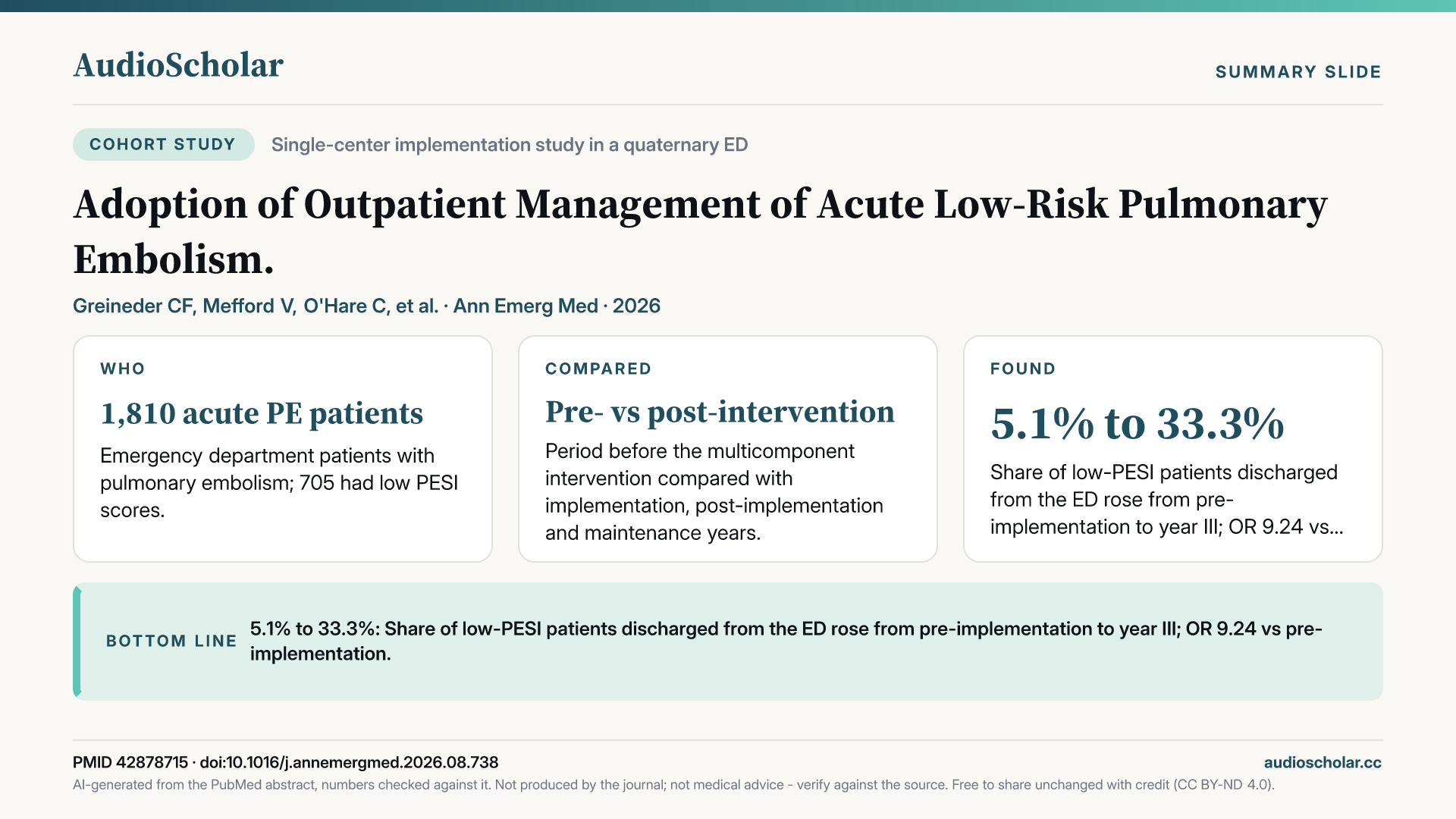
Adoption of Outpatient Management of Acute Low-Risk Pulmonary Embolism.
A single-centre multicomponent intervention raised emergency department discharge of low-PESI pulmonary embolism patients from about 5 percent to a third, with no 30-day recurrences or deaths.
Greineder CF et al. · Annals of Emergency Medicine · 2026
From the briefingOn pulmonary embolism, Greineder and colleagues in Annals of Emergency Medicine reported a single-centre implementation study at a quaternary academic hospital [5]. Among roughly 1,800 patients with acute embolism, about four in ten had a low PESI score. After a multicomponent intervention, discharge of those low-risk patients climbed from about 5 percent to a third by the third year, with no recurrent clots or deaths within 30 days of any emergency department discharge and no bleeding requiring admission. When patients with Hestia criteria were excluded, the proportion discharged reached three quarters. The authors suggest that future quality metrics combine PESI and Hestia rather than relying on PESI alone, which matters for how departments benchmark themselves; generalizability beyond one centre remains untested.
If you only have time for one paper this week, make it the Annals of Emergency Medicine pulmonary embolism implementation study [5]. It moves the outpatient embolism question from whether discharge is safe to how departments achieve it and measure it, and it challenges PESI alone as the yardstick.
Written by AI from the published abstract, for healthcare professionals. Not medical advice; check the paper before acting on it.
- 06
Prehospital Care of Older Adults Following Perceived Low-Acuity Falls and Related "Lift Assist" Encounters: An NAEMSP Position Statement and Resource Document.
NAEMSP recommends treating lift-assist and low-acuity fall calls in older adults as full clinical assessments, with tracked quality measures, non-transport options, and reimbursement for non-transport care.
Dorsett M et al. · Prehospital Emergency Care · 2026
From the briefingPrehospital Emergency Care also carried a position statement from the National Association of EMS Physicians, led by Dorsett, on older adults with perceived low-acuity falls and so-called lift assists [6]. The statement argues that system-level framing treats these calls as non-medical, leading to underassessment, and it recommends full assessment for medical causes, injury and safety, transport decisions that allow non-transport or referral, tracking these encounters as a quality measure, and reimbursement for care that does not end in transport. This is consensus guidance rather than trial evidence, but it reframes a very common call.
Written by AI from the published abstract, for healthcare professionals. Not medical advice; check the paper before acting on it.
- 07
Cost-Effectiveness of HCV Screening in Emergency Departments Using DETECT Hep C Trial Results.
Modelling from a multicentre trial found nontargeted emergency department hepatitis C screening cost about 12,800 dollars per quality-adjusted life-year, outperforming targeted or no screening on value.
Czoty LMW et al. · JAMA Internal Medicine · 2026
From the briefingFinally on the screening side, JAMA Internal Medicine published a cost-effectiveness analysis by Czoty and colleagues using data from the DETECT Hep C trial at three United States emergency departments [7]. Nontargeted screening cured the most infections and cost about 12,800 dollars per quality-adjusted life-year gained, well under the 100,000 dollar threshold. Absolute gains across the whole simulated cohort were small because more than nine in ten people screened did not have hepatitis C, but benefits were clear among those infected. As a model, it depends on its assumptions, but it strengthens the economic case for routine emergency department screening.
Written by AI from the published abstract, for healthcare professionals. Not medical advice; check the paper before acting on it.
- 08
Efficacy of Inhaled Methoxyflurane for Acute Trauma Pain Management: A Systematic Review and Meta-Analysis.
Across seven randomized trials, inhaled methoxyflurane relieved acute traumatic pain about six minutes faster than controls and reduced rescue analgesia, with more dizziness, drowsiness, and cough.
Husain AZ et al. · Journal of Emergency Medicine · 2026
From the briefingIn the Journal of Emergency Medicine, Husain and colleagues meta-analysed seven randomized trials, about 1,600 patients, of inhaled methoxyflurane for acute traumatic pain [8]. Methoxyflurane brought first pain relief roughly six minutes sooner than control treatments, lowered pain scores through the first twenty minutes, and cut the need for rescue analgesia by more than half. Overall adverse events were similar, though dizziness, drowsiness and cough were more common. The authors call for better trials comparing it against specific agents across settings.
Written by AI from the published abstract, for healthcare professionals. Not medical advice; check the paper before acting on it.
- 09
Emergency medicine updates: Contrast media hypersensitivity.
Evidence reviewed indicates switching to a chemically different contrast agent prevents breakthrough hypersensitivity better than corticosteroid premedication, which no longer has demonstrated benefit for routine use.
Kim IJ et al. · American Journal of Emergency Medicine · 2026
From the briefingIn the American Journal of Emergency Medicine, Kim and colleagues reviewed contrast media hypersensitivity [9]. Their synthesis holds that the strongest risk factor is a prior hypersensitivity reaction, that prior physiologic reactions need neither premedication nor a contrast switch, and that switching to a chemically different agent prevents breakthrough reactions better than corticosteroids, whose routine use the evidence no longer supports. Severe reactions are managed as anaphylaxis with intramuscular epinephrine.
Written by AI from the published abstract, for healthcare professionals. Not medical advice; check the paper before acting on it.
- 10
Emergency medicine pharmacotherapy literature of 2025.
A GRADE-based review summarizes 2025's highest-quality emergency pharmacotherapy evidence, spanning intubation sedatives, bicarbonate in acidemia, late-window thrombolysis, acetylcysteine regimens, ketamine analgesia, and naltrexone.
Porter BA et al. · American Journal of Emergency Medicine · 2026
From the briefingAlso in the American Journal of Emergency Medicine, Porter and colleagues offered their annual review of the 2025 pharmacotherapy literature [10], drawing on seven randomized trials, ten guidelines and eleven meta-analyses, covering topics from sedatives for rapid sequence intubation and sodium bicarbonate in severe acidemia to late-window thrombolysis, two-bag acetylcysteine regimens and naltrexone, a useful catch-up reference rather than new evidence.
Written by AI from the published abstract, for healthcare professionals. Not medical advice; check the paper before acting on it.
The full briefing
This AudioScholar briefing is generated by artificial intelligence for healthcare professionals and trainees. It is not medical advice.
Welcome to This Week in Emergency Medicine. This week we're covering 10 notable papers spanning resuscitation from cardiac arrest and hemorrhage, safe rule-out and discharge decisions in the emergency department and the field, and analgesia and drug safety. Let's dive in.
We start with resuscitation, where three papers ask whether common interventions actually move outcomes. In Academic Emergency Medicine, Khan and colleagues pooled eleven randomized trials, about 4,100 ventilated adults after return of spontaneous circulation, comparing restrictive with higher oxygen targets [1]. Restrictive oxygenation made no meaningful difference to mortality or to poor neurological outcome. A strict hypothermia subgroup, cooled to 33 to 34 degrees, showed lower mortality, but trial sequential analysis judged that signal unstable. Restrictive targets bought roughly two extra ventilator-free days at the cost of about two thirds more hypoxemia. The authors conclude that under current normothermia protocols the evidence trends toward futility for a restrictive strategy, though the full required sample has not quite been reached. In Resuscitation, Chu and colleagues turned to ventilation during CPR itself, in a Bayesian meta-analysis of eight mostly observational studies and nearly 6,850 adults [2]. Mechanical ventilation at any point during CPR was associated with about a fifth more return of spontaneous circulation than manual bag-valve ventilation, with a 99 percent posterior probability of benefit, and pneumothorax rates were similar. Probabilities of benefit for survival and neurological outcome hovered in the low nineties, which the authors describe as imprecise and inconclusive. Guidelines currently do not favour mechanical ventilation, and this association-level evidence is not enough on its own to change that. Moving to hemorrhage, Prehospital Emergency Care published a descriptive report by Bailey and colleagues on two years of paramedic-delivered low-titer O-positive whole blood across Oklahoma City and Tulsa [3]. Roughly seven in ten recipients had penetrating trauma, and blood pressure, heart rate and shock index all improved after transfusion. Patients whose systolic pressure improved had close to ten times the odds of surviving to hospital arrival, though that estimate is very imprecise, and prehospital traumatic arrest was linked to worse survival. Many patients deteriorated again in transit, and the authors frame whole blood as buying time rather than providing definitive rescue. Without a comparison group, this is an implementation roadmap, not proof of survival benefit.
Our second theme is identifying who can safely go home, whether from the department or from a living room floor. In the European Journal of Emergency Medicine, Daalen and colleagues systematically reviewed four commercially available high-sensitivity point-of-care troponin devices, across eleven studies and about 10,000 chest pain patients [4]. The assays performed best as a single-sample rule-out on arrival, with sensitivity and negative predictive value close to 100 percent at very low cutoffs, for example below 4 nanograms per litre on the Atellica VTLi and below 3 on the TriageTrue. Performance was weaker when the devices were used with 99th percentile serial protocols, with sensitivity in some studies falling into the sixties to eighties. The authors conclude these devices are ready for rapid rule-out in patients with very low initial values, though the evidence mixes derivation and validation cohorts and device-specific thresholds matter. On pulmonary embolism, Greineder and colleagues in Annals of Emergency Medicine reported a single-centre implementation study at a quaternary academic hospital [5]. Among roughly 1,800 patients with acute embolism, about four in ten had a low PESI score. After a multicomponent intervention, discharge of those low-risk patients climbed from about 5 percent to a third by the third year, with no recurrent clots or deaths within 30 days of any emergency department discharge and no bleeding requiring admission. When patients with Hestia criteria were excluded, the proportion discharged reached three quarters. The authors suggest that future quality metrics combine PESI and Hestia rather than relying on PESI alone, which matters for how departments benchmark themselves; generalizability beyond one centre remains untested. Prehospital Emergency Care also carried a position statement from the National Association of EMS Physicians, led by Dorsett, on older adults with perceived low-acuity falls and so-called lift assists [6]. The statement argues that system-level framing treats these calls as non-medical, leading to underassessment, and it recommends full assessment for medical causes, injury and safety, transport decisions that allow non-transport or referral, tracking these encounters as a quality measure, and reimbursement for care that does not end in transport. This is consensus guidance rather than trial evidence, but it reframes a very common call. Finally on the screening side, JAMA Internal Medicine published a cost-effectiveness analysis by Czoty and colleagues using data from the DETECT Hep C trial at three United States emergency departments [7]. Nontargeted screening cured the most infections and cost about 12,800 dollars per quality-adjusted life-year gained, well under the 100,000 dollar threshold. Absolute gains across the whole simulated cohort were small because more than nine in ten people screened did not have hepatitis C, but benefits were clear among those infected. As a model, it depends on its assumptions, but it strengthens the economic case for routine emergency department screening.
Our third theme covers analgesia and drug safety. In the Journal of Emergency Medicine, Husain and colleagues meta-analysed seven randomized trials, about 1,600 patients, of inhaled methoxyflurane for acute traumatic pain [8]. Methoxyflurane brought first pain relief roughly six minutes sooner than control treatments, lowered pain scores through the first twenty minutes, and cut the need for rescue analgesia by more than half. Overall adverse events were similar, though dizziness, drowsiness and cough were more common. The authors call for better trials comparing it against specific agents across settings. In the American Journal of Emergency Medicine, Kim and colleagues reviewed contrast media hypersensitivity [9]. Their synthesis holds that the strongest risk factor is a prior hypersensitivity reaction, that prior physiologic reactions need neither premedication nor a contrast switch, and that switching to a chemically different agent prevents breakthrough reactions better than corticosteroids, whose routine use the evidence no longer supports. Severe reactions are managed as anaphylaxis with intramuscular epinephrine. Also in the American Journal of Emergency Medicine, Porter and colleagues offered their annual review of the 2025 pharmacotherapy literature [10], drawing on seven randomized trials, ten guidelines and eleven meta-analyses, covering topics from sedatives for rapid sequence intubation and sodium bicarbonate in severe acidemia to late-window thrombolysis, two-bag acetylcysteine regimens and naltrexone, a useful catch-up reference rather than new evidence.
If you only have time for one paper this week, make it the Annals of Emergency Medicine pulmonary embolism implementation study [5]. It moves the outpatient embolism question from whether discharge is safe to how departments achieve it and measure it, and it challenges PESI alone as the yardstick.
Here is what this week's evidence adds up to in Emergency Medicine. First, after cardiac arrest, pooled trials show no outcome benefit from restrictive oxygen targets under normothermia, while mechanical ventilation during CPR is linked to more return of circulation but uncertain survival, based largely on observational data. Second, single-sample point-of-care high-sensitivity troponin rule-out looks highly sensitive at very low thresholds, though cutoffs are device specific and prospective implementation data are still needed. Third, a single-centre program shows outpatient management of low-risk embolism can be scaled safely, with Hestia proposed alongside PESI for defining the eligible population. Fourth, nontargeted emergency department hepatitis C screening appears cost-effective in modelling, and methoxyflurane offers faster trauma analgesia in pooled trials, both pending broader confirmation. Prehospital whole blood and lift-assist guidance remain descriptive or consensus evidence.
That's your roundup for This Week in Emergency Medicine. The full transcript and references are available on the episode page. This is an AI-curated summary — for clinical decisions, always consult primary sources and current guidelines. See you next week.
If this weekly briefing is useful, follow the show in your podcast app so new episodes arrive automatically. And think of one colleague — in any specialty — who never has time to keep up with the literature. Tell them about AudioScholar: a free ten-minute weekly for every specialty, to listen to in any podcast app, or to read at audioscholar dot C C.
This is an automated summary generated by artificial intelligence, which can make mistakes. Always review the original source materials.
Spot something worth flagging?
Get this every week in your podcast app — free.
New emergency_medicine episodes land in your feed automatically — listen on your commute.