This Week in Emergency Medicine — Oct 13, 2026
Generated Oct 13, 2026 · 11:23
The week's practice-changing Emergency Medicine research, summarized for clinicians.
If the audio fails to play, refresh the page to renew the link.
Get next week’s Emergency Medicine briefing — free.
In your podcast app, or readable in your inbox with the audio one tap away.
Occlusion Myocardial Infarction Missed by ST-Elevation Myocardial Infarction (STEMI) Criteria: An Angiographic Emergency Department Cohort.
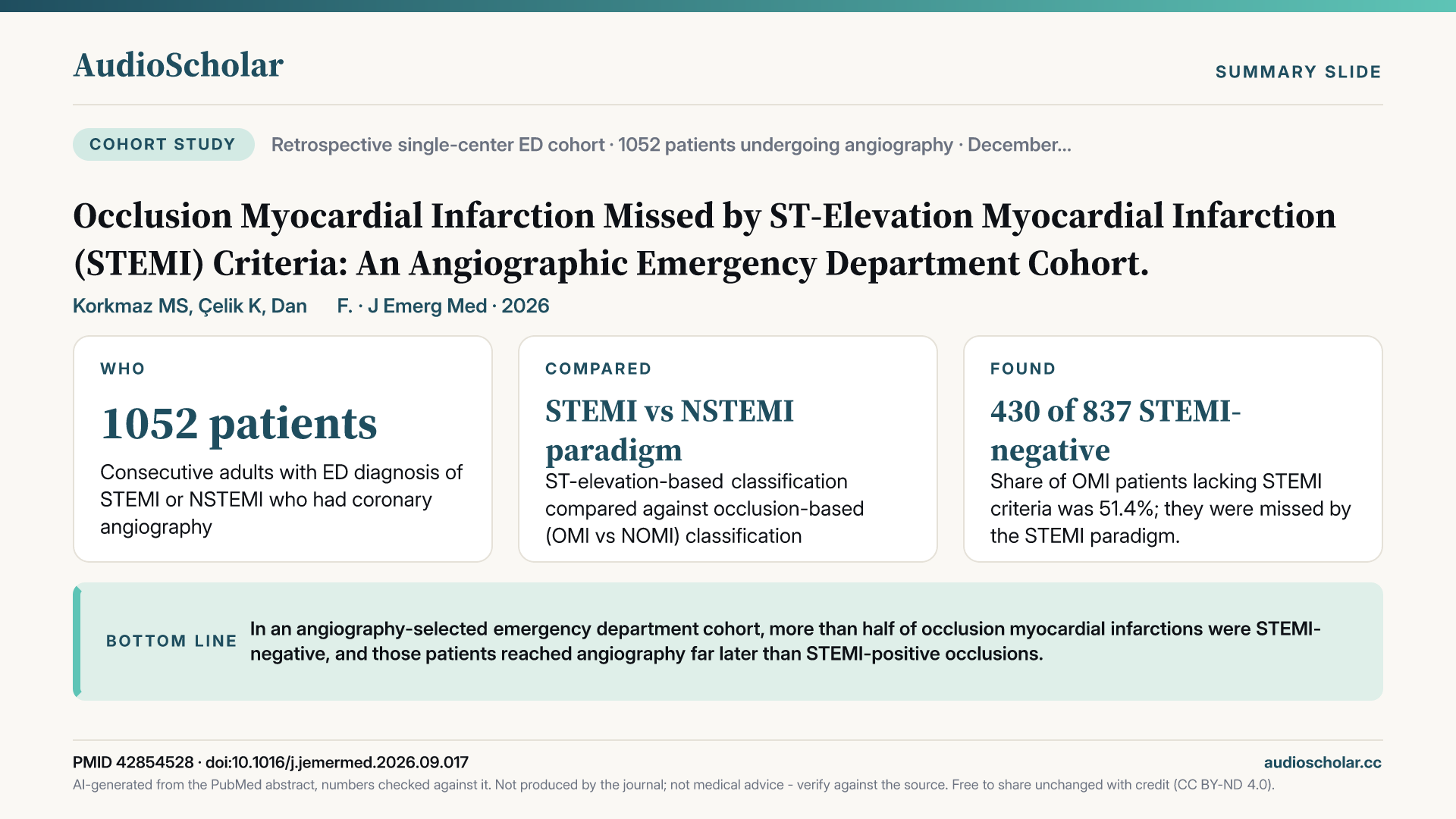
In an angiography-selected emergency department cohort, more than half of occlusion myocardial infarctions were STEMI-negative, and those patients reached angiography far later than STEMI-positive occlusions.
Journal of Emergency Medicine · 2026 · PubMed

This week’s papers
- 01
Occlusion Myocardial Infarction Missed by ST-Elevation Myocardial Infarction (STEMI) Criteria: An Angiographic Emergency Department Cohort.
In an angiography-selected emergency department cohort, more than half of occlusion myocardial infarctions were STEMI-negative, and those patients reached angiography far later than STEMI-positive occlusions.
Korkmaz MS, Çelik K, Danış F · Journal of Emergency Medicine · 2026
- 02
Final Diagnoses and Outcomes After Paramedic-Suspected ST-Segment Elevation Myocardial Infarction.
Only about 60 percent of paramedic-suspected STEMI patients in a statewide Australian registry had confirmed STEMI, and those with noncardiac diagnoses had higher adjusted long-term mortality.
Lankaputhra M, Bishop A, Wijaya J, et al. · Annals of Emergency Medicine · 2026
- 03
Amiodarone After Conversion From a Non-shockable to a Shockable Rhythm in Out-of-Hospital Cardiac Arrest A Propensity Score-Matched Analysis from the German Resuscitation Registry.
In cardiac arrest converting from non-shockable to shockable rhythm, amiodarone was associated with better survival to discharge, but favourable neurological outcome did not differ significantly in this registry analysis.
Knapp J, Greif R, Bathe J, et al. · Resuscitation · 2026
- 04
Bystander AED effectiveness despite low utilisation in OHCA.
Against a clean no-defibrillation comparison, bystander AED use in Korean cardiac arrests was associated with better survival and neurological outcome, yet devices were rarely applied, especially in homes.
Sohn Y, Cho G, Cho Y, et al. · Prehospital Emergency Care · 2026
- 05
Outcomes Following Impedance Threshold Device Use During Out-of-Hospital Cardiac Arrest.
Impedance threshold device use in a large United States prehospital dataset was associated with more return of circulation but lower survival to discharge and worse neurological outcomes.
Weidman AC, Crowe RP, Treichel A, et al. · Resuscitation · 2026
- 06
Risk Stratification of Acute Pulmonary Embolism: Outcomes in Patients With Intermediate sPESI Scores and Negative Cardiac Biomarkers.
Veterans with pulmonary embolism, sPESI scores of 2 or 3, and negative cardiac biomarkers on oral anticoagulants had low short-term mortality, and hospitalisation was not associated with lower mortality.
Dore M, Duffy R, Melikechi O · Academic Emergency Medicine · 2026
- 07
DO Generations MAtter for Treatment of Outpatient Pyelonephritis With Cephalosporins in the Emergency Department? DOGMA-ED Study.
Across eleven emergency departments, first-, second- and third-generation oral cephalosporins had similar 14-day treatment failure for outpatient pyelonephritis, with roughly one in five patients failing overall.
Mattson AE, Spolsdoff D, Brown CS, et al. · Annals of Emergency Medicine · 2026
- 08
Performance of updated American College of Surgeons field triage guidelines in identifying need for trauma center care.
The 2021 field triage guidelines showed about 97 percent sensitivity but only 13 percent specificity for trauma centre need among activations at a level one trauma centre.
Beamish IV, Friedman DJ, Nisenbaum R, et al. · CJEM · 2026
- 09
Optimizing massive transfusion protocol activation: A new decision tool based on a Dutch trauma cohort.
A single-centre eight-variable tool predicted justified massive transfusion activation with about 92 percent sensitivity and 56 percent specificity, but still requires external validation before use.
Berenschot KF, Cnossen ME, van Bohemen MR, et al. · American Journal of Emergency Medicine · 2026
- 10
Reengineering the Concept of Emergency Care.
A conceptual analysis argues emergency care should be defined by clinical risk and time sensitivity determined through triage, not by arrival at the emergency department door.
Taylor RA · Academic Emergency Medicine · 2026
The full briefing
This AudioScholar briefing is generated by artificial intelligence for healthcare professionals and trainees. It is not medical advice.
Welcome to This Week in Emergency Medicine. This week we're covering 10 notable papers spanning the recognition of acute coronary occlusion, the evidence behind cardiac arrest interventions, and risk tools that shape disposition and trauma triage, along with a provocative essay on what emergency care should even mean. Let's dive in.
We start with the electrocardiogram, and with growing evidence that the familiar STEMI label captures only part of the patients who need urgent reperfusion. In the Journal of Emergency Medicine, Korkmaz and colleagues reviewed just over a thousand consecutive emergency department patients with a diagnosis of STEMI or non-STEMI who went on to angiography at a single centre [1]. Using a definition of occlusion myocardial infarction based on culprit flow, or a tight stenosis with a very high troponin, they found that roughly seven in ten of the non-STEMI patients actually met occlusion criteria, and that slightly more than half of all occlusion patients were STEMI-negative. Meanwhile about one in nine of the STEMI patients had no occlusion at all. The practical gap was timing: the large majority of STEMI-positive occlusion patients reached the cath lab within two hours, compared with only about one in six of the STEMI-negative occlusion patients [1]. This is retrospective, single-centre and angiography-selected, and the occlusion definition was partly troponin-based, so it cannot tell us whether these patients could have been recognised earlier; the authors themselves call for prospective validation of prespecified ECG criteria. A complementary picture comes from Annals of Emergency Medicine, where Lankaputhra and colleagues followed more than eight thousand paramedic-suspected STEMI activations across the Australian state of Victoria [2]. Among patients with a recorded discharge diagnosis, only about 60 percent had confirmed STEMI; the remainder were split among other coronary syndromes, other cardiac diagnoses, noncardiac conditions and symptom-based diagnoses. This was a sick group overall, with in-hospital mortality around nine percent, and patients ultimately given a noncardiac diagnosis had roughly three quarters higher adjusted long-term mortality than those with confirmed STEMI [2]. Read together, the two papers describe the same imperfect filter from opposite directions: the STEMI construct misses many true occlusions, while prehospital STEMI activation sweeps in a heterogeneous, high-risk population that includes serious mimics. Neither study changes activation criteria on its own, but both strengthen the case for diagnostic refinement beyond ST elevation.
Our second theme is out-of-hospital cardiac arrest, with three registry studies that each test an intervention and each carry the usual caveats of observational resuscitation data. In Resuscitation, Knapp and colleagues used the German Resuscitation Registry to ask about amiodarone in a group guidelines do not specifically address: patients whose initial rhythm was non-shockable but who later converted to a shockable rhythm and received at least two shocks [3]. In about 1,800 propensity-matched pairs, amiodarone was associated with more patients arriving at hospital with return of circulation and with better 24-hour survival, and survival to discharge rose from about four percent to about six and a half percent. Favourable neurological outcome, however, was not significantly different [3]. That neurological signal matters, because survival without good function is a limited gain, and residual confounding around who received the drug cannot be excluded; the authors frame this as a reason for controlled trials on timing rather than as settled evidence. From Korea, published in Prehospital Emergency Care, Sohn and colleagues revisited bystander defibrillation in a registry of nearly 24 thousand arrests [4]. Their key methodological point is that comparing bystander AED use against everyone who did not get a bystander AED pools patients later shocked by paramedics with patients never shocked at all, and that this blurs the effect. Against a clean no-defibrillation reference, bystander AED application was associated with about 60 percent higher odds of survival and more than double the odds of good neurological outcome, comparable to paramedic-delivered shocks; with the conventional pooled comparison, the benefit shrank to non-significance [4]. The bigger finding is how rarely the devices were used: bystander AEDs were applied in under one in ten public-area opportunities and in about two percent of non-public ones, a roughly four-and-a-half-fold gap concentrated in homes. The study supports prioritising residential rapid-response systems, though only a few hundred patients actually received a bystander AED. Then a cautionary result, again in Resuscitation, from Weidman and colleagues, analysing almost a hundred thousand arrests in a large United States prehospital data set [5]. The impedance threshold device was associated with modestly higher rates of return of circulation and survival to hospital arrival, but with lower survival to discharge, about 24 percent versus 32 percent, and similar trends for favourable neurological outcome; combining it with active compression-decompression showed even more extreme versions of both patterns [5]. Hospital outcomes were available for under a quarter of patients, which limits interpretation, but the divergence between early and late outcomes is a useful reminder, alongside the amiodarone data, that prehospital surrogates do not reliably predict meaningful survival.
Our third theme is risk stratification, where several papers test whether existing tools and choices are calibrated to real outcomes. In Academic Emergency Medicine, Dore and colleagues examined Veterans Affairs patients in the United States with acute pulmonary embolism treated with a direct oral anticoagulant, focusing on those with simplified PESI scores of 2 or 3 but negative cardiac biomarkers, a group traditionally not considered low risk [6]. Among roughly 1,800 such patients, 7-day mortality was under half a percent and 30-day mortality around one and a half to two percent. About three quarters of these patients were admitted, yet hospitalisation was not associated with lower mortality in either group [6]. This is retrospective work in a predominantly male veteran population, and the authors are explicit that it supports prospective trials of outpatient management rather than an immediate change in disposition. In Annals of Emergency Medicine, the multicentre DOGMA-ED study by Mattson and colleagues addressed a common discharge question: does cephalosporin generation matter for outpatient pyelonephritis [7]? Across eleven academic emergency departments and more than eleven hundred patients, most of them women, 14-day treatment failure was close to one in five regardless of whether patients received a first-, second- or third-generation agent, with no significant difference between them [7]. The second-generation group was small and the design observational, but the finding is relevant to stewardship debates around cephalexin versus broader agents such as cefdinir, and it also highlights that failure rates were high across the board.
Trauma triage tools raise the same balance between catching every sick patient and overcalling. In CJEM, Beamish and colleagues applied the 2021 American College of Surgeons field triage guidelines retrospectively to about 1,400 trauma team activations at a Canadian level one centre [8]. The criteria were highly sensitive, at about 97 percent for hospital-defined need for trauma centre care, but specificity was only about 13 percent; altered mental status and vital signs were most strongly associated with need [8]. Because only patients already transported to the trauma centre were studied, true undertriage in the wider population cannot be measured. A Dutch study in the American Journal of Emergency Medicine by Berenschot and colleagues tackled overactivation of massive transfusion protocols, in a cohort where more than half of activations were judged unjustified [9]. Their eight-variable tool, combining pH, lactate, blood pressure components, heart rate, temperature and a positive eFAST, achieved about 92 percent sensitivity and a negative predictive value just over 90 percent, with specificity around 56 percent [9]. It is single-centre, derived without external validation, and defines justified activation by receipt of even one blood product, so it is a promising derivation rather than a ready tool.
Finally, a conceptual piece in Academic Emergency Medicine from Taylor argues that crowding and mismatched care are not just operational problems but consequences of how emergency care is defined, namely by crossing the department threshold rather than by clinical risk [10]. Taylor proposes redefining emergency care as a risk- and time-sensitive, triage-determined subset of acute unscheduled care wherever it occurs, while keeping the emergency department as the acute hub in rural and safety-net settings [10]. It is an argument rather than data, but it frames many of this week's disposition questions.
If you only have time for one paper this week, make it the occlusion myocardial infarction cohort from Korkmaz and colleagues [1]. It quantifies, in a real emergency department population, how many coronary occlusions sit outside the STEMI label and how much later those patients reach angiography, reopening the question of whether ST elevation should remain the gatekeeper for emergent reperfusion.
Here is what this week's evidence adds up to in Emergency Medicine. First, two observational cohorts suggest the STEMI paradigm both misses many occlusions and captures many mimics, but prospectively validated alternative ECG criteria do not yet exist. Second, in cardiac arrest, registry data associate amiodarone after conversion to a shockable rhythm and bystander AED use with better survival, while the impedance threshold device shows early gains that reverse by discharge; none of these replaces randomised evidence, and the AED story is mostly about how seldom devices reach patients at home. Third, pulmonary embolism patients with intermediate simplified PESI scores and negative biomarkers had low short-term mortality, supporting prospective outpatient trials rather than an immediate shift in practice. Fourth, retrospective multicentre data found no difference in pyelonephritis failure across cephalosporin generations, though failure was common with every class. And fifth, trauma triage and transfusion tools continue to trade specificity for sensitivity, with new tools still awaiting external validation.
That's your roundup for This Week in Emergency Medicine. The full transcript and references are available on the episode page. This is an AI-curated summary — for clinical decisions, always consult primary sources and current guidelines. See you next week.
If this weekly briefing is useful, follow the show in your podcast app so new episodes arrive automatically. And a quick rating on Apple Podcasts or Spotify helps other physicians discover the show.
This is an automated summary generated by artificial intelligence, which can make mistakes. Always review the original source materials.
Spot something worth flagging?
Get this every week in your podcast app — free.
New emergency_medicine episodes land in your feed automatically — listen on your commute.